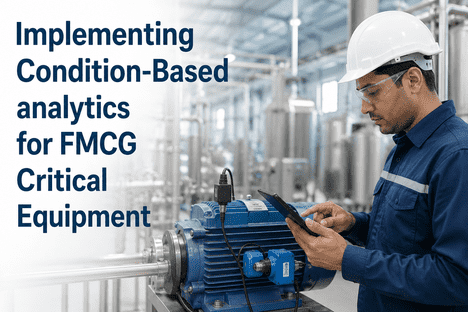
Condition-based analytics represents a fundamental shift in how FMCG manufacturers manage critical equipment reliability moving from fixed-interval preventive maintenance schedules to sensor-driven condition monitoring that detects early-stage degradation in bearings, gears, seals, shafts, and lubricating oil before failure occurs. In FMCG production environments where high-speed fillers operate at 400 to 1,200 containers per minute, packaging machines cycle 80 to 150 times per minute, and conveyors run 24 hours per day across multiple production shifts, unplanned equipment failures cost $10,000 to $50,000 per hour in lost production, wasted raw materials, and emergency repair mobilization. Traditional time-based maintenance weekly lubrication, monthly belt tension checks, quarterly bearing replacements applies uniform maintenance intervals to assets operating under widely varying loads, speeds, and environmental conditions, resulting in premature maintenance on healthy equipment and missed interventions on assets that are degrading faster than the PM schedule anticipates. Condition-based analytics closes this gap by deploying vibration sensors, infrared thermography, oil analysis sensors, and ultrasonic detectors that measure actual equipment health parameters and feed them into AI models trained to recognize the specific failure signatures of FMCG critical assets filler valve wear, packaging cam degradation, conveyor bearing spalling, compressor valve leakage, and gearbox tooth fatigue. Book a Demo to see how iFactory's AI-powered predictive analytics platform connects your existing sensor infrastructure to condition-based maintenance workflows.
Why Condition-Based Analytics is Critical for FMCG Equipment Reliability
FMCG manufacturing lines are designed for continuous, high-speed production where every minute of unplanned downtime directly impacts throughput, OEE, and profitability. The critical equipment population in a typical FMCG plant — 20 to 50 filling machines, 30 to 80 packaging machines, 100+ conveyors, 15 to 30 compressors, 10 to 20 HVAC units, and 5 to 15 gearbox-driven agitators operates under conditions that cause degradation patterns specific to each asset class, load profile, and operating environment. Time-based PM applies the same inspection interval to a filler running 500 containers per minute on viscous product as one running 200 containers per minute on thin liquid, despite the 2.5x difference in bearing load and seal wear rate. The following comparison illustrates the gap between traditional time-based maintenance and condition-based analytics for FMCG critical equipment.
- Maintenance intervals fixed by calendar or runtime hours — same schedule applied regardless of actual load, speed, ambient temperature, or product viscosity variation
- Bearing replacement at fixed intervals — 30 to 50% of bearings replaced while still in good condition, while the 15 to 20% that degrade early run to failure before the next PM window
- Lubrication performed on a fixed schedule — over-lubrication causes bearing overheating in 20% of assets while under-lubrication allows accelerated wear in high-load equipment
- Visual inspections by maintenance technicians — subjective assessments that miss internal degradation until it produces visible symptoms like leaking seals or abnormal noise
- Reactive repairs triggered by operator-reported issues — 60 to 70% of emergency work orders originate from production operators, indicating the maintenance team learned of the problem after it affected production
- Analytics-driven maintenance triggered by actual equipment condition — vibration velocity, temperature rise, oil particle count, and ultrasonic decibel level determine when intervention is required
- AI bearing health models track degradation progression — vibration spectrum analysis detects inner race, outer race, and rolling element defects at stage 1 or 2, allowing planned replacement 3 to 6 weeks before failure
- Oil condition sensors monitor viscosity, particle count, moisture, and additive depletion in real time — lubrication interventions triggered by oil health rather than calendar intervals
- Continuous sensor monitoring with automated alerting — AI models analyze vibration signatures, thermal images, oil samples, and ultrasonic readings to detect degradation invisible to visual inspection
- Predictive alerts issued 2 to 6 weeks before failure — maintenance teams schedule interventions during planned downtime, reducing emergency repairs by 50 to 70%
Four Condition Monitoring Technologies for FMCG Critical Equipment
Effective condition-based analytics for FMCG plants requires the integration of four complementary monitoring technologies — each detecting specific failure modes across the critical equipment population. The table below maps each technology to the FMCG asset classes it serves, the failure modes it detects, and the business impact of deploying it within iFactory's AI-powered predictive analytics platform.
| Monitoring Technology | FMCG Asset Classes | Failure Modes Detected | iFactory AI Analytics Output | Business Impact |
|---|---|---|---|---|
| Vibration Monitoring | Filler bearings, packaging cam followers, conveyor rollers, motor bearings, gearbox shafts, compressor bearings | Bearing spalling (inner race, outer race, rolling element), gear tooth fatigue, shaft misalignment, imbalance, looseness, resonance | Vibration spectrum analysis, trend envelopes, bearing fault frequency identification, remaining useful life (RUL) estimation per ISO 10816-3 severity bands | 3 to 6 week advance warning of bearing and gear failures — 50 to 70% reduction in unplanned bearing-related downtime |
| Thermal Analysis | Motor windings, electrical panels, conveyor drives, compressor valves, HVAC coils, bearing housings, gearbox casings | Insulation degradation, electrical imbalance, overloading, cooling loss, bearing overheating, clutch slip, brake drag, refractory loss, steam trap failure | Thermal trend analysis, delta-T threshold monitoring, emissivity-corrected temperature tracking, automated inspection route scheduling with Shift Logbook integration | Early detection of electrical and mechanical overheating — preventing 40 to 60% of thermally-induced equipment failures |
| Oil Analysis | Gearboxes (mixer drives, conveyor gearboxes), hydraulic systems, compressors, vacuum pumps, circulating oil systems | Wear particle generation, viscosity breakdown, moisture ingress, additive depletion, oxidation, thermal degradation, glycol contamination | Particle count trending, wear debris analysis, viscosity deviation alerts, moisture breakthrough detection, remaining useful life estimation for lubricant and component | Extended oil change intervals by 30 to 50% through condition-based oil replacement, reduced gearbox failure by 40 to 60% |
| Ultrasonic Monitoring | Compressed air systems, steam traps, valves, bearings (low-speed), vacuum systems, pneumatic actuators, leak detection | Pressure leakage, steam trap blow-through, bearing lubrication starvation, valve seat wear, cavitation, electrical partial discharge, pneumatic cylinder seal wear | Ultrasonic decibel level trending, leak quantification (cfm or kg/hr), bearing lubrication optimization, valve condition scoring, compressed air system efficiency tracking | Reduced compressed air energy costs by 15 to 25%, steam system efficiency improvement, bearing life extension through lubrication optimization |
Implementing a Condition-Based Analytics Program with iFactory
Transitioning from time-based PM to condition-based analytics follows a structured deployment framework that iFactory has validated across FMCG plants of varying sizes and equipment configurations. The platform is the AI software intelligence layer — not a sensor vendor — and integrates with existing vibration sensors, thermal cameras, oil analysis sensors, ultrasonic detectors, PLCs, SCADA systems, CMMS databases, and IoT gateways already deployed on your FMCG critical equipment.
Measured Impact: Condition-Based Analytics in FMCG Production Environments
The metrics below represent average results from iFactory platform deployments across FMCG production facilities over a 12-month validation period. Individual results vary based on equipment population, existing maintenance maturity, sensor infrastructure density, and deployment scope per plant.
Industry Expert Perspective: Condition-Based Analytics in FMCG Manufacturing
I spent seven years as a reliability engineer at a food manufacturing plant with 24 production lines running 24 hours a day, six days a week. We had a PM program that looked comprehensive on paper — every bearing lubricated every four weeks, every gearbox sampled quarterly, every motor thermographed annually — but our unplanned downtime rate was still running at 8 to 12 percent of total available production time. When we analyzed the data, we found that 65 percent of our emergency work orders were for assets that had received PM within the previous cycle. The PM program was doing the right tasks, but it was doing them at the wrong time — too late for the assets that were degrading faster than the average, and too early for the assets that could have run much longer. The condition-based analytics platform changed our approach completely. We instrumented our 50 highest-criticality fillers and packaging machines with vibration and temperature sensors connected to iFactory's AI platform. Within the first three months, the platform detected a developing inner race defect on a filler main bearing that our next PM cycle would have missed by six weeks. The bearing had 2.3 millimeters of remaining useful life according to the vibration trend — we replaced it during a scheduled weekend changeover and avoided what would have been a catastrophic failure on a Monday morning production startup. That single event covered the entire first-year cost of the platform deployment.