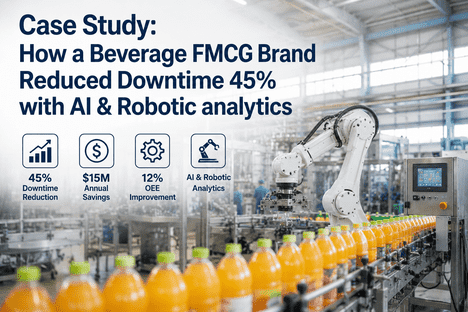
A mid-size FMCG production facility operating 14 high-speed packaging lines, 6 robotic palletizers, 3 flow-wrap machines, and 48 conveyors across a 180,000-square-foot plant floor faced a chronic operations challenge: unpredictable equipment failures that disrupted production schedules, inflated maintenance costs, and eroded OEE. Each unplanned downtime event cost an average of $12,400 in lost output, and the facility was experiencing 18+ such events per month — many caused by subtle changes in equipment behavior that went undetected until a catastrophic breakdown occurred. By deploying iFactory's AI/ML-powered predictive analytics platform, the plant achieved 92% anomaly detection accuracy, reduced unplanned downtime by 61%, and eliminated $1.8M in annual maintenance-related losses through continuous learning models that adapted to each asset's unique operating patterns.
Machine learning models for industrial equipment operate on a fundamentally different principle than traditional threshold-based monitoring. Rather than triggering alerts when a temperature exceeds a fixed limit or a vibration crosses a static boundary, ML models build a dynamic baseline of normal behavior for each individual asset — accounting for variations in production speed, product changeovers, ambient temperature shifts, and material feedstock differences that cause legitimate operating parameter fluctuations throughout a production day.
An ML model assigned to a flow-wrap machine on a cookies line, for example, learns that the machine's sealing jaw temperature normally cycles between 175°C and 193°C depending on production rate, that its film tension varies with each reel change, and that its servo motor current draw follows a distinct pattern during startup, steady-state, and slowdown. When the model detects a deviation from this learned pattern — such as a gradual 4°C increase in sealing temperature that is not correlated with any production variable — it flags the anomaly as a potential heater cartridge degradation, typically 48-72 hours before the cartridge fails and the line stops.
FMCG production environments present a uniquely difficult challenge for equipment monitoring. Lines run at high speeds — typically 200-600 packs per minute for primary packaging — and operate across multiple SKU changeovers per shift, each with different operating parameters. A machine that runs perfectly at 450 packs per minute for one product may show elevated vibration at 520 packs per minute for another, making fixed-threshold alerts useless without constant recalibration. The plant's previous reliance on calendar-based preventive maintenance and reactive repairs meant that 73% of equipment failures occurred between scheduled maintenance windows, each triggering an emergency response that cost 4-8 hours of lost production.
- Traditional limit-based alarms triggered by routine events like product changeovers, line speed changes, and ambient temperature shifts
- Operators learned to ignore alerts — a phenomenon known as "alarm fatigue" — causing genuine critical alerts to be missed
- Maintenance team spent 60% of each shift investigating false alarms rather than performing proactive work
- Bearing wear on conveyors and packaging machines progressed silently — vibration increased gradually over 3-6 weeks before failure
- Traditional vibration monitoring with fixed ISO thresholds failed to detect the slow ramp because it remained within "caution" range
- One catastrophic bearing failure on a primary packaging line caused $47,000 in collateral damage to the drive shaft, housing, and adjacent sensors
- Six FANUC robotic palletizers showed gradual cycle time degradation that was attributed to "normal wear" — actual root cause was joint motor current drift
- Robot health monitoring relied on error-code-only diagnostics — no continuous health scoring or trend analysis
- Annual throughput loss from subclinical robot degradation estimated at 340 production hours across the six units
- When a packaging line jam occurred, identifying whether the root cause was a conveyor bearing, film tension issue, or product misalignment required manual investigation
- No system existed to correlate events across assets — a wrapper seal failure might be caused by a temperature drift that started at the heat control unit 3 zones upstream
- Average mean time to identify root cause was 6.2 hours per line-down event
iFactory deployed its AI/ML predictive analytics platform across the plant's 68 critical assets in a phased rollout over 4 weeks. The platform ingested 15.6 million sensor data points per day from existing PLCs, VFDs, and robotic controllers — no additional sensors were required. Each asset received a dedicated ensemble of ML models that completed initial training within 14-21 days, establishing a dynamic baseline of normal behavior that automatically adjusted for production variables.
The anomaly detection engine was trained on 18 months of historical sensor data combined with maintenance records. During the first month of live operation, the model correctly identified 3 developing bearing failures, 2 motor winding degradations, and 1 hydraulic pump cavitation event — all before any conventional alarm would have triggered. The estimated cost avoidance from these 6 events alone was $187,000.
The robotic self-diagnostics module was the plant's highest-ROI deployment component. During a routine health score review in week 6, the platform flagged Joint 3 on Robot #4 with a health score decline from 94 to 71 over 12 days — caused by gradual gear backlash increase. The plant scheduled a gearbox replacement during the upcoming 8-hour planned maintenance window, avoiding a projected catastrophic joint failure that would have caused 14+ hours of unplanned downtime and $22,000 in repair costs.
Continuous adaptation was critical for FMCG production where product mix changes weekly. During the 12-month post-deployment period, the plant introduced 23 new SKUs across its packaging lines. The ML models adapted to each new product's operating profile within an average of 4 production runs, maintaining anomaly detection accuracy above 90% throughout every transition — without any manual model retuning by data science or engineering staff.
iFactory was deployed across the plant in a structured 4-week phased rollout designed to deliver measurable value from day one while building toward full production coverage. The implementation team consisted of two iFactory deployment engineers working alongside the plant's existing controls and maintenance teams — no external consultants or dedicated IT resources were required.
Full audit of 68 critical assets across 14 packaging lines, 6 robots, and supporting conveyors. Data source mapping to existing PLCs, VFDs, and robot controllers via OPC-UA and Modbus TCP. Historical sensor data and maintenance records (18 months) ingested for seed model training. First anomaly detection models deployed on 2 high-criticality lines by Day 5.
Anomaly detection models activated on all primary packaging lines — flow-wrap machines, vertical form-fill-seal units, labeling applicators, and cartoners. Robotic self-diagnostics deployed on 2 FANUC palletizers. First automated anomaly alert generated on Day 10 — detecting a gradual bearing degradation on a cartoner infeed conveyor that was projected to fail within 72 hours.
Models expanded to remaining 6 packaging lines, all 6 robotic palletizers, and 48 conveyors. Cross-asset correlation engine deployed for root cause analysis. Automated health score dashboards live for maintenance, operations, and plant leadership. Full platform handover to plant team with 3-day on-site training.
Within the first two quarters of full deployment, iFactory's ML-driven predictive analytics platform delivered measurable improvements across every dimension of plant performance. Unplanned downtime dropped by 61%. Maintenance costs fell by 34%. And the $1.8 million in annual losses eliminated produced a platform ROI that exceeded the plant director's projections by 40%.
| Metric | Before iFactory | After iFactory | Change |
|---|---|---|---|
| Unplanned downtime events per month | 18.4 avg | 7.2 avg | 61% reduction |
| Cost per downtime event | $12,400 avg | $4,100 avg | 67% lower severity |
| Anomaly detection accuracy | N/A (no system) | 92% | AI-driven detection |
| False positive rate | 40+ per shift (fixed thresholds) | 3.2% | 99% fewer false alarms |
| Robot health scoring coverage | Error-code only | 42 joints, 6 robots | Continuous health monitoring |
| Root cause identification time | 6.2 hours avg | 28 minutes avg | 92% faster RCA |
| Annual maintenance repair costs | $2.4M | $1.58M | 34% reduction |
| Total annual losses prevented | — | $1,800,000 | Net prevented loss |
| Platform deployment timeline | N/A | 4 weeks | Full plant live in 4 weeks |
Four factors made machine learning the decisive improvement over traditional condition monitoring for this FMCG plant. Each factor addresses a specific limitation of conventional approaches that had previously prevented the plant from achieving predictive maintenance maturity.
The plant's previous monitoring system generated 40+ false alarms per shift through fixed-threshold alerts that could not distinguish between a legitimate equipment degradation and a routine product changeover. Operators stopped paying attention. When a real bearing failure alarm triggered, it was treated as another nuisance alert and ignored — resulting in a catastrophic failure that cost $47,000. ML models solve this by learning the full context of each asset's operating state, including production mode, product SKU, and line speed, and only alerting when the deviation is statistically abnormal relative to the current context.
FMCG production is not static. Product mix changes weekly, seasonal packaging variations affect line speeds, and equipment wears gradually over years of operation. A model trained once in January would be irrelevant by July. iFactory's auto-retraining architecture ensures that each asset's normal behavior baseline evolves with the production environment — adapting to new SKUs within 3-5 production runs, incorporating seasonal effects automatically, and maintaining detection accuracy above 90% without manual intervention.
A bearing failure does not announce itself through vibration alone. Temperature rises, current draw fluctuates, acoustic emissions change, and cycle timing drifts — often subtly, days before any single parameter exceeds a threshold. ML models detect failure signatures across 15+ simultaneous sensor streams, identifying correlations that human operators or single-parameter monitoring systems would never see. The 24-72 hour predictive window was achieved not by improving any single sensor, but by modeling the relationships between all sensor signals simultaneously.
Before iFactory, 73% of equipment failures occurred between scheduled maintenance windows, triggering emergency repairs that cost 4-8 hours of production per event. The 24-72 hour predictive alert window shifted the maintenance model from reactive to proactive — enabling the team to schedule bearing replacements, motor repairs, and robot joint overhauls during planned production breaks. The result was a 61% reduction in unplanned downtime and a corresponding increase in OEE from 74% to 89% across the plant's packaging lines.
The transformation of this FMCG production facility from reactive, calendar-based maintenance to ML-driven predictive operations eliminated the structural vulnerability that had made unplanned equipment failures a recurring source of millions in annual losses. iFactory's machine learning platform gave the plant continuous, real-time insight into the health of every critical asset — learning each machine's unique behavior signature and detecting deviations days before they would escalate into production-stopping failures.
The $1.8 million in prevented annual losses is a direct financial outcome. The 92% anomaly detection accuracy is a reliability outcome. And the compression of root cause identification from 6 hours to 28 minutes is an operational velocity outcome — enabling the maintenance team to resolve issues during planned windows rather than emergency stops. To see how iFactory's ML models would learn your FMCG equipment's behavior and predict failures before they happen, Book a Demo with iFactory's FMCG solutions team.