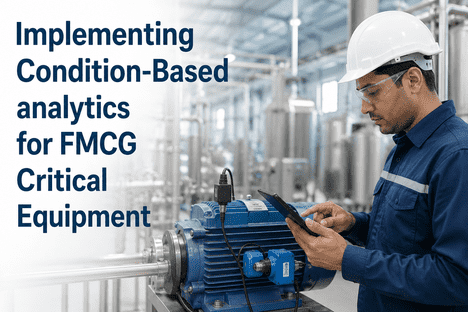
A mid-size spice manufacturer in Kerala was spending $18,000 per month on an external analytics firm that delivered monthly production reports 45 days after month-end. The reports showed what had already happened, not what was about to go wrong. When a filling machine began showing vibration anomalies, the outsourced team detected it two weeks later during their monthly data pull, after $63,000 in unplanned downtime had already occurred. The plant manager faced a familiar decision: continue paying for delayed external analytics, or build an in-house capability that would require hiring data engineers, investing in infrastructure, and managing platform maintenance. Most FMCG plant managers face the same fork in the road. Outsourced analytics offers lower upfront cost and access to specialised expertise, but introduces latency, data security concerns, and limited control over priorities. In-house analytics offers real-time visibility, full data control, and customisation, but requires capital investment, specialised hiring, and ongoing platform management. The decision is not binary. iFactory AI enables a hybrid model deploying an on-premise analytics platform that runs continuously with zero latency, managed by your existing maintenance and quality team, with optional cloud-based benchmarking and model updates from iFactory's data science team. Book a Demo to see how iFactory's hybrid analytics model works for FMCG plants, or to discuss the right analytics model for your plant.
FMCG Analytics · Build vs Buy · Decision Framework
Outsource, Build In-House, or Go Hybrid: The FMCG Analytics Decision Framework That Considers Cost, Latency, Food Safety, and Scalability.
iFactory AI deploys on-premise analytics that run with zero latency, managed by your existing team, with optional cloud-based model updates from iFactory's data science team no data engineer hiring required.
3-5x
Total cost of outsourced analytics vs iFactory hybrid over 5 years including data latency losses
45 days
Average delay in outsourced analytics reports reaching FMCG plant managers
4 weeks
iFactory hybrid analytics deployment time from data access to live dashboard
$240K
Average annual cost of outsourced analytics for a mid-size FMCG plant including provider fees, data integration surcharges, and report delivery delays
$85K
Annual cost of iFactory hybrid analytics including on-premise appliance amortisation, software license, and optional data science support retainer
65%
Of FMCG plants that switched from outsourced to hybrid analytics recovered platform investment within 9 months through reduced downtime and improved decision speed
The Decision Framework
Outsourced vs In-House vs Hybrid: Comparing FMCG Analytics Models
| Decision Factor |
Outsourced Analytics |
In-House Analytics |
iFactory Hybrid Analytics |
| Data latency |
Weeks to months (batch reporting) |
Real-time (if infrastructure exists) |
Real-time (on-premise edge processing) |
| Upfront investment |
Low (monthly subscription) |
High ($200K-$500K infrastructure + hiring) |
Moderate ($45K-$85K appliance + license) |
| Data security / IP control |
Shared with third party; data leaves plant |
Full control; data stays on-premise |
Full control; data stays on-premise; optional encrypted outbound model updates |
| Staffing requirement |
None (provider managed) |
2-3 data engineers + analytics team |
Existing maintenance/quality team (1-week training) |
| Food safety compliance |
Provider must be BRC/SQF compliant |
Full control over compliance |
Full compliance; audit-ready data trail built-in |
| Flexibility / customisation |
Limited to provider's report templates |
Unlimited (full stack control) |
High (configurable dashboards; customisable models) |
Why FMCG Plants Outsource Analytics
Outsourced analytics is the default choice for many FMCG plants because it requires no capital investment, no specialised hiring, and no platform management. A third-party provider pulls plant data, builds reports, and delivers insights on a recurring schedule. For plants with limited IT resources and a clear understanding of what metrics they need, outsourced analytics can provide value — particularly for benchmarking across multiple plants or accessing specialised statistical expertise that would be difficult to hire in-house.
The cost structure appears attractive at first glance. A typical FMCG analytics outsourcing contract ranges from $12,000 to $25,000 per month depending on the number of lines, data sources, and report frequency. This is significantly less than the $200,000 to $500,000 capital investment required to build an in-house analytics capability. However, the total cost over a 5-year period — including contract escalations, data integration surcharges, and the hidden cost of delayed insights — often exceeds the cost of a hybrid or in-house solution by a factor of 3 to 5.
1
Data Latency Costs Are Hidden But Significant
When outsourced analytics delivers reports 30 to 45 days after month-end, the insights are historical. A vibration anomaly or temperature drift that occurred during production is detected weeks later, after scrap or downtime has already happened. A Gujarat spice plant calculated that delayed detection of a filling machine seal failure cost $63,000 in unplanned downtime that an on-premise real-time system would have caught within minutes. The annual cost of this latency — $75,000 to $150,000 depending on plant size — is never itemised in the outsourcing contract but directly impacts the plant's P&L.
2
Data Security and IP Concerns
Outsourced analytics requires sending production data, recipe parameters, and quality metrics to a third-party platform. For FMCG plants producing branded products with proprietary formulations, this creates IP exposure risk. Several biscuit and snack manufacturers iFactory has worked with specifically require on-premise data processing because their recipe data and process parameters are considered trade secrets. BRC and SQF auditors increasingly ask about data security practices for outsourced analytics providers, adding compliance overhead.
3
Limited Flexibility and Responsiveness
Outsourced analytics providers deliver reports on a fixed schedule with predefined metrics. When the plant manager needs a new analysis — correlating a new raw material lot with fryer temperature variation — the request enters the provider's change order queue and may take 4 to 8 weeks to implement. During that time, the plant continues operating without the insight needed to solve the problem. In-house or hybrid analytics enables the plant team to create new analyses in hours, not weeks.
The Case for In-House Analytics
Building an in-house analytics capability gives the plant complete control over data, dashboards, and analytical priorities. Real-time visibility into production metrics, the ability to create custom analyses on demand, and full data sovereignty are the primary advantages. However, the capital and operating costs of an in-house analytics function are substantial and often underestimated.
Cost Breakdown
True Cost of In-House FMCG Analytics Over 5 Years
A mid-size FMCG plant building in-house analytics typically incurs: server and data infrastructure ($80K-$150K upfront), data platform software license ($30K-$60K annually), data engineer salary ($90K-$130K annually), analytics engineer or data scientist ($100K-$140K annually), and ongoing maintenance and upgrade costs. Total 5-year cost ranges from $1.1M to $1.8M. Most plants underestimate the staffing cost — hiring and retaining data engineers in manufacturing locations is challenging, and turnover creates continuity gaps in the analytics platform. For plants with multiple lines and complex data integration needs, the in-house model can be cost-effective. For plants with fewer than 8 production lines, the per-line cost of in-house analytics is typically higher than outsourced or hybrid alternatives.
The Hidden Cost of Outsourced Analytics Is Not the Invoice. It Is the Week-Long Delay Between a Machine Starting to Drift and Someone Knowing About It. iFactory Hybrid Analytics Closes That Gap to Zero Seconds.
iFactory deploys on-premise analytics with real-time dashboards, automated SPC, and predictive maintenance — managed by your existing team — with optional cloud-based benchmarking from iFactory's data science team.
The iFactory Hybrid Model: Best of Both Worlds
iFactory's hybrid analytics model combines the real-time performance and data control of in-house analytics with the specialised expertise and low upfront cost of outsourced services. The platform runs on an on-premise NVIDIA appliance inside your plant network, processing data continuously with zero latency. Your existing maintenance or quality team manages daily operations after a one-week training period. iFactory's data science team provides model updates, new dashboard templates, and cross-plant benchmarking through an optional support retainer.
On-Premise Edge
For Real-Time Analytics & Data Sovereignty
Edge nodes collect PLC data at 100ms resolution, compute OEE, SPC, and predictive maintenance metrics locally. Full data sovereignty. Operates offline. Zero latency.
Real-time OEE, SPC, and PdM dashboards
100ms PLC data capture for micro-stop detection
BRC/SQF/FSMA audit-ready data trail
Managed by existing plant team after 1-week training
Book a Demo
Cloud Services
For Multi-Plant Benchmarking & Model Updates
Aggregate anonymised metrics across plants for fleet-wide benchmarking. Receive AI model updates and new dashboard templates from iFactory's data science team.
Cross-plant OEE and reliability benchmarks
Monthly AI model retraining and updates
New dashboard templates from industry experts
Optional data science support retainer
Talk to an Expert
Making the Decision: A Framework for FMCG Plants
The right analytics model depends on plant size, data complexity, security requirements, and internal capability. Use this framework to evaluate your position.
1
Assess Your Data Latency Tolerance
If your plant can absorb 2-4 week delays in analytics insights without significant financial impact, outsourced analytics may be sufficient. Most FMCG plants with high-volume lines cannot — a single undetected drift event can cost more than the annual analytics subscription. Real-time analytics (via in-house or hybrid) is recommended for plants where hourly OEE, SPC, or quality metric visibility directly affects production decisions.
2
Evaluate Data Security and Compliance Requirements
If your plant handles proprietary formulations, customer-specific recipes, or has strict BRC/SQF data security requirements, outsourced analytics that sends data to a third-party platform may not be compliant. On-premise processing (in-house or hybrid) ensures full data control and auditor-ready documentation. iFactory's hybrid model is specifically designed for FMCG plants that require on-premise data sovereignty with optional cloud-based benchmarking.
3
Calculate Total 5-Year Cost, Not Monthly Subscription
Compare the 5-year total cost of outsourced ($720K-$1.5M including contract escalation and latency losses), in-house ($1.1M-$1.8M including staffing), and hybrid ($225K-$425K including appliance, license, and optional support). Most FMCG plants with 4-12 production lines find hybrid analytics delivers the best balance of cost, capability, and control.
Book a Demo to receive a custom cost comparison for your plant.
Conclusion
The decision between outsourced and in-house analytics is not binary. For most FMCG plants, the optimal choice is a hybrid model that combines the real-time performance and data control of on-premise processing with the specialised expertise and benchmarking capability of a cloud-connected analytics partner. iFactory's hybrid analytics platform deploys in four weeks, runs on an on-premise appliance with zero data latency, and is managed by your existing maintenance or quality team — no data engineer hiring required. Book a Demo to see iFactory's hybrid analytics platform on live FMCG plant data, or Talk to an Expert to receive a custom analytics model recommendation for your plant.
Frequently Asked Questions
Stop Paying for Delayed Analytics. Deploy Real-Time On-Premise Analytics in Four Weeks.
Your PLC data is already streaming. Your team is already capable. The only question is whether you keep waiting weeks for insights or start seeing them in real time. iFactory hybrid analytics deploys on your plant network in four weeks and is managed by your existing team.
Hybrid Analytics
Real-Time OEE
On-Premise SPC
Predictive Maintenance
BRC/SQF Compliant