Your production line just completed 847,000 units today without a single quality defect reaching packaging. Not because you hired more inspectors, but because automated vision systems caught every misaligned label, every seal irregularity, and every fill-level variance at 300 units per minute. Meanwhile, collaborative robots handled 12,600 palletizing operations across three shifts without breaks, injuries, or errors. And iFactory's platform coordinated all of it scheduling preventive maintenance during production lulls, tracking equipment performance in real time, and ensuring your automated systems stayed operational 99.7% of the time. FMCG facilities implementing comprehensive automation report 10–12% productivity increases, 25–40% lower maintenance costs, and ROI achievement within two years. Book a Demo to see how iFactory's manufacturing operations platform coordinates automation, maintenance, and quality across your FMCG production lines.
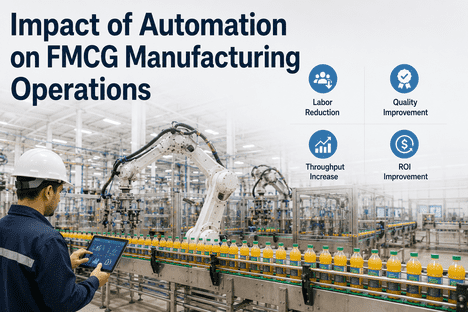
Labor reduction · Quality improvement · Throughput increase · ROI analysis for automation investments in food and consumer goods manufacturing. iFactory's platform coordinates every layer of automated production.
Why Reactive Operations Fail in High-Volume FMCG Production
FMCG facilities face operational pressures that manual processes simply cannot address at scale. Daily production targets reach millions of units across multiple SKUs, each requiring consistent quality, accurate labeling, and precise packaging. Labor shortages compound the challenge — manufacturing facilities struggle to fill technical roles even with competitive wages, while repetitive manual tasks increase injury risks and employee turnover. Consumer demand fluctuates rapidly, requiring production flexibility that traditional fixed lines cannot accommodate. These pressures create an impossible equation: produce more, faster, with fewer people, at lower cost, without compromising quality. Automation solves this equation by replacing manual variability with programmatic consistency. But automation success depends on one critical factor that many facilities overlook: the maintenance management infrastructure that keeps automated systems operational. iFactory's platform provides this infrastructure connecting automated production lines with predictive maintenance, real-time monitoring, and coordinated scheduling that ensures automation uptime of 99.7%.
Three FMCG Automation Challenges iFactory Addresses
How iFactory Turns FMCG Production Data Into Coordinated Automation Intelligence
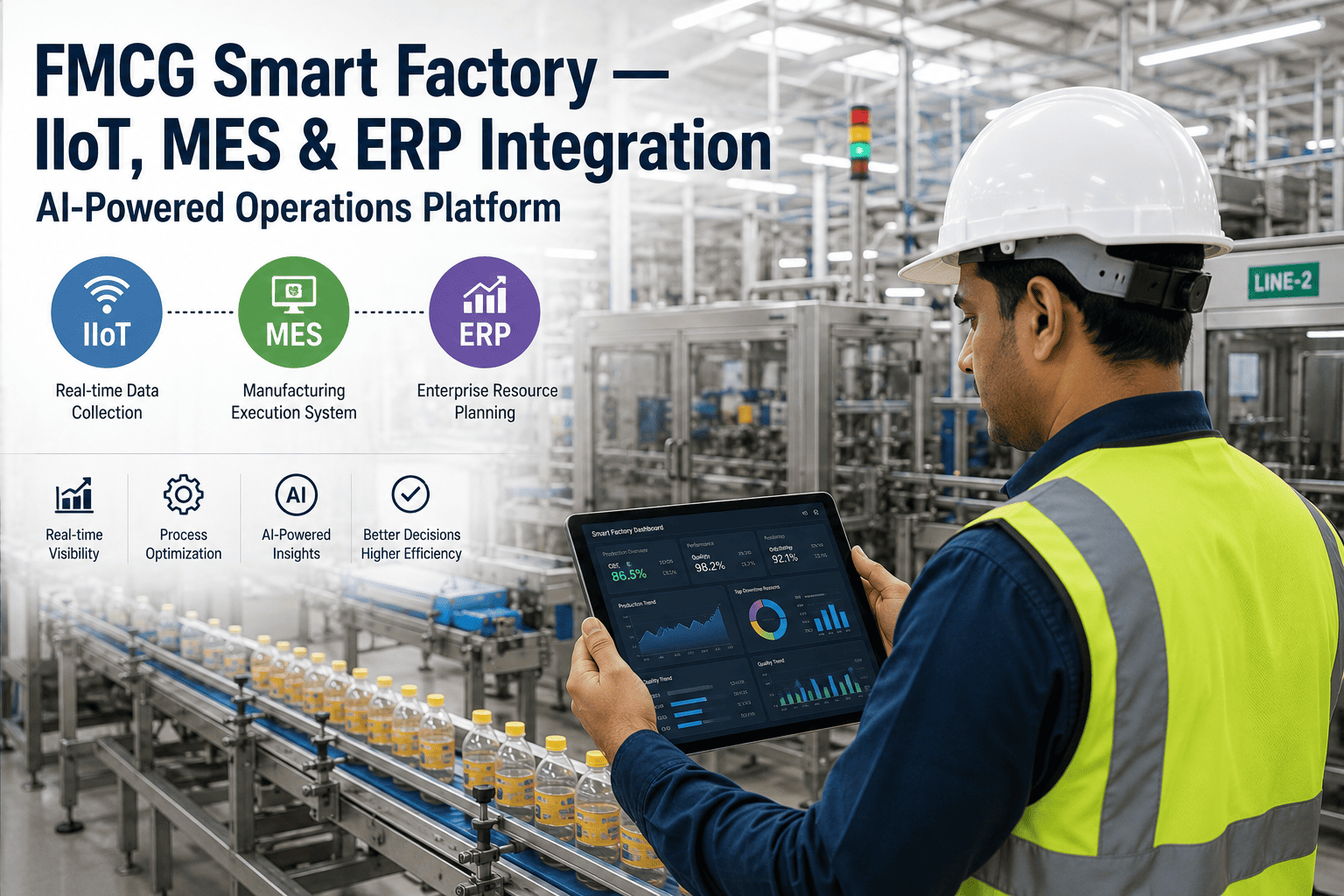
iFactory is the AI software intelligence layer that coordinates FMCG automation — not a hardware vendor or sensor manufacturer. The platform integrates with existing production line equipment including PLC/DCS systems (Siemens, Rockwell, Schneider), robotic controllers (FANUC, ABB, KUKA, Universal Robots), automated inspection systems (Mettler-Toledo, Loma, Teledyne), packaging machinery, and CMMS platforms already deployed across your filling, packaging, palletizing, and material handling lines. The Shift Logbook captures operator reports, defect tags, changeover logs, and maintenance notes alongside the automated sensor stream, creating a unified data fabric for real-time production coordination across every line and shift in your FMCG facility.
Automation Impact Use Cases for FMCG Operations
iFactory coordinates robotic palletizing cells, AGV fleets, and conveyor systems into a unified material flow network. The platform schedules robotic cell maintenance during natural production lulls, routes AGVs based on real-time demand from packaging lines, and balances palletizing load across multiple cells to prevent bottlenecks. Operator intervention drops from 45 minutes per shift to 5 minutes for exception handling. Injuries from manual palletizing — the leading cause of lost-time incidents in FMCG facilities — are eliminated for automated stations.
iFactory connects automated inspection systems — vision cameras, X-ray units, checkweighers, and metal detectors — into a unified quality platform. Every reject event is logged with product image, weight deviation, time, and line position. Trend analysis identifies recurring defect patterns by shift, supplier, or SKU, enabling root-cause correction before the next production run. Real-time dashboard displays defect rate by line and SKU, with automated alerts when rates approach control limits.
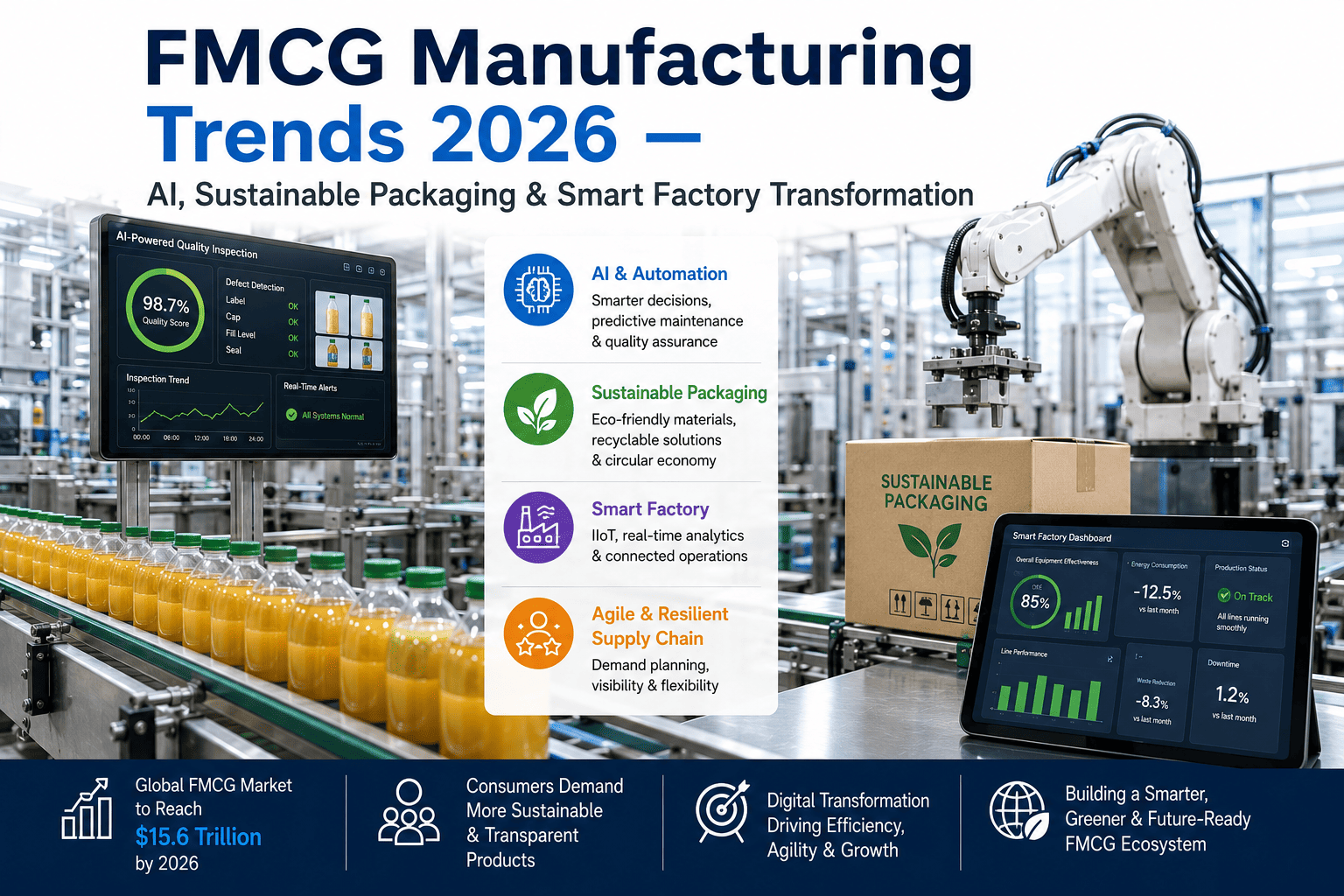
Automated equipment uptime is the single largest factor determining automation ROI. iFactory monitors vibration, temperature, current draw, and cycle time trends across every automated asset — robotic cells, conveyors, packaging machines, and inspection systems. ML models predict bearing failure, gearbox degradation, and actuator wear 2–6 weeks in advance. Maintenance work orders generate automatically with equipment ID, failure type, and intervention window aligned to production schedules. Facilities using iFactory report 25–40% lower maintenance costs and 70% fewer unplanned breakdowns.
iFactory coordinates changeover sequences across flow wrappers, cartoners, case packers, labelers, and stretch wrappers. Each SKU changeover is a programmable recipe that sets guide positions, film tension, label application timing, and case pattern parameters in seconds rather than hours. The platform tracks changeover duration by SKU, shift, and operator, identifying the fastest sequences and standardizing them across teams. Changeover time drops from 2–6 hours to 15–45 minutes, recovering 8–15% of production capacity previously lost to format transitions.
ROI — What FMCG Facilities Achieve with Coordinated Automation
Manual vs Automated FMCG Operations — Performance and Cost Comparison
The financial and operational impact of automation becomes clear when manual and automated production performance metrics are compared side by side. The comparison below presents per-line metrics for a mid-size FMCG facility running 2,000 SKU-hours per year across two packaging lines.
Manual Operations
- Operating hours: 16–18 hr/day across three shifts with breaks
- Line speed: 80–120 units/min (packaging lines)
- Defect rate: 2–5% with manual inspection
- Changeover time: 2–6 hours per SKU transition
- Equipment uptime: 94–96% with reactive maintenance
- Injury rate: Industry baseline for repetitive manual tasks
- Labor cost: High variable cost per unit
Automated Operations
- Operating hours: 23–24 hr/day continuous operation
- Line speed: 250–400 units/min with automated packaging
- Defect rate: 0.1–0.3% with vision inspection
- Changeover time: 15–45 min with programmable recipes
- Equipment uptime: 99.7% with predictive maintenance
- Injury rate: 90% reduction for automated tasks
- Labor cost: 40–60% lower per unit
Automation Implementation Readiness — What Your Facility Needs
Implementing coordinated automation requires preparation across five areas — production line assessment, data infrastructure, equipment connectivity, team readiness, and maintenance foundation. The checklist below covers the essential elements iFactory's implementation team reviews during deployment at each FMCG facility.
Production line automation audit
Assess current level of automation across material handling, packaging, inspection, and process control. Identify high-impact applications where automation replaces expensive manual operations or removes production bottlenecks.
Data infrastructure readiness
Confirm that PLC, SCADA, and CMMS systems are collecting and storing production data. iFactory integrates with existing systems — most facilities already generate the data needed for automation coordination.
Equipment connectivity and telemetry
Verify that robotic controllers, inspection systems, packaging machines, and conveyors have network connectivity and data output capability. iFactory connects to any system with standard industrial protocols.
Predictive maintenance foundation
Deploy condition monitoring on automated equipment before or alongside automation implementation. Predictive maintenance is the critical enabler that ensures automation uptime and protects ROI.
Team training and role transition planning
Develop training programs that transition operators from manual tasks to automation technician roles. Facilities investing in role advancement report 40% higher retention and faster automation adoption.
Real-time production monitoring deployment
iFactory configures production dashboards displaying OEE, line speed, defect rate, changeover time, and equipment condition across every line and shift — with automated alerts for deviation from target.
What FMCG Operations Managers Say About Automation Impact
I have managed production operations at three FMCG facilities over twelve years — two in the Midwest and one in the Southeast — and the most persistent challenge I have seen is not whether automation works, but whether the maintenance infrastructure exists to keep it working. At my last facility, we installed three robotic palletizing cells that were projected to reduce our labor cost by 45% and eliminate our highest-injury manual task. The robots ran beautifully for the first three months. Then one cell went down with a bearing failure in the wrist joint. We had no vibration monitoring on the robot, no spare bearing in inventory, and no predictive model that could have told us the bearing was degrading. That cell was down for 11 days. We lost 847 pallets of finished product throughput. The ROI calculation that assumed 98% uptime was suddenly running on 89% uptime, and the payback period stretched from 18 months to 28 months. That experience taught me that automation hardware is only as valuable as the maintenance infrastructure supporting it. At our next facility, we deployed iFactory's predictive maintenance platform before the automation installation completed. Every robot, every conveyor drive, every inspection system was connected to the monitoring platform from day one. When a wrist joint bearing in one of the new cells showed elevated vibration six weeks into operation, the platform generated a work order with the bearing part number, the predicted remaining life of 19 days, and a recommended replacement window aligned to our upcoming SKU changeover. The bearing was replaced during a planned 90-minute changeover stop. Zero unplanned downtime. The automation ROI hit 19 months. The difference between 89% uptime and 99.7% uptime is the difference between a failed automation investment and a transformational one.
— Operations Manager, FMCG Manufacturing — 12 Years Production Operations — Six Sigma Green Belt — PMMI MemberCommon Questions About Automation Impact on FMCG Manufacturing
Coordinated Automation Is the Fastest Path to Competitive FMCG Operations — If You Have the Infrastructure to Sustain It
Every FMCG facility in the United States faces the same pressures: labor shortages, rising costs, SKU proliferation, and quality demands at ever-higher throughput. The barrier to automation success is not the availability of robotic hardware, vision systems, or packaging machinery. It is the coordination layer that connects these systems — the maintenance infrastructure, the data platform, the real-time monitoring, and the team readiness — that determines whether automation delivers its projected ROI or falls short. The facility that builds this coordination layer before — or alongside — its automation investment can sustain 99.7% uptime, 150–300% output increases, 40–60% lower labor cost per unit, and ROI payback in 12–24 months. These are not theoretical targets. They are the results that FMCG operations managers achieve when they replace siloed automation with coordinated production intelligence.
iFactory's Manufacturing Operations Platform provides FMCG production managers with the digital infrastructure to coordinate every layer of automated production — robotic material handling, quality inspection, packaging, predictive maintenance, and process control — replacing the siloed approach to automation with a unified intelligence system that delivers sustained results from day one of deployment.
AI-driven manufacturing operations platform connecting robotic material handling, quality inspection, packaging, and predictive maintenance into one unified intelligence layer — with real-time production monitoring, Shift Logbook integration, CMMS workflow automation, and plant-wide OEE analytics. Pre-built FMCG templates deploy in weeks, not months. Protect your production throughput and margin with coordinated automation intelligence.