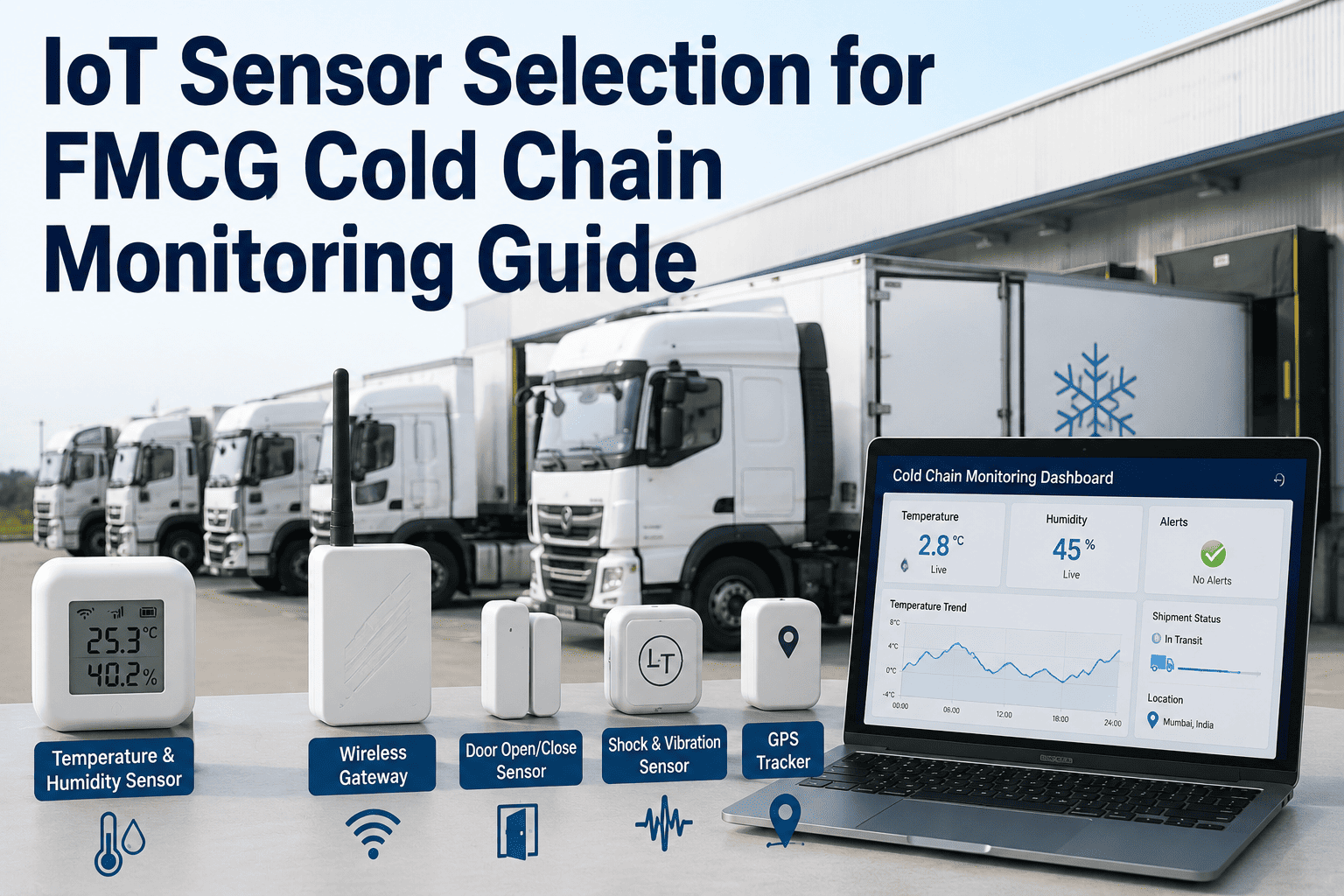
Most FMCG brands buy cold chain sensors the way they buy office supplies: get a quote, compare the price per unit, order enough to cover the warehouse and the trucks, and move on. Then six months later a pallet of dairy arrives with a five-degree excursion nobody caught, and the investigation turns up a sensor that was rated for the wrong temperature range, reporting on a battery cycle too slow to catch a short door-open event, sitting on a wireless protocol that could not reach the gateway from the back of a trailer. The sensor was never wrong on its own spec sheet. It was wrong for the job it was actually doing, which is a different failure with the same result, and the fix starts with picking hardware for the environment rather than the price list. Get a walkthrough of how the right sensor mix maps to your own network at ifactory support.
The Sensor You Pick Decides How Much of Your Cold Chain You Can Actually See
A practical breakdown of accuracy, battery life, wireless protocol, and calibration cycle for warehouse, truck, and last-mile deployments, built for teams choosing hardware for a real FMCG network rather than a lab demo.
Why the Same Sensor Cannot Cover Every Location
A warehouse sensor sits in a fixed, powered, climate-stable environment and mainly needs to be accurate and easy to calibrate on a schedule. A truck sensor rides through vibration, temperature swings at the dock door, and long stretches with no cellular signal, so it needs battery life and a protocol that survives a moving metal box. A last-mile sensor, riding in a delivery tote or a parcel to a consumer's door, needs to be small, cheap enough to deploy at volume, and able to report fast enough to catch an excursion that might last twenty minutes rather than two days. Treating all three as interchangeable is the single most common reason FMCG brands end up with monitoring gaps they only discover after a spoilage claim.
Accuracy: The Number Every Spec Sheet Leads With
Accuracy is usually printed as a plus-or-minus figure, and it is worth reading closely rather than trusting the headline number. A sensor rated at plus-or-minus 0.5 degrees Celsius in its ideal calibration range can drift well outside that tolerance near the edges of its operating range, which matters a great deal for frozen goods sitting near minus eighteen degrees if the sensor's stated range only goes down to minus twenty. For most ambient and chilled FMCG categories, a general-purpose sensor accurate to within half a degree across zero to eight degrees Celsius is sufficient. Frozen categories need a sensor validated specifically at the low end of its range, not just accurate on average across a wider band it rarely touches.
| Product Category | Target Range | Recommended Accuracy | Read Frequency |
|---|---|---|---|
| Frozen (ice cream, frozen meals) | -25°C to -18°C | ±0.3°C at low end of range | 1 to 3 minutes |
| Chilled dairy and deli | 0°C to 4°C | ±0.5°C | 1 to 5 minutes |
| Fresh produce | 2°C to 8°C | ±0.5°C | 5 minutes |
| Temperature-sensitive ambient | 15°C to 25°C | ±1°C | 10 to 15 minutes |
Battery Life Is a Route Planning Problem, Not Just a Spec
A reusable trailer sensor that needs a battery swap every ninety days sounds fine until it has to be pulled from a trailer mid-route to make that swap happen, which is a maintenance task nobody schedules on time. The realistic way to size battery life is against the sensor's actual duty cycle: a sensor reporting every minute over a cellular network burns through a battery far faster than the same hardware reporting every ten minutes over a low-power wide-area network, and the difference between those two settings can be the gap between a three-month battery and an eighteen-month one. For long-haul reefer routes, prioritize sensors rated for at least twelve months at the reporting interval you actually intend to use, not the interval shown in the marketing spec at its lowest power setting.
Wireless Protocol: The Choice That Decides Where Coverage Actually Works
Bluetooth Low Energy sensors are cheap and accurate but only transmit a short distance, which makes them a poor fit for a moving trailer unless there is a gateway riding in the cab to relay the signal. Cellular sensors solve the range problem outright and work almost anywhere a truck drives, at the cost of a higher unit price and a recurring data plan per device. Low-power wide-area protocols sit in between, offering longer range than Bluetooth at lower cost than cellular, but they depend on network coverage that is still uneven in rural corridors and some international lanes. The right choice usually depends less on which protocol is best in the abstract and more on which one already has usable coverage across the specific lanes and facilities the fleet runs.
| Protocol | Typical Range | Battery Impact | Best Fit |
|---|---|---|---|
| Bluetooth Low Energy | 10 to 50 meters | Low, longest battery life | Warehouse zones, sensors paired with an in-cab gateway |
| LoRaWAN / Low-Power WAN | 2 to 15 kilometers | Moderate | Fixed sites and yards with a gateway already installed |
| Cellular (4G/5G, NB-IoT) | Wherever carrier coverage reaches | Highest, needs larger battery or fixed power | Long-haul trailers, last-mile parcels, remote routes |
Not Sure Which Protocol Fits Your Lanes?
Bring your current facility list and route map to the call. We will map sensor type and protocol against your actual network instead of a generic recommendation.
Book a Demo Talk to Our TeamCalibration Cycle: The Requirement Most Buying Guides Skip
A sensor that was accurate on the day it was installed does not stay that way indefinitely. Thermistors and other sensing elements drift over time, and the rate of drift depends on the sensing technology, the temperature swings it experiences, and how it is handled between deployments. Warehouse sensors in a stable environment can often go twelve months between calibration checks. Trailer sensors exposed to vibration, temperature cycling, and rougher handling should be checked more frequently, typically every six to nine months, and any sensor involved in a documented excursion event should be recalibrated or replaced before it goes back into service rather than assumed to still be accurate.
Calibration is also where a lot of programs quietly fail, because the requirement is easy to write into a policy and easy to skip in practice once a fleet has hundreds of sensors in circulation. Building a calibration schedule directly into whatever system tracks sensor inventory, so that a device is automatically flagged when it approaches its due date, removes the dependency on someone remembering a spreadsheet column. Without that structure, the sensors most likely to miss calibration are exactly the ones on the busiest routes, which are also the ones where an undetected drift causes the most damage.
A Decision Framework for Picking Sensors by Location
Four Sensor Selection Mistakes That Show Up Later, Not Immediately
What Good Sensor Coverage Looks Like in Practice
Curious how your current sensor fleet stacks up against this? Reach out to our team for a quick review.
Frequently Asked Questions
Get a Sensor Mix Built for Your Actual Network
Bring your facility list, route map, and product mix to the call. We will walk through accuracy, battery, protocol, and calibration requirements for each part of your cold chain.