Pharmaceutical-Grade FMCG Facility Passes FDA Audit with Zero Findings Using ifactory
By Seren on June 20, 2026
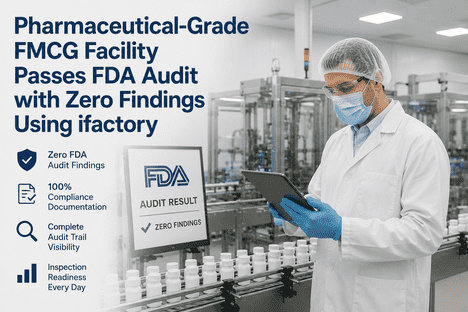
The quality assurance director of a pharmaceutical-grade FMCG facility operates in a regulatory environment that demands the documentation rigour of a pharmaceutical plant while maintaining the production throughput of a fast-moving consumer goods operation. Every batch record, every equipment calibration, every temperature excursion, and every change order must be documented with an audit trail that would withstand an FDA inspector's scrutiny — yet the production lines run at FMCG speeds, generating thousands of data points per shift across filling, packaging, labelling, and warehousing operations. The tension between pharmaceutical documentation standards and FMCG production velocity is the defining compliance challenge for hybrid facilities that manufacture personal care products, oral care items, and over-the-counter health products under pharmaceutical-grade quality systems. This case study examines how a mid-size pharma-grade FMCG facility producing 180 million units annually across 240 SKUs — including mouthwashes, topical antiseptics, and OTC health products — passed a scheduled FDA inspection with zero Form 483 observations by deploying iFactory's compliance and audit trail management platform across its eight validated production lines. The result was not merely the absence of findings. The facility established a compliance operating model in which FDA inspection readiness is a continuous state rather than a pre-audit preparation exercise, audit documentation that previously took three weeks to assemble is produced in under 90 minutes, and preventive maintenance schedule compliance reached 98% within 90 days of deployment.
FDA Compliance · Audit Trail Management · Zero 483 Observations · Pharmaceutical-Grade FMCG
The Facility Was Producing 180M Units Annually Under Pharmaceutical-Grade Quality Standards. The FDA Found Nothing Wrong. The Difference Was Not Better Procedures — It Was An Audit Trail That Proved Every Procedure Was Followed.
iFactory gives pharmaceutical-grade FMCG facilities a single platform for compliance and audit trail management — 21 CFR Part 11-compliant electronic records, automated calibration tracking, real-time temperature monitoring with audit-ready logs, and preventive maintenance documentation that is generated automatically from every work order.
First post-deployment FDA inspection resulted in zero Form 483 observations — compared to three maintenance-related findings in the prior inspection cycle 18 months earlier
98%
PM compliance rate
Preventive maintenance schedule compliance achieved within 90 days of deployment — up from 61% with the previous paper-based and spreadsheet-driven system
90 min
audit documentation time
Complete audit documentation assembled in under 90 minutes during the FDA inspection — versus the three weeks of manual effort required for the prior inspection cycle
$2.4M
avoided regulatory exposure
Estimated cost of regulatory exposure from the previous 483 observations that would have escalated to Warning Letter action items if the documentation gaps had not been closed
The Compliance Architecture — Six Documentation Pillars That Delivered Zero Findings
The facility operates under a pharmaceutical-grade quality system that must satisfy FDA 21 CFR Part 211 (Current Good Manufacturing Practice for Finished Pharmaceuticals) requirements while producing consumer health products at FMCG volumes. The iFactory compliance and audit trail management platform was deployed across the six documentation domains that FDA investigators scrutinise most closely during a pharmaceutical inspection. Each domain had a specific compliance gap that the platform closed — and each closure contributed to the zero-finding outcome.
01
Equipment Calibration Records — Eliminating Data Integrity Findings
The prior FDA inspection cycle had produced a 483 observation specifically for calibration record discrepancies under 21 CFR 211.68. Calibration activities were performed on schedule — but records were handwritten in the field and transcribed to the system-of-record hours or days after the activity. FDA investigators found 23 calibration records where the document date did not match the instrument timestamp, triggering a data integrity observation. The iFactory platform eliminated transcription entirely: calibration results are captured on mobile devices at the instrument location, with the system timestamp locked at the moment of entry. Electronic signatures compliant with 21 CFR Part 11 are applied at completion. The FDA inspector in the post-deployment cycle reviewed 180 calibration records across the facility's 312 instruments and found zero discrepancies between the calibration date on the record and the instrument timestamp in the system log.
02
Preventive Maintenance Schedule Compliance — Closing the Visibility Gap
The prior inspection had also identified that the facility could not produce a consolidated, auditable PM completion log for the preceding 12 months when the FDA investigator requested one. The PM schedule was managed in a spreadsheet maintained by the maintenance planner, and production supervisors and QA had no real-time visibility into completion status. The iFactory platform centralised the PM schedule for all 312 assets across eight production lines, with automated work order generation, mobile completion verification, and a real-time compliance dashboard visible to maintenance, production, and QA simultaneously. Within 90 days of deployment, PM schedule compliance reached 98% — and the FDA inspector was able to pull the complete 12-month PM compliance report from the system in under five minutes during the inspection.
03
Temperature and Environmental Monitoring — Audit-Ready Continuous Logs
The facility's OTC health products and oral care formulations require temperature-controlled storage and production environments. Temperature monitoring data was collected by stand-alone data loggers that required manual download and transcription into compliance spreadsheets — a process that generated quarterly reports that were never reviewed in the context of batch release decisions. The iFactory platform ingested temperature data from 48 monitoring points across production, warehousing, and quality control laboratories into a single continuous log. Temperature excursions are flagged automatically within the monitoring system, and the excursion record — including duration, magnitude, and corrective action — is linked to the affected batch records. The FDA inspector reviewed temperature data for the preceding 18 months during the inspection and confirmed that every excursion was documented, investigated, and dispositioned before batch release.
04
Change Control and Deviation Management — Complete Traceability
One of the most common FDA inspection findings across pharmaceutical facilities is incomplete change control documentation — changes made to validated processes or equipment without the required quality review and approval. The facility had a change control procedure on paper, but the link between the change request, the risk assessment, the approval workflow, and the implementation verification was maintained as email threads and physical file folders. The iFactory platform automated the entire change control workflow: every change request is created, reviewed, approved, implemented, and verified within the system, with each step generating a time-stamped audit trail entry. The FDA inspector selected seven change orders at random from the preceding 12 months and traced each one from initial request through risk assessment, quality approval, implementation, and requalification verification — all within the system, without a single missing signature or date.
05
Training and Personnel Qualification Records — Verifiable Competence
The FDA investigator requested training records for 14 operators across three production shifts during the inspection. In the previous system, training records were maintained as paper sign-off sheets stored in personnel files, and retrieving the requested records would have required pulling files from HR archives, cross-referencing training matrices, and reconciling incomplete records. The iFactory platform centralised training documentation with automated training assignment, electronic sign-off, and recertification tracking linked to the individual operator's access permissions in the production system. The requested training records were retrieved and displayed within 12 minutes — showing each operator's initial training date, most recent refresher training, competency assessment results, and recertification due date.
06
Batch Record Review and Release — Documented Conformance
The batch release process required QA review of production records, in-process testing results, finished product test data, and equipment cleaning verification before each batch was approved for distribution. Under the paper-based system, batch record review was a bottleneck that averaged 8.3 days per batch — and the documentation that QA reviewers were signing off on was often incomplete, requiring follow-up requests for missing data. The iFactory platform digitised the batch record review workflow: all production data, testing results, and equipment status information is captured in real time during production, and the QA reviewer reviews a complete digital batch record with all required documentation already attached. The average batch review cycle was reduced from 8.3 days to 1.8 days, and the FDA inspector confirmed that all 47 batches produced during the three-day inspection window had complete, signed, and traceable batch records.
Documentation Maturity — Manual vs. Digital Audit Trail Management Across the Six Compliance Domains
The transition from manual compliance documentation to digital audit trail management produced measurable improvements across every domain that FDA investigators evaluate. The following comparison reflects the facility's documented performance — before and after iFactory deployment — across the six critical compliance areas that contributed to the zero-finding outcome.
Compliance Domain
Pre-iFactory (Manual System)
Post-iFactory (Digital Audit Trail)
Calibration Records
Paper-based field entry transcribed to digital records hours or days later. 23 date-discrepancy findings in prior FDA inspection. No real-time visibility into calibration schedule or completion status.
Mobile capture at instrument with system-locked timestamp. 21 CFR Part 11-compliant electronic signatures. Zero calibration record discrepancies confirmed by FDA inspector across 180 records reviewed. Real-time calibration compliance dashboard with automated overdue alerts.
Preventive Maintenance
Spreadsheet-based schedule maintained by maintenance planner. No visibility for production or QA. Could not produce 12-month consolidated PM completion log during prior FDA inspection.
Centralised PM schedule for 312 assets with automated work order generation. Real-time compliance dashboard accessible to maintenance, production, and QA. 98% schedule compliance achieved within 90 days. Complete 12-month PM log retrieved in under 5 minutes during inspection.
Environmental Monitoring
Stand-alone data loggers requiring manual download. Temperature data transcribed to compliance spreadsheets quarterly. Excursions documented in separate files not linked to batch records.
Continuous log from 48 monitoring points in single platform. Automated excursion flagging with corrective action linked to batch records. FDA inspector reviewed 18 months of continuous data and confirmed complete excursion documentation.
Training Records
Paper sign-off sheets in personnel files. Manual cross-referencing with training matrices. No automated recertification tracking. Retrieval required HR file pull.
Centralised digital training records with automated assignment and recertification tracking. 14 operator records retrieved in 12 minutes during inspection. Training status linked to system access permissions.
Digital Audit Trails · 21 CFR Part 11 Compliance · Automated Documentation · Zero-Finding Readiness
The Documentation Burden That Consumed Three Weeks Before Each FDA Inspection Now Exists as a Continuous Digital State — Accessible in Minutes, Auditable at Any Time.
iFactory embeds compliance documentation directly into the maintenance and quality workflow — calibration records, PM logs, temperature monitoring, change control, training, and batch release all generate FDA-ready audit trails automatically without manual transcription or pre-inspection assembly.
Three Audit Trails the FDA Inspector Traced That Previous Inspections Could Not Follow
During the post-deployment inspection, the FDA investigator selected three specific documentation trails that had produced findings in the prior inspection cycle. Each trail required the facility to demonstrate a complete, unbroken chain of documentation from the point of activity through the quality review to the final record. In the prior cycle, each trail had gaps. In the post-deployment cycle, each trail was complete, time-stamped, and auditable within the iFactory platform.
Audit Trail 01
Filling Line Temperature Excursion — From Sensor to Batch Disposition
The FDA investigator selected a specific production date and requested the temperature record for the filling line that was producing an OTC antiseptic mouthwash during that shift. The iFactory platform displayed the continuous temperature log for the production period, highlighted a 14-minute excursion above the validated range, and linked directly to the excursion investigation record — which included the QA disposition decision, the corrective action taken, and confirmation that all affected batch units were within the validated hold time and were released. The investigator traced the excursion from the sensor reading through the investigation to the batch release decision without leaving the platform interface.
Complete: Sensor → Investigation → Disposition — all linked in single platform
Audit Trail 02
Label Printer Calibration Record — From Instrument to Batch Audit
The investigator requested the calibration record for a label printer used on a product line where label accuracy is critical for regulatory compliance (ingredient declarations, dosage instructions, and lot numbers). In the prior inspection cycle, the equivalent request had produced a handwritten calibration log with dates that could not be reconciled with the instrument's internal event log. In the post-deployment cycle, the iFactory platform displayed the label printer's calibration record with the system-locked timestamp of the calibration completion, the electronic signature of the technician who performed the calibration, the as-found and as-left calibration readings, and a link to the calibration standard's own certification of traceability. The investigator confirmed the record in under three minutes.
Complete: Instrument → Calibration → Standard traceability — mobile capture with locked timestamp
Audit Trail 03
Change Order for Packaging Line Reconfiguration — From Request to Requalification
The investigator selected a change order that modified the configuration of a packaging line to accommodate a new bottle format for an oral care product. In the prior inspection cycle, the equivalent change order was documented in a paper file folder with the risk assessment stored separately in the quality manager's email archive — the link between the change and the requalification verification was established only by the investigator's request to see both documents. The iFactory platform displayed the change order with the complete workflow: the initial change request, the risk assessment (documenting the evaluation of potential impact on product quality), the quality manager's approval, the implementation record, and the requalification verification showing successful operational testing. The entire audit trail was presented in a single view.
The iFactory Compliance Dashboard — What the Quality Director Sees Across All Eight Production Lines
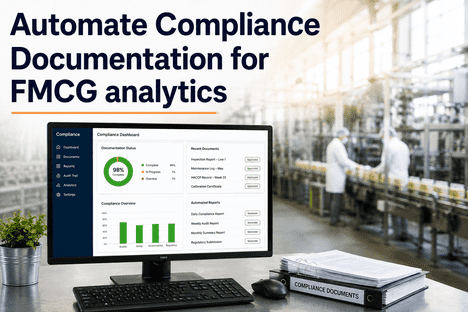
The quality director's dashboard is organised around the compliance questions that must be answered continuously: Are all calibrated instruments within their calibration window? Is every scheduled PM completed and documented? Are any temperature excursions open without disposition? Has every change order been approved and verified? The dashboard presents each compliance domain as a real-time status view that updates automatically from the audit trail data generated by maintenance, production, and quality activities.
Domain View
Calibration Compliance Status
All 312 instruments displayed with current calibration status — green for in-window, yellow for due within 30 days, red for overdue. The overdue count was zero throughout the FDA inspection period. Each instrument record shows the last calibration date, the next due date, the calibration standard used, and the electronic signature of the technician who performed the calibration.
Action: Review instrument calibration history or export compliance report
Domain View
PM Schedule Adherence
Real-time PM completion percentage for the current month, displayed alongside the trailing 12-month trend. The dashboard shows 98% compliance for the current month with the 2% gap representing three PMs that are within their grace period. The FDA inspector reviewed the 12-month trend and confirmed that compliance improved from 61% at deployment to consistently above 95% from month four onward.
Action: View overdue PM list or export 12-month compliance report
Domain View
Open Deviation and CAPA Tracker
Every open deviation, temperature excursion, or quality event displayed with its current status, days open, and assigned owner. CAPA records are linked to the originating deviation and tracked through effectiveness verification. During the inspection, the dashboard showed zero deviations open beyond their target closure date — a metric that the quality director used to demonstrate that the corrective action system was functioning effectively.
Action: Review aging deviations or verify CAPA effectiveness
Domain View
Inspection Readiness Score
A composite readiness score calculated from the status of all compliance domains — calibration, PM, temperature monitoring, change control, training, and batch review. The score is calculated continuously and displayed as a percentage with a green-yellow-red threshold. The facility maintained a readiness score above 95% throughout the 90-day period preceding the FDA inspection, confirming that the continuous audit trail approach had eliminated the pre-inspection documentation scramble.
Action: Generate pre-inspection readiness report for any date range
"
The prior FDA inspection had been a difficult experience — not because our procedures were wrong, but because we could not prove that our procedures had been followed. We had done the calibrations, completed the PMs, and documented the deviations. But the documentation was scattered across paper files, spreadsheets, and email inboxes, and when the investigator asked for a specific record, it took us hours or days to find it — and sometimes the record we found had gaps that made it look like the work had not been done at all. The three 483 findings were all documentation failures, not procedural failures. When we deployed iFactory, we did not change our procedures. We changed how we documented that we followed them. The next FDA investigator spent three days in the facility and found zero discrepancies. The difference was not that we were doing different work. It was that every action we took generated an audit trail that was complete, time-stamped, and instantly available.
The pharmaceutical-grade FMCG facility's zero-finding FDA inspection was not achieved by implementing new quality procedures or hiring additional compliance staff. It was achieved by deploying a digital audit trail system that ensured every action taken in the facility — every calibration, every PM, every temperature reading, every change order, every training session, and every batch review — generated a complete, time-stamped, and traceable record that could be retrieved in minutes rather than days.
The six documentation domains that the iFactory platform addressed correspond to the six areas that FDA investigators prioritise during pharmaceutical inspections: calibration records, preventive maintenance documentation, environmental monitoring, change control, training records, and batch release documentation. In each domain, the facility's prior system produced documentation that was either incomplete, untraceable, or too slow to retrieve — creating the appearance of compliance gaps even when the underlying work had been performed correctly. The digital audit trail closed each gap by capturing documentation at the point of activity, locking it with system-generated timestamps and electronic signatures, and making it accessible through a single platform that both the quality team and the FDA investigator could navigate.
The results are measurable and unambiguous: zero Form 483 observations at the first post-deployment FDA inspection, compared to three findings in the prior cycle. PM schedule compliance improved from 61% to 98% within 90 days. Audit documentation that previously required three weeks of manual assembly was produced in under 90 minutes during the inspection. The estimated regulatory exposure from the prior inspection's findings — which would have escalated to Warning Letter status if the documentation gaps had not been closed — was valued at $2.4M. For pharmaceutical-grade FMCG facilities operating under FDA 21 CFR Part 211 requirements while maintaining FMCG production volumes, the question is no longer whether digital compliance documentation is worth the investment. It is whether the facility can afford to continue producing audit trails that are scattered across paper, spreadsheets, and email inboxes — and whether the next FDA inspection will be the one that finds the gap. iFactory's compliance and audit trail management platform is designed for pharmaceutical and pharma-grade FMCG facilities that need to move from inspection preparation to continuous inspection readiness. Book a Demo to see the platform configured for your facility's compliance documentation requirements, or talk to an expert about a free compliance documentation gap assessment for your next FDA inspection cycle.
Frequently Asked Questions
Yes. The iFactory platform is designed to satisfy FDA 21 CFR Part 11 requirements for electronic records and electronic signatures. The system features computer-generated, time-stamped audit trails that capture the creation, modification, and deletion of all regulated records. Audit trail entries are secure, tamper-resistant, and cannot be disabled by operational users. Electronic signatures are unique to each user, require secure authentication, and are permanently linked to the signed record — preventing copying, reassignment, or deletion. The platform also supports operational system checks to enforce permitted sequencing of steps, authority checks to ensure only authorised individuals can perform regulated actions, and device checks to validate the source of data input. The platform is validated as part of the deployment process, with IQ, OQ, and PQ documentation delivered as part of the implementation package. Talk to an expert about the Part 11 compliance validation package for your facility.
The deployment timeline depends on the facility's existing system infrastructure and the number of production lines and assets. The facility in this case study — eight production lines, 312 monitored assets, 48 temperature monitoring points, and approximately 180 active SOPs — was deployed in six weeks from kickoff to go-live. The deployment included system configuration, asset register population, calibration schedule import, PM template creation, temperature monitoring point integration, user training, and system validation documentation (IQ/OQ). An additional two weeks were dedicated to the system validation and user acceptance testing phase before the platform was placed under GMP compliance. The quality director noted that the deployment timeline was driven primarily by the asset register data population and validation requirements — not by system configuration complexity. Book a Demo to see a deployment roadmap configured for your facility scale and production line count.
The platform supports multi-site deployment with a centralised compliance data model that accommodates site-specific regulatory requirements. Each facility is registered as a separate site within the platform with its own asset register, calibration schedules, PM templates, and temperature monitoring configuration — while all sites share a common audit trail structure and compliance dashboard. The corporate quality director can view compliance status across all sites from a single dashboard, while each site's quality manager operates within their own compliance domain. The platform supports US FDA 21 CFR Part 211 requirements for pharmaceutical facilities, 21 CFR Part 110 for food manufacturing facilities, and ISO 13485 for medical device facilities within the same multi-site deployment — with site-specific configuration for regulatory reporting formats and compliance thresholds. The facility in this case study has since expanded the platform to a sister facility in a different state, with the second site configured for its specific product mix and regulatory profile while sharing the same audit trail architecture and quality oversight dashboard. Talk to an expert about a multi-site compliance architecture assessment for your facilities.
The iFactory compliance platform is designed to integrate with existing enterprise systems rather than replace them. In this case study, the platform integrated with the facility's existing ERP system for asset register population and spare parts inventory, with the LIMS for test result import into batch records, and with the existing quality management system for CAPA workflow and document control. The integration architecture uses standard APIs and data exchange formats (XML, JSON, CSV), and the integration points are validated as part of the system validation package. Data flows bidirectionally where required — calibration records created in the iFactory platform are synchronised with the ERP asset register, and batch release decisions documented in the platform are exported to the QMS for archival. For facilities that do not have an existing QMS or LIMS, the platform includes embedded quality management capabilities — CAPA management, document control, deviation tracking, and audit management — that can serve as the primary system or as a complement to existing systems. Talk to an expert about configuring the integration architecture for your facility's existing enterprise systems.
Three Weeks of Pre-Inspection Documentation Preparation Is Not a Compliance Strategy — It Is a Gamble. Continuous Digital Audit Trails Mean Zero-Finding Readiness Is a State You Live In Every Day. Get a Free Compliance Documentation Gap Assessment.
iFactory's compliance and audit trail management platform — 21 CFR Part 11-compliant electronic records, automated calibration tracking, real-time temperature monitoring with audit-ready logs, PM compliance dashboards, and integrated change control and deviation management — built for pharmaceutical and pharma-grade FMCG facilities that need to demonstrate continuous inspection readiness.