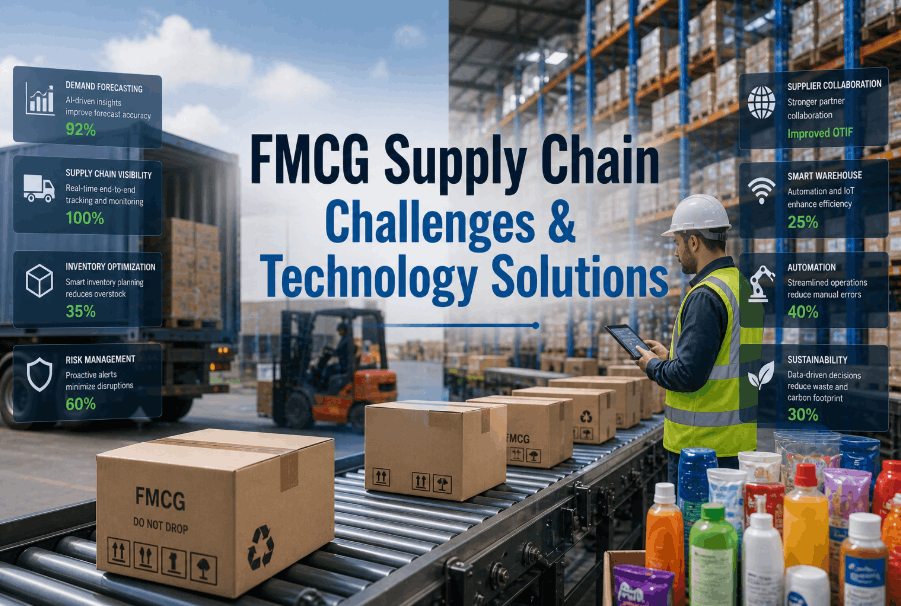
The FMCG supply chain is under more pressure than at any point in recent history. Demand volatility, raw material shortages, geopolitical disruptions, and escalating logistics costs have converged into a structural challenge that no single operational fix can resolve. For food and consumer goods manufacturers, every link in the supply chain now carries compounded risk — and the cost of a single disruption cascades across production schedules, retailer commitments, and brand equity. FMCG supply chain challenges are no longer seasonal or cyclical — they are the permanent operating environment. Manufacturers who build supply chain resilience through technology and AI-powered intelligence are widening the gap between themselves and competitors who continue to operate on reactive, spreadsheet-driven models. Book a demo to see how purpose-built supply chain technology is helping FMCG manufacturers absorb disruption without losing production continuity.
FMCG SUPPLY CHAIN
·
AI-POWERED RESILIENCE
·
LOGISTICS OPTIMIZATION
Build an FMCG Supply Chain That Absorbs Disruption and Keeps Production Running
iFactory's AI-powered supply chain platform gives food and consumer goods manufacturers real-time visibility, predictive demand intelligence, and logistics optimization to eliminate disruption-driven downtime — at scale, across every facility.
Why FMCG Supply Chain Disruption Has Become the New Normal
The traditional FMCG supply chain was built on assumptions of relative stability — predictable demand patterns, dependable supplier networks, and logistics infrastructure that delivered on schedule. Those assumptions have been systematically dismantled. Global supply chain disruption in the food and consumer goods sector is now a structural condition, not a temporary shock. Manufacturers who attempt to operate within legacy frameworks are absorbing avoidable costs at every stage — from over-purchasing raw materials to buffer against shortage risk, to emergency freight charges that erode margin on already thin FMCG product lines.
The compounding nature of food supply chain challenges is what makes them uniquely difficult to manage without technology. A single ingredient shortage triggers a reformulation decision, which delays production, which breaks a retailer commitment, which generates a financial penalty — all traceable back to a supplier disruption that predictive analytics could have flagged weeks in advance. The difference between FMCG manufacturers that absorb these events with minimal production impact and those that spiral into cascading losses is almost always a technology gap, not an operational talent gap.
73%
of FMCG manufacturers report supply chain disruptions as their top operational risk in 2025
$1.8M
average annual cost of unplanned supply chain disruptions per mid-size FMCG facility
38%
reduction in supply disruption impact achieved with AI-powered demand and supply visibility
4.2x
faster supplier risk response time when AI supply chain monitoring is deployed
Root Causes
The Six Core FMCG Supply Chain Challenges Eroding Manufacturer Margins
Understanding the specific mechanisms through which supply chain FMCG operations break down is the prerequisite for deploying the right technology responses. Each challenge has a defined root cause, measurable operational impact, and a technology solution category that addresses it directly. Manufacturers who treat these as isolated problems consistently underinvest in platform capabilities that solve them together.
Demand Volatility and Forecast Inaccuracy
FMCG demand patterns have become structurally unpredictable. Promotional spikes, retailer inventory swings, and shifting consumer behavior create forecast errors that cascade into either excess inventory carrying costs or stock-out events that damage retailer relationships and brand positioning. Traditional statistical forecasting models cannot incorporate the real-time signals — weather events, social trends, regional economic shifts — that now drive meaningful demand variance in food and consumer goods categories.
Raw Material and Ingredient Shortages
Ingredient supply for food manufacturers has been permanently destabilized by climate-driven agricultural yield volatility, geopolitical disruptions to commodity flows, and single-source supplier dependencies that expose manufacturers to concentrated risk. The shortage of a single key ingredient can halt an entire production line — and without multi-tier supplier visibility, manufacturers often learn about shortage risk only when the ingredient fails to arrive, leaving insufficient time to source alternatives without production impact.
FMCG Logistics Disruption and Cost Escalation
Freight capacity volatility, driver shortages, port congestion, and fuel cost variability have transformed FMCG logistics from a predictable cost line into an active risk category. Manufacturers without dynamic logistics visibility and routing optimization are absorbing avoidable premium freight costs and experiencing delivery failures that trigger retailer penalties — compounding the margin pressure that already defines FMCG operating environments.
Supplier Performance Variability and Risk Concentration
FMCG supply chains depend on multi-tier supplier networks where performance visibility typically extends only to tier-one suppliers — leaving manufacturers blind to sub-supplier risks that propagate upstream with little warning. A tier-two packaging component supplier experiencing a quality failure or capacity constraint creates production impacts that first-tier visibility systems cannot detect until the disruption is already materializing on the plant floor.
Inventory Imbalance Across the Distribution Network
Disconnected inventory visibility across warehouses, distribution centers, and retail partners creates simultaneous excess and shortage conditions across the same SKU portfolio. FMCG manufacturers carrying excess ambient inventory in one region while experiencing stock-outs in another are absorbing both holding costs and lost sales — a direct consequence of supply chain visibility gaps that supply chain technology for food manufacturers resolves through real-time multi-node inventory intelligence.
Regulatory Compliance and Traceability Complexity
Food safety regulations governing FMCG supply chains have increased in scope, geographic reach, and enforcement intensity. Full-chain traceability from ingredient origin to retail shelf is becoming a baseline regulatory requirement — not a premium capability. Manufacturers without digital supply chain traceability infrastructure are managing compliance through manual documentation processes that are slow, error-prone, and incapable of delivering the rapid response required during a product safety event.
Technology Framework
How AI-Powered Supply Chain Technology Solves FMCG Resilience Gaps
Food supply chain AI operates through specific mechanisms that directly address the disruption drivers outlined above. The shift from reactive supply chain management — where manufacturers respond to disruptions after they occur — to predictive supply chain intelligence — where AI detects risk signals and triggers mitigation actions before disruptions materialize — is the defining capability gap between FMCG manufacturers building resilience and those absorbing avoidable losses. Book a demo to see these AI capabilities demonstrated on real FMCG supply chain data.
01
AI Demand Forecasting — Reduce Forecast Error and Inventory Imbalance
Machine learning demand models trained on historical sales data, promotional calendars, retailer point-of-sale signals, and external demand drivers generate forecasts that reduce error rates by 30–45% compared to statistical baselines. Accurate demand forecasting directly reduces both excess inventory carrying costs and stock-out frequency — the two most impactful margin levers in FMCG supply chain management. AI demand models also update continuously as new signals arrive, making them inherently adaptive to the demand volatility that has made traditional forecasting models structurally inadequate.
02
Multi-Tier Supplier Risk Monitoring — Detect Disruption Before It Arrives
AI-powered supplier risk platforms aggregate signals from news feeds, financial data, weather systems, and logistics networks to detect supplier risk indicators weeks before disruptions materialize on the production floor. When a tier-two packaging supplier in a flood-affected region is flagged as at-risk, procurement teams receive an alert with sufficient lead time to qualify alternative sources, adjust production schedules, or pre-position safety stock — converting what would be an unplanned production stoppage into a managed risk event. This capability is the foundation of genuine
FMCG supply resilience in high-volatility operating environments.
Book a demo to see supplier risk monitoring in action on your supply network.
03
Dynamic Inventory Optimization — Eliminate Simultaneous Excess and Shortage
AI inventory optimization engines continuously rebalance safety stock levels, reorder points, and distribution network positioning based on real-time demand signals, supplier lead time variability, and logistics capacity. For FMCG manufacturers managing hundreds of SKUs across multiple distribution nodes, this eliminates the manual re-planning overhead that consumes planning team capacity and consistently produces suboptimal outcomes relative to AI-driven continuous optimization. The result is lower total inventory investment with higher service levels — the combination that defines supply chain competitiveness in food and consumer goods markets.
04
FMCG Logistics Optimization — Cut Freight Costs and Delivery Failures
AI-driven logistics platforms optimize carrier selection, routing, load consolidation, and delivery scheduling in real time — responding to capacity availability, fuel cost variability, and delivery time requirements simultaneously. FMCG logistics optimization at this level consistently delivers 12–18% freight cost reduction and measurable improvement in on-time delivery performance — directly reducing retailer penalty exposure and improving the cost-to-serve metrics that determine category profitability. Real-time shipment visibility also enables exception management before deliveries fail, rather than after service failures are recorded.
05
End-to-End Supply Chain Traceability — Regulatory Compliance at Speed
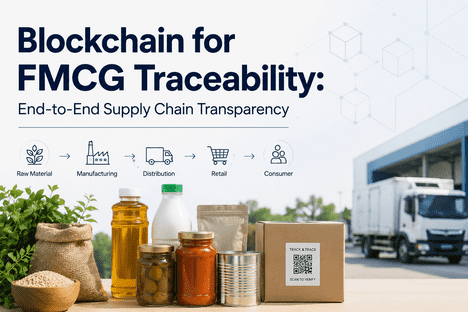
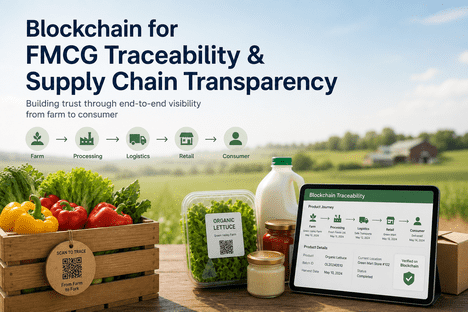
Digital traceability platforms that capture ingredient origin, processing records, quality test results, and distribution chain data provide FMCG manufacturers with the full-chain visibility required for regulatory compliance and rapid recall response. When a food safety event requires a trace-back in hours rather than days, manufacturers with digital traceability infrastructure contain the event — while those relying on paper records face extended investigations that expand both the regulatory exposure and the volume of product potentially subject to recall. Traceability is no longer a compliance cost — it is a risk containment asset.
FMCG Supply Chain Performance: Traditional vs. AI-Powered Operations
How food and consumer goods manufacturers perform across critical supply chain metrics without versus with AI-powered supply chain management technology.
FMCG Supply Chain Technology Benchmark — 2026
Implementation Insight
What FMCG Supply Chain Technology Looks Like in Daily Operations
The practical transformation that supply chain management FMCG platforms deliver is often more immediate and visible than strategic frameworks suggest. Supply chain technology does not replace human judgment — it replaces the information gaps that cause human judgment to produce suboptimal decisions under pressure. Book a demo to see how AI supply chain intelligence reshapes daily decisions for procurement, planning, logistics, and operations teams.
Morning Supply Intelligence Briefing
Planning and procurement teams begin each day with an AI-generated supply intelligence summary — flagging supplier risk events, demand signal changes, inventory imbalances, and logistics exceptions that require action. Teams spend the first hour of the day responding to the highest-priority supply chain signals rather than manually pulling data from disconnected systems to construct a picture that is already hours out of date.
Automated Purchase Order Optimization
AI procurement engines generate purchase order recommendations that optimize across supplier lead times, pricing tiers, minimum order quantities, and current inventory positions — simultaneously. Procurement teams review and approve AI-generated recommendations rather than manually constructing orders from fragmented data, reducing ordering cycle time by 60% and virtually eliminating the over-ordering that characterizes reactive procurement under shortage pressure.
Real-Time Logistics Exception Management
When a shipment is flagged as at-risk for a delivery failure — due to carrier delay, weather, or customs hold — logistics teams receive an alert with time sufficient to activate alternatives before the failure reaches the customer. FMCG logistics exception management at this speed converts potential service failures into managed events, eliminating the reactive fire-fighting that consumes logistics team capacity and produces the retailer relationship damage that is slow to repair.
Cross-Facility Supply Chain Performance Dashboard
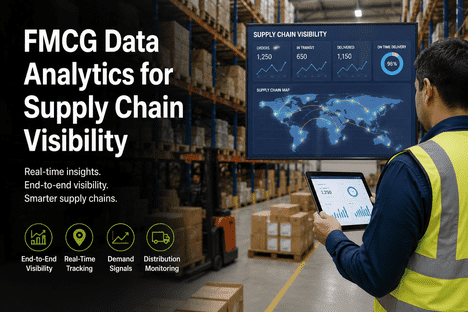
FMCG manufacturers operating multiple production facilities and distribution centers gain unified supply chain visibility — comparing supplier performance, inventory health, logistics cost, and service level metrics across the entire network from a single operations dashboard. Network-level visibility surfaces rebalancing opportunities and risk concentrations that facility-level tools make invisible — and delivers the cross-facility optimization that defines enterprise supply chain competitiveness.
Enterprise Outcome
FMCG Supply Chain Resilience in Practice — A Multi-Facility Case
Real-World Result
A large-format ambient food manufacturer operating six production facilities across three regions deployed an AI-powered supply chain platform after consecutive quarters of retailer penalty charges driven by logistics disruptions and ingredient shortage-induced production schedule failures. The platform's supplier risk monitoring identified a critical packaging component supplier facing financial distress 23 days before the supplier's capacity became compromised — providing sufficient lead time to qualify and onboard an alternative supplier with zero production impact. AI demand forecasting reduced forecast error from 31% to 11% across the product portfolio, directly reducing safety stock requirements by 26% and freeing $4.2M in working capital in the first operating year. Logistics optimization reduced freight cost per delivery by 16% while improving on-time delivery performance from 81% to 96% — eliminating $1.1M in annual retailer penalty exposure. The total supply chain resilience value generated in the first year reached $7.8M across all six facilities.
Selection Guide
Choosing the Right Supply Chain Technology for FMCG Manufacturers
The market for FMCG supply chain solutions includes platforms ranging from point-solution demand forecasting tools to fully integrated supply chain intelligence suites. The distinction matters enormously — because supply chain resilience is an interconnected outcome, not a collection of independent metrics. Manufacturers who deploy siloed tools consistently underachieve the resilience improvements that integrated platforms deliver, and the evaluation criteria below identify the specific capabilities that separate purpose-built FMCG supply chain platforms from generic industrial tools. Book a demo to benchmark your current supply chain technology stack against these criteria.
1
FMCG-Specific AI Training and Demand Signal Integration
AI demand models trained on generic retail data significantly underperform on food and consumer goods SKU portfolios — which have distinct seasonality patterns, promotional response curves, and demand volatility signatures. Purpose-built platforms with FMCG training data and retailer POS signal integration deliver forecast accuracy that generic platforms cannot approach in food supply chain environments.
2
Multi-Tier Supplier Visibility Beyond Tier-One
Platforms that deliver supplier risk monitoring only at the direct supplier level leave FMCG manufacturers blind to the sub-supplier disruptions that increasingly drive production failures. Genuine supply chain resilience requires multi-tier visibility — including external risk signal integration — that extends the risk detection horizon to weeks rather than days before disruption impact.
3
Integration with Existing ERP, WMS, and Food Safety Systems
Supply chain platforms that require replacing existing ERP or WMS infrastructure face adoption resistance and extended deployment timelines that delay ROI. Platforms with pre-built connectors for SAP, Oracle, Microsoft Dynamics, and food safety compliance systems deploy on top of existing technology investments — delivering supply chain intelligence without the disruption of system replacement programs.
4
End-to-End Traceability Architecture for Food Safety Compliance
FMCG supply chain platforms must deliver full-chain traceability from ingredient origin through production, distribution, and retail — not as a separate compliance module, but as a core capability integrated into supply chain visibility. Manufacturers subject to FSMA, EU Food Safety regulations, or major retailer traceability requirements need platforms that make compliance a continuous operational output rather than a periodic documentation exercise.
5
Enterprise-Scale Network Visibility for Multi-Plant Operations
FMCG manufacturers operating multiple production and distribution facilities need supply chain platforms architected for network-level optimization — not plant-level dashboards that must be manually reconciled to construct an enterprise view. Cross-facility inventory rebalancing, network-wide logistics optimization, and enterprise supplier risk aggregation are capabilities that only enterprise-architected supply chain platforms deliver at the speed and scale that FMCG supply chain management requires.
Implementation Roadmap
Deploying FMCG Supply Chain Technology — 90-Day Activation Plan
The most effective FMCG supply chain technology deployments follow a structured activation sequence that delivers measurable disruption reduction and forecast accuracy improvement within the first 30 days — building organizational confidence and adoption momentum before full platform capabilities are engaged. This 90-day model has been validated across FMCG manufacturers ranging from single-facility ambient food producers to twelve-plant enterprise networks with complex multi-tier supplier relationships.
1
Supply Chain Baseline and Data Integration (Days 1–21)
Audit current forecast error rates, supplier performance variability, inventory imbalance by node, and logistics cost benchmarks. Integrate with existing ERP, WMS, and supplier data systems. Define AI model training priorities based on highest-disruption-impact supplier relationships and highest-volatility demand categories.
Outcome: Baseline supply chain metrics established and AI model training initiated
2
AI Demand Forecasting and Supplier Risk Activation (Days 22–55)
Deploy AI demand forecasting across the top 20% of SKUs by revenue contribution. Activate supplier risk monitoring for critical direct suppliers. Onboard planning and procurement teams on AI-generated recommendations and supplier risk alert workflows. Begin capturing early forecast accuracy improvements and supplier risk events for ROI documentation.
Outcome: First measurable forecast accuracy gains and proactive supplier risk detections visible in data
3
Full Network Coverage and Enterprise Supply Chain Optimization (Days 56–90)
Extend AI forecasting to the full SKU portfolio. Activate logistics optimization and multi-tier supplier visibility. Deploy enterprise supply chain dashboard for operations leadership. Begin cross-facility network optimization and measure total supply chain resilience ROI against baselines established in Phase 1.
Outcome: Full supply chain resilience platform operational, ROI documented and compounding
Frequently Asked Questions
FMCG Supply Chain Challenges and Technology Solutions — FAQ
What are the biggest FMCG supply chain challenges manufacturers face in 2026?
The most impactful challenges are demand volatility driven by forecast inaccuracy, ingredient and raw material shortages from supplier concentration risk, logistics cost escalation and delivery failures, and regulatory traceability requirements. These challenges interact and compound — making integrated AI-powered supply chain platforms significantly more effective than point-solution tools that address them individually.
How does AI improve demand forecasting accuracy for FMCG manufacturers?
AI demand models incorporate retailer POS data, promotional calendars, weather signals, and market trend data that statistical forecasting ignores. The result is 30–45% reduction in forecast error — directly reducing both excess inventory investment and stock-out frequency. AI models also update continuously as new signals arrive, making them adaptive to the demand volatility that has made static forecasting models structurally inadequate for FMCG portfolios.
How quickly can AI supply chain technology deliver ROI for food manufacturers?
Most FMCG manufacturers see measurable forecast accuracy improvements and first proactive supplier risk detections within 30–45 days of deployment. Full ROI — including inventory reduction, freight cost savings, and retailer penalty elimination — typically materializes within 6–9 months for facilities with complex supply networks. Enterprise-scale deployments across multiple facilities consistently achieve 4–7x first-year ROI.
Can supply chain technology integrate with existing ERP and food safety systems?
Purpose-built FMCG supply chain platforms maintain pre-built connectors for SAP, Oracle ERP, Microsoft Dynamics, and major food safety compliance systems — deploying on top of existing technology investments without requiring system replacement. Integration depth, not just API compatibility, is the key evaluation criterion. Platforms that require replacing ERP infrastructure consistently deliver ROI 12–18 months later than integration-first platforms.
How does supply chain technology address ingredient shortage risk in food manufacturing?
AI supplier risk platforms aggregate signals from financial databases, news feeds, weather systems, and logistics networks to detect ingredient supplier risk weeks before shortages materialize. When risk is flagged, procurement teams have sufficient lead time to qualify alternative suppliers, adjust production schedules, or pre-position safety stock — converting what would be a production stoppage into a managed risk event with zero or minimal production impact.
What is the role of traceability technology in FMCG supply chain resilience?
Digital traceability provides FMCG manufacturers with full-chain ingredient and product visibility from source to shelf — enabling regulatory compliance responses in hours rather than days and limiting the scope of recall events. In an environment of increasing food safety regulation, traceability is no longer a compliance cost — it is a risk containment asset that limits both the financial and reputational damage of food safety events.
AI-POWERED
·
FMCG READY
·
SUPPLY CHAIN RESILIENCE
Stop Absorbing Supply Chain Disruptions. Start Predicting and Preventing Them.
iFactory's AI supply chain platform gives FMCG manufacturers the demand intelligence, supplier risk visibility, logistics optimization, and traceability infrastructure to build genuine supply chain resilience — regardless of how volatile the external environment becomes. Deploy in 90 days, document ROI in under 9 months.