Total Productive analytics (TPM) Implementation Guide for FMCG Facilities
By Seren on June 18, 2026
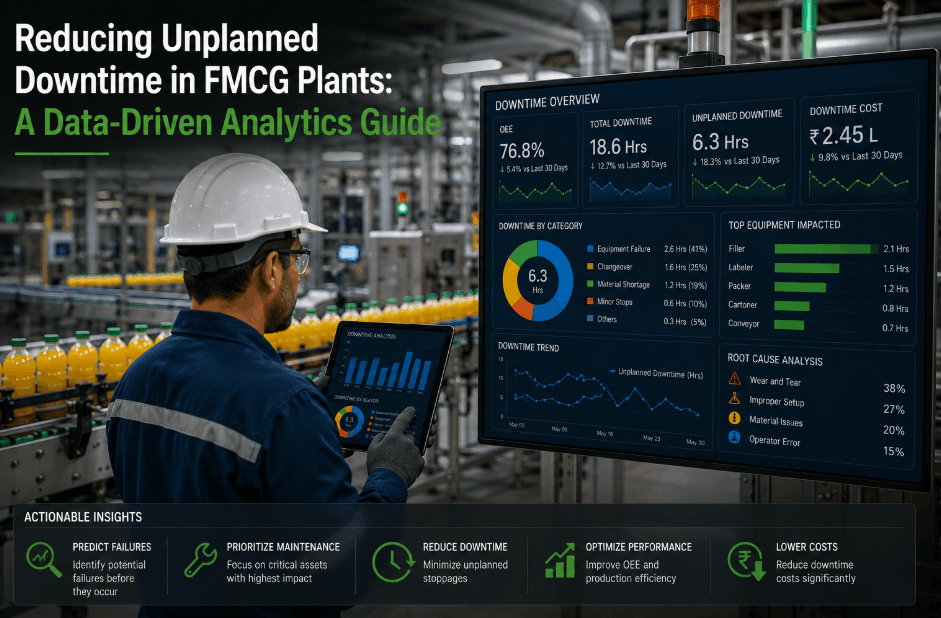
A FMCG manufacturer producing 3,200 SKUs across four high-speed packaging lines deployed iFactory's TPM implementation platform combining autonomous maintenance digital workflows, planned maintenance analytics, and real-time OEE dashboards to raise overall equipment effectiveness from 58% to 81% over a 36-week deployment across eight TPM pillars. The platform ingests data from 2,400+ asset condition monitoring points, production scheduling systems, quality inspection stations, and operator maintenance logs mapping every activity to its corresponding TPM pillar objective. By correlating real-time operational data against TPM maturity benchmarks, the system surfaces pillar gaps before they stall implementation progress, enabling plant managers and TPM coordinators to prioritise corrective actions with data-driven confidence. The deployment delivered a 23-point OEE improvement, reduced unplanned downtime by 67%, and eliminated three of the top five recurring defect categories through operator-led autonomous maintenance routines. Plant managers and continuous improvement leaders evaluating TPM implementation platforms for high-speed FMCG production environments.
23-Point OEE Gain 67% Less Unplanned Downtime 36 Weeks Across All 8 Pillars. See the TPM Blueprint for Your FMCG Lines.
iFactory's TPM implementation platform gives plant managers and CI leaders a structured, data-driven approach to deploy all eight TPM pillars across high-speed FMCG production environments — with real-time pillar maturity tracking and automated workflow execution.
Overall equipment effectiveness improved from 58% to 81% across four high-speed packaging lines over a structured 36-week TPM pillar deployment.
67%
Downtime Reduction
Reduction in unplanned downtime achieved through autonomous maintenance routines, improved changeover procedures, and data-driven planned maintenance scheduling.
8
TPM Pillars Deployed
All eight TPM pillars implemented with digital workflow support — from autonomous and planned maintenance through quality, training, and safety management.
3X
Operator Engagement
Operator-led improvement suggestions tripled after deploying digital autonomous maintenance workflows with real-time feedback and recognition loops.
Why FMCG Facilities Need a Structured TPM Implementation Approach
FMCG production environments present unique challenges for TPM implementation that distinguish them from discrete manufacturing or process industry settings. High-speed packaging lines operating at 400 to 1,200 units per minute leave zero margin for equipment instability. Frequent product changeovers — sometimes six to twelve per shift in co-packing and multi-SKU facilities — introduce repetitive setup losses that erode OEE daily. Short shelf-life products impose strict cleaning and sanitation cycles that compete with production time. And the labour model, which often combines permanent operators with temporary or agency staff, makes standardised autonomous maintenance training and sustainment particularly difficult. A structured TPM implementation that addresses these FMCG-specific constraints — rather than applying a generic manufacturing template — is the difference between a TPM programme that delivers measurable OEE improvement and one that generates binders of documentation without moving the production metrics.
The eight TPM pillars — Autonomous Maintenance, Planned Maintenance, Quality Maintenance, Focused Improvement, Early Equipment Management, Training and Education, Safety Health and Environment, and TPM in Administration — must be sequenced and scoped for FMCG realities. Autonomous maintenance in a beverage filling line looks different from autonomous maintenance in a machining centre. Planned maintenance for a flow wrapper with heated seal jaws and film registration sensors requires different frequency and task design than planned maintenance for an injection moulding machine. The TPM implementation platform addresses these differences by providing pillar-specific workflow templates calibrated to FMCG asset types, with maturity assessment criteria that reflect the speed, hygiene, and changeover demands of consumer goods production.
The Eight TPM Pillars Adapted for FMCG Production Environments
Pillar 01
Autonomous Maintenance
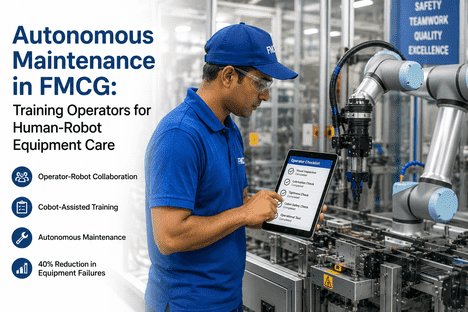
Operators take ownership of basic equipment care — cleaning, inspection, lubrication, and minor adjustments. In FMCG environments, autonomous maintenance routines are structured around the seven-step methodology adapted for high-speed lines: initial cleaning and inspection to uncover hidden defects, countermeasure development for contamination sources and hard-to-access areas, provisional standards for cleaning and lubrication, general inspection skills training, autonomous inspection execution, workspace organisation and standardisation, and autonomous management with continuous improvement. The platform provides digital work instructions with photo-based standards, inspection checklists calibrated to each asset type, and automated escalation when an operator detects a condition beyond their countermeasure authority. The key FMCG adaptation is the integration of sanitation and hygiene requirements into autonomous cleaning routines — distinguishing between product-contact surfaces that require food-grade sanitation and non-contact surfaces that follow standard industrial cleaning protocols.
7-step AM deployment with integrated sanitation and hygiene workflows
Pillar 02
Planned Maintenance
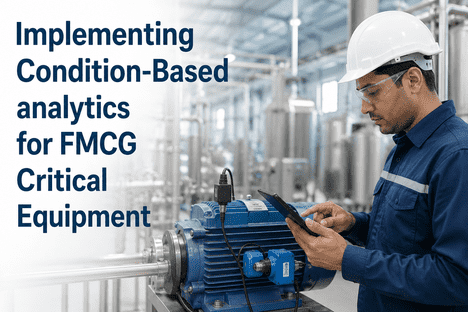
Planned maintenance in FMCG must balance equipment reliability with production schedule demands. The platform supports time-based and condition-based maintenance strategies with automated work order generation from equipment run hours, cycle counts, and sensor data. The planned maintenance pillar addresses the specific challenges of FMCG equipment: seal and gasket replacement intervals on fillers and packaging machines, knife and cutter blade sharpening schedules, conveyor belt tracking and tension verification, and thermocouple and controller calibration for heat-sealing and cooking equipment. The platform integrates with CMMS and parts inventory systems to ensure that planned maintenance tasks have the required spare parts available before the work order is released. The maintenance calendar is visible to production schedulers, enabling proactive coordination of maintenance windows with changeover and sanitation downtime.
Condition-based PM with automated work orders and parts reservation
Pillar 03
Quality Maintenance
Quality maintenance focuses on establishing zero-defect conditions by identifying and controlling the equipment and process parameters that determine product quality. In FMCG, this means mapping critical quality attributes — fill weight, seal integrity, package appearance, product temperature, metal contamination — to their controlling equipment parameters. The platform enables quality maintenance through condition-flaw-defect-cause-mechanism mapping for each product-equipment combination. For a vertical form-fill-seal machine, the quality maintenance pillar identifies that seal jaw temperature (condition), seal pressure (condition), and film tension (condition) control seal integrity (quality attribute). When seal integrity drifts toward the specification limit, the platform flags the controlling parameter and recommends corrective adjustment before non-conforming packages are produced. This proactive quality maintenance approach eliminates the root causes of defects rather than inspecting them out at the end of the line.
Condition-flaw-defect mapping with proactive parameter adjustment
Pillar 04
Focused Improvement
Focused improvement applies structured problem-solving methodologies — Kaizen, DMAIC, PDCA — to eliminate chronic losses identified through OEE analysis and loss decomposition. The platform captures every OEE loss event — breakdown, setup, adjustment, minor stoppage, speed loss, quality defect — and categorises it by loss type, equipment, product, and shift. Focused improvement teams select the highest-impact loss categories for structured problem-solving projects, with the platform providing a digital A3 or DMAIC template that guides the team through problem definition, root cause analysis, countermeasure development, implementation, and standardisation. In FMCG facilities, the highest-impact focused improvement projects typically target changeover time reduction through SMED methodology, minor stoppage elimination on packaging lines, and start-up loss reduction after sanitation and changeover events. The platform tracks project status and verified savings, building a continuous improvement portfolio that directly demonstrates TPM ROI to plant leadership.
Digital A3/DMAIC with OEE loss-driven project selection
Pillar 05
Early Equipment Management
Early equipment management applies TPM principles to the design, procurement, installation, and commissioning of new equipment to minimise lifecycle maintenance costs and maximise starting OEE. The platform supports early equipment management through a digital commissioning checklist that captures installation verification, run-in and ramp-up monitoring, and OEE stabilisation tracking for every new asset. Lessons learned from the existing equipment fleet — chronic failure modes, difficult-to-maintain components, hard-to-clean design features — are systematically documented and reviewed before new equipment specifications are finalised. In FMCG facilities, early equipment management is particularly valuable for packaging line integrations where filler, capper, labeler, case packer, and palletiser must operate as a synchronised system. The platform tracks the OEE ramp-up curve for each new asset and flags any asset that is not reaching its projected steady-state OEE within the expected window, triggering a structured problem-solving intervention before the warranty period expires.
Digital commissioning with OEE ramp-up tracking and lesson-learned capture
Pillar 06
Training and Education
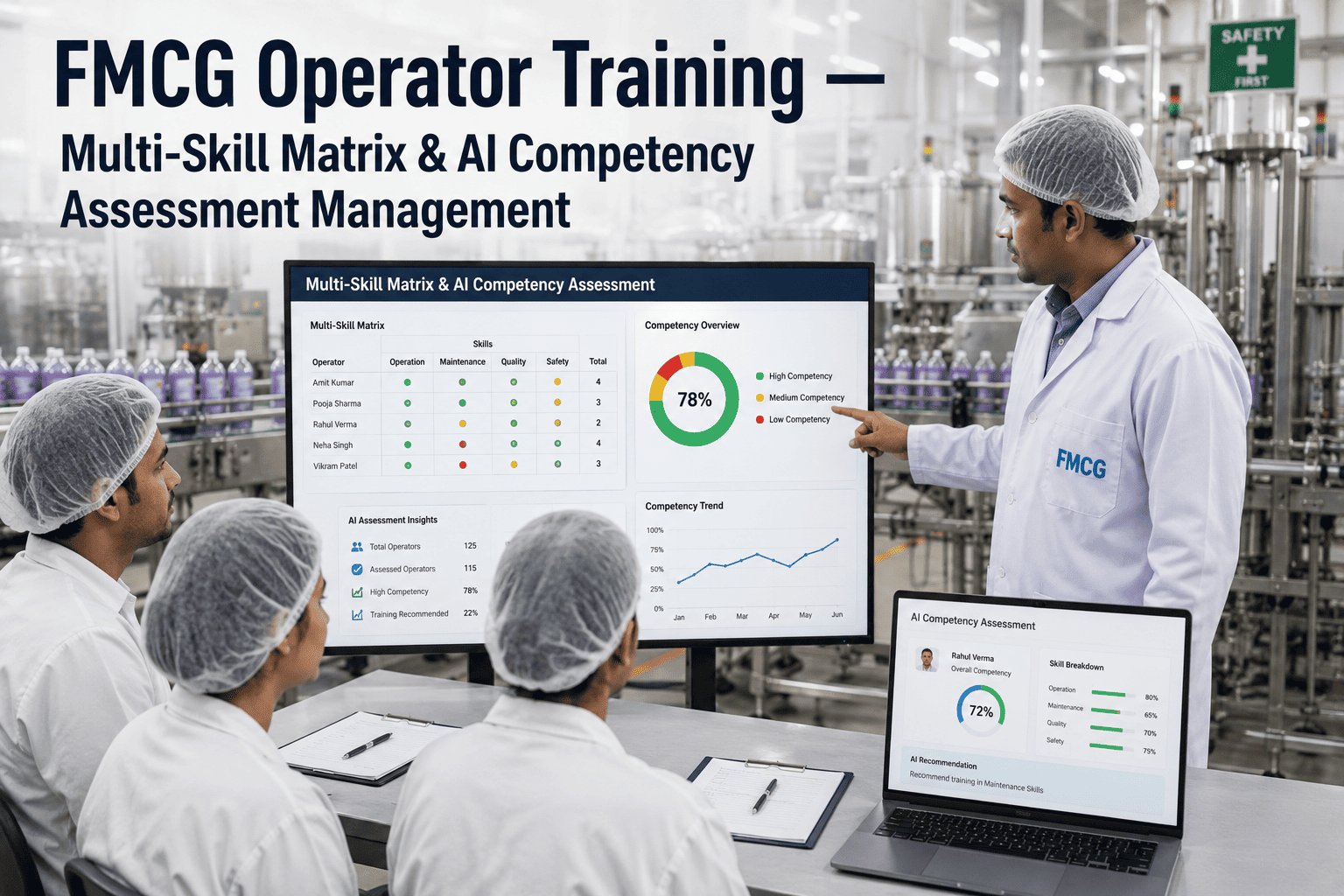
The training and education pillar develops the multi-skilled operators and maintenance technicians required to sustain TPM. In FMCG environments with high temporary labour turnover, this pillar is both the most critical and the most challenging to implement. The platform provides a structured skills development framework with competency matrices for each role — operator, mechanical technician, electrical technician, shift supervisor, TPM coordinator — and training content delivery through digital work instructions, video-based standard operating procedures, and on-machine skill verification checklists. Skills are assessed and certified through a combination of knowledge tests, observed demonstrations, and on-the-job performance verification. The platform tracks certification status by employee and identifies gaps between current skills and the skills required to execute TPM pillar activities. For temporary and seasonal workers, the platform provides streamlined training pathways that focus on the specific autonomous maintenance and quality checking skills required for their assigned production area, reducing onboarding time from weeks to days while maintaining skill standardisation.
Role-based competency matrices with digital skill verification
Pillar 07
Safety, Health and Environment
The SHE pillar integrates safety, occupational health, and environmental management into every TPM activity. Autonomous maintenance routines include safety observation checkpoints — lockout-tagout verification before cleaning, machine guarding inspection, personal protective equipment compliance. Planned maintenance tasks incorporate environmental controls — proper disposal of lubricants and cleaning chemicals, energy isolation verification, wastewater management. The platform captures near-miss reports, safety observations, and environmental incidents alongside maintenance and production data, enabling correlation analysis between equipment condition and safety risk. In FMCG facilities, the SHE pillar also addresses specific hazards: confined space entry for tank and hopper cleaning, hot work permits for seal bar and packaging knife maintenance, noise exposure monitoring in high-speed packaging areas, and allergen cross-contact prevention during product changeovers. The platform generates SHE performance dashboards that track leading indicators — safety observation completion rate, near-miss closure time, training completion percentage — alongside trailing indicators, giving plant leadership a balanced view of SHE performance.
Integrated SHE with maintenance task-specific hazard controls
Pillar 08
TPM in Administration
The administration pillar extends TPM principles to support functions — production scheduling, procurement, quality assurance, logistics, and human resources. While these functions do not operate production equipment, they directly influence OEE through their decision quality and response time. The platform applies TPM concepts to administrative processes: reduce processing time for work orders, purchase requisitions, and quality documentation; eliminate errors in production scheduling that cause unnecessary changeovers; streamline shift handover communication to prevent information loss; and automate data compilation for OEE and TPM pillar reporting. The platform includes an administrative process mapping module that identifies waste — waiting time, rework, excess processing, information search time — in support workflows and provides improvement tracking similar to focused improvement for production. For FMCG facilities with complex supply chains and multiple SKU families, the administration pillar delivers significant OEE leverage by improving production schedule adherence, reducing raw material shortages that cause line stoppages, and accelerating the corrective action cycle for quality issues.
Administrative process waste reduction with OEE impact correlation
36-Week TPM Implementation Roadmap for FMCG Facilities
The iFactory TPM implementation platform structures the deployment as a phased 36-week programme organised in four stages, with each stage building on the capabilities and cultural foundation established in the previous stage. The roadmap is designed to deliver measurable OEE improvement in the first 12 weeks while building the infrastructure for sustained improvement in subsequent phases.
01
Foundation & Assessment
Establish OEE baseline across all lines through automated data collection. Complete TPM pillar maturity assessment using FMCG-calibrated criteria. Form pillar steering teams and train TPM coordinators. Map all assets with criticality scoring. Duration: 8 weeks.
02
Autonomous & Planned Maintenance
Deploy autonomous maintenance seven-step programme on pilot lines. Implement planned maintenance with automated work order generation. Train operators on inspection standards. Establish CIL (clean-inspect-lubricate) schedules. Begin minor stoppage and speed loss reduction. Duration: 12 weeks.
03
Quality & Focused Improvement
Deploy quality maintenance condition-flaw-defect mapping for top defect categories. Launch focused improvement projects targeting top three OEE loss categories. Implement SMED programme for changeover reduction. Establish early equipment management for new assets. Duration: 10 weeks.
04
Sustainment & Maturity Growth
Roll out training and education with competency certification for all production roles. Implement TPM in administration for scheduling, procurement, and logistics. Deploy SHE pillar with integrated maintenance task hazard controls. Establish pillar maturity review cadence. Duration: 6 weeks.
"
We had attempted TPM implementation twice before using manual binders and spreadsheet-based tracking. Both attempts lost momentum after the initial training wave because we could not see which pillars were falling behind until the quarterly review. The digital platform changed this fundamentally. Our TPM coordinator can see real-time pillar maturity scores for every line, and the system automatically flags when autonomous maintenance step completion drops below target. In the first 12 weeks, we saw a 9-point OEE improvement just from getting the autonomous maintenance routines consistently executed. The structured approach — especially the FMCG-calibrated pillar templates — made the difference. We are now in week 30 and on track for our 23-point OEE target. The platform did not just make TPM easier to manage; it made it possible to sustain.
TPM Implementation · FMCG Production · All 8 Pillars · OEE Improvement
TPM Implementation That Delivers Measurable OEE Improvement — Not Just Binders of Documentation. Deploy All 8 Pillars With Confidence.
iFactory's TPM implementation platform gives plant managers and CI leaders a structured, data-driven approach to deploy and sustain all eight TPM pillars across high-speed FMCG production environments — with automated maturity tracking, digital workflow execution, and real-time OEE dashboards that prove the improvement.
TPM implementation in FMCG facilities fails when it is treated as a training programme rather than a management system. The facilities that achieve sustainable OEE improvement are those that deploy TPM as a structured, data-driven operational framework — with pillar-specific maturity criteria, real-time performance visibility, and digital workflow support that ensures standardised execution across shifts and seasons. The eight pillars adapted for FMCG realities — autonomous maintenance with integrated sanitation, planned maintenance synchronised with production schedules, quality maintenance that maps product attributes to equipment parameters, focused improvement targeting the specific loss profile of high-speed packaging lines, early equipment management that captures commissioning lessons, training and education calibrated for high-turnover workforces, SHE integration with maintenance task controls, and administrative process improvement that removes support function waste — together create a complete OEE improvement system.
The documented outcomes across FMCG facilities that have deployed structured TPM implementation with digital platform support are consistent: 15 to 25 point OEE improvement over 24 to 40 weeks, 50 to 70 percent reduction in unplanned downtime, 60 to 80 percent reduction in top defect categories, and 2x to 4x increase in operator-led improvement suggestions. The plant managers achieving the upper end of these ranges are the ones who deployed TPM as an integrated system rather than a collection of independent pillar initiatives — and who used real-time data visibility to adjust implementation priorities as pillar maturity developed at different rates.
iFactory's TPM implementation platform is designed for plant managers and continuous improvement leaders in FMCG production who need to deploy all eight TPM pillars with measurable OEE outcomes and sustainable execution. Book a Demo to see the platform configured for your facility's asset profile and production schedule, or talk to an expert about a free TPM maturity and OEE improvement assessment for your facility.
Frequently Asked Questions
The recommended deployment sequence for FMCG facilities begins with Autonomous Maintenance and Planned Maintenance as the foundational pillars — they establish the basic equipment care and reliability infrastructure that all other pillars depend on. Focused Improvement should launch in parallel with these two pillars, targeting the highest-impact OEE losses as they become visible through the baseline data collection. Quality Maintenance typically follows once the equipment is stable and operators have developed inspection skills through the autonomous maintenance programme. Training and Education must run continuously from the start but becomes a formal pillar focus once the initial deployment is underway. Early Equipment Management is most valuable when new equipment is being specified or commissioned, which may occur at any point in the sequence. Safety, Health and Environment should be integrated into every pillar activity from day one rather than deployed as a standalone phase. TPM in Administration is typically addressed after the production pillars are established, since the administrative improvement priorities become clearer once the production TPM system is operating. The 36-week roadmap described above follows this recommended sequence with specific milestone gates at each phase transition. Talk to an expert to discuss the optimal pillar sequence for your facility's current maturity level.
The platform addresses high-turnover workforce challenges through role-based competency matrices that define the specific skills required for each production role, bite-sized digital training content with photo and video-based standard operating procedures that reduce language and literacy barriers, on-machine skill verification checklists that a trainer or supervisor completes with the operator during the first week on the job, and automated certification expiry tracking that alerts the training coordinator when refresher training is due. For temporary and seasonal workers, the platform supports streamlined training pathways that focus on the specific autonomous maintenance and quality checking skills required for their assigned production area — typically completing initial certification within two to three shifts rather than the two to three weeks required for comprehensive operator training. The platform's training records are audit-ready for GFSI, FDA, and customer quality audits, providing documented evidence of operator competency for every individual who has performed maintenance or quality checks on each production line.
OEE is calculated as Availability × Performance × Quality, with each component measured using the standard OEE formula. Availability captures planned production time minus unplanned downtime (breakdowns, adjustments, minor stoppages) and planned downtime (changeovers, sanitation, planned maintenance, breaks). Performance captures actual production rate relative to ideal rate, accounting for speed losses from reduced line speed during start-up, end-of-run, and product transition periods. Quality captures first-pass yield — good units produced divided by total units started, accounting for start-up waste, changeover waste, and in-process quality defects. The platform tracks the six big losses specifically calibrated for FMCG lines: breakdown losses (mechanical and electrical failures), setup and adjustment losses (changeover time, warm-up time, sanitation-to-production transition), minor stoppage losses (sensor activation, film break, label misregistration, package jams), speed losses (reduced line speed below design rate), quality defects (in-process non-conformances), and start-up/rework losses (first-run waste after changeover or sanitation). Each loss event is tagged with duration, root cause category, equipment ID, SKU, and shift for granular OEE loss decomposition.
The platform supports SMED implementation through a structured digital workflow that guides the focused improvement team through each SMED phase. The platform captures the baseline changeover process as a timed video or step-by-step log, automatically classifying each step as internal (must be performed while the machine is stopped) or external (can be performed while the machine is running). The improvement team uses the platform to identify which internal steps can be converted to external steps, which steps can be streamlined or eliminated, and which steps require new tooling or equipment modifications to reduce changeover time. Each SMED improvement project is tracked with before-and-after time measurements, implementation status, and verified savings. The platform also supports quick changeover standardisation by storing the optimised changeover procedure as a digital work instruction with timed step sequences, tool lists, and setup parameter records for each SKU. In FMCG facilities with six to twelve changeovers per shift, SMED implementation through the platform typically delivers 30 to 50 percent changeover time reduction in the first improvement cycle. Talk to an expert to discuss SMED implementation for your facility's changeover profile.
ROI for TPM implementation with digital platform support typically follows a three-phase curve. Phase one (weeks 1 to 12) delivers 5 to 10 points of OEE improvement primarily from autonomous maintenance execution and baseline loss visibility — this phase alone typically recovers 30 to 50 percent of the total implementation investment through reduced downtime and improved line speed. Phase two (weeks 12 to 24) delivers an additional 8 to 12 OEE points through focused improvement projects, quality maintenance deployment, and changeover reduction — bringing cumulative ROI to 100 to 200 percent of implementation cost. Phase three (weeks 24 to 52) delivers continued improvement through pillar maturity growth, with OEE stabilising at 15 to 25 points above baseline and annual savings from reduced maintenance cost, improved yield, and increased production capacity reaching 5 to 15 times the implementation investment. For a typical mid-size FMCG facility with 4 to 6 high-speed packaging lines, each OEE point represents $200,000 to $500,000 in annual capacity value depending on product margin and line speed. iFactory provides a detailed ROI projection specific to your facility's current OEE, line configuration, and product mix as part of the free TPM maturity and OEE improvement assessment.
Your FMCG Lines Already Have the OEE Improvement Potential. TPM Implementation Unlocks It. Get a Free TPM Maturity and OEE Improvement Assessment.
iFactory's TPM implementation platform gives plant managers in FMCG production a structured, data-driven approach to deploy all eight TPM pillars — with FMCG-calibrated pillar templates, automated OEE tracking, digital workflow execution for autonomous and planned maintenance, focused improvement project management with real-time savings verification, and audit-ready training and competency records for every operator and technician.