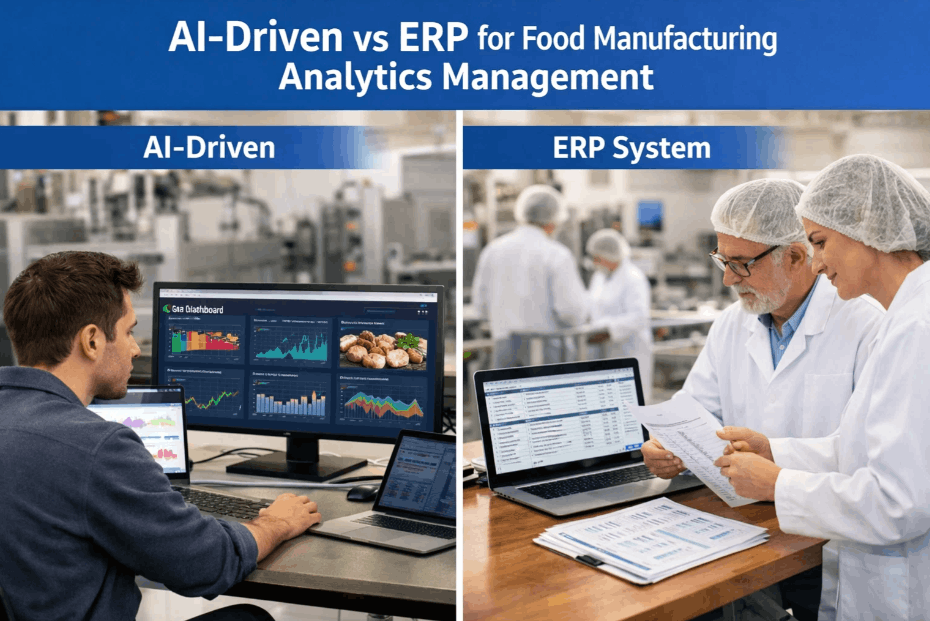
In today's hyper-competitive food production landscape, AI-driven analytics vs ERP for food manufacturing has become one of the most strategic decisions a plant director can make. Legacy ERP platforms were built for transactional record-keeping — not real-time operational intelligence. Meanwhile, purpose-built AI-driven analytics software is fundamentally reshaping how food manufacturers track production performance, predict equipment failures, and manage compliance. This guide delivers a definitive, data-backed comparison to help operations leaders choose the right technology stack for their facility. Book a demo to see how iFactory's AI-driven platform outperforms traditional ERP in live food manufacturing environments.
See Why Food Manufacturers Are Moving Beyond ERP for Real-Time Analytics
iFactory's AI-driven production analytics platform gives food plants the operational visibility, predictive intelligence, and compliance automation that ERP systems were never designed to deliver.
What Is the Core Difference Between AI-Driven Analytics and ERP in Food Manufacturing?
Enterprise Resource Planning (ERP) systems like SAP, Oracle, and Microsoft Dynamics were architected to manage procurement, finance, inventory, and HR within a single integrated platform. In food manufacturing, they handle purchase orders, batch records, and master data — but they were never designed to ingest high-frequency machine sensor data or generate real-time operational insights at the line level.
AI-driven analytics software for food manufacturing, by contrast, is purpose-built to process continuous data streams from production equipment, quality sensors, and maintenance systems. It applies machine learning models to identify anomalies, predict failures, and surface actionable cost reduction opportunities that no ERP dashboard can generate. The result is a fundamentally different class of operational intelligence — one that operates at machine speed rather than reporting cycle speed. Understanding this architectural gap is the foundation of every honest analytics software evaluation for food plants.
AI-Driven vs ERP for Food Manufacturing: Feature-by-Feature Breakdown
The table below compares ERP systems and AI-driven analytics platforms across the capabilities that matter most to food manufacturing operations teams.
| Capability | Traditional ERP | AI-Driven Analytics Platform | Impact on Food Plant Operations |
|---|---|---|---|
| Real-Time OEE Tracking | Manual / batch updates | Continuous, line-level monitoring | 8–15 hrs/week saved on reporting |
| Predictive Maintenance | Not supported | ML-based failure prediction | 40% reduction in emergency repairs |
| Downtime Cost Attribution | Post-shift manual entry | Automated, real-time attribution | Captures 100% of hidden cost layers |
| FSMA Compliance Documentation | Manual corrective actions | Auto-generated audit trails | Reduces compliance admin by 60% |
| Changeover Optimization | No capability | Shift-level benchmarking | 15–30% planned downtime reduction |
| Anomaly Detection | Rule-based alerts only | Pattern-based ML detection | Identifies failures weeks in advance |
| Integration Complexity | High (months to deploy) | Low (6–10 weeks deployment) | Faster time-to-value |
Comparison based on food manufacturing analytics software evaluation across mid-to-large food processing facilities. ERP configurations vary; results reflect typical out-of-the-box capabilities.
Why ERP Systems Alone Fall Short for Food Manufacturing Analytics Management
The limitations of ERP in food manufacturing analytics management are structural, not superficial. ERP systems aggregate data after the fact — pulling from completed transactions, batch records, and manual operator inputs. This retrospective model creates an unavoidable intelligence lag that makes proactive production management impossible. By the time an ERP dashboard flags a recurring quality deviation, the root cause has already cost the facility multiple production cycles.
Food manufacturers running ERP as their primary analytics tool consistently report three critical gaps: inability to correlate equipment sensor data with production KPIs in real time, no predictive capability for maintenance scheduling, and manual FSMA documentation workflows that consume significant engineering resources. These gaps are not addressable through ERP customization — they require a fundamentally different data architecture. Leading food manufacturers are increasingly deploying AI-driven analytics platforms alongside existing ERP systems to close this intelligence gap without displacing the financial and inventory management capabilities ERP provides well. If you're evaluating your current stack, book a demo to understand how iFactory integrates with your existing ERP infrastructure.
The Data Latency Problem in ERP-Based Food Plant Analytics
In a food production environment running three shifts at 50,000+ units per hour, production intelligence that arrives 24 hours late is not intelligence — it's historical record-keeping. ERP reporting cycles operate on daily or shift-end cadences, meaning quality deviations, equipment degradation signals, and changeover inefficiencies accumulate undetected for hours before any corrective action is possible. AI-driven platforms ingest sensor data continuously, enabling operations teams to intervene during the same shift the anomaly begins — a capability difference that translates directly into measurable cost reduction.
6 Food Manufacturing Scenarios Where AI-Driven Analytics Outperforms ERP
These are the operational situations where the gap between AI-driven analytics and ERP capabilities is most consequential for food plant performance.
Unplanned Equipment Downtime
ERP cannot predict equipment failures — it can only record them after they occur. AI-driven platforms analyze vibration, temperature, and motor current data to identify failure precursors weeks in advance, enabling scheduled interventions that eliminate emergency stoppage costs entirely.
Allergen Changeover Management
Allergen changeovers represent both a food safety risk and a significant planned downtime category. AI-driven analytics benchmarks actual changeover performance against target times across all shifts, surfacing procedure deviations and crew-specific inefficiencies that ERP systems have no visibility into.
CCP Monitoring and FSMA Compliance
Critical Control Point deviations under FSMA 21 CFR Part 117 require documented corrective actions with full audit trails. AI-driven platforms auto-generate compliant documentation at the point of deviation, while ERP requires manual data entry — introducing both delay and human error into the compliance record.
Multi-Line OEE Benchmarking
Comparing Overall Equipment Effectiveness across production lines, shifts, and product SKUs requires continuous data aggregation that ERP reporting cannot support. AI-driven analytics delivers ranked OEE performance in real time, enabling management to direct improvement resources to the highest-impact opportunities immediately.
Perishable Inventory Risk Management
When a line stops unexpectedly, in-process perishable inventory enters a holding window that ERP cannot actively monitor. AI-driven platforms integrate with temperature and time tracking systems to alert production teams before safe holding limits are breached, preventing mandatory disposal events worth $15,000–$80,000 per incident.
Customer SLA and Fill Rate Compliance
Major retailers impose financial penalties for missed fill rate commitments. AI-driven production analytics provides shift-level output forecasting against committed volumes, enabling proactive scheduling adjustments before SLA breaches occur — a capability entirely absent from standard ERP production planning modules.
ERP Integration vs. AI-Driven Replacement: Which Strategy Wins?
The most effective ERP integration strategy for food manufacturing is not replacement — it is augmentation. ERP systems excel at what they were designed for: managing procurement workflows, financial records, regulatory batch documentation, and supplier data. These capabilities are deeply embedded in food plant operations and represent years of configuration investment that should not be discarded.
The winning architecture deploys AI-driven analytics as a production intelligence layer that sits alongside ERP, consuming relevant master data while contributing real-time operational insights that ERP cannot generate. This integration model — where AI-driven platforms pull recipe and scheduling data from ERP while pushing downtime event records and compliance documentation back — is how leading food manufacturers are achieving the best of both systems without the cost and disruption of full ERP replacement. Operations teams considering this approach can book a demo with iFactory to see a live walkthrough of the ERP integration architecture in a food manufacturing context.
How Long Does AI-Driven Analytics Integration Take in a Food Plant?
Unlike ERP deployments that routinely span 12–24 months and consume seven-figure implementation budgets, purpose-built AI-driven analytics platforms for food manufacturing are designed for rapid deployment. Most facilities complete the core integration — connecting equipment sensors, production line data, and ERP master data — within 6–10 weeks without disrupting active production. Measurable downtime reductions typically appear within the first 60–90 days, delivering ROI that is visible to plant leadership and corporate finance teams well within the same fiscal year as deployment.
Analytics Software Evaluation: ROI Metrics That Drive the Decision
When food plant leaders evaluate AI-driven analytics against ERP analytics modules, these are the performance metrics that define the business case outcome.
Achieved within 12 months of AI-driven analytics deployment. ERP analytics modules show negligible impact on unplanned downtime frequency.
For every dollar invested in AI-driven analytics, food manufacturers recover $3.20 in documented downtime cost reduction within 12 months of full deployment.
AI-driven platforms reach full investment payback in 4–8 months. ERP analytics module upgrades rarely achieve payback within 24 months from downtime reduction alone.
Automated FSMA documentation generation reduces the engineering and quality team hours spent on corrective action records by up to 60% versus manual ERP workflows.
How to Build the Business Case for AI-Driven Analytics Over ERP Upgrades
When presenting the AI-driven vs ERP analytics decision to plant leadership and corporate finance, the most persuasive argument is not a feature comparison — it is a quantified revenue recovery calculation. Start with your facility's total annual unplanned downtime hours, multiply by your true cost per hour (including all hidden cost layers), and apply a conservative 25% reduction assumption from AI-driven analytics deployment. For most mid-sized food manufacturers, this produces an annual cost recovery figure that delivers a sub-12-month payback — a threshold that meets standard capital approval criteria without requiring complex financial modeling.
Contrast this with ERP analytics module upgrades, which typically require 12–24 months of implementation effort before generating any operational improvement, and which lack the predictive capabilities that drive the largest downtime reductions. The business case writes itself when the numbers are laid out side by side. Food plant operations leaders looking to accelerate this analysis can book a demo with iFactory's team for a facility-specific ROI model built from actual production and maintenance data.
Key Decision Criteria for Food Manufacturing Analytics Software Evaluation
A rigorous analytics software evaluation for food manufacturing should assess five dimensions: real-time data ingestion capability from production equipment sensors; predictive maintenance algorithm accuracy for food processing equipment categories; deployment timeline and integration complexity with existing ERP infrastructure; FSMA compliance documentation automation; and the vendor's track record in food manufacturing environments specifically. Generic manufacturing analytics platforms frequently underperform in food-specific contexts due to the unique demands of perishable inventory management, allergen control, and CCP monitoring that differ fundamentally from discrete manufacturing environments.
Evaluating vendors on food-specific use cases — rather than generic OEE dashboards — is the single most important differentiator in the selection process. The platforms that deliver the strongest ROI in food manufacturing are those built with food safety, perishable logistics, and FSMA compliance as core design requirements rather than afterthoughts. If your current ERP analytics module was not purpose-built for food manufacturing, the gap in operational intelligence is costing your facility measurable revenue every quarter. To quantify that gap for your specific plant, book a demo and receive a benchmarked cost analysis scoped to your facility profile.
AI-Driven vs ERP for Food Manufacturing: Frequently Asked Questions
The Future of Food Manufacturing Analytics: Where AI-Driven Platforms Are Heading
The trajectory of AI-driven analytics software for food manufacturing points decisively toward deeper integration, more autonomous decision-making, and tighter alignment with food safety regulatory frameworks. Next-generation platforms are extending predictive models beyond equipment failure into quality deviation prediction — identifying upstream process variables that correlate with downstream quality defects before the defective product is produced. This capability fundamentally changes the economics of quality management in food manufacturing, shifting intervention from the inspection stage to the production stage.
ERP vendors are responding by acquiring or partnering with analytics software companies, but the integration of purpose-built machine learning models into legacy ERP architectures is a multi-year process that leaves food manufacturers waiting for capabilities that are available today from standalone AI-driven platforms. For food plant leaders evaluating their analytics technology roadmap, the most strategic decision is deploying AI-driven production intelligence now — capturing ROI from current operations while ERP vendors work to close the capability gap in future release cycles. The facilities that act earliest on this transition consistently outperform peers on OEE, maintenance cost, and customer fill rates across every major food manufacturing benchmark study.
Ready to Move Beyond ERP Limitations? See AI-Driven Analytics in Action.
iFactory delivers the real-time production intelligence, predictive maintenance capability, and FSMA compliance automation that ERP analytics modules were never built to provide — with a 4–8 month payback period and 3.2× first-year ROI.