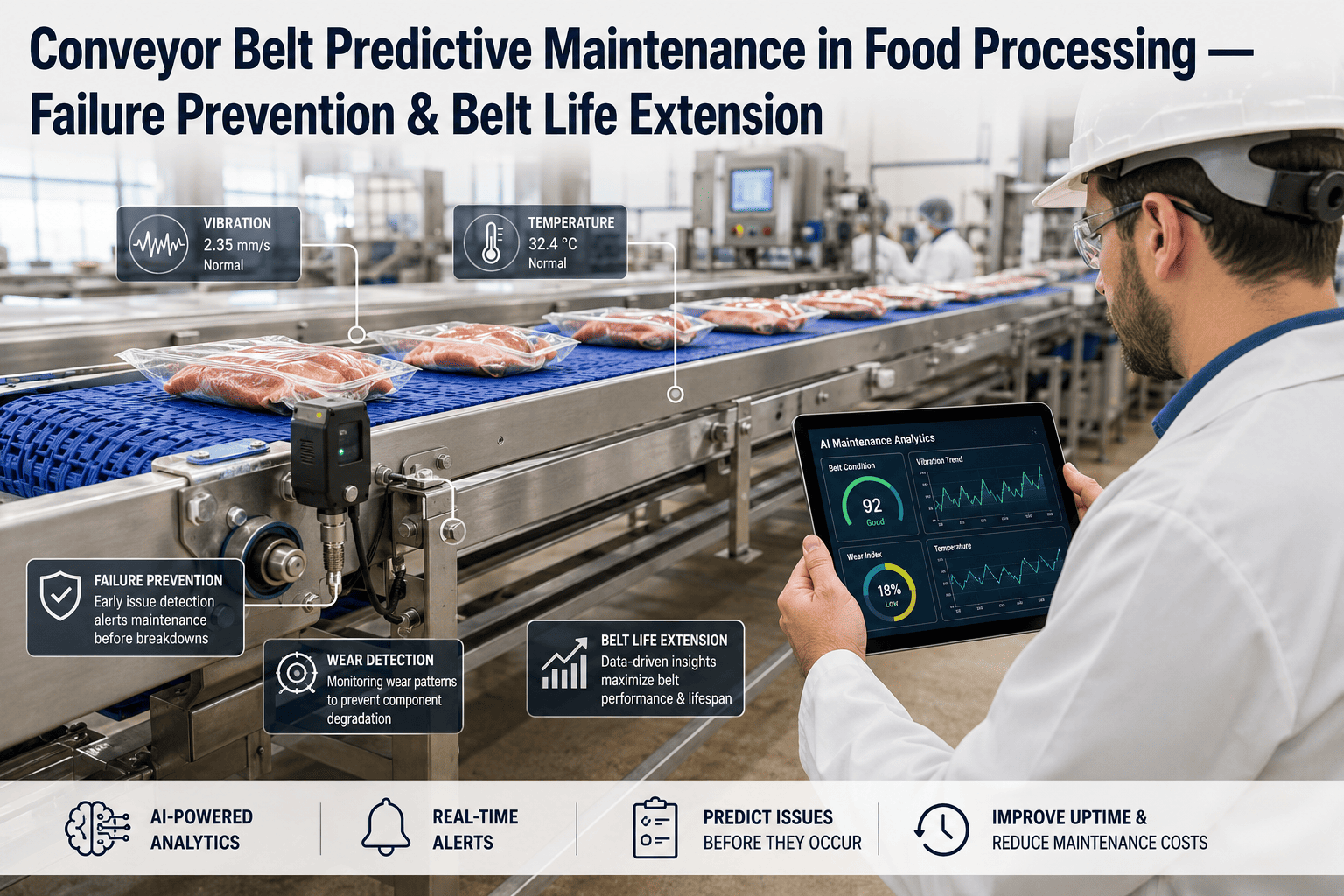
A conveyor belt rarely fails all at once. It usually starts with a slightly misaligned idler or a motor drawing a bit more current than normal, small signs that get lost in the noise of a busy production floor. By the time a belt actually stops moving, the line behind it has already backed up, product is at risk of quality issues from sitting too long, and a maintenance crew is scrambling mid-shift instead of working from a planned schedule. Food processing conveyors have it especially hard, running through washdown cycles and temperature swings that accelerate wear on belts, idlers, and drive motors alike. Catching these early signs of failure is exactly why more plants are choosing to see how AI-based conveyor monitoring works before their next unplanned stoppage.
CONVEYOR RELIABILITY FOR FOOD PROCESSING
Catch Conveyor Failures Before the Line Stops
Belt tracking sensors, motor current analysis, and idler vibration monitoring flag developing conveyor problems while there is still time to plan the fix.
Where Conveyor Failures Usually Start
Most conveyor breakdowns trace back to one of a handful of recurring failure points, each of which leaves an early signal well before the belt actually stops.
Belt Tracking Drift
A belt that slowly drifts off center wears unevenly against the frame, eventually causing edge damage or a full derailment if left uncorrected.
Idler Bearing Wear
Worn idler bearings create vibration patterns that build gradually, often long before the bearing seizes and forces an emergency stop.
Motor Overload
Rising motor current draw can signal belt tension issues, jammed rollers, or product buildup long before the drive motor actually trips.
Splice and Belt Fatigue
Repeated flexing at belt splices in food-grade belting accelerates fatigue, and small tears often go unnoticed until they widen under load.
How Continuous Conveyor Monitoring Works
1
Sensor Placement on Key Points
Vibration sensors on idlers and tracking sensors along the belt edge are positioned at the points most likely to show early wear signals.
2
Motor Current Signature Capture
Drive motor current is tracked continuously, revealing load patterns that shift gradually as friction or jamming builds up over time.
3
Trend Comparison Against Baseline
Each reading is compared against the conveyor's own healthy baseline, so alerts reflect real drift rather than normal day-to-day variation.
4
Scheduled Repair Instead of Emergency Stop
Maintenance teams receive an early alert with enough lead time to schedule the belt, idler, or motor repair during planned downtime.
Early Signal
Vibration and current trends shift well before a belt actually stops moving
Longer Belt Life
Correcting tracking drift early reduces edge wear and premature belt replacement
Planned Repairs
Idler and motor issues get scheduled instead of forcing a mid-shift stoppage
Fitting Into Existing Maintenance Workflows
Conveyor monitoring is designed to slot into the maintenance processes a plant already runs, not replace them with something entirely new.
Work Order Integration
Alerts can generate work orders directly in existing maintenance management systems, keeping the repair process familiar for technicians.
Shift Handoff Dashboards
Trend dashboards are reviewed during shift changes, giving incoming maintenance staff visibility into anything developing on the line.
Historical Failure Records
Every flagged event and resulting repair is logged, building a record that helps plan belt and idler replacement schedules going forward.
Map Monitoring to Your Conveyor Layout
Walk through where sensors would go on your specific conveyor lines and what early signals would look like.
Frequently Asked Questions
Belt tracking drift happens when a conveyor belt gradually shifts away from its centered running position, often due to uneven loading, worn idlers, or frame misalignment. Left uncorrected, the belt edge rubs against the frame or guides, accelerating wear and eventually leading to fraying or a full derailment that stops the line. Tracking sensors catch this drift early, giving maintenance teams time to make a small adjustment instead of facing a belt replacement.
A conveyor drive motor draws a fairly consistent amount of current under normal, healthy operation, and that current signature shifts when something changes mechanically, whether it is belt tension, a jammed roller, or product buildup on the belt. Continuous current monitoring catches these shifts as they develop, often before the change is large enough to trip an overload protection or cause a visible slowdown. This gives maintenance teams a much earlier warning window than waiting for a fault alarm.
Yes, sensors used for conveyor monitoring in food processing environments are selected specifically for washdown durability, using sealed housings and food-grade cable jacketing rated for repeated water and chemical exposure. This means the monitoring hardware survives the same daily sanitation cycles as the conveyor itself without needing removal or special handling. Teams can review specific hardware options for their belt type through a demo walkthrough.
Advance warning varies by failure type, but idler bearing wear and motor current drift often show measurable trend changes days to weeks before an actual stoppage, giving maintenance planners enough lead time to schedule repairs. Sudden failures, like a foreign object jamming a roller, are harder to predict in advance, though the resulting vibration or current spike is still detected immediately, speeding up the response once it happens.
Most sensor installations are non-invasive, clamping or mounting onto existing frame points, idler housings, and motor junction boxes without requiring structural changes to the conveyor itself. Installation is typically scheduled during a planned maintenance window so there is no disruption to production. Plants with unusual conveyor configurations can request a site-specific installation review by contacting support.
FEWER MID-SHIFT SURPRISES
Keep Your Conveyors Running Between Planned Stops
Get a monitoring plan built around your conveyor layout, belt type, and washdown schedule.