Every case of expired product written off at the end of the month represents inventory that was tracked correctly on paper and managed incorrectly in practice. Plant managers know FIFO and FEFO in theory, but enforcing either discipline manually across a warehouse full of mixed lot dates is nearly impossible without constant, tedious cross-checking. AI-driven inventory management fixes this by tracking shelf life and lot dates automatically and guiding pickers to the correct case every time, turning a rule everyone knows into a rule that actually gets followed. Plant managers ready to see this running against their own warehouse layout can book a demo.
AI FOOD INVENTORY MANAGEMENT · FIFO / FEFO · 2026
Never Let a Case Expire on the Shelf Again
Automatic FIFO and FEFO enforcement, shelf-life tracking, and batch expiration monitoring that turns inventory discipline into a system, not a hope.
Why Manual FIFO and FEFO Discipline Breaks Down
First-in-first-out sounds simple until a warehouse has dozens of SKUs, multiple lot dates per SKU, and pickers working under time pressure to fill an order fast. Left to manual judgment, pickers naturally reach for the case in front of them rather than checking every date code against every other case on the pallet, and that small, understandable shortcut is exactly how older stock quietly gets buried behind newer stock. First-expired-first-out is even harder to enforce manually, since expiration date and receipt date do not always move together across suppliers and product types.
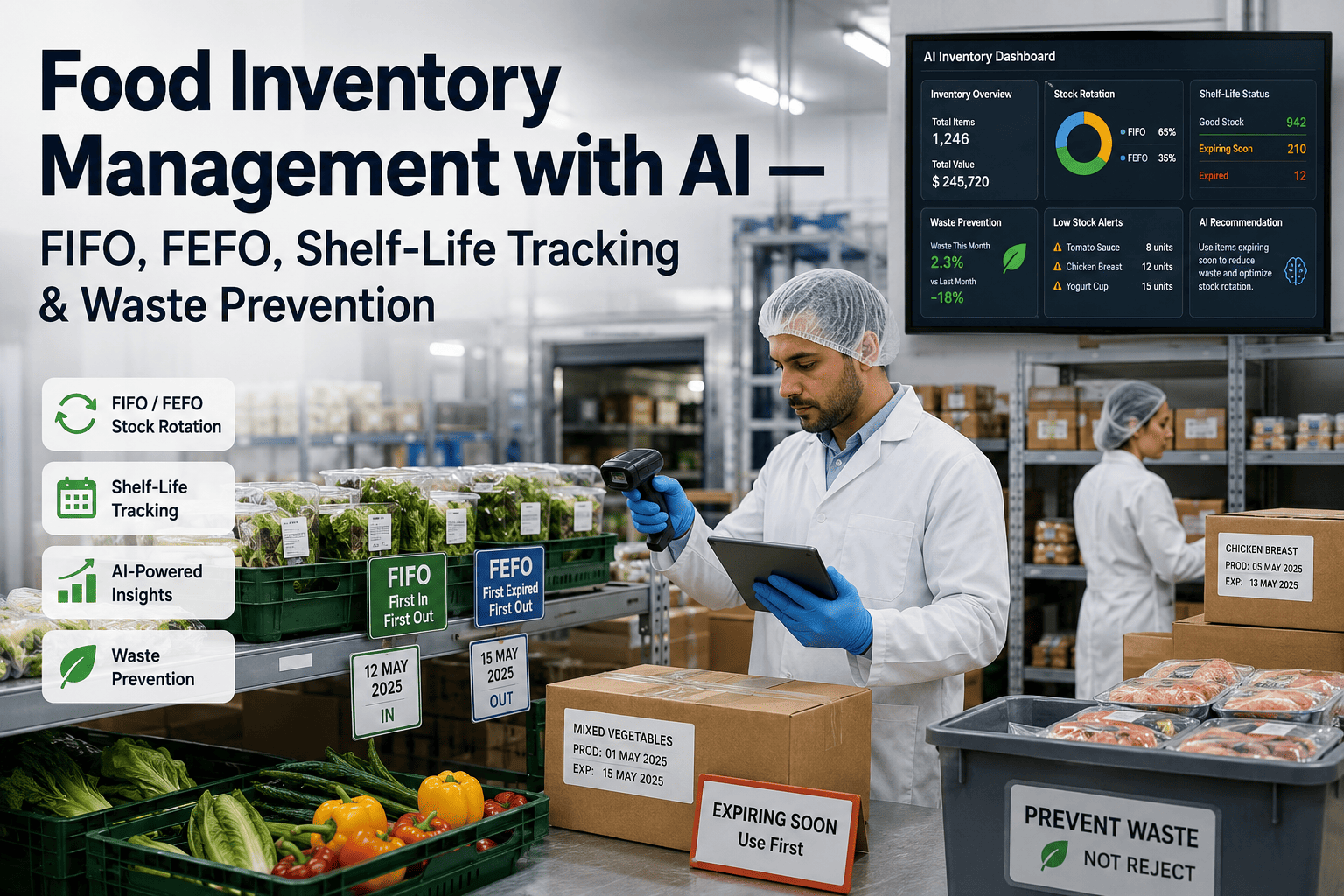
AI inventory systems remove the judgment call entirely. Every case is tagged with its lot and expiration data at receiving, and the system directs pickers to the correct case automatically, whether that means the oldest received stock or the stock closest to its expiration date, without requiring anyone to manually compare date codes under pressure.
FIFO — FIRST IN, FIRST OUT
Stock is picked in the order it was received, regardless of shelf life. Works well for products with consistent, predictable shelf life across lots.
Best for: Shelf-stable dry goods, canned products
FEFO — FIRST EXPIRED, FIRST OUT
Stock is picked based on expiration date rather than receipt date, critical when shelf life varies significantly between lots or suppliers.
Best for: Fresh, refrigerated, and short shelf-life products
STOP WRITING OFF EXPIRED INVENTORY
See Automatic FIFO/FEFO Enforcement in Action
Walk through how pick guidance would work across your own warehouse layout and SKU mix.
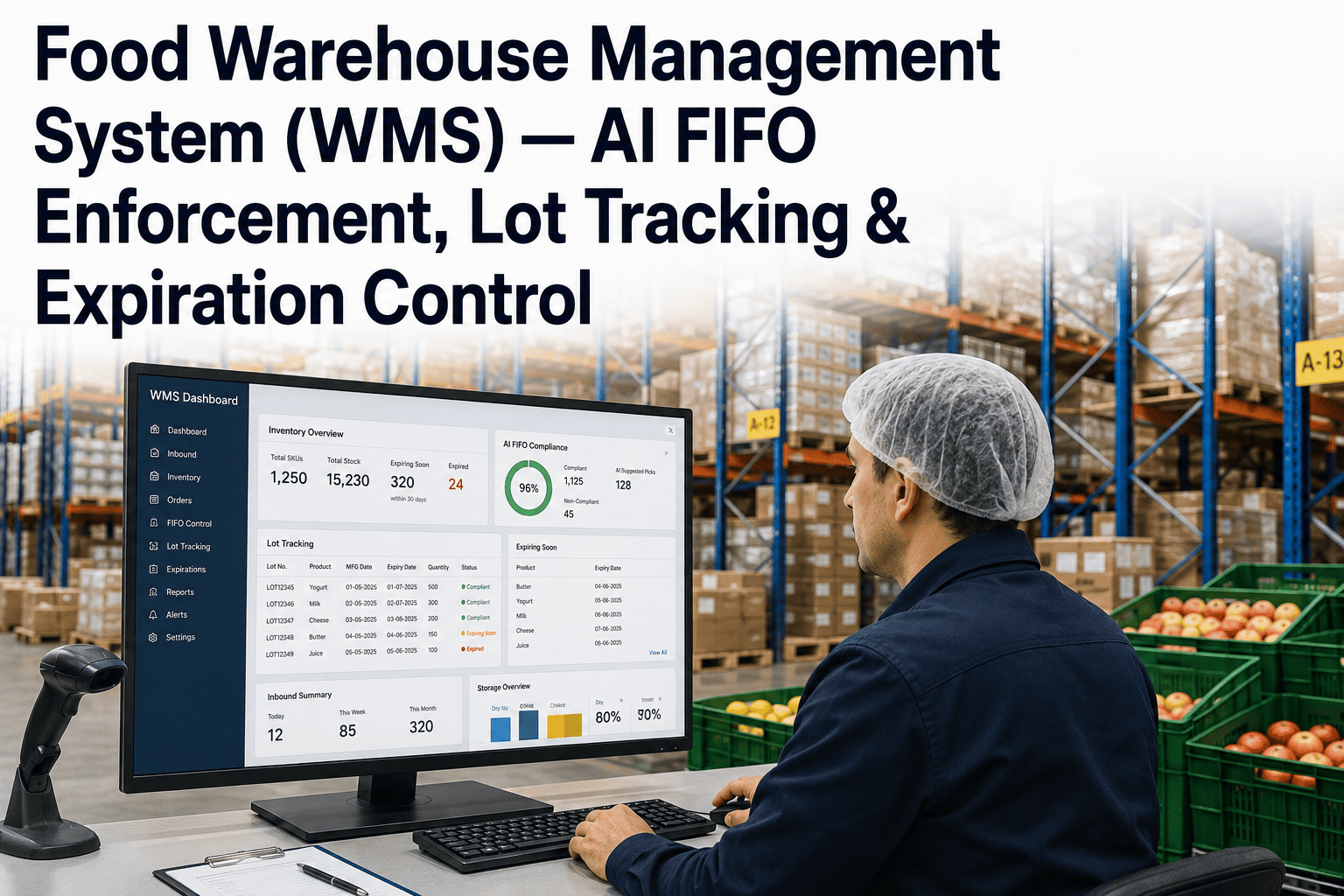
What the System Tracks on Every Case
Shelf-life tracking only works if the underlying data is captured accurately and consistently from the moment product enters the warehouse, which is where most manual systems already start to fail.
| Data Point | Captured At | Used For |
|---|---|---|
| Lot Number | Receiving | Traceability and recall response |
| Expiration Date | Receiving | FEFO pick sequencing and waste alerts |
| Receipt Date | Receiving | FIFO pick sequencing |
| Storage Location | Put-away | Pick path optimization and inventory accuracy |
From Receiving to Reduced Waste
1
Capture at Receiving
Lot number, expiration date, and receipt date are captured automatically as product arrives, removing manual data entry from the process.
2
Guide the Pick
The system directs each picker to the correct case based on FIFO or FEFO rules specific to that product category.
3
Flag Aging Stock
Cases approaching their expiration window are flagged proactively, giving teams time to redirect or discount before write-off.
4
Report on Waste Trends
Expired write-offs are tracked by SKU and supplier, surfacing patterns that point to ordering or storage adjustments.
What Plant Managers Are Saying
We knew FEFO in theory for years, but our pickers were still grabbing whatever case was closest. Once the system started directing every pick automatically, our expired write-offs dropped within the first month, and our team stopped having to think about it at all, which is exactly the point.
Plant Manager, Refrigerated Dairy Products Facility
Frequently Asked Questions
Can the system handle products that need FIFO in one area and FEFO in another?
Yes, pick logic is configured at the product category level rather than applied uniformly across the entire warehouse, so shelf-stable dry goods can follow FIFO rules while refrigerated or fresh items follow FEFO rules within the same facility. This flexibility matters for plants handling a mixed product range, since forcing one rule across every category would either be unnecessarily strict for stable goods or dangerously loose for perishables.
How is expiration and lot data captured without slowing down receiving?
Most implementations use barcode or label scanning at the receiving dock, which captures lot number and expiration date in seconds as part of the normal receiving workflow rather than as an additional separate step. For suppliers whose labels already include this data in a scannable format, the process adds essentially no time to receiving. For suppliers with less standardized labeling, a brief manual entry step is used, and this is typically the first area addressed during rollout planning.
What happens when the system flags aging stock, does it get pulled automatically?
The system generates an alert and a recommended action, such as prioritizing that stock for the next outbound order or flagging it for a promotional discount, but the actual decision and physical handling remains with your team. This keeps a human in the loop for decisions that may involve customer relationships or pricing, while ensuring nobody has to manually scan the entire warehouse to find which cases are approaching their expiration window in the first place.
Does this integrate with our existing warehouse management or ERP system?
Yes, inventory and lot data typically syncs with your existing warehouse management or ERP system rather than operating as a separate, disconnected tool. This keeps stock counts, order fulfillment, and financial records aligned with the same underlying inventory data, so teams are not reconciling two different systems. Teams can review integration details for their specific WMS or ERP setup through support.
How much waste reduction is realistic in the first few months?
Results depend heavily on how much waste was already being driven by manual FIFO or FEFO enforcement failures versus other causes like over-ordering, but plants coming from a fully manual picking process tend to see the fastest and most visible early reductions in expired write-offs. A short pilot on your highest-waste product category is typically the fastest way to establish a realistic number for your own facility. Plant managers can book a demo to get a waste-reduction estimate scoped to their own SKU mix.
AI FOOD INVENTORY MANAGEMENT · FIFO / FEFO
Turn Inventory Discipline Into a System
Join food manufacturers already cutting expired write-offs with automatic FIFO and FEFO enforcement.