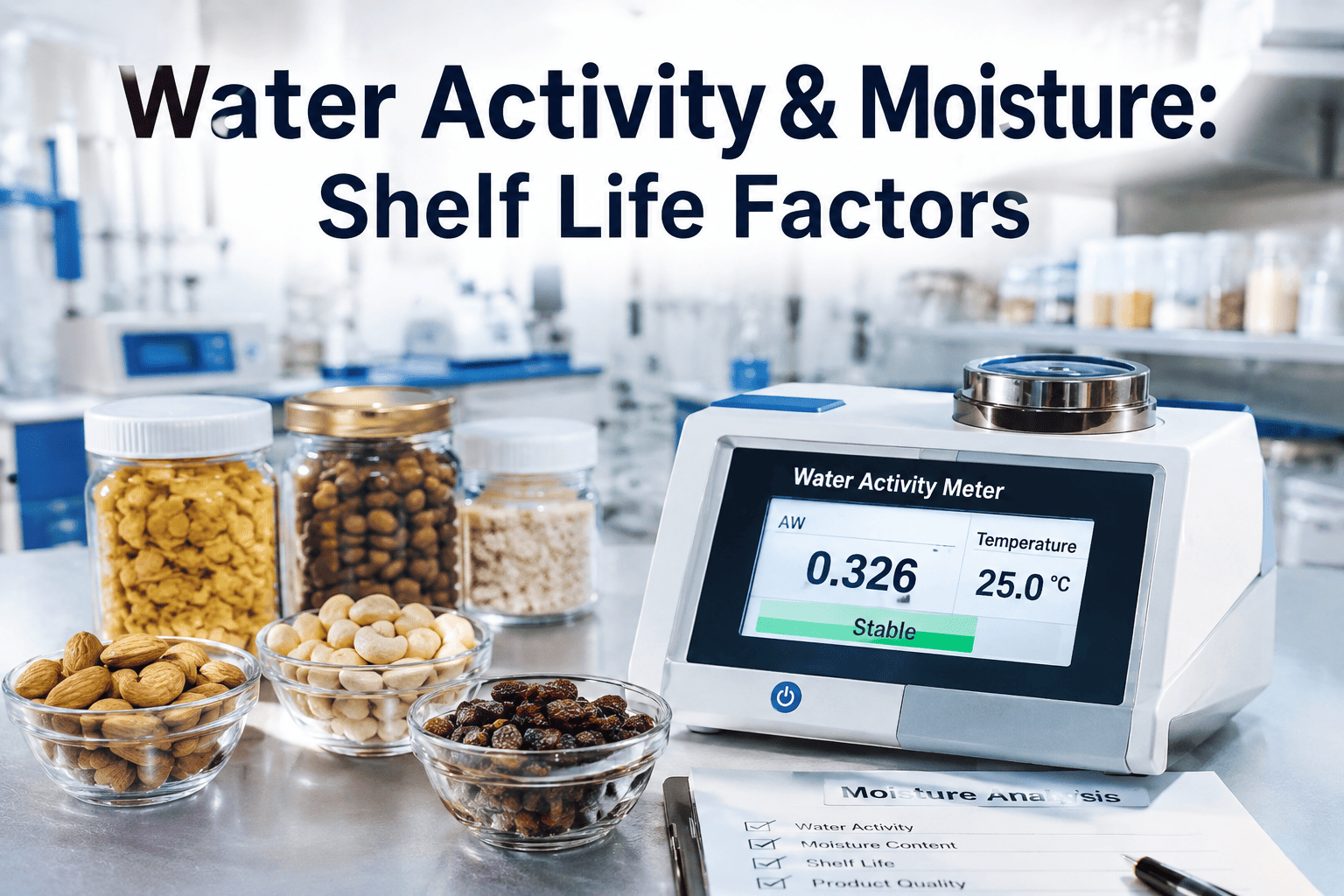
Two batches of the same product can show identical moisture content on paper and still behave completely differently on the shelf, because moisture content and water activity measure two different things — one tells you how much water is present, the other tells you how much of that water is actually available for microbial growth and chemical reactions. A product formulated by moisture percentage alone can pass every spec sheet and still mold early, dry out, or lose texture faster than expected. iFactory helps food manufacturers build water activity and moisture monitoring into product development and production, with the complete framework at iFactory support.
Shelf-Life Science · Water Activity & Moisture Control
Water Activity vs. Moisture Content: Why Both Numbers Matter for Shelf Life
iFactory helps quality teams measure and monitor water activity alongside moisture content, connecting both to shelf-life prediction and product stability by category.
The Core Distinction
Moisture Content Measures Quantity. Water Activity Measures Availability.
Moisture Content
The total percentage of water in a product by weight, typically measured by oven drying or moisture analyzer, telling you how much water is physically present.
Water Activity (Aw)
The ratio of water vapor pressure in the product to pure water, on a scale of 0 to 1, telling you how much of that water is actually free to support microbial growth and chemical reactions.
Risk Thresholds by Category
Where Water Activity Determines Product Risk Classification
Aw Range
Typical Products
Microbial Risk
Above 0.85
Fresh, moist foods
High — supports most bacteria
0.60–0.85
Intermediate-moisture foods
Moderate — molds and yeasts
Below 0.60
Shelf-stable dry goods
Low — most microbial growth halted
A Product That Meets Its Moisture Spec Can Still Fail Its Shelf-Life Promise
Tracking water activity alongside moisture content catches formulation risks that a moisture percentage alone will never reveal.
Getting Accurate Readings
Five Sampling Practices That Prevent Misleading Results
1Allow samples to equilibrate to instrument temperature before measurement, since temperature swings skew water activity readings significantly.
2Sample from multiple points within a batch, since moisture and water activity can vary meaningfully across a single production lot.
3Calibrate instruments against known salt solutions on a regular schedule, not just at initial setup.
4Measure water activity as close to production time as practical, since packaging and storage conditions can shift readings over time.
5Track both moisture and water activity trends over time, not just single-point specification checks at release.
Field Case
Explaining Inconsistent Mold Complaints Across Identical Moisture Specs
A bakery products manufacturer had experienced sporadic early mold complaints on a shelf-stable product line despite every batch passing its standard moisture content specification at release. Adding water activity measurement to the release testing protocol revealed that batches made with a reformulated humectant blend were meeting the moisture percentage target while carrying meaningfully higher water activity than the original formulation, making more water available for mold growth even though the total water content looked identical on paper. Adjusting the humectant ratio to bring water activity back in line with historical levels resolved the complaint pattern without changing the product's moisture content specification at all.
1Formulation variable identified as root cause
0Change needed to moisture spec
ResolvedMold complaint pattern after adjustment
Frequently Asked Questions
Water Activity & Moisture — Common Questions
Do we need to measure both moisture content and water activity, or is one enough?
Both measurements serve distinct purposes and are generally not interchangeable for shelf-stability decisions. Moisture content is useful for process control and yield calculations, while water activity is the more direct predictor of microbial stability and shelf life. Products formulated with humectants, sugars, or salts in particular can show a wide range of water activity at the same moisture content, making water activity the more reliable indicator for safety and stability.
Book a Demo to discuss measurement strategy for your product category.
What instrument accuracy is needed for reliable water activity readings?
Most food industry applications rely on chilled-mirror dew point or capacitance-based water activity meters with accuracy within 0.01 to 0.02 Aw units, which is generally sufficient for shelf-stability decisions near common risk thresholds. Regular calibration against certified salt standards is more important to overall accuracy than instrument selection alone.
How does this connect to shelf-life prediction models?
Water activity data feeds directly into moisture sorption isotherm modeling, which predicts how a product's water activity will shift over time as it interacts with its packaging and storage environment, giving a more grounded shelf-life estimate than accelerated testing alone.
Contact support to review isotherm modeling for your product line.
Can water activity monitoring help with formulation cost reduction?
Yes — understanding exactly how much humectant or preservative a formulation actually needs to reach a target water activity, rather than over-formulating for safety margin, can reduce ingredient costs while maintaining the same stability profile, particularly in intermediate-moisture products where humectant cost is a meaningful part of the formulation budget.
How long does it take to establish water activity specifications for a new product?
Establishing baseline specifications alongside an accelerated shelf-life study typically takes four to eight weeks depending on product category and target shelf life. Products with well-established category benchmarks can move faster using existing reference data.
Book a Demo for a timeline specific to your product.
Know Which Water in Your Product Is Actually Working Against Shelf Life
Water activity and moisture monitoring connected to shelf-life prediction, live in as little as four weeks.