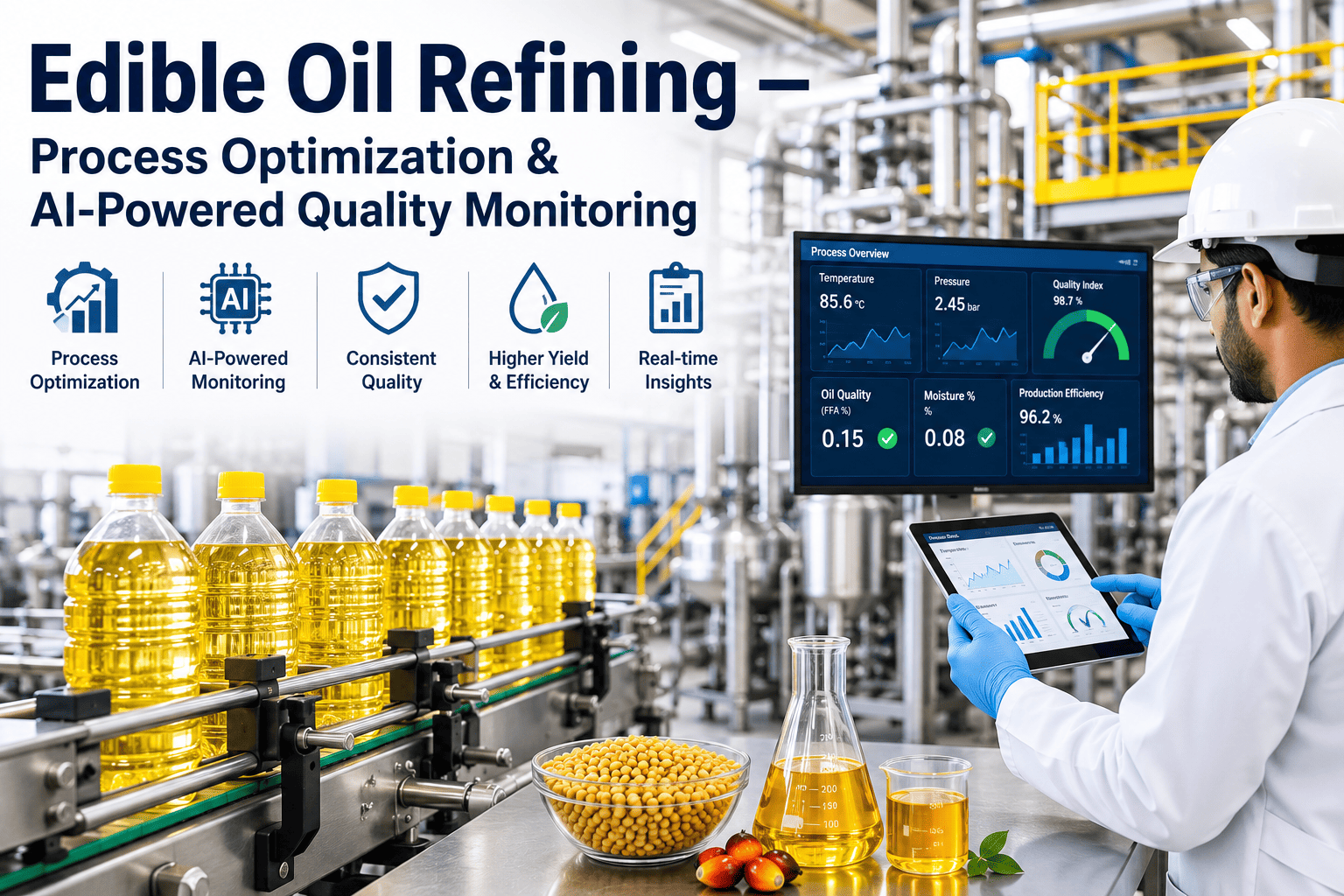
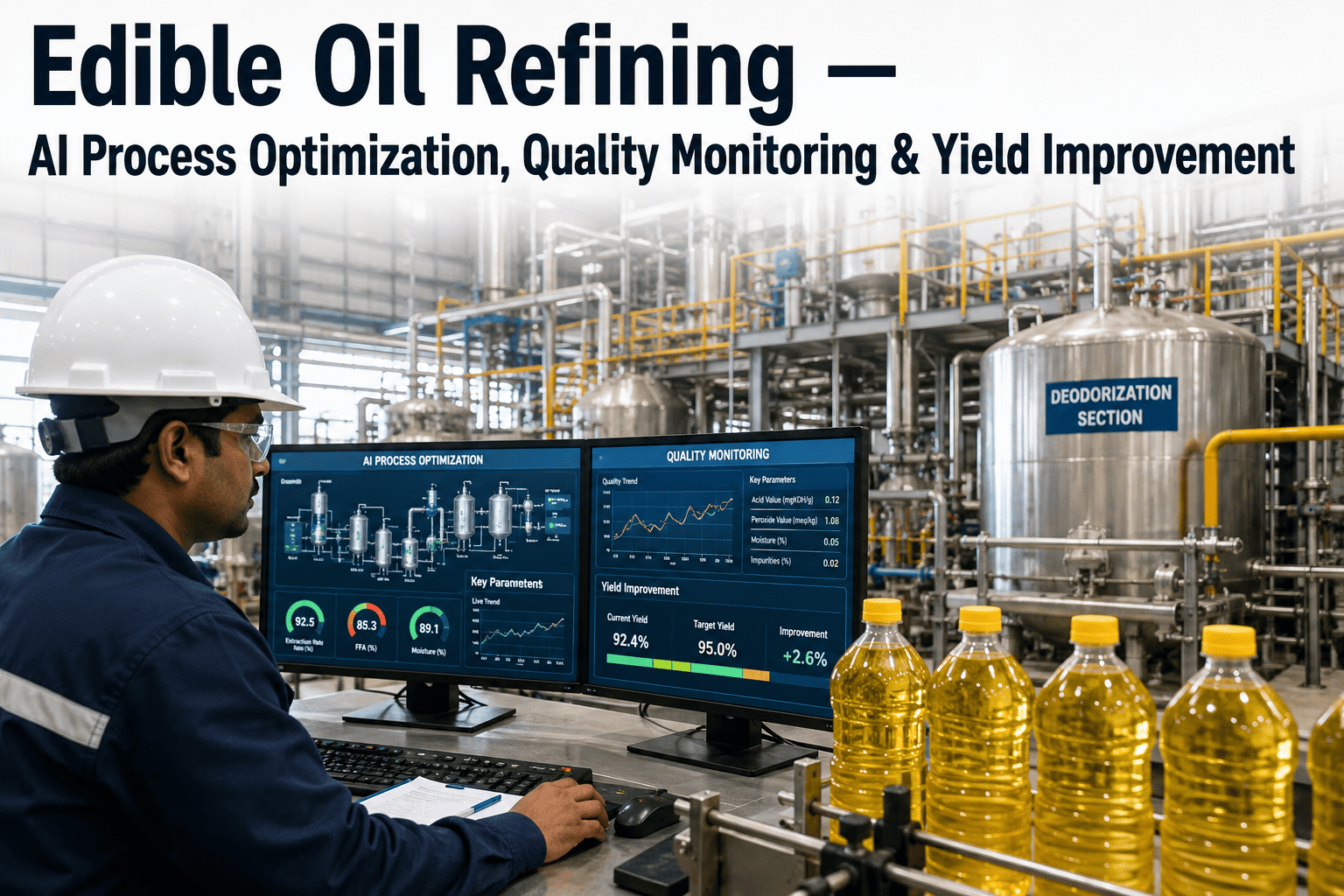
Edible oil refining is a chain of chemical reactions happening in sequence — degumming, bleaching, deodorization — and a small miss at any one stage carries forward into every stage after it. A bleaching earth dose that runs slightly rich costs yield directly. A deodorizer running a few degrees off temperature can leave free fatty acid levels out of spec on a batch that already used a full day of processing time. Book a demo to see how continuous process analytics protect yield across palm, soybean, sunflower, and olive oil lines.
Edible Oil & Fats · Process Engineering
Protect Yield at Every Stage of the Refining Chain, Not Just at Final Test
AI-driven bleaching, deodorization, and free fatty acid monitoring for palm, soybean, sunflower, and olive oil refining lines — built to catch a drift before it compounds through the next stage.
The Refining Chain
Four Stages Where a Small Miss Becomes a Bigger One Downstream
Refining is sequential by nature, which means a problem caught at degumming is a quick correction, while the same problem caught only at final quality test has already consumed the rest of the batch's processing time.
01
Degumming
Phosphoric acid dosing removes phospholipids, and under-dosing leaves gums that foul the bleaching stage that follows immediately after.
02
Bleaching
Bleaching earth dose and contact time determine color removal and directly affect yield, since earth also carries away entrained oil as it is filtered out.
03
Deodorization
Temperature, vacuum level, and residence time drive free fatty acid reduction and flavor stripping, and a miss here is the hardest and most expensive stage to correct after the fact.
04
Final Quality Testing
FFA, peroxide value, and color are verified before release, and a failure at this point means the batch has already absorbed the cost of every prior stage with nothing to show for it.
4 Reactions
Sequential process stages where a drift in one compounds into the next
Entrained Loss
Bleaching earth over-dosing is one of the most common and least visible sources of yield loss
Multi-Feedstock
Palm, soybean, sunflower, and olive oils each carry different optimal process parameters at every stage
iFactory Tracks Yield and Quality From Degumming to Final Test
Continuous process analytics across bleaching, deodorization, and FFA monitoring, configured for your specific feedstock mix and refining line.
Yield Protection Checklist
Five Process Points Worth Continuous Monitoring on Any Refining Line
✓
Phosphoric acid dosing tracked against incoming crude oil phosphorus content
✓
Bleaching earth dose and contact time monitored against color and yield targets together
✓
Deodorizer temperature and vacuum level tracked continuously through the full cycle
✓
Free fatty acid trend monitored between batches, not only at final release testing
✓
Feedstock changeover parameters adjusted automatically when the oil source switches
We ran palm and soybean oil through the same refining line on alternating weeks, and switching feedstocks meant resetting bleaching and deodorizing parameters by hand based on whatever the shift supervisor remembered from the last run. More than once we ran the first batch of a changeover with the wrong parameters still active, and it cost us yield before anyone caught it at final test. With continuous monitoring tied to feedstock identification, the system now flags a parameter mismatch as soon as a new feedstock starts running, instead of us finding out after a full batch has already gone through deodorization.
— Process Engineer, Edible Oil Refinery
Frequently Asked Questions
What Process Engineers Ask About AI-Driven Refining Analytics
Can this handle multiple feedstocks running through the same equipment?
Yes, and this is one of the most common reasons refineries adopt continuous monitoring in the first place. Target parameters are configured per feedstock, so the system can flag when a process setting does not match the oil actually running through the line, rather than assuming every batch should be held to a single generic target.
How does this actually improve yield rather than just quality?
Bleaching earth dosing and deodorizer conditions are tracked against both the quality outcome and the yield outcome together, since over-dosing bleaching earth to be safe on color removal is one of the most common and least visible ways refineries lose yield. Continuous tracking lets a plant find the minimum effective dose for its actual feedstock rather than running a conservative margin on every batch.
Does this replace our lab-based FFA and peroxide value testing?
No, it works alongside your lab testing rather than replacing it. Continuous process monitoring gives you a real-time trend that correlates with FFA and peroxide outcomes, so a likely deviation can be caught and corrected mid-process, while your lab testing remains the verified release check before product ships.
What equipment integration does a typical refining line need?
Most refining lines already have temperature, vacuum, and dosing sensors installed as part of their existing process control system, and monitoring typically starts by connecting to that data rather than adding new hardware. Additional sensors are added only where a specific gap, such as inline color measurement, is identified during a line assessment.
Contact support to review what your current line already has in place.
How quickly can we expect to see a yield improvement after deployment?
Early yield signals on a single stage, such as bleaching earth optimization, are often visible within the first several weeks once the system has enough production data to identify where a conservative margin can be safely tightened. A fuller picture across the entire refining chain typically develops over a couple of months.
Book a demo to scope a realistic timeline for your specific line.
Every Refining Stage Is a Chance to Protect Yield — or Quietly Lose It.
Continuous bleaching, deodorization, and FFA monitoring — configured for your feedstock mix and refining line, reviewed with your process team before go-live.