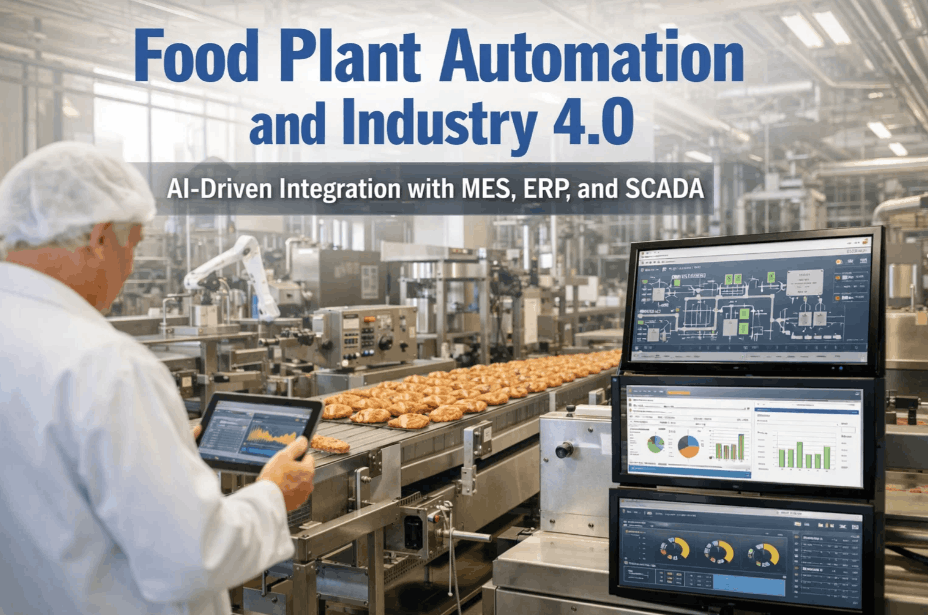
Food plant automation and Industry 4.0 are no longer future ambitions — they are the operational baseline for food manufacturers competing in a data-driven market. As production environments grow more complex, integrating AI-driven platforms with MES, ERP, and SCADA systems has become the defining factor separating high-performance smart food factories from facilities still running on disconnected spreadsheets and manual handoffs. When these systems communicate in real time, the result is a food manufacturing operation that is faster, leaner, and dramatically more compliant.
Why Food Plant Automation Requires Integrated Systems, Not Isolated Tools
The promise of Industry 4.0 food production is straightforward: every system that generates data — from PLC-controlled filling lines to ERP-managed procurement modules — should share that data in a continuous, bidirectional flow. In practice, most food facilities operate with islands of automation. SCADA handles equipment control. MES tracks production orders. ERP manages inventory and finance. But without integration, each system holds a fragment of operational truth that no single decision-maker can see whole.
AI-driven food plant integration solves this fragmentation by creating a unified data layer that sits across all three systems, translating signals from the shop floor into enterprise intelligence and pushing planning parameters back down to production execution. The result is a connected food manufacturing environment where schedule changes cascade automatically, quality events trigger corrective workflows without manual escalation, and OEE data flows directly into ERP cost accounting. Facilities ready to close this gap can book a demo to see the integration architecture in action.
AI-Driven MES Integration for Food Manufacturing: Closing the Loop Between Planning and Production
Manufacturing Execution Systems are the operational backbone of food plant automation — managing production orders, tracking material consumption, recording in-process quality checks, and generating batch records for regulatory compliance. When an AI-driven platform integrates with MES, these functions are no longer dependent on operator data entry. IoT sensor readings flow directly into MES records. Equipment status updates automatically advance production order states. Quality parameter deviations trigger non-conformance workflows without manual intervention.
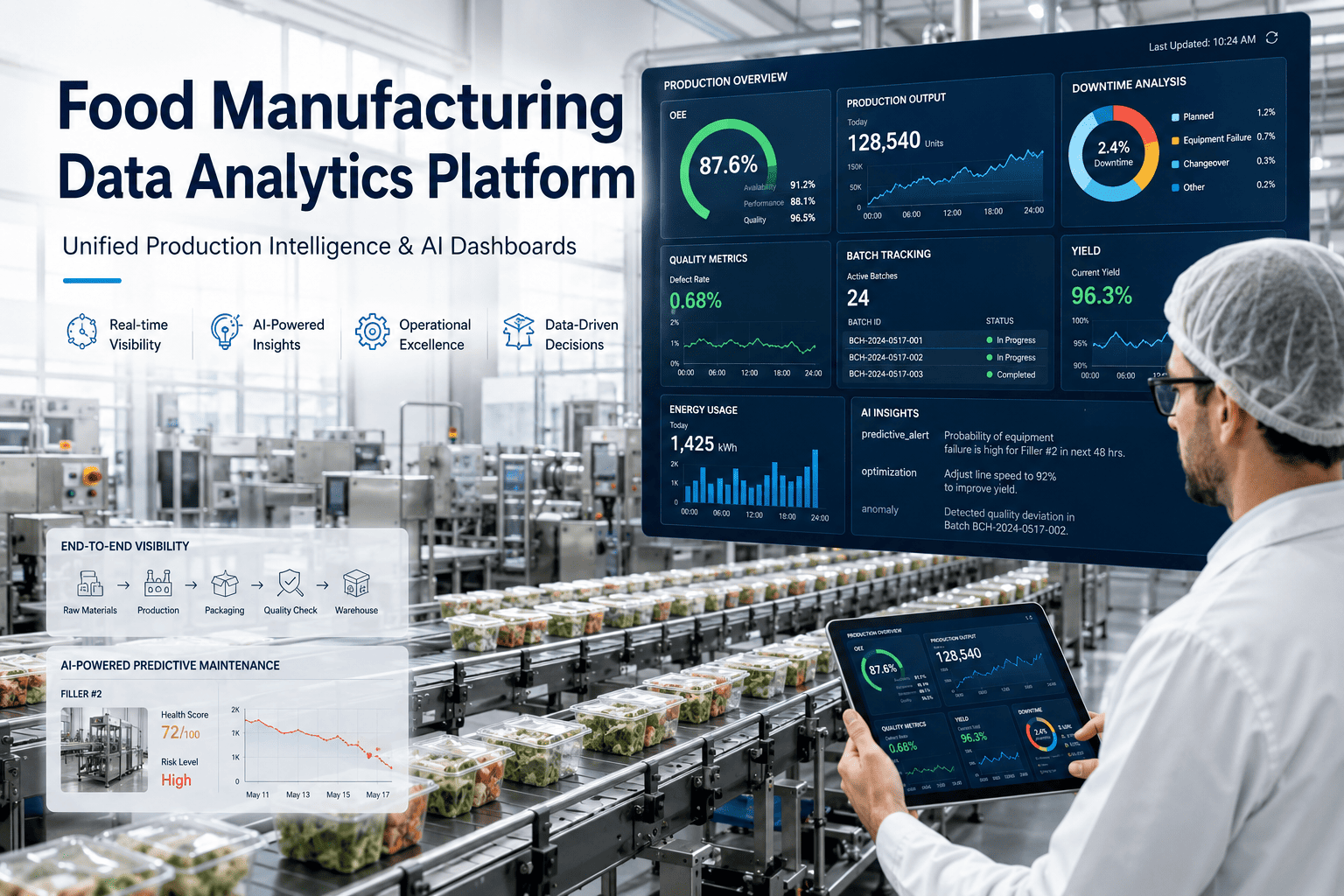
For food manufacturers pursuing Industry 4.0 digital transformation, MES AI-driven integration is where shop-floor data becomes actionable intelligence. Production analytics alignment — matching actual throughput, yield loss, and downtime data to planned production targets — becomes possible only when MES records reflect real-time conditions rather than operator-reported estimates. Manufacturers exploring this capability can book a demo to see how iFactory connects sensor data to MES workflows.
Food Plant ERP AI-Driven Integration: Connecting Shop-Floor Reality to Enterprise Planning
Enterprise Resource Planning systems govern the financial and material planning decisions that upstream food production: procurement schedules, inventory replenishment triggers, cost accounting allocations, and customer order fulfillment timelines. The persistent gap in most food facilities is that ERP planning assumptions — standard yields, scheduled run rates, material consumption norms — do not reflect actual shop-floor performance. AI-driven food plant data integration closes this gap by feeding real production outcomes directly back into ERP as they occur.
| ERP Function | Without Integration | With AI-Driven Integration | Business Impact |
|---|---|---|---|
| Production Order Status | Manual updates, hours delayed | Real-time MES sync | Accurate delivery commitments |
| Inventory Consumption | End-of-shift reconciliation | Continuous material actuals | Reduced safety stock requirements |
| Work Order Generation | Manual planner creation | Auto-triggered by sensor thresholds | Faster maintenance response |
| Yield Variance Reporting | Weekly production review | Real-time batch-level tracking | Immediate cost deviation alerts |
| Quality Hold Management | Paper-based, multi-day resolution | Automated hold and disposition workflow | Faster release, lower write-off risk |
| Maintenance Cost Capture | Manual time entry, incomplete | Auto-linked to work orders and assets | Accurate asset cost accounting |
For food manufacturers operating on tight margins, the financial value of accurate real-time ERP data is substantial. Procurement teams stop over-ordering because inventory counts are trustworthy. Finance teams close the books faster because production actuals flow into cost accounting without manual journal entries. Supply chain planners respond to demand signals with confidence that production capacity data is current. Teams evaluating this integration model can book a demo to review ERP connectivity options for their specific system environment.
SCADA Food Plant AI-Driven: Turning Equipment Signals into Production Intelligence
Supervisory Control and Data Acquisition systems generate the most granular operational data in any food manufacturing environment — continuous readings from temperature sensors, pressure transmitters, flow meters, motor drives, and programmable logic controllers that govern every critical process parameter. In a traditional automation architecture, this data lives in the SCADA historian: accessible to controls engineers, but rarely integrated with the production planning, quality management, or maintenance systems that could act on it.
AI-driven SCADA integration for food plants changes this by extracting process data from the historian in real time and routing it to the systems where it drives operational decisions. A temperature excursion in a pasteurization circuit does not just generate a SCADA alarm — it triggers a quality hold in MES, notifies the maintenance team via work order, and updates the batch record in the food plant ERP system. This level of connected response is what distinguishes a smart food factory from a facility with advanced automation but limited integration. Explore how this architecture works by booking a demo with iFactory's integration engineers.
Building a Smart Food Factory: The Industry 4.0 Integration Stack
A fully integrated Industry 4.0 food production environment is not built in a single project — it is assembled layer by layer, with each integration delivering immediate operational value while extending the foundation for the next capability. The architecture that enables connected food manufacturing data flow follows a consistent pattern: IoT sensors and SCADA systems at the equipment level, AI-driven analytics at the integration layer, and MES and ERP systems at the production and enterprise planning levels.
PLCs, SCADA historians, IoT sensors, and inline instrumentation generate continuous process data. AI-driven integration platforms connect to these sources via OPC-UA, MQTT, and Modbus — capturing every relevant signal without manual data collection.
The AI analytics layer contextualizes raw sensor data against production schedules, quality specifications, and maintenance histories. It routes actionable information to the correct downstream system — triggering MES quality holds, ERP inventory updates, and CMMS work orders automatically.
MES, ERP, and quality management systems receive production actuals in real time — eliminating the manual data entry bottleneck that delays planning decisions, compliance reporting, and financial reconciliation in conventionally operated food facilities.
Production Analytics Alignment: Connecting Actual Performance to Planning Targets
Production analytics alignment is the practice of ensuring that the performance data visible in planning and reporting systems accurately reflects what is happening on the production floor — in real time, not 24 hours later. In food manufacturing, this alignment is critical because production variability is high: yield loss from raw material variation, throughput loss from changeover and sanitation, and quality holds from CCP deviations can shift actual-versus-planned performance significantly within a single shift.
AI-driven food manufacturing integration enables production analytics alignment by continuously updating planning system inputs with actual performance data. OEE calculations reflect real equipment availability, not scheduled uptime assumptions. Yield variance reports draw on actual sensor-measured output, not operator-estimated quantities. Capacity planning models incorporate actual cycle times from SCADA rather than engineered standard times that may be years out of date. Food manufacturers who want to see this level of production intelligence in their facility can book a demo to review how iFactory's analytics engine integrates with existing planning tools.
Frequently Asked Questions: Industry 4.0 Integration in Food Plants
iFactory — AI-Driven MES, ERP, and SCADA Integration for Industry 4.0 Food Manufacturing
Stop operating with disconnected systems and manual data handoffs. iFactory's AI-driven integration platform connects your SCADA equipment layer, MES production execution, and ERP enterprise planning into a single real-time data environment — delivering automated work orders, production analytics alignment, and compliance-ready documentation without manual effort.