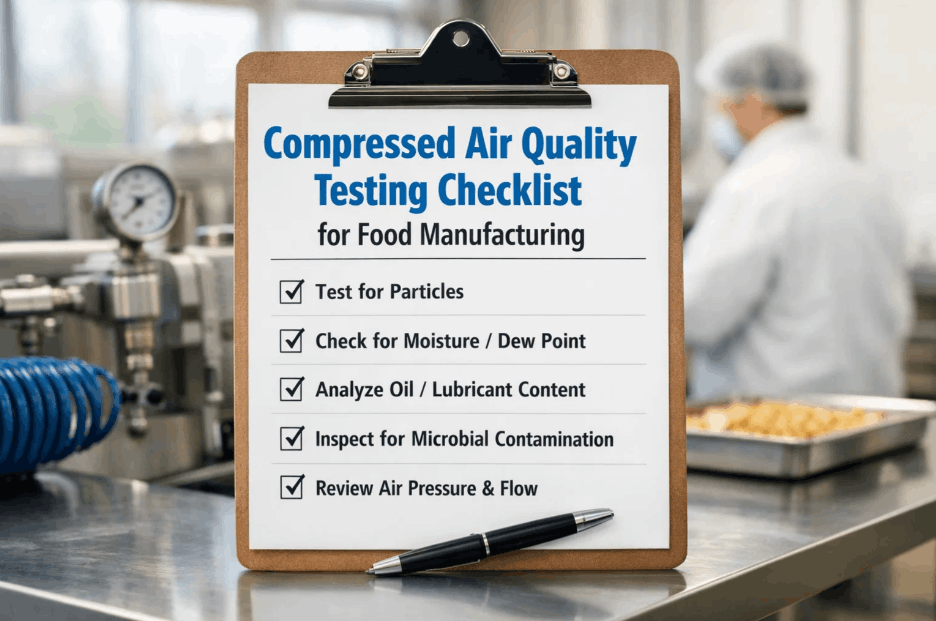
Compressed air is the invisible ingredient in food manufacturing — powering pneumatic conveyors, packaging systems, and direct product contact applications. Yet most facilities allow untested, unmonitored air to contact food surfaces, packaging, and ingredients daily. Contaminated compressed air carrying oil aerosols, microbial particulates, or excess moisture is a direct food safety violation under FSMA 21 CFR Part 117 and a recurring source of product recalls. Book a Demo to automate your ISO 8573-1 compressed air quality testing logs, air dryer PM schedules, and filter change records across every compressor in your facility.
Why Compressed Air Quality Verification is Non-Negotiable
Direct Food Contact Contamination Risk
Compressed air used for product conveying, blow-off, packaging inflation, or direct ingredient mixing is classified as a food contact surface under FSMA. A single failed oil aerosol test on a food-grade air line can trigger an immediate production hold, product destruction, and a regulatory citation. Book a Demo to see how iFactory tracks every air quality test result in real time.
ISO 8573-1 & Global Audit Readiness
International air quality standard ISO 8573-1 defines purity classes for particles, moisture, and oil. SQF Edition 9, BRCGS Issue 9, and FSSC 22000 Version 6 all require food plants to document compressed air quality at defined intervals. Facilities without a traceable verification program consistently fail third-party audits on this point alone.
Benefits of Digital Compressed Air Quality Management
Automated Filter PM Scheduling
iFactory triggers filter change work orders based on hours of use or differential pressure thresholds — keeping your air quality within spec automatically.
Instant Lab Certificate Storage
Upload and organize third-party air quality test certificates by compressor, date, and ISO class — fully searchable and accessible during any audit.
Dew Point Trend Monitoring
Connect dew point transmitters to iFactory's cloud to track moisture trends. Catch a failing air dryer weeks before it causes a product quality event.
Oil Content Test Logging
Record and trend all colorimetric and sensor-based oil content test results. Correlate oil content spikes with specific compressor service events.
Multi-Compressor Fleet Visibility
Manage every compressor, dryer, and filter bank across your facility from a unified asset register. No more spreadsheets, no missed service intervals.
FSMA & GFSI Compliance Proof
Generate complete, timestamped compressed air prerequisite program documentation for SQF, BRCGS, FSSC 22000, and FDA audits in seconds.
Compressed Air Quality FAQs
Most major food safety schemes (SQF, BRCGS, FSSC 22000) reference these classes in their compressed air prerequisite programs and conduct specific clause audits.
Book a Demo to see how iFactory automatically tracks your ISO class compliance in real time across all compressors.
Internal monitoring with calibrated dew point transmitters and oil content analyzers should occur continuously or at each shift start to detect dryer or filter failures early.
Any change to the compressor system — new equipment, filter type, or lubricant brand — mandates an immediate retest before resuming food contact operations.
Food-grade air has dedicated pipelines, filters, and dryers specifically sized to achieve ISO Class 1 purity — it must be physically separated and clearly labeled from utility air circuits.
Cross-contamination between utility and food-grade air lines is a critical audit finding that results in immediate production suspension under BRCGS and SQF audits.
Ambient air still contains airborne bacteria, hydrocarbon vapors, and humidity — making downstream filtration, drying, and periodic microbial testing mandatory even with oil-free equipment.
iFactory's compressed air module tracks oil-free compressor maintenance alongside your filtration and testing logs for complete end-to-end documentation.
The facility must implement a documented corrective action plan, reroute production away from affected lines, and provide re-test results to the certification body within a defined timeframe.
Having a complete digital history of prior-passing test results demonstrates due diligence and can significantly reduce the audit severity rating and corrective action window.
All filter housings should carry EN 12021 compliance markings, and element change intervals must follow the manufacturer's hours-of-use recommendations — not just a calendar date.
Book a Demo to learn how iFactory's maintenance module automatically schedules your filter changes based on actual run hours and differential pressure readings.