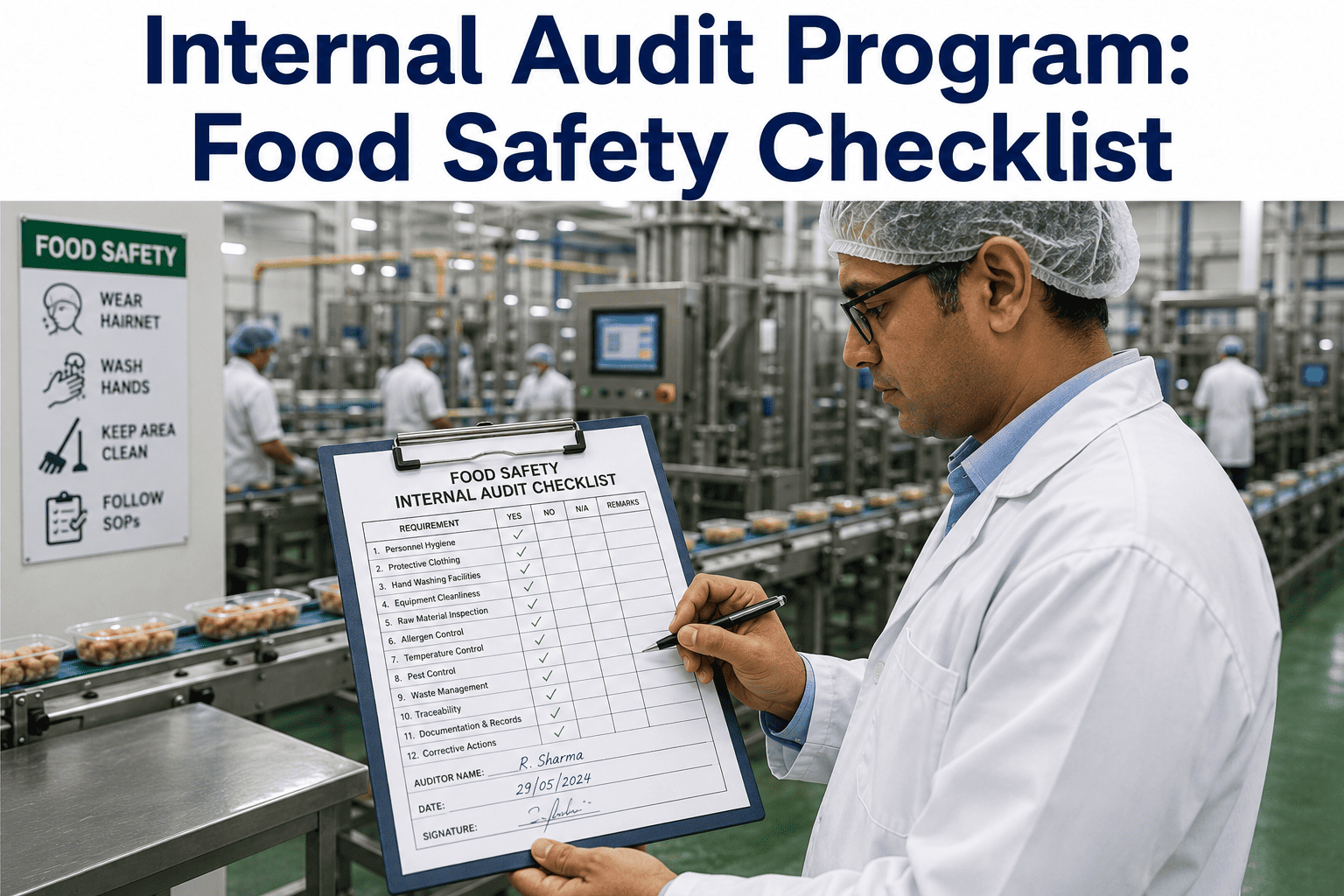
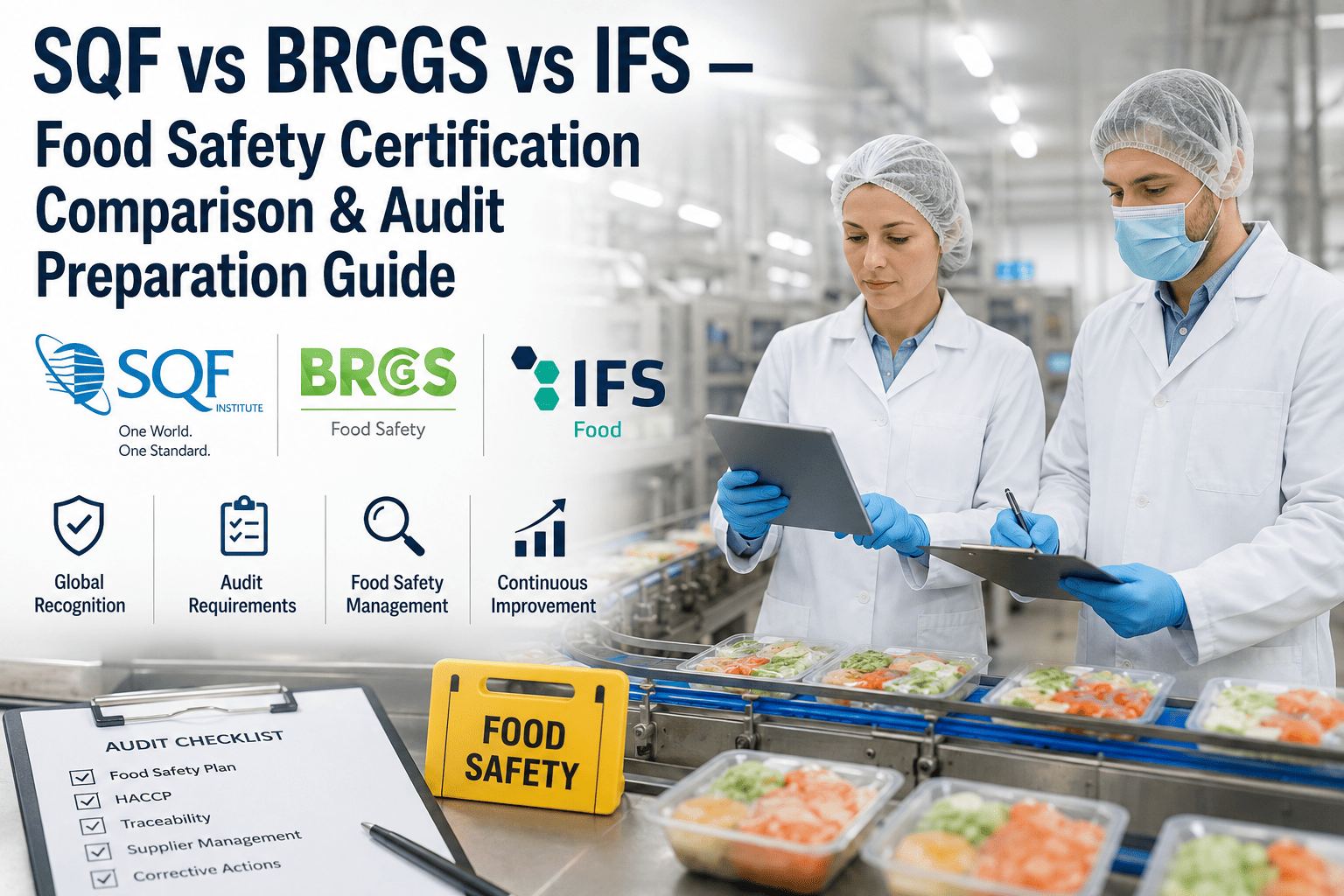
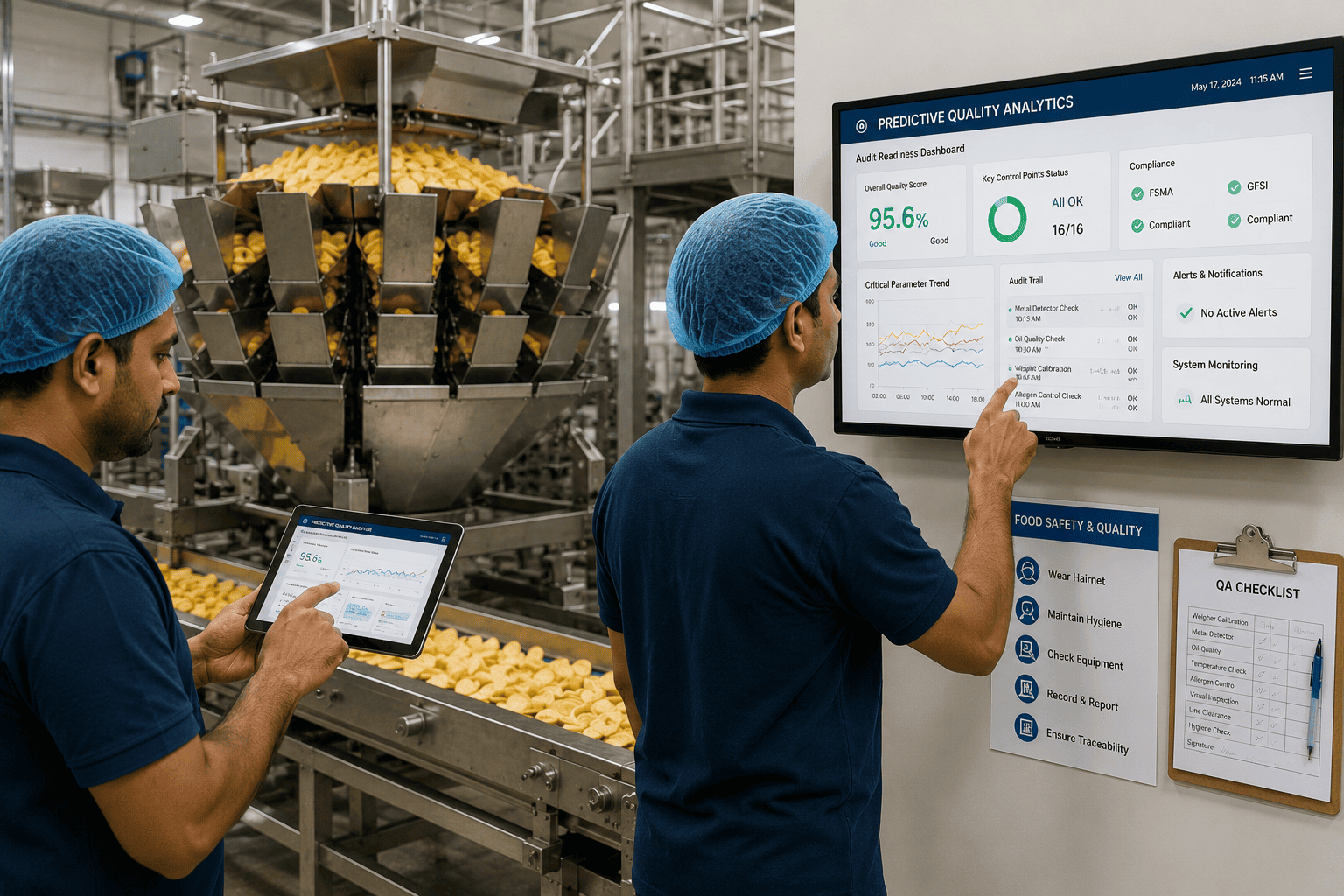
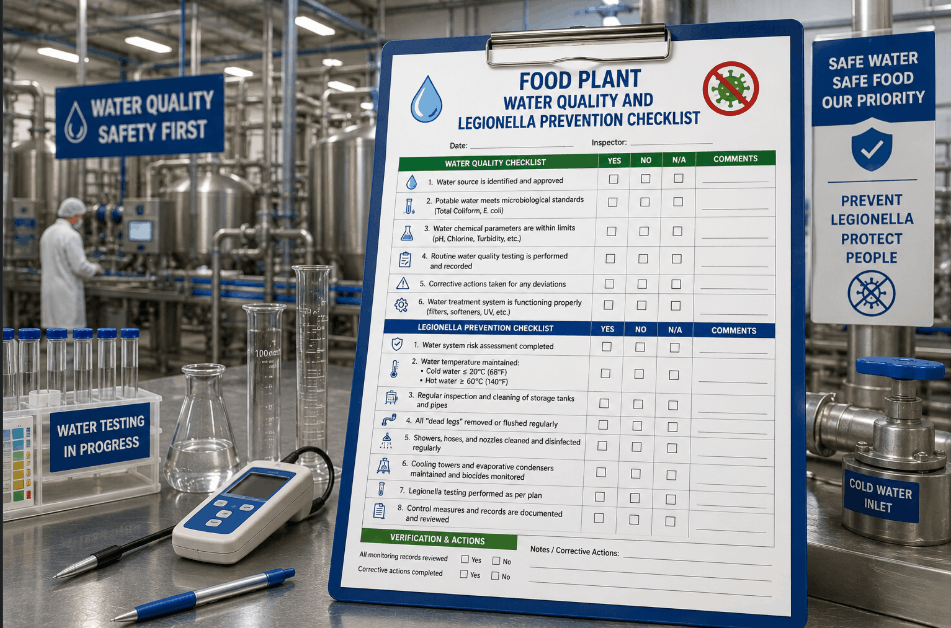
A poorly designed internal audit program is consistently cited as one of the most common non-conformances found during GFSI-benchmarked certification audits — not a missing document, but the internal audit program itself failing to meet the standard it's supposed to help verify. This is a specific kind of irony worth sitting with: the exact mechanism a facility relies on to catch problems before an external auditor does is itself frequently the problem an external auditor finds first. This checklist covers the four components a defensible program actually needs: audit schedule, auditor qualification, checklist development, and finding closure, drawn from ISO 19011 auditing methodology and GFSI's auditor qualification framework. Use it to verify your own program before a certification auditor does. See how iFactory tracks your internal audit schedule, findings, and corrective action closure in one connected system instead of a spreadsheet that drifts.
Food & Beverage · HACCP Compliance · Internal Audit Program
Internal Audit Program: Food Safety Checklist
Verify all four components of a GFSI-benchmarked internal audit program in one pass — schedule, auditor qualification, checklist development, and finding closure — built from ISO 19011 auditing principles.
4
Program components covered in this checklist
Top
Finding category in GFSI-benchmarked certification audits
ISO 19011
Auditing methodology this checklist is built from
5
Major GFSI schemes this checklist applies across
Section 1 — Audit Schedule
Section 2 — Auditor Qualification
Section 3 — Checklist Development
Section 4 — Finding Closure
Section 01
Audit Schedule
A defensible audit schedule is risk-based, not uniform — higher-risk areas around critical control points need more frequent internal scrutiny than lower-risk administrative elements of the food safety management system. A schedule built once and reused unchanged year after year, regardless of what the audit history actually shows, is a common and easily overlooked weakness.
Schedule Coverage & Frequency
Every clause of the certification scheme (SQF, BRCGS, FSSC 22000, or other GFSI-benchmarked standard) is mapped to at least one scheduled internal audit within the certification cycle
Record: Audit schedule matrix · Role: Quality Manager
Processes involving critical control points identified in the HACCP plan are scheduled for audit more frequently than lower-risk administrative or documentation-only elements
Record: Risk-based schedule justification · Role: Food Safety Manager
The schedule is documented in advance for the full certification cycle, not built reactively audit by audit as dates approach
Record: Annual audit calendar · Role: Quality Manager
A documented process exists for adding an unscheduled audit in response to a triggering event — a customer complaint, a recall, or a significant process change
Record: Triggered-audit procedure · Role: Quality Manager
Completed audits are tracked against the schedule, with any missed or delayed audit visibly flagged rather than silently dropped from the record
Record: Schedule compliance tracker · Role: Quality Manager
The schedule accounts for seasonal or campaign-specific production changes, ensuring audit coverage doesn't quietly lapse during a period when the facility runs a different product mix or process configuration
Record: Seasonal audit adjustment log · Role: Quality Manager
Audit scope for each scheduled session is defined in advance — which clauses, which areas, which records — rather than left to the auditor's discretion on the day of the audit
Record: Audit scope definition · Role: Quality Manager
Section 02
Auditor Qualification
GFSI's auditor qualification framework generally covers four dimensions. A common program failure is satisfying only one or two — usually training completion — while treating the others as informal or assumed rather than actively verified and kept current.
HACCP Training & Sector Knowledge
Every internal auditor has completed formal HACCP training sufficient to understand and evaluate critical control points, not just recite the seven principles
Record: HACCP training certificate · Role: HR / Quality Manager
HACCP training is refreshed on a defined interval, not treated as a one-time credential from years earlier that predates the current HACCP plan
Record: Training refresher log · Role: Quality Manager
Each auditor has working familiarity with the specific food category, process, and hazards relevant to the area they are assigned to audit
Record: Auditor competency matrix · Role: Quality Manager
Core Auditing Competence & Audit History
Auditors have completed formal internal auditor training based on ISO 19011 methodology, covering evidence-based findings and structured audit planning
Record: Internal auditor training record · Role: Quality Manager
A documented track record of audit hours actually conducted against the specific GFSI scheme exists for each qualified auditor
Record: Audit hours log · Role: Quality Manager
Auditors are independent of the area they are auditing — nobody is assigned to audit a process or department they directly manage or operate
Record: Auditor assignment log · Role: Quality Manager
Common Failure Patterns
What Certification Auditors Actually Flag
These four patterns account for the large majority of internal-audit-program findings during certification audits. Recognizing them in your own program before the certification body does is the entire purpose of this checklist.
Warning Signs Worth Checking For
The audit schedule exists as a document but completed-vs-planned tracking doesn't — nobody can quickly show which scheduled audits from the current cycle have actually happened
Pattern: Schedule exists on paper only
Auditor training certificates are on file, but nobody can produce a documented record of actual audit hours conducted against the specific scheme
Pattern: Qualification treated as one-time credential
The same generic checklist template has been used, unmodified, across multiple certification cycles despite process or HACCP plan changes in between
Pattern: Checklist never updated to reflect current operations
Findings from the audit report are marked "closed" with no corresponding evidence of verification — the status changed, but nobody documented how or by whom it was confirmed
Pattern: Closure without verification
Keep audit schedules, auditor qualifications, and findings in one connected system instead of a spreadsheet that quietly drifts.
Section 03
Checklist Development
A checklist downloaded generically and applied unchanged tends to drift toward a GMP-walkthrough-only program. A checklist built specifically against the facility's own HACCP plan and scheme clauses produces a fundamentally more useful audit — and it's worth revisiting the checklist itself at least as often as the HACCP plan changes.
Checklist Scope & Customization
The checklist references the facility's own documented procedures by name, not generic industry language that could apply to any facility
Record: Checklist template version · Role: Quality Manager
Each critical control point from the HACCP plan is named specifically on the checklist, with the exact monitoring and verification activity that needs to be confirmed
Record: CCP-to-checklist crosswalk · Role: Food Safety Manager
The checklist goes beyond floor condition and housekeeping items to include records review, verifying that monitoring and corrective action records match what actually happened
Record: Records-review checklist section · Role: Quality Manager
Areas flagged as findings in the previous audit cycle are specifically called out for closer scrutiny in the next checklist version, not silently dropped once closed
Record: Prior-finding follow-up flag · Role: Quality Manager
The checklist is version-controlled, with a clear record of when it was last updated and why, rather than an undated file that may or may not reflect the current scheme requirements
Record: Checklist version history · Role: Quality Manager
The checklist includes verification of supplier and raw material approval records, not just internal process steps, since food safety risk frequently originates upstream of the facility's own operations
Record: Supplier approval verification section · Role: Quality Manager
Checklist items are written specifically enough that two different auditors evaluating the same area would reach the same pass/fail conclusion, rather than leaving significant room for individual interpretation
Record: Checklist item review · Role: Quality Manager
Version-control your checklists automatically and get flagged the moment an item goes stale against your current HACCP plan.
Section 04
Finding Closure
Writing findings is the visible half of the process. Closing them with a verified corrective action is the half that quietly stalls in most programs — and the point where certification auditors most often find a gap, since a program can look complete on paper while its actual closure discipline has quietly eroded.
Finding Documentation & Corrective Action
Every finding states what was directly observed against the specific standard or procedure requirement — not a general impression — and is dated and attributed to the auditor
Record: Finding report · Role: Internal Auditor
Every finding is assigned a named corrective action owner and a specific, realistic deadline — not left open-ended or assigned to a department rather than a person
Record: Corrective action assignment · Role: Quality Manager
Verification & Recurrence Tracking
Closure requires a second person — not the corrective action owner alone — to verify the correction was actually implemented and is effective
Record: Verification sign-off · Role: Quality Manager
Closed findings are retained and cross-referenced across audit cycles so a recurring issue in a similar area is visible, not treated as an unrelated new finding each time
Record: Finding history log · Role: Quality Manager
A recurring finding triggers root-cause investigation rather than another round of the same corrective action that failed to hold the first time
Record: Root-cause investigation record · Role: Food Safety Manager
Open findings are visible to leadership on a standing basis, not only surfaced when someone specifically asks for a status update ahead of a certification renewal
Record: Open findings dashboard · Role: Quality Manager
A finding significant enough to indicate a potential food safety risk, rather than a minor administrative gap, triggers immediate escalation rather than waiting for the standard closure timeline
Record: Escalation procedure · Role: Food Safety Manager
KPI Reference
Internal Audit Program Metrics That Matter
Completing every scheduled audit on the calendar is not the same as running a program that actually catches problems. These five metrics, reviewed on a standing cadence, are what separate a program that looks complete from one that's genuinely functioning.
| Metric |
How to Measure |
Target |
Review Cadence |
| Schedule Compliance |
Audits completed on schedule / Audits planned |
100% |
Quarterly |
| Finding Closure Rate |
Findings closed with verified corrective action / Total findings within the cycle |
> 95% |
Per audit cycle |
| Recurring Findings |
Same or similar finding flagged in 2+ consecutive cycles |
0 recurrences |
Annual review |
| Auditor Qualification Currency |
Auditors with current qualification across all four dimensions / Total active auditors |
100% |
Quarterly |
| Average Days to Closure |
Days from finding raised to verified closure, averaged across the cycle |
Tracked — falling trend indicates improving discipline |
Per audit cycle |
Expert Review
What Food Safety Professionals Say
01
Treat the internal audit program like a wedding rehearsal, not a formality to get through. The whole point is catching the missed steps before the actual event, and that only works if the internal team is honest with itself during the rehearsal. I've seen far too many internal audits that quietly avoid the hard findings because nobody wants to be the one who flags a problem right before certification season — and every single time, the external auditor finds it anyway. Write the finding. Fix the finding. That's the whole program, done honestly.
Dolores Ferreira-Nakamura, Food Safety & Quality Systems Manager · 15 years in GFSI-certified programs
02
The programs that stay clean year over year are never the ones with the fanciest checklist template. They're the ones where a finding from eighteen months ago and a finding from last month are sitting in the same searchable record, so someone actually notices the pattern. Most facilities lose that visibility the moment audit reports live in separate folders by date instead of a connected history.
Marcus Whitfield-Osei, HACCP Consultant · 12 years supporting SQF and FSSC 22000 certification readiness
FAQs
Frequently Asked Questions
Is an internal audit program actually required, or is it a best practice?
If a facility is certified to a GFSI-benchmarked scheme such as SQF, BRCGS, or FSSC 22000, internal audits are a mandatory clause under that certification, not an optional best practice — the scheme requires the facility to systematically verify its own food safety management system between external certification audits.
Book a program assessment to confirm your current program meets your specific scheme's requirements.
Is a GMP walkthrough the same thing as a complete internal food safety audit?
No — a GMP inspection of floor conditions and housekeeping is one component of a complete internal audit program, not a substitute for it. A genuine audit reviews the full food safety management system, verifies critical control points are actually monitored as documented, and produces findings that feed a real corrective action process, a scope considerably broader than a walkthrough checklist alone can cover.
What does an auditor need to be considered qualified under GFSI requirements?
Generally four things: HACCP training sufficient to evaluate critical control points, working knowledge of the specific sector and process being audited, core auditing competence based on ISO 19011 methodology, and a documented track record of audit hours in the relevant program. A common gap is satisfying only the training-completion box while treating the other three dimensions as informal.
Talk to solutions engineering about tracking auditor qualification status automatically.
Why do findings sometimes reappear in a similar form the next audit cycle?
A recurring finding usually signals the corrective action addressed the symptom rather than the root cause. This is only visible if findings are tracked and compared across multiple audit cycles, not just reviewed within a single report.
How often should internal food safety audits be scheduled?
Audit frequency varies by certification scheme and by the risk profile of the specific process — most GFSI schemes expect higher-risk areas around critical control points to be audited more frequently than lower-risk administrative elements, rather than applying one blanket frequency across the entire facility.
Book a program assessment to build a risk-based schedule specific to your process.
Build a Program That Holds Up to Scrutiny
iFactory tracks your internal audit schedule, auditor qualification status, checklist versions, and finding closure — including recurrence across audit cycles — in one connected system, so your program is ready for its next certification audit instead of scrambling to reconstruct history from spreadsheets the week before.