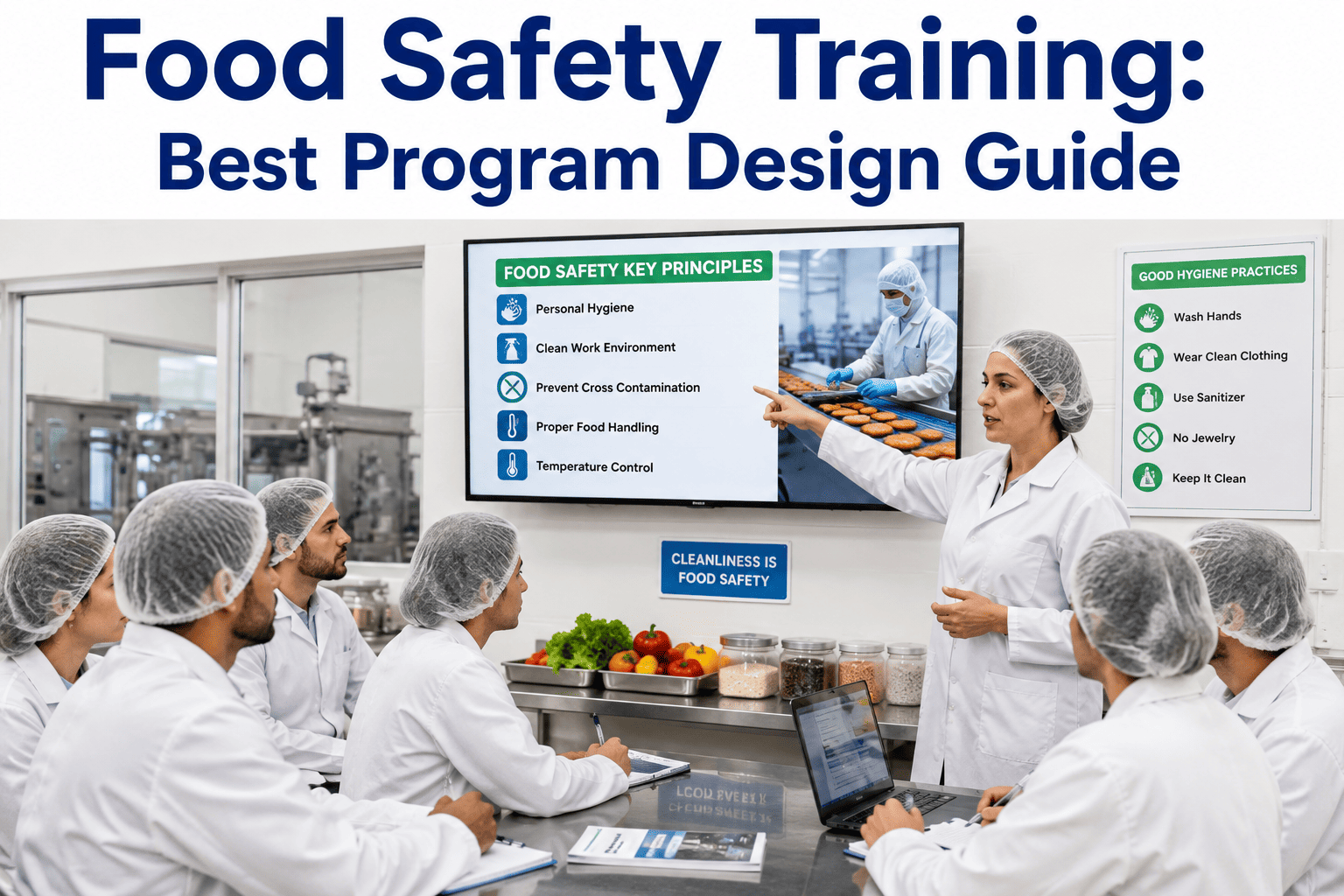
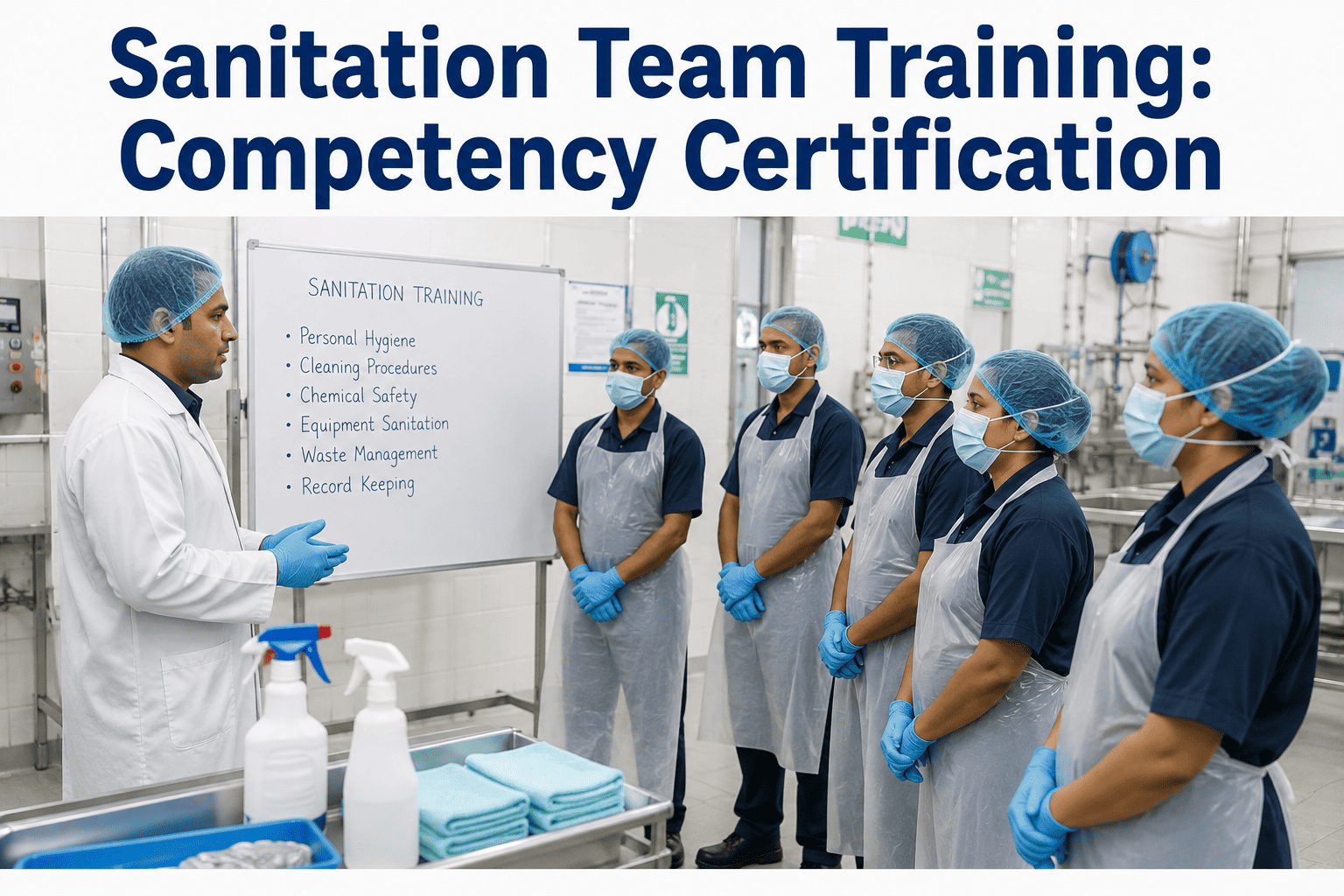
Food safety training is the single most audited element of any HACCP program, and yet it remains the area where processors most often lose points during third-party audits and regulatory inspections. A well-designed training program is not a stack of PowerPoint decks pulled out once a year — it is a structured curriculum that begins with new hire orientation on day one, layers in job-specific competency verification before an employee touches product, and continues through annual refresher cycles that keep the entire workforce aligned with current regulations, allergen controls, and sanitation standard operating procedures. iFactory helps food and beverage plants build, track, and verify every training touchpoint from onboarding through annual recertification, with the workflow explained at iFactory support.
Food Safety Training · HACCP Compliance
Designing a Food Safety Training Program That Covers New Hires, Annual Refreshers, and Job-Specific Competency
Structured curriculum design across new hire orientation, role-specific training, annual refreshers, and documented competency verification — built to satisfy FDA, USDA-FSIS, GFSI, and SQF audit expectations.
Day 1
Food safety orientation required before production floor access
Annual
Refresher training cycle mandated by most GFSI schemes
100%
Documented competency verification required per SQF Edition 9
4 Tiers
Training layers from awareness to HACCP team certification
Why Training Fails Audits
The Five Findings That Turn a Passing Audit Into a Corrective Action
Across FDA warning letters, USDA-FSIS Noncompliance Records, and GFSI audit reports, training-related findings cluster around a predictable set of gaps. Understanding these ahead of the auditor's arrival is the difference between a clean walkthrough and a scramble for records.
01
Missing Training Records
Employee on the floor whose signed training record cannot be produced within the audit day. This is the most common single finding across food safety audits and typically indicates a records management problem, not a training problem.
02
No Competency Verification
Training was delivered but the employee's ability to actually perform the task was never checked. Under SQF Edition 9, GFSI schemes now require documented evidence of competency, not just attendance at a session.
03
Expired Refresher Cycles
Annual refresher training past due for a portion of the workforce, often because the tracking system did not flag employees whose one-year interval had elapsed. Auditors sample training records specifically to catch this.
04
Language and Literacy Gaps
Training delivered only in English on a floor where a significant portion of employees are more comfortable in Spanish, Vietnamese, or another language. The training happened, but the comprehension is not defensible.
05
Generic Content, Job-Specific Task
General food safety awareness delivered to an employee whose actual role involves allergen changeovers, CCP monitoring, or sanitation chemical handling. The training covered the topic but not the job the person is doing.
The Four-Tier Curriculum Model
How a Complete Food Safety Training Program Actually Layers
A defensible training program is built in tiers, each with a distinct audience, distinct content depth, and distinct verification method. A single blanket curriculum cannot cover a temporary sanitation contractor and a HACCP team leader at the same time.
Tier 1
General Food Safety Awareness
All employees, contractors, and visitors with plant access
GMP basics, personal hygiene, handwashing, protective clothing, foreign material awareness, allergen recognition, reporting illness and injury, glass and hard plastic policy, jewelry and cosmetics rules
Signed acknowledgment plus short comprehension quiz
Tier 2
Job-Specific Task Training
Employees assigned to a specific line, station, or process step
SOPs for the actual job, allergen changeover procedures if applicable, sanitation SSOPs, equipment-specific hygiene, product handling, temperature control, metal detector and X-ray testing procedures
On-the-job demonstration observed by a qualified trainer, checklist signed
Tier 3
CCP Monitoring & Advanced Roles
Employees monitoring Critical Control Points, sanitation leads, QA technicians
HACCP principles, CCP monitoring procedures, critical limits, corrective actions, verification activities, record keeping, deviation handling, environmental monitoring program participation
Written assessment plus supervised monitoring shift with sign-off
Tier 4
HACCP Team & PCQI Certification
HACCP team members, Preventive Controls Qualified Individuals, QA management
Accredited HACCP curriculum, PCQI training under FSMA Preventive Controls Rule, hazard analysis methodology, food safety plan development and reassessment, validation and verification
Accredited external certification, renewed per scheme requirements
New Hire Onboarding Blueprint
A Day-by-Day Structure for the First Two Weeks on the Floor
Day 1
Orientation Before Floor Access
Personal hygiene and GMP fundamentals, handwashing procedure with observed demonstration, dress code and jewelry policy, allergen program overview, foreign material and glass policy, illness reporting requirements. Employee cannot enter the production area until orientation is complete and acknowledgment is signed.
Day 2 – 3
Facility Walkthrough & Zone Awareness
Guided walkthrough of raw, RTE, and packaging zones with color-coded PPE and equipment rules, traffic flow between zones, sanitation posting locations, allergen segregation, emergency and evacuation routes, chemical storage locations and MSDS access.
Day 4 – 7
Job-Specific SOP Training
Training on the specific SOPs for the assigned role, shadowing an experienced operator, review of applicable SSOPs, equipment handling procedures, and any CCP or prerequisite program touchpoints the role involves. Trainer signs off on each SOP as demonstrated.
Day 8 – 10
Supervised Independent Work
Employee performs the role independently under close supervision, with the trainer available to answer questions and observe. Any deviation is corrected and re-explained on the spot, and additional practice time is scheduled if needed.
Day 11 – 14
Competency Verification & Release
Final competency check by a qualified supervisor or trainer, signed competency verification form filed in the employee's training record, and formal release to unsupervised work on the assigned role. Any gap identified triggers additional training before release.
Every Auditor Asks the Same Two Questions: "Show Me the Training Record" and "How Do You Verify Competency?" Both Answers Need to Be on Paper, on Demand.
iFactory tracks every training event, every competency sign-off, and every refresher due date for every employee — so audit day starts with confidence, not a filing cabinet search.
Annual Refresher Cycle
What Actually Belongs in the Yearly Recertification Curriculum
Annual refresher training is not a repeat of the new hire orientation slides. It is a targeted update built around what has changed in the past year, where the internal audit program found weaknesses, and what regulatory expectations have shifted. A well-scoped refresher is short, specific, and verifiable.
Regulatory & Standard Updates
New or revised FDA, USDA, or state regulations affecting the plant
GFSI scheme version changes since last refresher
Customer specification changes with food safety impact
New allergen declarations or labeling requirements
Findings From the Past Year
Internal audit findings and their root cause categories
Customer complaint themes with food safety relevance
Environmental monitoring program trends and hot spots
Any recall, withdrawal, or hold-and-release events
SOP & SSOP Changes
Newly issued or revised SOPs since last training cycle
Sanitation SSOP revisions from validation studies
New equipment or process changes with hygiene impact
Updated corrective action procedures for CCP deviations
Refreshed Fundamentals
Handwashing technique, observed demonstration
Allergen awareness, refreshed with current product mix
Foreign material and glass policy reminders
Illness reporting expectations and confidentiality
Competency Verification Methods
How to Prove the Training Actually Worked
Method
What It Verifies
Best For
Records Kept
Written Assessment
Knowledge recall and rule comprehension
GMP awareness, allergen rules, HACCP theory
Scored answer sheet with pass threshold
Observed Demonstration
Actual ability to perform the task correctly
Handwashing, sanitation SSOPs, changeovers
Signed observation checklist by qualified trainer
Supervised Shift
Sustained performance under real conditions
CCP monitoring, QA sampling, metal detector checks
Shift sign-off log with corrective feedback notes
Third-Party Certification
Accredited external validation of qualification
HACCP team, PCQI, allergen program manager
Certificate with issuing body and expiry date
Verbal Interview
Understanding of the "why" behind the procedure
Auditor-style checks before internal audits
Interview log with topics covered and outcome
Language, Literacy & Delivery
Making Training Actually Land With a Diverse Workforce
Multi-Language Materials
Training materials produced in the primary languages of the workforce, with each translation reviewed by a native speaker familiar with food industry terminology. English-only training in a bilingual workforce is a recurring GFSI finding and a defensibility problem during regulatory inspection.
Visual-First Content
Photo-based and video-based SOPs paired with written procedures. Visual reference reduces the literacy barrier and gives every employee the same picture of what "correct" looks like — critical for handwashing, PPE donning, and allergen changeover work.
Short, Focused Modules
Ten to fifteen minute modules on single topics rather than multi-hour blanket sessions. Retention drops sharply after twenty minutes, and short modules are easier to schedule around shift patterns without pulling the whole line down.
On-the-Floor Refreshers
Toolbox talks, pre-shift huddles, and posted visual reminders at the point of use. A handwashing reminder posted above the sink is more effective than the same content buried in an annual PowerPoint deck delivered in the break room.
Training Records That Survive an Audit
What Every Employee's Training File Needs to Contain
A
Signed Orientation Acknowledgment
Dated acknowledgment that new hire orientation was completed before floor access was granted, with the topics covered listed and the employee's signature confirming understanding.
B
Job-Specific SOP Sign-Off
Checklist of every SOP relevant to the employee's role, each signed by the trainer confirming the employee demonstrated the procedure correctly. Includes revision date of the SOP so it is clear which version was trained on.
C
Competency Verification Form
Signed verification that the employee is competent to perform the assigned role independently, dated and signed by a qualified verifier who is not the same person as the direct trainer where the standard requires independence.
D
Annual Refresher Records
Dated record of every annual refresher session attended, with topics covered, assessment scores where applicable, and the trainer's signature. Gap of more than twelve months between refreshers is a standard audit finding.
E
Reassignment or Cross-Training Records
When an employee moves to a new role or is temporarily assigned to cover a different station, the training and competency verification for the new role must be documented before the employee performs that work unsupervised.
F
External Certification Records
Copies of HACCP, PCQI, or other accredited certifications with issue dates, expiry dates, and issuing body identification, filed and tracked so renewal is triggered before expiry.
Training Frequency by Role
Who Needs What, and How Often
Role
Initial Training
Refresher
Triggered Retraining
Production Operator
Tiers 1 + 2 before floor release
Annual
SOP revision, role change, corrective action
Sanitation Team
Tiers 1 + 2 + chemical safety
Annual + quarterly toolbox
New chemical, SSOP change, verification finding
CCP Monitor
Tiers 1 + 2 + 3
Annual + monitoring drill
CCP deviation, monitoring procedure change
QA Technician
Tiers 1 + 2 + 3
Annual + method updates
New test method, equipment change
HACCP Team Member
Accredited HACCP course
Per certification body cycle
Food safety plan reassessment
Preventive Controls QI
FSPCA-recognized PCQI course
Per regulatory guidance
FSMA rule updates, product category change
Contractor / Visitor
Tier 1 awareness on each visit
Every plant entry
Policy update between visits
Field Example
A Ready-to-Eat Processor Cutting Training-Related Audit Findings From Twelve to Zero in One Cycle
A mid-sized ready-to-eat meat processor operating under SQF Edition 9 was carrying twelve training-related findings across its most recent audit cycle, with the majority clustering in three categories: missing signed acknowledgments for three temporary sanitation contractors, expired annual refreshers for eleven production operators whose one-year interval had lapsed unnoticed, and no documented competency verification for four newly cross-trained employees who had moved between the raw and RTE zones during a staffing shortage. The site was actively preparing for its recertification audit and had been given a corrective action deadline that made the manual training records approach unworkable at scale.
Over an eight-week rollout with iFactory, the plant migrated every active employee's training file into a structured record with automated tracking of refresher due dates, contractor-onboarding flows that required completed Tier 1 acknowledgment before badge activation, and competency verification checklists that had to be signed off before a cross-trained employee could be scheduled on the new zone. The next audit cycle closed with zero training-related findings, and the site's food safety manager reported that the time previously spent assembling training records for auditor requests dropped from roughly two days of preparation per audit to under thirty minutes of on-demand queries during the audit itself. The refresher due-date tracking has since caught early-warning gaps on two occasions where employees returned from extended leave with expired records, allowing retraining to be scheduled before the employees resumed their previous roles.
12 to 0
Training-related audit findings, one cycle
8 weeks
Full rollout from kickoff to audit-ready
2 days to 30 min
Audit prep time for training records
Frequently Asked Questions
What Food Safety Managers Ask Before Rebuilding Their Training Program
Is annual refresher training a regulatory requirement, or a GFSI expectation?
The answer depends on the standard and the role. FDA's FSMA Preventive Controls Rule requires that employees receive training appropriate to their assigned duties, and that the training be documented, but it does not specify a fixed annual cycle for all roles. USDA-FSIS regulations require training for HACCP-related activities. GFSI schemes such as SQF, BRCGS, and FSSC 22000 do explicitly expect at least annual refresher training for food safety awareness and documented competency verification for all food safety related roles. In practice, most audit-focused plants build their program around an annual cycle because it satisfies the strictest applicable standard and simplifies scheduling. To align your program with the specific standard you are audited against,
book a demo.
Who is qualified to deliver food safety training in-house?
For general awareness and job-specific SOP training, a qualified in-house trainer is typically an experienced employee or supervisor who has themselves been trained on the material and is designated in writing. For HACCP team training and PCQI certification, delivery must come from accredited external sources such as IHA-recognized HACCP instructors or FSPCA-recognized PCQI lead instructors. Sanitation chemical training often requires the chemical supplier or a certified industrial hygienist depending on jurisdiction. The training program document should specify who is authorized to deliver each tier of training, and their qualifications should be on file with their own training records. For a checklist of qualification requirements by role, contact
iFactory support.
What is the difference between training and competency verification, and why does it matter?
Training is the delivery of information, whether through classroom instruction, on-the-job shadowing, video, or written material. Competency verification is the separate step of confirming that the employee can actually perform the task correctly on their own. An employee can sit through an eight-hour training session on allergen changeovers and still not be able to perform one competently — the sign-in sheet proves attendance, not capability. Modern GFSI schemes, particularly SQF Edition 9, have moved decisively toward requiring documented competency verification as a distinct record from training attendance, and this is now a common finding area for auditors. Building the two records separately is the cleanest way to satisfy the expectation and defensibly show that trained employees are also competent employees.
How do we handle training for temporary and contract workers who may only be on site for days?
Temporary and contract workers must receive at minimum Tier 1 general food safety awareness training before floor access, and if they will be performing any food-contact or CCP-related work, they need the same job-specific training and competency verification as a direct employee. The practical approach is a streamlined contractor onboarding module delivered on arrival, with the acknowledgment signed and filed against the contractor's plant badge or entry log before access is granted. Repeat contractors visiting frequently can be enrolled in a shortened annual refresher rather than repeating the full module on every visit. This is one of the most frequently missed areas in audits because contractor training often lives outside the main HR training system entirely.
How does iFactory actually help with training program management day-to-day?
iFactory provides a structured employee training record for each person on site, tied to their role, with automated tracking of due dates for annual refreshers, expiry dates for external certifications, and required competency verifications before role changes take effect. New hire onboarding flows enforce completion of Tier 1 acknowledgment before floor access is granted, and cross-training assignments trigger competency verification checklists that route to the qualified verifier before the schedule can include the employee on the new role. During audits, training records are queryable on demand by employee, by role, by SOP revision, or by date range, so the auditor's request becomes a fifteen-second lookup rather than a filing cabinet search. To see the workflow live against your specific standard and workforce mix,
book a demo.
Turn Food Safety Training From an Audit Liability Into a Documented, Defensible Program.
New hire onboarding, job-specific training, annual refreshers, and competency verification — tracked for every employee, ready for every auditor.