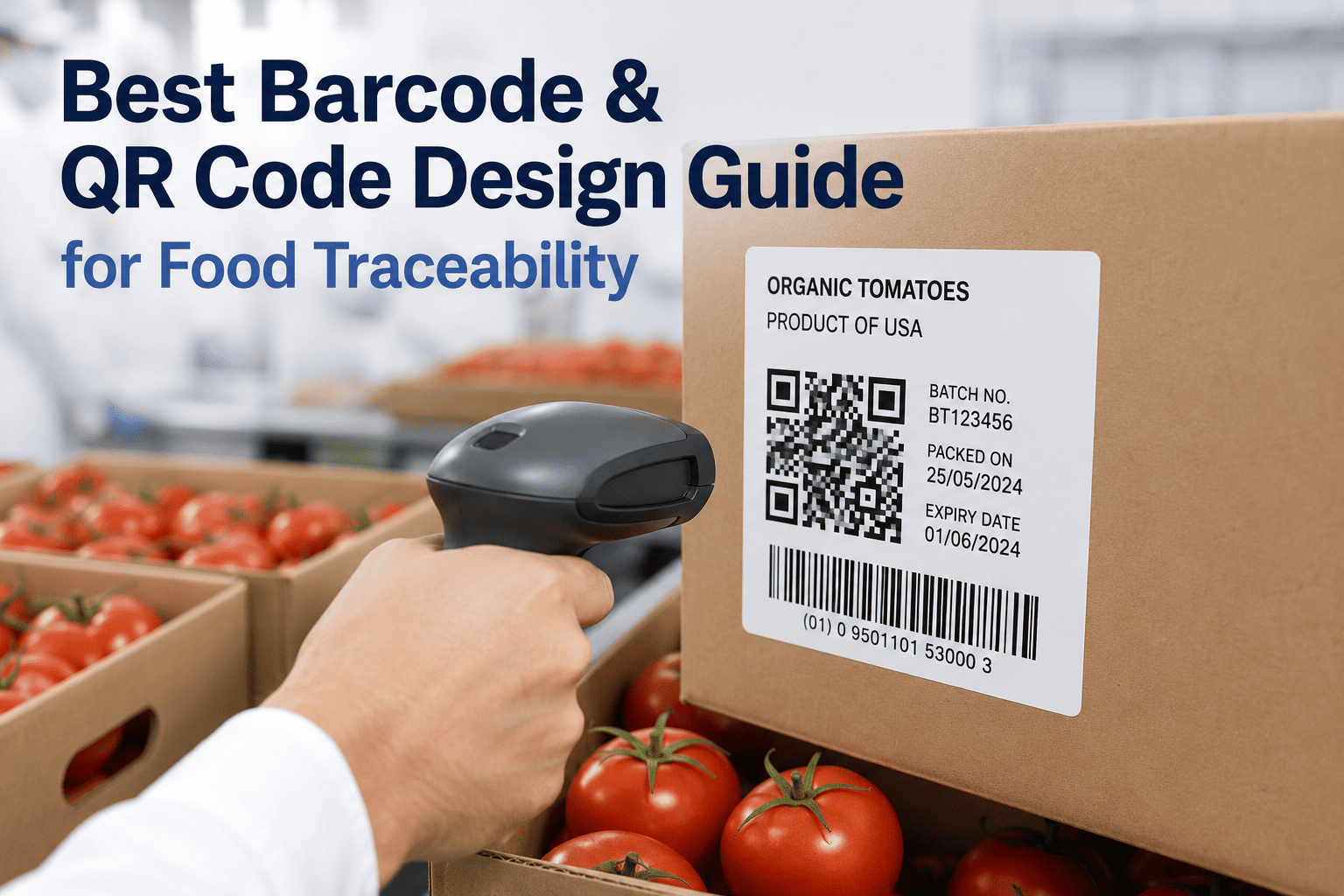
A barcode that scans perfectly on the plant floor printer can still fail at a retail distribution center three states away, and in food traceability that failure isn't a minor inconvenience — it's a shipment held at the dock, a recall record with a gap in it, or a batch that can't be pulled fast enough when it matters most. The gap between "prints fine here" and "scans reliably everywhere" comes down to a handful of design decisions made once, early, and then applied consistently: which symbology to use, how it's sized and printed, how its quality is verified before it ever leaves the plant. This guide walks through those decisions for GS1-128 and GS1 DataMatrix specifically, the two standards food and beverage traceability runs on. Teams building or auditing a labeling program can book a demo with iFactory to see automated print verification running against real label samples.
A Barcode That Survives the Trip From Your Line to Their Dock
GS1-128 and GS1 DataMatrix design, printing, and verification rules that hold up under a retail DC scanner — not just your own.
GS1-128 or GS1 DataMatrix — Which One and When
Food traceability programs almost always need both symbologies somewhere in the supply chain, applied to different unit levels. Choosing correctly up front avoids a relabeling exercise later when a customer's receiving system rejects the wrong format.
Linear barcode, case and pallet level
The standard for shipping cartons and pallets moving through retail distribution centers. Encodes GTIN, batch or lot number, and best-before date in Application Identifiers most DC scanners are tuned to read.
2D matrix, small item and unit level
Suited to small packaging where a linear barcode's footprint won't fit, or where more data — batch, expiry, serial — needs to travel with an individual unit rather than just the case.
The Five Print Parameters That Actually Determine Scannability
A barcode that looks correct to the eye can still fail a scanner if any one of these parameters falls outside spec. Each is measured independently during verification, and a failure in any single one is enough to fail the whole symbol.
X-dimension
The width of the narrowest bar or module. Too small and print resolution can't render it cleanly; too large and the label may not fit the target substrate.
Quiet zone
The blank margin surrounding the symbol. Any text, logo, or graphic encroaching on this zone is one of the most common causes of a scan failure.
Contrast (PCS)
Print contrast signal between bars and background. Low-contrast substrates or faded thermal print heads degrade this first and fastest.
Aspect ratio
For GS1-128, bar height relative to code length. Too short a bar height reduces the scanner's tolerance for a slightly off-angle read.
Data structure
Correct GS1 Application Identifiers, check digit calculation, and field separators — a print-perfect symbol with malformed data still fails downstream.
Verify Every Label Before It Leaves the Line
iFactory grades every printed barcode against ISO verification standards in real time, catching a failing label before it reaches a pallet.
Reading a Verification Grade
ISO/IEC verification produces a letter grade from A to F for each printed symbol, and most retail trading partner agreements set a minimum acceptable grade in the routing guide. Knowing what the grade actually reflects makes it a management tool rather than a pass/fail mystery.
Most retail routing guides require a minimum grade of C (often expressed as 1.5/letter equivalent) measured under ANSI conditions. A grade of D or F at the point of print all but guarantees a downstream scan failure once the label experiences any real-world handling wear.
Where Food Labels Fail in the Real World
A barcode that verifies perfectly fresh off the printer can still fail after the journey through a cold chain, a case erector, or a few days on a loading dock. These are the conditions specific to food and beverage packaging that print verification alone won't catch.
Condensation on refrigerated or frozen packaging
Moisture forming on cold-chain packaging can distort thermal-transfer print or fog a laminate over a direct-print label, degrading contrast exactly when the scan matters most.
Curved or flexible substrates
Barcodes printed on flexible pouches or curved containers distort under wrap tension — verification should be performed on the substrate in its actual final shape, not a flat proof.
Print head wear over a production run
Thermal print quality degrades gradually as a print head wears, meaning the first label off a run can pass verification while the two-thousandth quietly fails.
Audit Readiness: What a Trading Partner Will Actually Check
When a retail trading partner or auditor reviews a food traceability labeling program, these are the specific items that come up most consistently.
Frequently Asked Questions
What minimum barcode grade do most retail distribution centers require?
Requirements vary by retailer, but a grade of C or better under ANSI/ISO verification conditions is a common baseline written into routing guides, with some trading partners requiring B or higher for high-volume automated receiving lines. The safest approach is checking the specific routing guide for each major customer rather than assuming a single universal threshold, since penalties for non-compliant labels — chargebacks, refused shipments — are typically spelled out there directly.
Can the same barcode data be represented as both GS1-128 and GS1 DataMatrix?
Yes, the underlying GS1 Application Identifier data structure is symbology-independent, so the same batch, GTIN, and date information can be encoded in either format depending on which level of packaging it's applied to. Many food traceability programs use GS1-128 on the case and pallet labels while using GS1 DataMatrix on the individual consumer unit, all pulling from the same underlying batch record.
How often should print verification actually happen — once per setup or continuously?
Because print quality can degrade gradually over a production run from print head wear, ribbon depletion, or substrate variation, verifying only at setup misses failures that develop mid-run. Continuous or statistically frequent in-line verification, rather than a single check at the start, is what actually catches the labels most likely to fail downstream — this is the core reason automated in-line verification outperforms a manual spot-check program.
Does condensation-prone cold chain packaging need a different labeling approach entirely?
Cold chain and frozen packaging generally needs a label material and print method rated for moisture and temperature cycling, such as a synthetic label stock with a protective laminate, combined with print verification performed under representative humidity conditions rather than a dry lab environment. Skipping this step is one of the most common reasons a barcode passes verification at print time but fails after the product completes its actual cold chain journey.
What's the fastest way to find out if our current labels would pass a trading partner audit?
Running a verification pass against a representative sample of your current production labels — including ones pulled later in a run rather than only the first off the press — is the quickest way to see where the real gaps are. Book a demo to have that sample review run against your actual barcode and label data.
Stop Finding Out About Bad Labels at the Dock
Book a 30-minute demo and see how iFactory verifies every GS1-128 and DataMatrix label in-line, before it ever reaches a pallet.