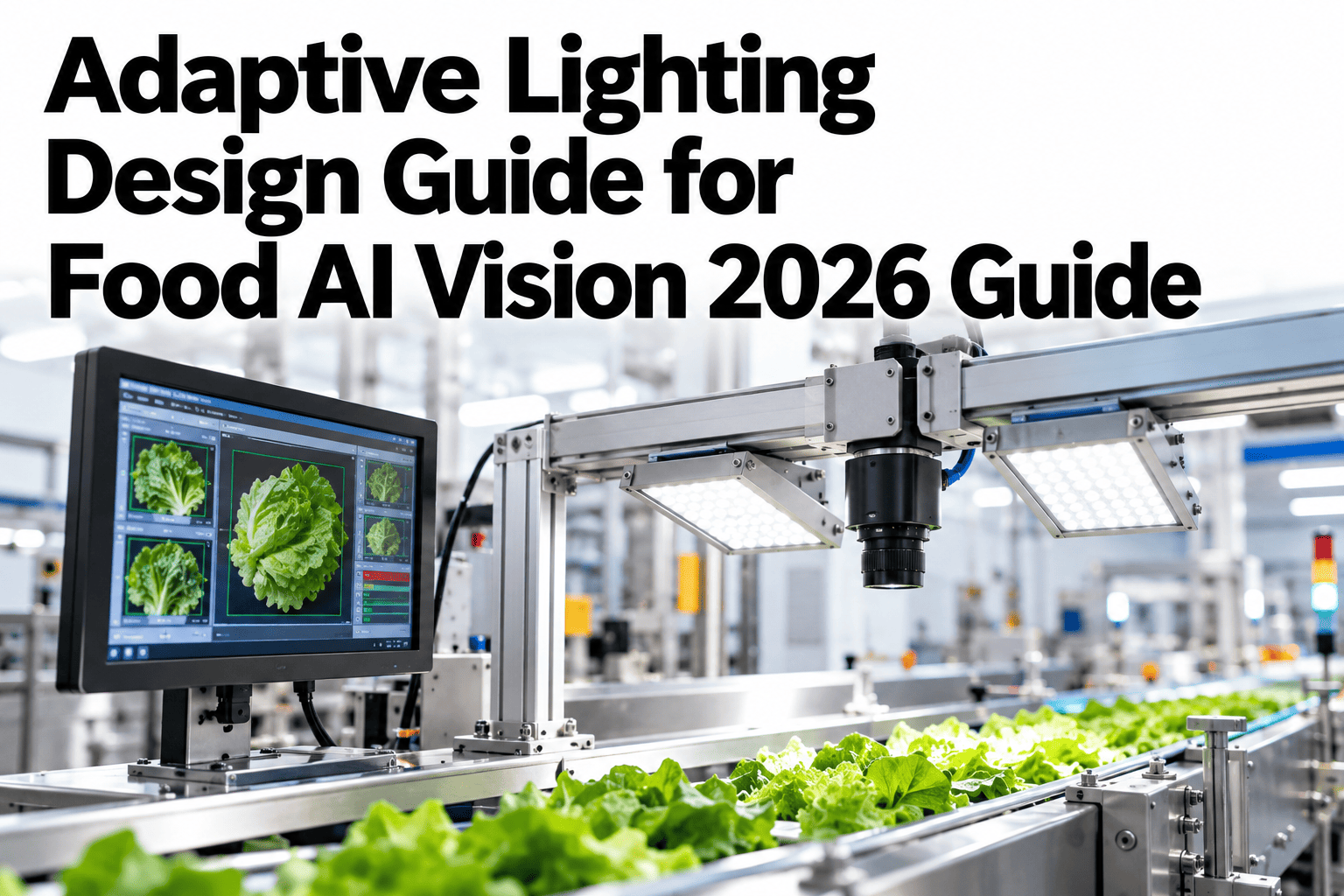
A vision model can be trained perfectly and still fail on the floor if the light hitting the product changes between training day and production day. Ambient light drifting with the sun through a nearby window, a shadow cast by a passing operator, or a specular glare off wet packaging all shift what the camera actually sees, even though the product itself hasn't changed at all. Most AI vision failures blamed on "the model" are actually lighting problems the model was never built to handle. Getting enclosed hoods, uniform LED banks and polarization right from the start prevents a long list of problems later, and plants can review their own camera setup against this design in a short session.
Most "Model" Failures Are Actually Lighting Failures
iFactory designs enclosed, uniformly lit inspection zones so ambient drift never becomes a false reading.
Why Lighting Drift Breaks a Trained Model
A model learns the visual relationship between pixel values and defect classes, trained under one set of lighting conditions. When lighting shifts, the same physical defect produces different pixel values than the model learned, and accuracy degrades without the underlying product actually changing.
| Lighting Problem | Common Cause | Fix |
|---|---|---|
| Ambient light drift | Sunlight through windows, overhead lights cycling | Enclose the inspection zone from outside light |
| Hotspots and shadows | Uneven LED placement or insufficient diffusion | Use a uniform LED bank with proper diffusion |
| Specular glare | Reflective packaging or wet product surfaces | Add polarization to the lighting and camera path |
| Color temperature shift | Mixed light sources with different color temperatures | Use a single, consistent light source for the inspection zone |
Get Your Inspection Zone's Lighting Assessed
Book a 30-minute session and iFactory will assess your current lighting setup for uniformity and drift risk.
Three Design Elements That Stop Drift
Enclosed Inspection Hoods
An enclosed hood blocks ambient light entirely, so the only light the camera sees is the light the system controls.
Uniform LED Banks
Properly placed and diffused LED arrays eliminate hotspots and shadows that otherwise distort how a defect appears.
Polarized Lighting and Lens Path
Polarization cuts specular glare off reflective or wet surfaces, revealing surface detail a glare would otherwise hide.
Before and After: Uniformity Across the Field of View
One line's inspection zone was remapped before and after an enclosed hood and uniform LED bank were installed.
Signals Your Lighting Is Driving False Readings
Where iFactory Fits
iFactory designs the full lighting environment around each inspection zone, not just the camera and model.
Custom Enclosure Design
Hoods are designed to fit your specific line geometry while fully blocking ambient light sources.
Uniformity-Mapped LED Banks
Lighting is mapped and validated for uniformity across the full field of view before the model is trained on it.
Polarization Where Needed
Reflective and wet-surface products get polarized lighting paths to eliminate glare-driven false readings.
Ongoing Lighting Health Checks
LED degradation and drift are monitored over time, catching gradual uniformity loss before it affects accuracy.
Reviewed by iFactory's Vision Systems team for alignment with current machine vision lighting practice. The uniformity maps shown are illustrative; actual lighting design should be validated on your specific line geometry, product surface and camera placement.
Frequently Asked Questions
Can we fix lighting issues without a full enclosure rebuild?
Sometimes, if the main issue is a specific ambient source like a nearby window or door, a targeted fix may resolve it without a full enclosure. A lighting assessment identifies whether a partial or full solution is appropriate. Support can assess what your specific setup needs.
How often does LED lighting need to be checked for degradation?
LEDs degrade gradually over their operating life, so periodic uniformity checks, commonly every few months, catch drift before it meaningfully affects model accuracy.
Does polarization reduce the amount of usable light reaching the camera?
Yes, polarization filters reduce overall light transmission, so the lighting system needs to be designed with that in mind rather than added as an afterthought to an existing setup. See a polarization setup designed for your specific product in a short session.
Does this apply to lines running multiple product types?
Yes, though different products with different surface properties, reflective versus matte, for example, may need slightly different lighting configurations within the same enclosure design.
How do we know if a reported accuracy issue is actually a lighting problem?
Patterns tied to time of day, shift, or specific product orientation in the frame are strong indicators, as are clusters of false rejects concentrated in one area of the field of view. Ask support how to diagnose this on your own line.
Fix the Light, Not Just the Model
iFactory designs enclosed, uniform, drift-resistant lighting for every inspection zone. Book a walkthrough on your own setup.