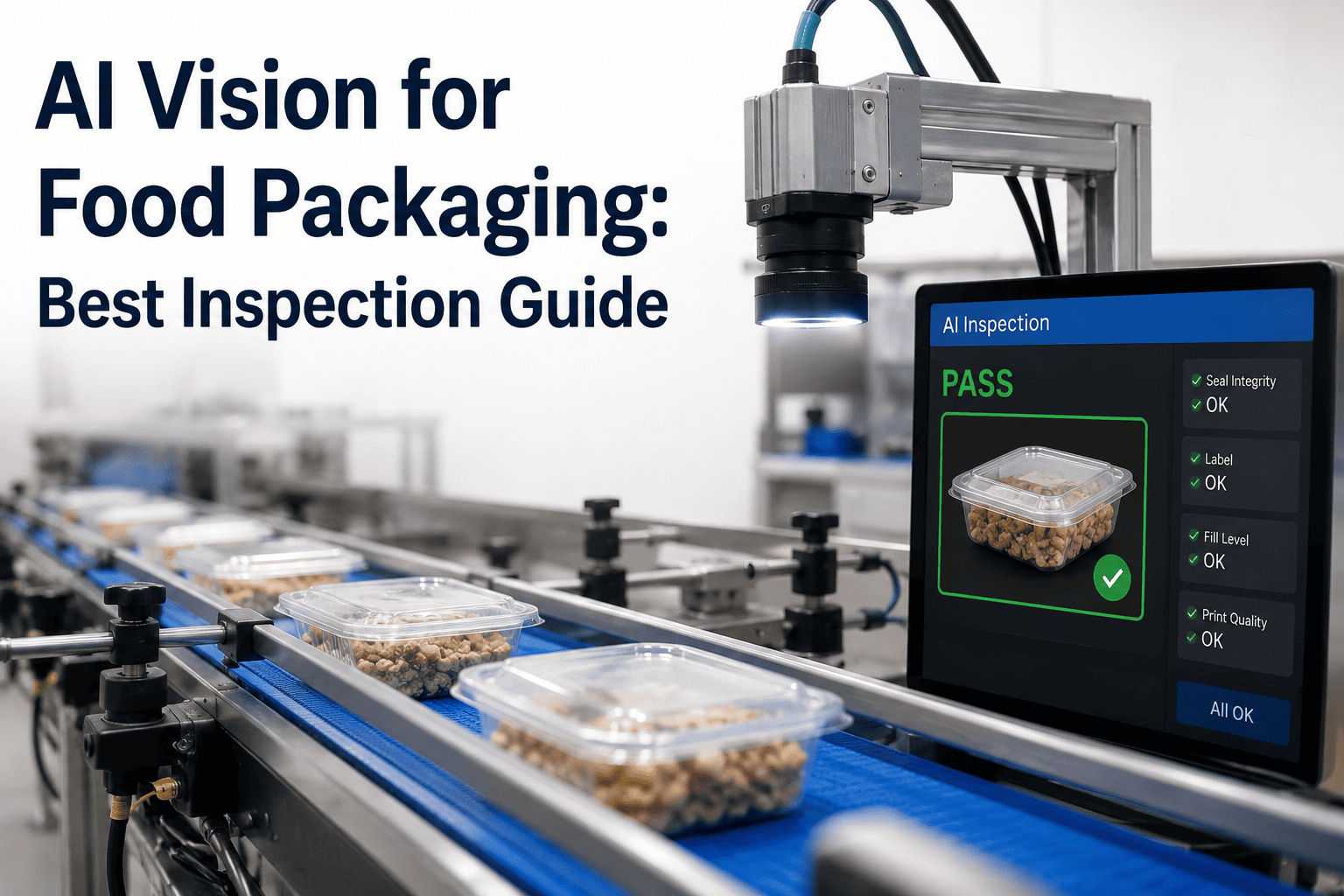
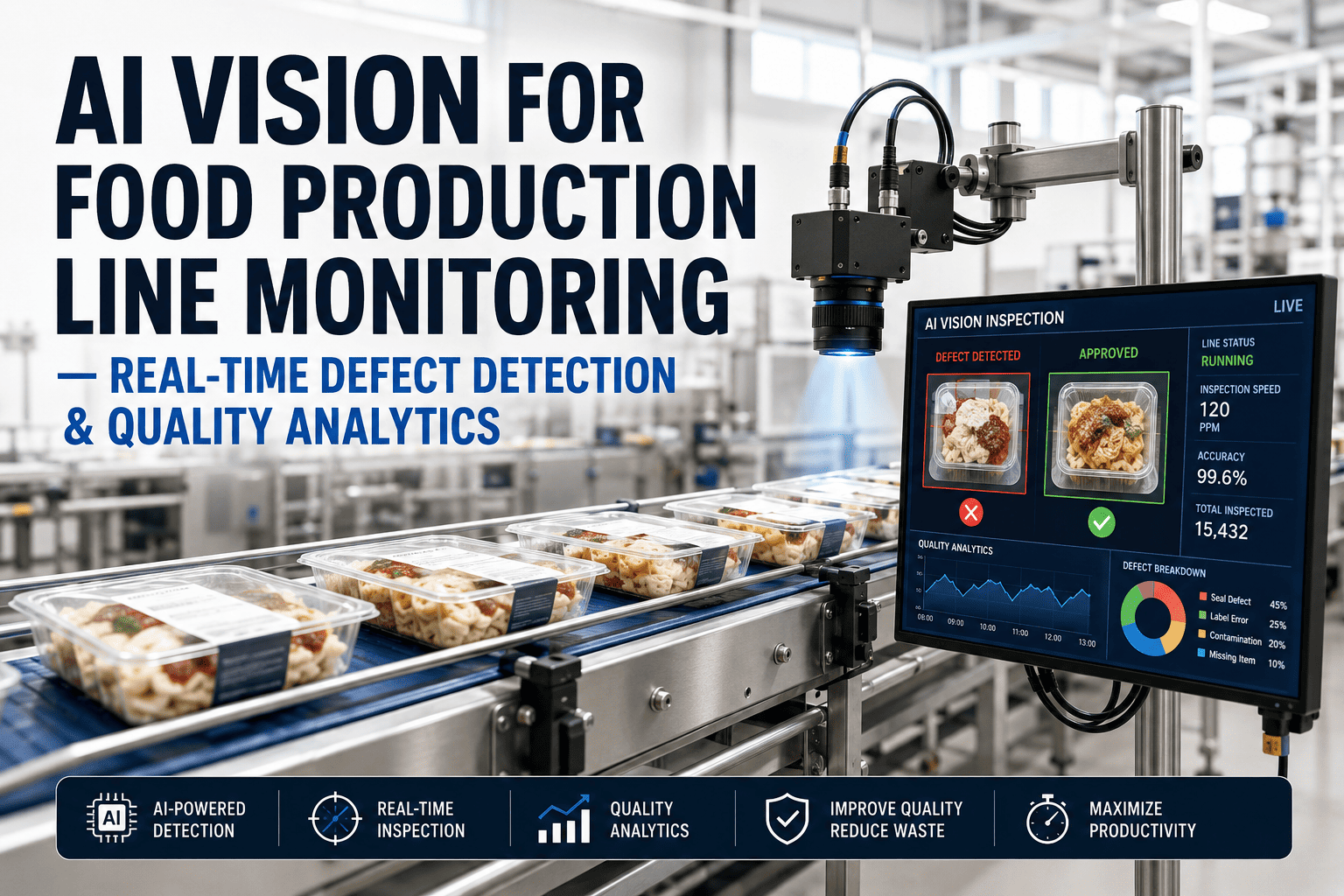
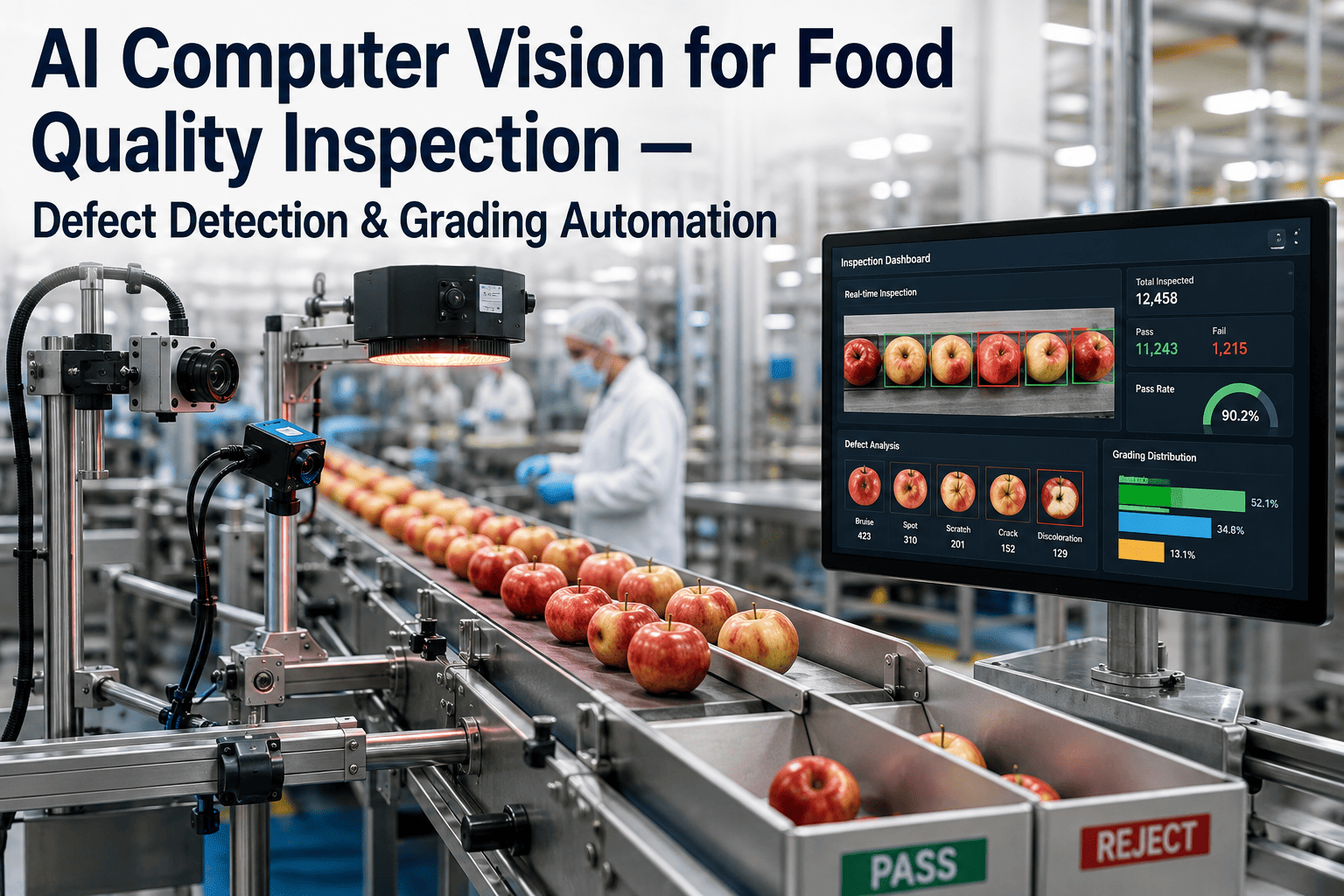
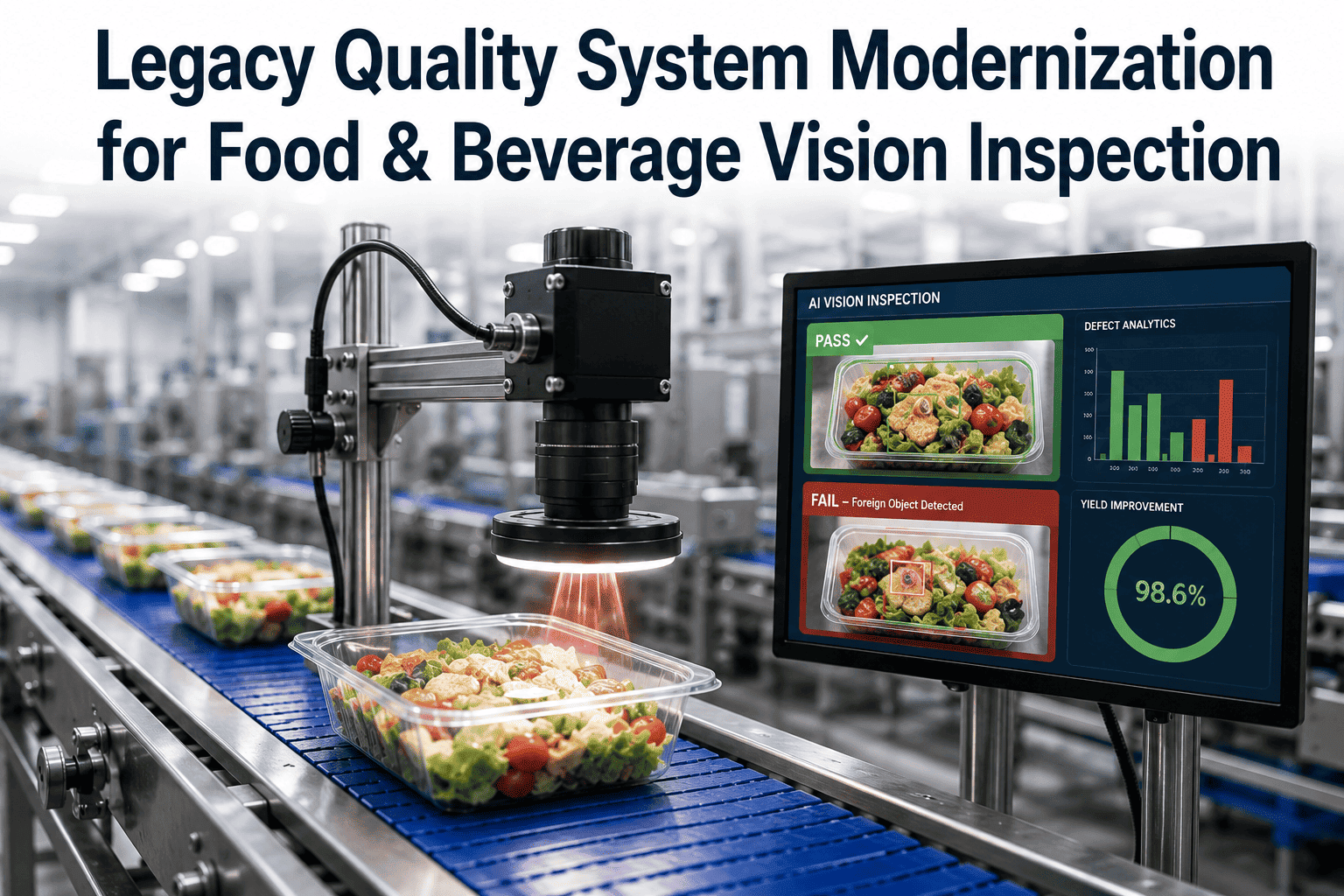
A single micro-channel in a heat seal, a smudged date code, a barcode that scans at the plant but fails at retail — each of these is a recall waiting to happen, and none of them is reliably caught by human inspection at line speeds of 400 to 1,200 units per minute. AI vision cameras trained on your specific packaging materials replace the sampling model with 100% inline verification, hitting 99%+ detection accuracy at full production speed and triggering the reject mechanism within 200 milliseconds. This guide walks through what an AI vision stack for food packaging actually inspects, where deep learning outperforms rule-based systems, and where rule-based checks still belong. Walk it against your own packaging line when you book a demo.
AI VISION · FOOD PACKAGING · SEAL · LABEL · PRINT · BARCODE
Every seal, label, date code, and barcode inspected on every unit at full line speed — not one in fifty.
Manual sampling misses the recall-grade defects that live between samples. Rule-based vision holds up for deterministic checks like barcode decode and date-code OCR, but breaks on reflective substrates, subtle seal defects, and label artwork variation. AI vision closes that gap.
CAMERA · LIGHTING · EDGE INFERENCE · REJECT SIGNAL
99%+
Detection accuracy with deep learning models trained on your packaging.
200 ms
Time from image capture to reject signal reaching the divert mechanism.
1,200/min
Sustained inspection speed on beverage packaging lines at full production.
Under 60%
Human detection rate for small foreign objects on fast-moving food lines.
The four inspection surfaces on every food package
Packaging inspection is not one problem, it's four. Each surface has its own physics, its own defect library, and its own decision speed budget — and any one of them can trigger a recall or a retailer chargeback if it fails.
01
Seal Integrity
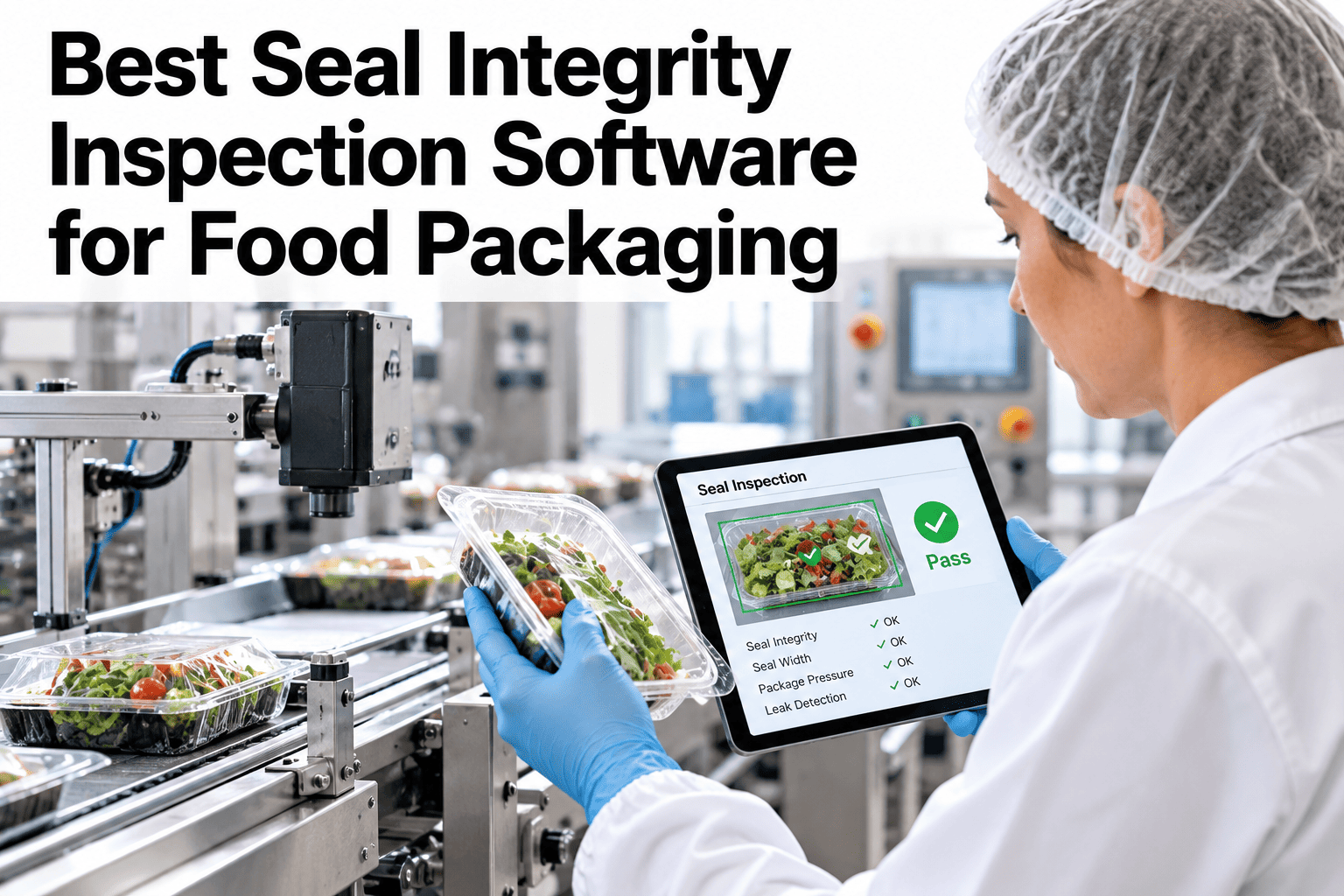
Heat seals, induction seals, and lidding films must close cleanly around the sealing area. Micro-channels, contaminant traps, wrinkles, and incomplete closures let oxygen and pathogens in — and are the single biggest source of leaker complaints in fresh, frozen, and MAP food packaging.
02
Label Placement and Artwork
Labels must land within tolerance, right-side up, on the correct product, with the correct SKU artwork. Allergen declarations, ingredient lists, and regulatory panels have to match exactly what's inside the pack — a mismatch here has recall consequences.
03
Date Code and Print Quality
Best-by dates, lot codes, and batch identifiers printed by inkjet, laser, or thermal transfer must be present, legible, and correct for the shift's production plan. Missing, smudged, or wrong-format codes fail retailer scans and block trace-back during recall investigation.
04
Barcode Readability and Grade
Consumer UPC, GS1-128 case labels, and 2D DataMatrix codes must scan at the retailer's front-end, not just at your plant. A code that decodes fine on a fresh label often fails after freezer transit or minor abrasion — grade quality matters as much as raw readability.
Where rule-based vision runs out
Classical vision is not obsolete. It still earns its place on hard, deterministic checks. But the defects that actually cause recalls are subtle, variable, and context-dependent, and that's where deep learning trained on your own packaging closes the gap.
| Inspection task | Rule-based vision | Deep learning vision | Recommended stack |
| Barcode decode and grade |
Reliable, deterministic, ISO-graded |
Overkill for pure decode |
Rule-based, keep it |
| Date-code OCR |
Works on clean print |
Handles smudge and low contrast |
Rule-based first, DL fallback |
| Fill-level gauge |
Works on fixed geometry |
Handles product variation |
Rule-based or 3D sensor |
| Seal micro-channel |
Misses subtle defects |
Trained on defect library |
Deep learning only |
| Label artwork match |
Template matching brittle |
Recognizes SKU variants |
Deep learning only |
| Foreign material on food |
Threshold-based false positives |
Anomaly detection against baseline |
Deep learning only |
The six seal defect types the model catches
Seal integrity is the last line of defense between your product and contamination, and every one of these defects is invisible to human inspection at line speed. A deep learning model trained on your specific seal materials catches them at 99%+ accuracy without stopping the line.
D-01
Micro-channel Leak
A hairline gap in the seal that lets air through — invisible under normal lighting, catastrophic for shelf life. Detected by texture analysis of the seal band under directed illumination.
D-02
Product in Seal Zone
Sauce, powder, or fibre trapped in the sealing area prevents full closure. The model classifies contamination against a clean-seal baseline of the same film and product.
D-03
Wrinkle or Fold
Film folded over during sealing creates a channel underneath. Rule-based systems mistake wrinkles for shadows; a trained model recognizes the geometry consistently.
D-04
Incomplete Closure
Seal did not close along a portion of the band, often due to jaw wear or temperature drop. Detected by comparing continuous seal signature against the trained normal.
D-05
Weak Seal
Seal formed but bond strength is below spec, typically from temperature or dwell time drift. Visual signature differs subtly from a full-strength seal; deep learning catches it.
D-06
Foreign Material Occlusion
Non-product material — glove fibre, brush bristle, cardboard fleck — lodged in or near the seal. Anomaly detection flags any deviation from the trained normal envelope.
See seal defect detection running against your own packaging film
iFactory trains the model on your seal materials, product mix, and line lighting — so detection accuracy holds across every SKU changeover instead of drifting after each recipe change.
Book a Demo
The label and print inspection sequence
A single camera position rarely covers everything a label needs. On most food lines the label inspection sequence chains several decisions in order, and any one of them can trigger a reject before the pack reaches case packing.
01
Label Presence
Confirm a label is on the pack at all. Missing labels are common after applicator jams and go undetected without inline verification.
02
Position and Orientation
Label centred within tolerance, right-side up, no fold or lift. Skewed labels are the most common cause of retail scan failures.
03
Artwork and SKU Match
Label artwork matches the production order — critical after SKU changeovers when the wrong roll can survive an operator handoff.
04
Allergen Declaration
Allergen panel present, legible, and matching the actual formulation running on the line. Mismatches here are direct recall triggers.
05
Date Code Legibility
Best-by, lot, and batch codes present, correctly formatted, and readable under retail scanning conditions, not just at the print head.
06
Reject Signal
Any failure sends a digital output to the divert mechanism within 200ms, and writes the defect image to the audit record automatically.
Barcode verification is not the same as barcode decoding
A barcode that decodes fine at the plant camera can fail at the retailer scanner after freezer transit, minor abrasion, or lighting variation. Verification checks the print quality against ISO grade thresholds so the code survives the whole supply chain, not just the moment of print.
Decode Only
Can the camera read the code right now, on this label, under this lighting? A yes-or-no answer that ignores print margin, contrast, and defect grades that predict downstream failure.
ISO Grade Verification
Grade against ISO 15415 for 2D codes and ISO 15416 for 1D. A minimum grade of C is typical for retail acceptance; anything below is a chargeback risk.
Content Match to ERP
Decoded content matches the SKU, lot, and date the production order says should be on this pack. Wrong content on a readable code is worse than an unreadable one.
Retail Scanability Model
Predict whether the code will still scan after distribution stress. The model learns from field-return data which grade drops predict retail failures.
The stack that sits above your packaging line
A working AI vision deployment is four layers that have to be integrated cleanly with the line PLC and the plant network. iFactory ships all four layers as a turnkey on-prem stack, so the packaging engineer doesn't manage GPU drivers or model retraining.
L1 · SENSING
Cameras and Lighting
High-resolution area or line-scan cameras positioned at seal, label, print, and barcode inspection points. Controlled LED lighting stabilises image conditions across shifts and ambient light changes.
L2 · INFERENCE
On-Prem NVIDIA Edge Server
Deep learning models run on GPU-accelerated hardware on the plant floor, keeping inference under the 200ms budget without a round trip to cloud. No image data leaves the facility.
L3 · CONTROL
PLC and Reject Integration
Digital I/O to the line PLC triggers the air blast, pusher, or divert gate. Bidirectional handshake confirms the reject actually happened and the defective unit was removed.
L4 · RECORDS
Audit Log and MES Feed
Every inspection decision logged with image, timestamp, SKU, and model version. Feeds MES and quality reports directly, so the FSMA 204 traceability spreadsheet inherits inspection evidence.
Frequently asked questions
How much training data does the model need before it goes live?
Training a production-ready model typically needs several thousand images per defect class, but iFactory bootstraps from a defect library covering common seal, label, print, and barcode failure modes, then fine-tunes on your specific packaging materials. The model runs in shadow mode against your line first, capturing images without triggering rejects, until detection accuracy meets the agreed threshold. Only then does it move to live rejection.
Book a demo to see the training and shadow-mode workflow.
Will AI vision replace our existing rule-based cameras?
No, and it shouldn't try to. Rule-based vision keeps its place on hard deterministic checks — barcode decode and grade, date-code OCR against clean print, fill-level gauging against fixed geometry. Deep learning is added for the checks where classical vision breaks: subtle seal defects, label artwork variation across SKUs, foreign material on food surfaces, and defects that shift with lighting or product changeovers.
Contact our support team to map your current cameras against the recommended split.
What happens when we introduce a new SKU or change packaging film?
Every SKU change or film change is a retraining event. iFactory captures the new packaging under the same camera and lighting setup during the first production runs, adds those images to the training set, and pushes an updated model to the edge server. During the transition, the previous model runs against the new SKU with a tightened confidence threshold so operators review borderline decisions rather than auto-rejecting them.
Book a demo to see the changeover workflow in action.
Where does the image data go, and does it leave the plant?
All inference runs on the on-prem NVIDIA edge server inside the plant. Image data, model weights, and inspection decisions stay on plant infrastructure and do not leave the facility unless the plant explicitly enables a training-data upload path. That meets the data residency requirements most food companies operate under, and it keeps the inspection latency inside the 200ms reject budget.
Contact our support team for a data flow diagram for your DMZ.
How long does a first packaging line deployment typically take?
A single-line packaging vision deployment typically takes six to twelve weeks depending on camera count, defect class coverage, and PLC integration complexity. The first three to four weeks cover physical installation, lighting tuning, and shadow-mode training data collection; the middle weeks are model training and validation; the final weeks are live rejection with confidence thresholds tuned against real production.
Book a demo to scope a timeline against your line configuration.
Turn packaging inspection from sampling into 100% inline verification
iFactory ships cameras, on-prem NVIDIA edge inference, PLC integration, and audit-ready records as one stack. Book a demo and walk it against your seal, label, and barcode inspection points.
Book a Demo