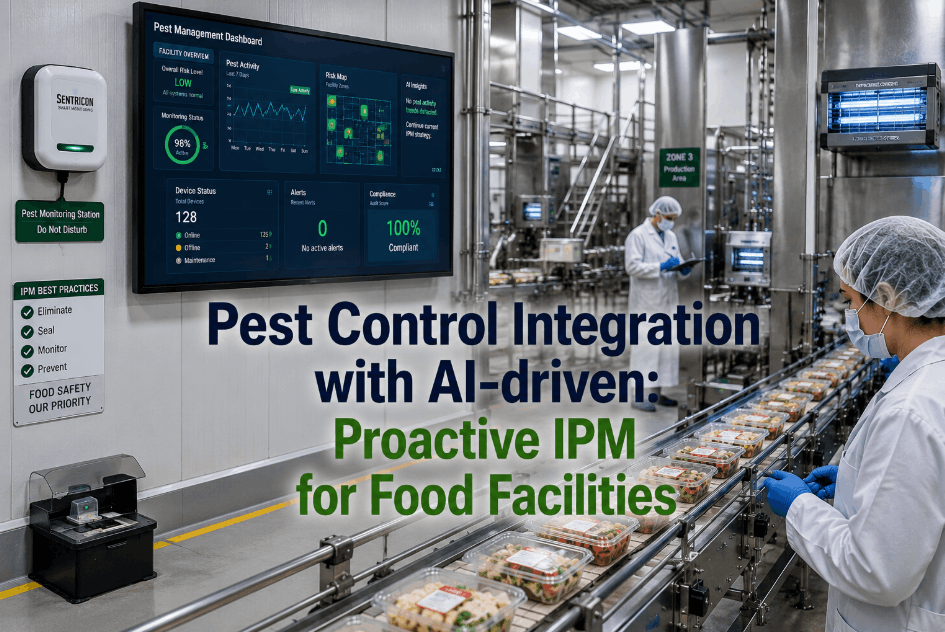
Every HACCP plan rests on an assumption that's easy to overlook: the facility itself is already clean, pest-free, and staffed by people who understand basic hygiene practice before a single CCP is ever monitored. That assumption is exactly what prerequisite programs and Good Manufacturing Practices are supposed to guarantee, and when they're weak, no amount of critical-limit precision at a downstream CCP can compensate for contamination introduced by a cracked wall, an untrained new hire, or a pest control gap nobody flagged. Auditors know this, which is why prerequisite program failures are among the most common root causes behind major non-conformances, even in plants with an otherwise well-written HACCP plan. This guide covers what a complete prerequisite program actually includes, how it differs from — and supports — your CCPs, and how a demo can show what continuous PRP verification looks like on a live plant floor.
Why Prerequisite Programs Come Before HACCP, Not After
Prerequisite programs exist to control hazards that are too broad, too constant, or too facility-wide to manage through a CCP-by-CCP approach. You wouldn't set a critical limit for "the building is structurally sound enough to keep pests out" — that's a condition the whole facility either has or doesn't, and it needs to be verified continuously rather than measured at one process step. Building a HACCP plan without first confirming these baseline conditions is like calibrating a thermometer for a room with an open window: the reading might be accurate, but it doesn't tell you what you actually need to know.
Regulatory frameworks reflect this ordering directly. FSMA's Preventive Controls rule expects prerequisite programs to be in place and functioning before a facility even finalizes its food safety plan, and GFSI-recognized schemes like BRCGS and SQF dedicate entire clause sections to PRPs separate from HACCP-specific requirements. An auditor who finds a strong HACCP plan sitting on top of a weak prerequisite program treats it as a structural problem with the entire food safety system, not an isolated gap.
The practical challenge is that prerequisite programs span the entire facility and every shift, which makes them far harder to keep consistent than a handful of CCPs concentrated on one production line. A sanitation crew working overnight, a pest control contractor visiting monthly, and a supplier quality team reviewing documentation quarterly are all contributing to the same set of programs, often without a shared system that shows whether all three are actually current. When each function tracks its own piece on its own schedule, a gap in one area — an overdue pest inspection, a lapsed supplier certificate, a sanitation record missing a signature — can sit unnoticed for weeks before anyone reviewing the full picture would catch it.
GMPs: The Behavioral Layer of Prerequisite Programs
Good Manufacturing Practices are the personnel-facing half of the prerequisite program — the day-to-day behaviors that keep a well-designed facility from being undermined by human habit. A facility can have flawless equipment layout and still fail an audit because operators aren't washing hands after breaks, jewelry isn't being removed consistently, or an employee is working the line with symptoms that should have triggered a reporting procedure. GMP compliance is usually where prerequisite program audits find the most findings, precisely because it depends on consistent behavior across every shift and every new hire, not a one-time facility inspection.
The reason GMPs generate so many findings isn't usually a written procedure problem — most facilities have a reasonably thorough GMP policy on file. The gap shows up in how consistently that policy is applied under real shift pressure: a busy line during a rush order, a new temporary worker who missed part of orientation, or a returning employee who skips a hygiene step out of habit because nobody's actively watching. A GMP program that relies entirely on periodic spot checks by a supervisor will always have blind spots simply because a supervisor can't be everywhere on every shift, which is why the strongest programs pair written procedure with some form of continuous or high-frequency verification rather than relying on occasional walkthroughs alone.
Facility Design: The Prerequisite Program You Can't Retrofit Cheaply
Facility and equipment design is the prerequisite program category with the highest cost of getting wrong after the fact. A layout that routes raw material traffic across a path used for finished product, or a piece of equipment with hard-to-reach internal surfaces that can't be effectively cleaned, isn't something a stronger SSOP or a more diligent sanitation crew can fully compensate for — the physical layout itself is working against food safety every shift. This is why design review belongs early in any expansion, new line installation, or equipment purchase, rather than being addressed only when an auditor flags a traffic-flow or cross-contamination concern during a walkthrough, at which point the fix usually means a capital project instead of a procedure update.
How PRPs and CCPs Divide the Work of Food Safety
Confusion between a prerequisite program control and a Critical Control Point is one of the most frequent hazard analysis mistakes, and it usually goes one of two ways: either a facility relies on a PRP to control a hazard that actually needs a validated critical limit, or it names something a CCP when a well-run prerequisite program would have handled it more efficiently as a facility-wide control. Getting this division right isn't just a documentation preference — it determines whether the right level of monitoring rigor gets applied to each hazard, and misallocating it in either direction creates real risk or real inefficiency.
| Control Type | Scope | Verification Method |
|---|---|---|
| Prerequisite Program (PRP) | Facility-wide, continuous condition | Scheduled inspection, audit checklist, trend review |
| Critical Control Point (CCP) | Specific process step, specific hazard | Real-time monitoring against a validated critical limit |
| Operational PRP (oPRP) | Process-linked, moderate risk hazard | Defined monitoring, less strict than a full CCP |
Supplier Approval: The Prerequisite Program Most Often Left Incomplete
A raw material supplier's food safety controls become part of your own hazard analysis the moment their ingredient enters your facility, which is why supplier approval is treated as a prerequisite program in its own right rather than a procurement formality. A complete program defines the documentation required before approval — certificates of analysis, allergen statements, and often a copy of the supplier's own food safety certification — along with a schedule for re-verifying that documentation and a process for handling a supplier who falls out of compliance. Approval status also shouldn't be treated as permanent once granted; a supplier who passed an initial review two years ago can drift in quality, change their own suppliers, or let a certification lapse without proactively notifying every customer, which is exactly why ongoing re-verification is part of the program rather than a one-time gate. Support can walk through how supplier documentation tracking fits into your existing PRP structure so expired certificates don't slip through unnoticed between annual reviews.
Verifying Prerequisite Programs Without Adding Headcount
The instinct when PRP findings pile up is often to add more manual checks — another walkthrough, another spreadsheet, another person responsible for chasing signatures. That approach works for a while, but it scales linearly with the number of programs and locations you're tracking, and it still depends on someone remembering to look at the right document on the right day. A more durable fix is connecting the data these programs already generate — sanitation completion, pest trap counts, supplier certificate expiration dates, GMP training records — into one place where trends and gaps surface automatically instead of requiring someone to go looking for them.
This matters most for multi-line or multi-site operations, where the same prerequisite programs are being run independently at each location with no shared visibility. A pest trend that would be obvious if reviewed weekly can go unnoticed for a full quarter when it's buried in a site-specific binder nobody outside that site ever opens. Centralizing PRP data doesn't replace the people doing the physical inspections and cleaning — it just means the QA team overseeing the whole operation can see where attention is actually needed instead of assuming every site is equally current.
Common Gaps That Show Up in Prerequisite Program Audits
Most prerequisite program findings share a common root cause: the program exists on paper but isn't being verified consistently enough to catch drift before an outside auditor does. A few patterns account for a large share of findings across food manufacturing audits, and most of them are avoidable with a review cadence that's just slightly tighter than what's currently in place.