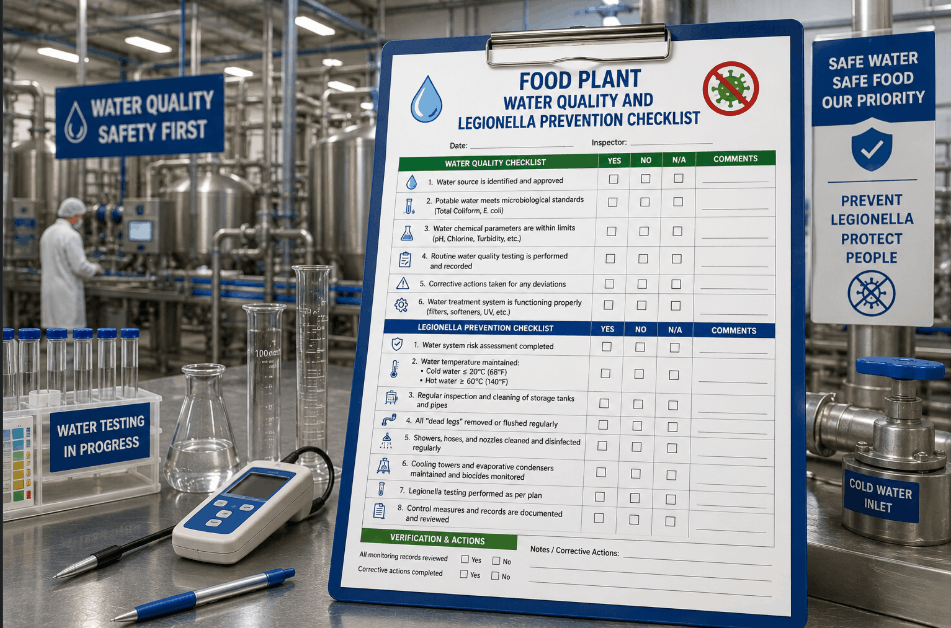
Food plant water quality and Legionella prevention are critical components of both food safety and occupational health, where failures in thermal management or aerosol control can lead to catastrophic Legionnaires' disease outbreaks or product contamination. A comprehensive water quality and Legionella prevention checklist is the foundation of an ASHRAE 188-compliant Water Management Plan (WMP) — covering thermal stability, biocide dosing precision, and dead-leg mitigation. Book a Demo to automate your water safety monitoring, track real-time temperature compliance, and generate audit-ready documentation for every water-asset in your facility.
1. Incoming Water Supply & Primary Filtration Analytics
Monitor municipal water quality and filtration performance at the entry point. Prevent sediment and microbial ingress by identifying turbidity spikes and chlorine drops. Book a Demo to integrate real-time water quality sensors at your main inlet.
2. Domestic Hot Water (DHW) Thermal Monitoring
Maintain thermal lethality temperatures to inhibit Legionella growth. Prevent colonization by ensuring hot water exceeds 140°F at the source. Book a Demo to log automated thermal compliance records.
3. Cooling Tower & Evaporative Condenser Hygiene
Monitor biocide levels and aerosol drift in high-risk cooling assets. Prevent the aerosolization of Legionella through rigid chemical and mechanical audits. Book a Demo to track cooling tower compliance analytics.
4. Dead-Leg Identification & Flushing Intelligence
Mitigate stagnation risks in low-flow plumbing zones. Prevent biofilm formation through scheduled flushing of dormant water lines. Book a Demo to automate flushing compliance logging.
5. Water Storage Tank & Cistern Integrity Analytics
Maintain sterile storage environments for process and domestic water. Prevent contamination through regular tank sealing and sediment audits. Book a Demo to track storage tank health.
6. Secondary Disinfection (UV/Chlorine) Analytics
Verify supplemental disinfection effectiveness at critical control points. Ensure water safety for process-contact applications. Book a Demo to track UV dose compliance.
7. Humidification & Misting System Verification
Maintain sterile aerosol zones in produce or aging rooms. Prevent Legionella aerosolization through rigid mist-water quality audits. Book a Demo to track misting sanitation logs.
8. Fixture Hygiene & Backflow Prevention Audit
Ensure mechanical safety and sanitation at point-of-use fixtures. Prevent cross-contamination through regular backflow and aerator audits. Book a Demo to track backflow compliance.
9. ASHRAE 188 & HACCP Compliance Analytics
Centralize water safety documentation for rapid audit response. Ensure all Water Management Plan (WMP) tasks are complete and timestamped. Book a Demo to digitize your water compliance logs.