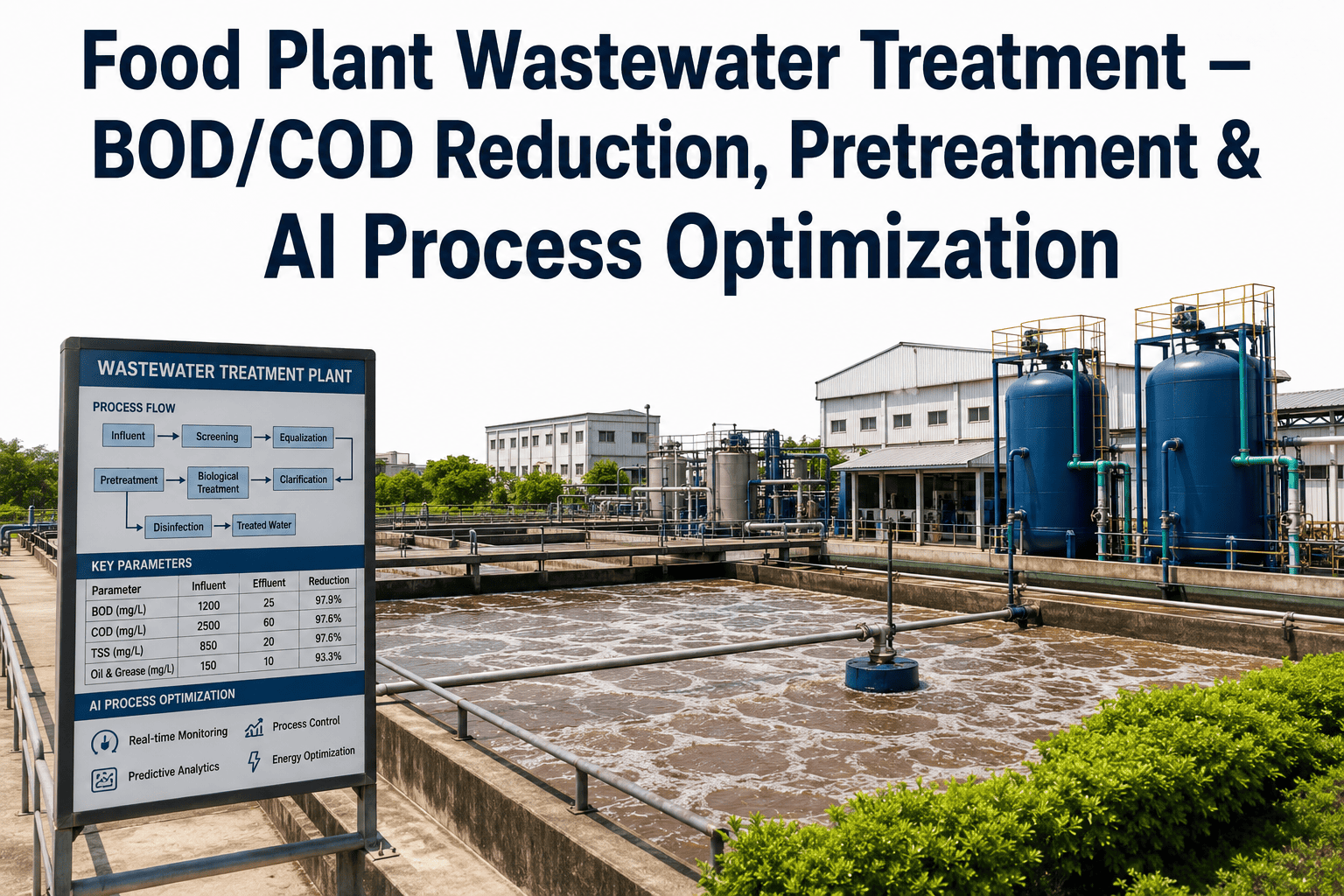
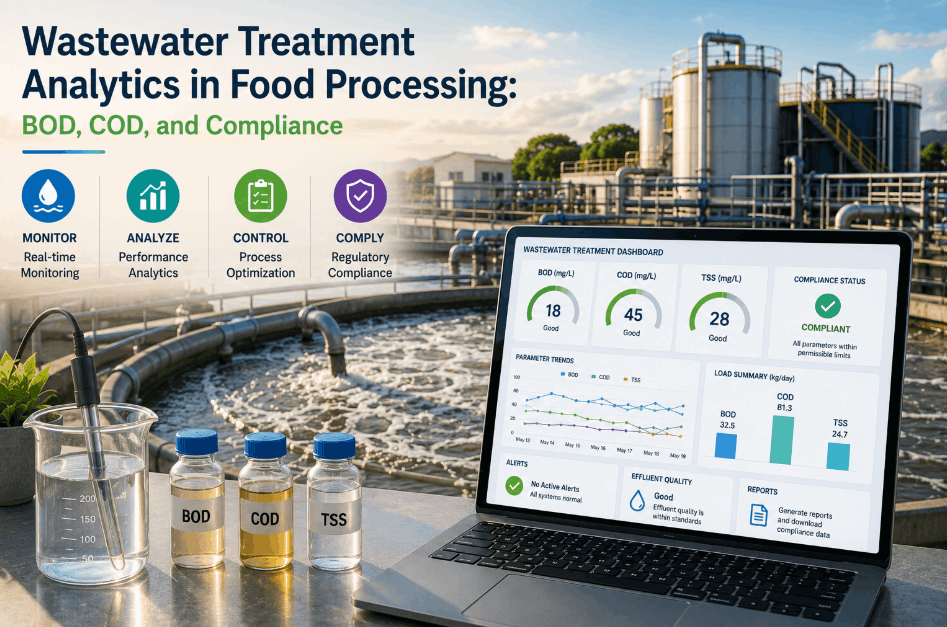
Raw effluent leaving a food processing line can carry an organic load thousands of times stronger than typical municipal wastewater, and every stage of treatment between that raw discharge and the permit limit depends on equipment that is easy to under-maintain because the consequences of doing so show up gradually rather than all at once. A DAF unit with worn skimmer blades or miscalibrated coagulant dosing does not fail loudly, it just quietly passes more fats, oils, and solids into the biological stage until dissolved oxygen drops and the whole treatment train falls out of compliance. By the time a lab result flags the exceedance, days of degraded effluent have often already been discharged. Reactive, lab-only monitoring is how most food plants still run this system today, and a short conversation can show what continuous, AI-assisted monitoring looks like against your own treatment train.
Catch a Wastewater Excursion Before the Lab Result Does
iFactory's Wastewater Analytics module tracks BOD, COD, TSS, and FOG loading continuously across your pretreatment and biological stages, flagging drift toward permit limits days before a lab sample would.
The Numbers
Just How Strong Food Plant Wastewater Really Is
Understanding the scale of the treatment challenge starts with understanding how far raw food plant effluent sits from a dischargeable result, and how much reduction every stage of the treatment train is actually responsible for.
2,000-8,000
mg/L of BOD commonly found in raw food plant effluent before any treatment stage
95-99%
Total BOD reduction typically required across the full treatment train to reach discharge compliance
20-50
mg/L final BOD limit typically set by consent-to-discharge permits for direct discharge
1.5-2.5x
Typical ratio of COD to BOD readings found in food plant effluent
Treatment Stages
What Each Stage of the Treatment Train Is Responsible For
Compliance Risk
Four Points Where Compliance Quietly Slips
DAF Skimmer Wear
A DAF unit is among the highest-maintenance assets in the whole system, and worn skimmer blades pass FOG straight into biological treatment.
Coagulant Dosing Drift
Manual dosing control tends to run an over-dosing buffer to stay safe, wasting polymer while still missing real load spikes.
FOG Carryover
Fats, oils, and grease that bypass pretreatment coat bacterial membranes downstream, degrading the biological stage's performance.
Nutrient Imbalance
Biological COD removal needs sufficient nitrogen and phosphorus; carbon-heavy food processing streams frequently need supplementation to keep microbial growth on track.
Bring Your Last Permit Exceedance to the Call
Our team will walk through how continuous BOD/COD surrogate monitoring would have flagged that specific excursion days before the lab result came back.
Reactive vs Continuous
Lab-Only Monitoring vs Continuous AI Analytics
Laboratory testing remains essential for regulatory reporting, but relying on it as the only signal for day-to-day operational decisions means every response is already a day or more behind the actual condition of the treatment train.
Lab-Only Monitoring
Samples taken on a fixed schedule, results returned after the fact
Dosing decisions made on operator judgment between results
Exceedances discovered after discharge has already occurred
Continuous AI Analytics
Surrogate sensors trend load continuously between lab samples
Adaptive dosing algorithms respond to real-time load changes
Predictive alerts flag drift toward the permit limit in advance
FAQ
Frequently Asked Questions
What discharge limits does a food plant typically need to meet?
Consent-to-discharge permits commonly set final effluent BOD limits between 20 and 50 mg/L and COD limits between 100 and 250 mg/L for direct dischargers, though exact numbers vary by jurisdiction and by whether the plant discharges to a receiving water body or to a publicly owned treatment works. Raw food plant effluent can carry BOD values in the thousands of mg/L, which is why the treatment train as a whole typically needs to achieve 95 to 99 percent reduction to reach compliance, something our
support team can help benchmark against your specific permit.
How often should DAF units be serviced to avoid compliance issues?
Grease traps, interceptors, and DAF skimmer components tied to fry-line or high-FOG drainage should be scheduled based on actual production volume rather than a fixed calendar interval, since under-scheduling allows fats, oils, and grease to carry over into biological treatment where they suppress microbial activity. The DAF unit is consistently one of the highest-maintenance assets in a food plant wastewater system, and worn skimmer blades or miscalibrated coagulant dosing are among the most common root causes of a downstream exceedance.
Can AI actually predict a BOD or COD exceedance before it happens?
Continuous surrogate monitoring, correlating flow, conductivity, and other real-time signals against historical lab results, can flag a developing load spike or a degrading DAF performance well before the next scheduled lab sample would catch it. This does not replace laboratory testing for regulatory reporting, but it does close the gap between samples where most preventable exceedances actually originate.
Does our biological treatment system need nutrient supplementation?
Carbon-heavy food processing wastewater frequently lacks sufficient nitrogen and phosphorus relative to its organic load, and the standard nutrient ratio needed for healthy microbial synthesis is commonly cited as roughly 100 parts BOD to 5 parts nitrogen to 1 part phosphorus. A deficiency in either nutrient limits microbial growth and reduces COD removal efficiency regardless of how well aeration and retention time are otherwise managed, which is worth checking through a
short call if your biological stage has been underperforming.
What does implementation of wastewater analytics involve for a process engineer?
Implementation typically starts by connecting existing flow meters, dissolved oxygen probes, and any surrogate sensors already installed on the treatment train into one continuous monitoring layer, then building a baseline against historical lab results before generating predictive alerts. Most facilities already have enough instrumentation to start, and gaps such as missing FOG or conductivity sensors can be filled incrementally rather than requiring a full system overhaul before the analytics layer adds value.
BOD/COD Monitoring · DAF Optimization · Compliance Analytics
Stop Finding Out About Exceedances From the Lab
iFactory's Wastewater Analytics module gives process engineers continuous visibility into BOD, COD, and FOG loading, catching drift toward permit limits while there is still time to act.