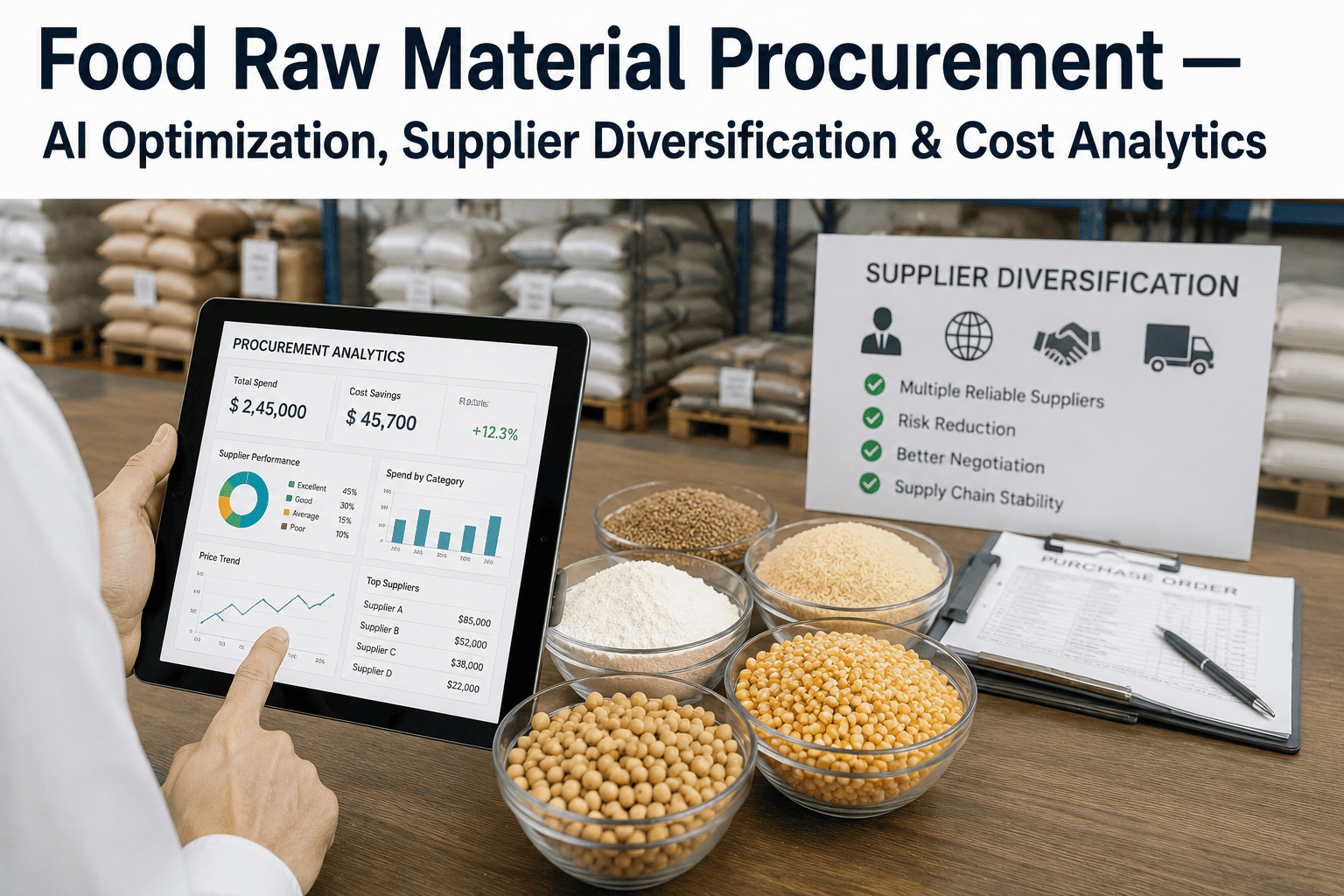
Food manufacturers sourcing key ingredients from a single supplier discover the risk only when that supplier has a crop failure, a quality recall or a sudden price spike, and production has no fallback plan ready to activate. Commodity price volatility on staples like wheat, cocoa, dairy solids and edible oils can shift landed cost 15-25% within a single quarter, yet most procurement teams still buy against a fixed annual budget built on last year's prices. Manually tracking supplier performance, alternative sourcing options and total cost of ownership across dozens of ingredients and hundreds of SKUs is more than any spreadsheet-based process can keep current. iFactory's AI procurement platform continuously tracks commodity price signals, supplier performance and viable alternative ingredients, giving procurement teams a live view of exposure and options instead of a static annual plan. Book a demo to see supplier risk and commodity exposure modeled from your actual sourcing data.
Single-Supplier Sourcing
1 Supplier = 100% Exposure
One Supplier Failure Shouldn't Be Able to Stop Production
iFactory continuously tracks supplier performance and viable alternatives, so a diversification plan already exists before you need it.
How iFactory Reduces Procurement Risk and Cost Together
Procurement teams juggling dozens of ingredients across hundreds of SKUs cannot manually track commodity futures, supplier quality trends and alternative sourcing options in real time. iFactory's AI does this continuously, surfacing exposure and options before a crisis forces a reactive decision. See how the platform tracks exposure across your specific ingredient portfolio.
Commodity Price Prediction
AI tracks futures markets and historical patterns for key commodities, flagging likely price movements weeks ahead of contract renewal windows.
Supplier Portfolio Risk Scoring
Each ingredient's supplier concentration is scored continuously, flagging single-source dependencies before they become a production risk.
Alternative Ingredient Sourcing
AI identifies qualified alternative suppliers and substitute ingredients that meet specification, ready to activate if a primary source is disrupted.
Total Cost of Ownership Analytics
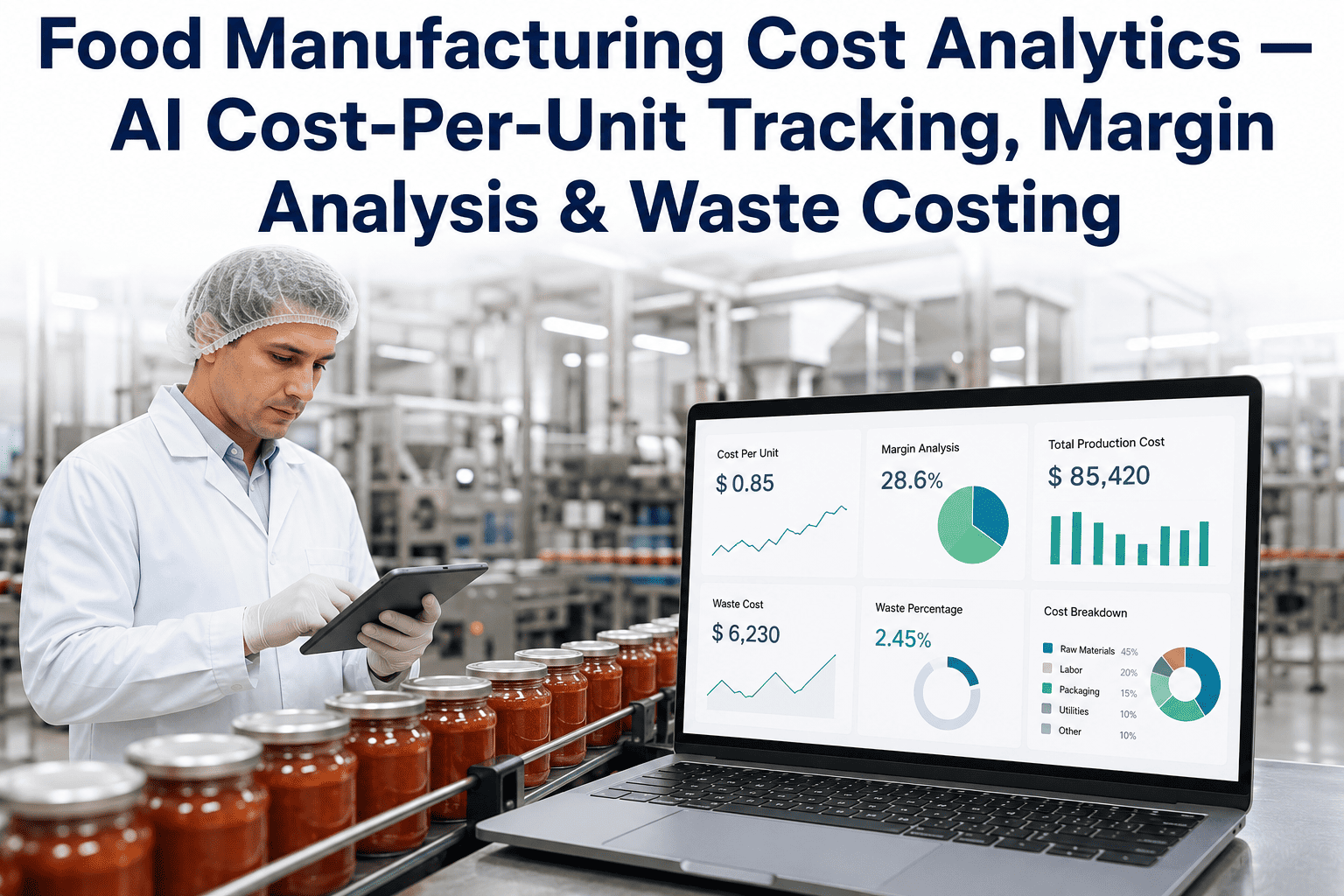
Landed cost, quality rejection rates and delivery reliability combine into a true cost comparison beyond quoted unit price alone.
Contract Timing Optimization
AI recommends optimal contract lock-in timing based on predicted price movement, rather than renewing on a fixed annual calendar.
Supplier Performance Monitoring
Delivery reliability, quality rejection rates and responsiveness are tracked continuously, informing sourcing decisions with current performance, not last year's review.
Annual Procurement Planning vs. Continuous AI Sourcing Intelligence
Here is how a traditional annual procurement planning cycle compares to continuous AI-driven sourcing intelligence. Compare your current procurement process against continuous intelligence directly.
| Capability | Annual Procurement Planning | iFactory Continuous Sourcing Intelligence |
| Price Exposure Visibility |
Budgeted once annually against last year's prices; misses in-year volatility. |
Continuously tracked against live commodity signals and contract timing. |
| Supplier Risk Awareness |
Single-source dependencies often unnoticed until a disruption occurs. |
Concentration risk scored continuously across the full ingredient portfolio. |
| Alternative Sourcing Readiness |
Alternative suppliers researched reactively after a disruption begins. |
Qualified alternatives identified and ready before disruption occurs. |
| Cost Comparison |
Based primarily on quoted unit price at time of bid. |
True total cost of ownership including rejection rates and reliability. |
| Contract Timing |
Renewed on a fixed annual calendar regardless of market conditions. |
Timed to predicted price movement for more favorable lock-in points. |
| Supplier Performance Review |
Reviewed periodically, often only at contract renewal. |
Monitored continuously, informing sourcing decisions in real time. |
Deployment Path to Continuous Sourcing Intelligence
Deployment builds a live risk and cost picture starting with your highest-spend, highest-risk ingredients before extending across the full procurement portfolio.
1
Ingredient & Spend Mapping
Purchasing history, supplier contracts and spend data are consolidated from existing procurement and ERP systems.
2
Risk Scoring Baseline
Supplier concentration and commodity exposure are scored across the full ingredient portfolio for the first time.
3
Alternative Sourcing Mapping
Qualified alternative suppliers and substitute ingredients are identified for your highest-risk items.
4
Commodity Price Monitoring
Continuous tracking activates for key commodities, feeding contract timing recommendations to buyers.
5
TCO Analytics Live
Total cost of ownership comparisons become available for every active sourcing decision.
6
Full Portfolio Coverage
Remaining ingredients onboard, with continuous supplier performance monitoring running plant-wide.
Start With Your Highest-Risk Ingredients. Expand From There.
Risk scoring and alternative sourcing mapping prove value on your most exposed ingredients before the full portfolio comes online.
Results From Food Manufacturers Running AI Sourcing Intelligence
These figures reflect deployments currently running iFactory's procurement intelligence platform. Request the case study closest to your ingredient portfolio.
Confectionery Manufacturer
Cocoa Price Spike Absorbed Without Production Disruption
A confectionery manufacturer sourcing cocoa from a single primary supplier faced a sudden regional crop shortage that spiked prices and threatened supply continuity. Because iFactory had already identified two qualified alternative suppliers meeting specification, procurement activated a blended sourcing arrangement within two weeks rather than scrambling to qualify a new supplier from scratch, avoiding a production disruption that competitors sourcing from the same region experienced.
2 weeks
Time to activate alternative sourcing
0 days
Production disruption from the shortage
18%
Cost premium avoided vs. spot market buying
What Procurement Leaders Say
We'd flagged single-source risk on cocoa internally for years without acting on it. Having qualified alternatives already mapped meant a regional shortage became a two-week adjustment instead of a production crisis.
Head of Procurement
Confectionery Manufacturer, Belgium
Total cost of ownership analytics changed how we evaluate quotes. A supplier with a slightly higher unit price but far better delivery reliability now clearly wins the comparison.
Sourcing Manager
Bakery Ingredients Manufacturer, France
Frequently Asked Questions
How does the platform identify qualified alternative suppliers?
AI cross-references ingredient specifications, certifications and historical quality data to identify suppliers capable of meeting your requirements, then ranks them by total cost of ownership and delivery reliability rather than unit price alone. Alternatives are pre-identified and ready to evaluate before a disruption occurs, rather than researched reactively once a crisis begins.
How accurate is commodity price prediction and how far ahead does it look?
Prediction windows vary by commodity, typically ranging from several weeks to a few months ahead, informed by futures market signals, seasonal production patterns and historical volatility specific to each ingredient. The platform flags likely price movement direction and magnitude to inform contract timing decisions rather than providing a precise guaranteed price.
Does supplier diversification always mean higher cost?
Not necessarily. Total cost of ownership analytics frequently reveal that a second qualified supplier, even at a marginally higher unit price, reduces overall cost once delivery reliability and quality rejection rates are factored in, while also reducing concentration risk. The platform quantifies this tradeoff explicitly rather than treating diversification as a pure cost versus risk decision.
How does this integrate with our existing procurement or ERP system?
iFactory connects to existing procurement and ERP systems to pull purchase history, contract terms and spend data, rather than requiring a separate standalone sourcing database. Integration specifics depend on your current system and are scoped during the initial ingredient and spend mapping phase.
Book a demo to confirm compatibility with your setup.
Which ingredients should we prioritize first?
Deployment typically prioritizes ingredients combining high spend, single-supplier concentration and commodity price volatility, since these carry the greatest combined cost and continuity risk. The initial risk scoring baseline identifies these priority ingredients specifically for your portfolio rather than applying a generic industry ranking.
Know Your Supplier Risk Before It Becomes a Production Problem.
iFactory continuously tracks commodity exposure, supplier concentration and alternative sourcing options, giving procurement a live picture instead of an annual plan.
Continuous commodity price and supplier risk tracking
Qualified alternative suppliers identified before disruption
Total cost of ownership beyond quoted unit price
Contract timing optimized against predicted price movement