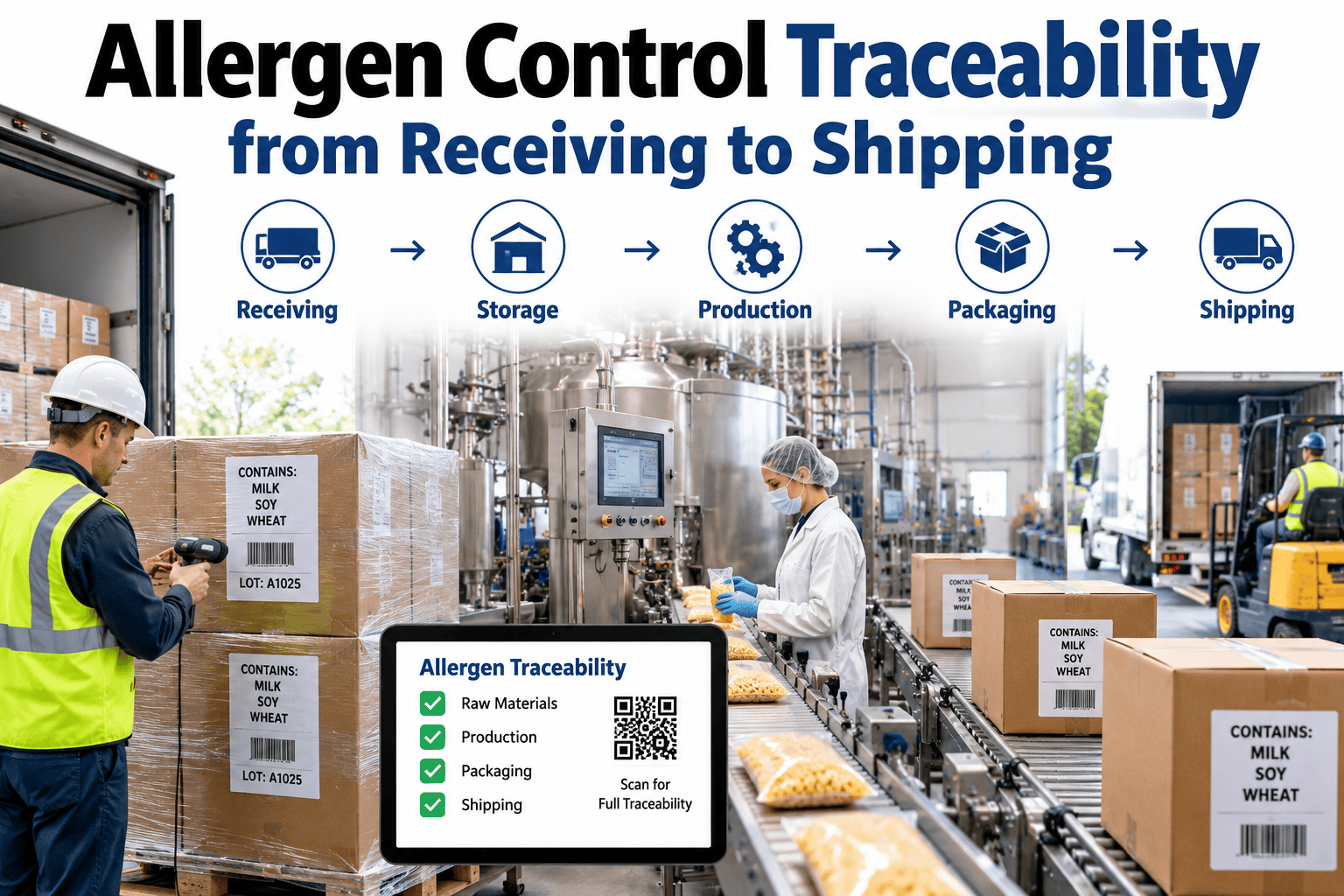
An allergen label is only as trustworthy as the weakest handoff behind it, and in most food plants that weakest link sits somewhere between receiving and shipping where a lot gets split, blended, or repackaged without the allergen status of every component staying attached to the paperwork. A single mislabeled allergen claim isn't a minor documentation error, it's a recall trigger and a genuine risk to a consumer with a life-threatening allergy, which is exactly why traceability for allergen control has to be built into every physical handoff, not just checked at final label review. Getting this right means segregation rules, digital handoffs, and lot-splitting logic all working together so an allergen status travels with the product automatically rather than depending on someone remembering to update a spreadsheet three steps downstream. Food manufacturers ready to build this kind of end-to-end allergen traceability can start that conversation with iFactory's support team.
Your Allergen Label Is Only as Honest as the Handoff Three Steps Before It
iFactory carries allergen status automatically through every receiving, production, and shipping handoff, so a lot split or blend never loses track of what's actually inside it.
Where Allergen Status Actually Gets Lost
Allergen mislabeling rarely comes from a single dramatic mistake, it comes from small, repeated gaps at the exact points where a product's physical form changes but its documentation doesn't automatically follow.
Lot Splitting Breaks the Paper Trail
When one incoming lot gets divided across multiple production runs, each resulting sub-lot needs its own linked allergen record, which manual tracking frequently fails to maintain.
Shared Equipment Introduces Cross-Contact Risk
A line that runs an allergen-containing product followed by an allergen-free one needs a documented, verified cleaning step before the allergen-free claim is actually valid.
Blending Combines Allergen Profiles Silently
Mixing two ingredient lots with different allergen statuses means the resulting batch needs to reflect the combined profile, not just the profile of the primary ingredient.
Label Review Happens Too Late to Catch the Real Error
Checking the label only at the final packaging stage means an allergen status error introduced upstream has already traveled through several unmonitored handoffs by the time anyone looks.
Segregation Rules That Actually Hold Up Under Handoff
Physical segregation and digital tracking need to reinforce each other at every stage a lot passes through, rather than treating segregation as a receiving-dock concern alone.
| Stage | Segregation Requirement | Digital Handoff Needed |
|---|---|---|
| Receiving | Dedicated storage zones by allergen status | Allergen tag attached at lot creation |
| Production & Blending | Verified changeover cleaning between allergen states | Combined allergen tag propagated to output lot |
| Packaging | Label matched against current lot's actual allergen tag | System-enforced label match, not manual visual check alone |
| Shipping | Final verification against shipping documentation | Allergen tag confirmed before shipment release |
Building Lot-Splitting Logic That Never Drops the Allergen Tag
The technical core of reliable allergen traceability is lot-splitting logic that automatically propagates and combines allergen status whenever a lot is divided, blended, or repackaged.
Tag Allergen Status at the Point of Receiving
Every incoming lot gets its allergen profile recorded digitally at intake, before it ever moves into storage or production.
Propagate the Tag Automatically Through Every Split
When a lot divides into sub-lots, each sub-lot inherits the parent's allergen tag automatically rather than requiring manual re-entry.
Combine Tags Correctly During Blending
When two lots merge, the resulting output lot's tag reflects the full combined allergen profile of every input, not just the dominant ingredient.
Verify the Final Label Against the Live Tag Before Shipment
A system-enforced check comparing the label to the lot's current allergen tag catches a mismatch before the product leaves the building.
Stop Trusting Allergen Labels to Manual Handoffs
iFactory carries allergen status automatically through every lot split, blend, and repackage, so your label always matches what's actually in the product.
A Composite Scenario: The Blend That Almost Shipped Wrong
A composite bakery ingredient manufacturer had built its allergen tracking around a shared spreadsheet updated manually at each production stage, a system that had worked reasonably well until a blending run combined a soy-free base with a smaller secondary ingredient lot that, unknown to the line operator entering data that day, actually contained soy from an upstream supplier substitution.
Because the spreadsheet relied on the operator manually checking and re-entering allergen status at each stage, the soy content wasn't correctly reflected in the output lot's label draft, and the error was only caught during a final quality review specifically because that reviewer happened to cross-check the secondary ingredient's certificate of analysis against the label by habit rather than any required step. The near-miss prompted the plant to implement automated lot-splitting and blending logic that propagates allergen tags directly from source documentation rather than relying on manual re-entry at each handoff.
Common Mistakes in Allergen Traceability
Checking Allergen Status Only at Final Label Review
Catching a mismatch this late means the error has already traveled through every earlier handoff without anyone verifying it along the way.
Relying on Manual Re-Entry at Every Lot Split
Each manual re-entry point is an opportunity for the allergen tag to be dropped, mistyped, or simply forgotten under production pressure.
Underestimating Cross-Contact Risk on Shared Equipment
Without a documented, verified cleaning step between allergen states, a shared line can introduce contamination that no downstream label check would catch.
Treating Supplier Ingredient Changes as Someone Else's Problem
A supplier substitution that changes an ingredient's allergen profile needs to flow into the plant's own traceability system immediately, not get caught only by chance.
Is Your Plant Ready to Build End-to-End Allergen Traceability
Every incoming lot's allergen status is recorded at receiving
Tagging allergen status right at intake is the foundation every downstream handoff depends on.
Your production process regularly splits or blends lots
Automated tag propagation matters most exactly where manual tracking is most likely to break down.
You have a documented changeover process for shared equipment
Verified cleaning steps between allergen states protect against cross-contact risk that a label check alone can't catch.
You can trace a supplier ingredient change through to finished product
A change at the supplier level needs a clear path to updating every affected downstream lot's allergen status.
Frequently Asked Questions
How does lot splitting actually cause allergen labeling errors?
When one incoming lot is divided across multiple production runs or blended with other ingredients, each resulting sub-lot needs to inherit the correct combined allergen profile, and manual systems that rely on someone re-entering that information at each split are prone to dropping or mistyping the tag under normal production pressure. Automated propagation, where the system carries the tag forward without requiring manual re-entry, closes this specific gap. Plants wanting help building this kind of automated lot-splitting logic can talk to iFactory support.
What's the difference between allergen segregation and allergen traceability?
Segregation refers to the physical practices, like dedicated storage zones and verified equipment cleaning, that prevent allergen cross-contact in the first place, while traceability is the documentation system that tracks allergen status accurately as products move and combine through the plant. Both are necessary and work together, since even perfect physical segregation doesn't help if the paperwork tracking that segregation loses accuracy somewhere along the process.
How does a supplier ingredient substitution get caught before it affects our labels?
The most reliable approach connects incoming certificate of analysis data directly to the receiving process, flagging any allergen profile change compared to what the system expects for that ingredient before the lot even enters production. Relying on someone manually cross-checking a certificate of analysis by habit, rather than as a required system step, is exactly the kind of gap that allows a substitution to go unnoticed until much later.
Does allergen traceability need to connect to the same system used for FDA traceability records?
Ideally yes, since allergen status is itself a key data element that regulators and buyers increasingly expect to see alongside standard lot and critical tracking event records, and maintaining two disconnected systems increases the risk of the two falling out of sync with each other. Book a demo to see how allergen tagging integrates with broader traceability recordkeeping in one system.
How quickly do we need to be able to retrieve allergen traceability records if the FDA asks?
Traceability records tied to Food Traceability List items generally need to be retrievable within 24 hours of a request, and allergen status documentation should be able to meet that same timeline as part of a complete traceability record rather than requiring a separate, slower manual search. A system built for automated, connected lot tracking supports this retrieval speed far more reliably than paper logs or disconnected spreadsheets.
Make Sure Your Allergen Label Never Outruns the Paperwork Behind It
iFactory carries allergen status automatically through every receiving, blending, and shipping handoff in your plant.