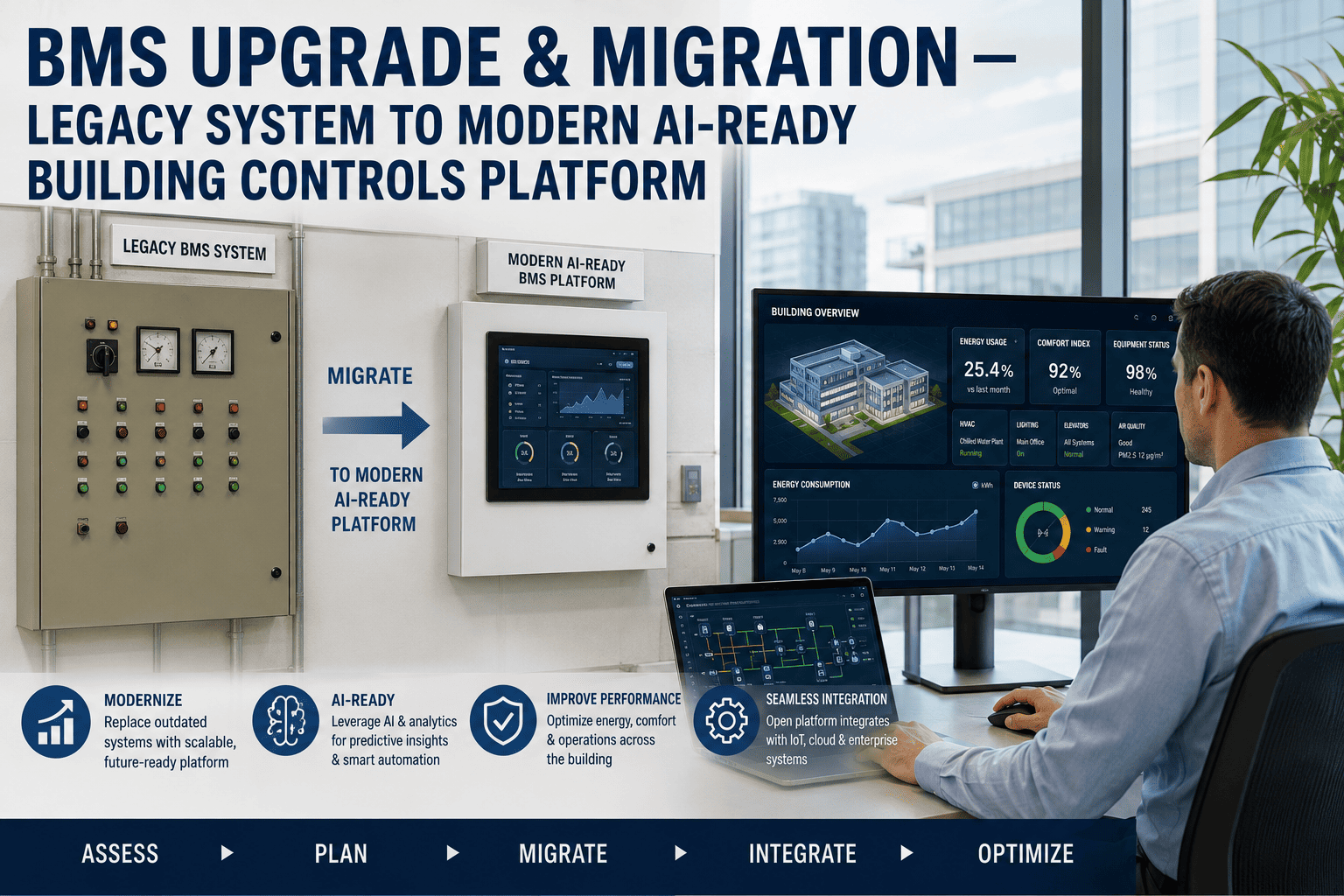
Every facility manager running a building on a fifteen-year-old proprietary controls platform knows the dread of a specific phone call: the manufacturer has discontinued the controller line, spare parts are down to whatever's left in a warehouse, and the one technician who knows the legacy programming language is retiring next year. Legacy BMS platforms fail slowly, through shrinking vendor support and a growing gap between what the system can do and what modern AI-driven operation requires. A well-planned migration replaces that risk without the disruption facility teams fear most. iFactory's building controls migration team plans and executes BMS upgrades across Tridium Niagara, Siemens Desigo, Honeywell EBI, Johnson Metasys, and other major platforms.
BMS Upgrade and Migration From Legacy Systems to AI-Ready Building Controls
Structured migration planning across Tridium Niagara, Siemens Desigo, Honeywell EBI, and Johnson Metasys platforms, preserving control sequences and historical data while opening the door to AI-driven optimization the legacy system was never built to support.
The Risk Curve Legacy BMS Platforms Follow Without Anyone Deciding It
Building management systems installed ten, fifteen, or twenty years ago were engineered to a standard that made sense at the time — proprietary protocols, closed architecture, and vendor-specific programming tools that locked a facility into a single integrator relationship for the life of the system. That architecture wasn't a mistake when it was installed; it was the industry norm. But every year that passes since the platform's introduction narrows the pool of technicians who know it, shrinks the vendor's willingness to keep manufacturing spare parts, and widens the functional gap between what the legacy system can do and what modern AI-driven optimization, fault detection, and energy analytics require as a baseline.
The risk this creates rarely shows up as a single dramatic failure. It shows up as a slow accumulation of small compromises: a controller that fails and gets replaced with a refurbished unit because new ones aren't manufactured anymore, a sequence change that takes three times longer than it should because only one integrator still understands the legacy programming environment, an energy analytics initiative that stalls because the platform simply cannot expose the data points modern software needs. By the time a facility team formally decides they need to migrate, they've often already been paying the cost of delay for years in the form of higher integration costs, slower response times, and missed optimization opportunities.
The counterargument facility teams raise, understandably, is operational risk — a controls migration touches every mechanical system in the building, and a poorly planned one can genuinely disrupt occupant comfort and building operation for weeks. That risk is real, but it's a project management risk, not an inherent property of migration itself. A properly phased, zone-by-zone migration plan with parallel-run verification at each stage is specifically designed to eliminate the all-or-nothing cutover risk that makes migration decisions feel so high-stakes.
There is also a budgeting dimension worth naming directly. Facility capital planning cycles tend to favor visible, urgent failures over slow-building risk, which means a functioning-but-aging BMS often loses out to more immediately pressing capital requests year after year, even as its underlying risk profile continues to worsen. Framing migration as a scheduled infrastructure investment, backed by a documented platform risk assessment, is generally the most effective way facility teams have found to secure budget before a forced, reactive replacement becomes the only option left on the table.
What Actually Changes When a Building Moves to a Modern Platform
The value of migration is easiest to see side by side, comparing what a legacy proprietary platform can and cannot support against a modern, open, AI-ready controls architecture.
| Capability | Legacy Proprietary Platform | Modern AI-Ready Platform |
|---|---|---|
| Protocol architecture | Closed, vendor-proprietary | Open standards, multi-vendor compatible |
| Integrator dependency | Single vendor lock-in | Multiple qualified integrators available |
| Fault detection capability | Basic alarm thresholds only | AI-driven pattern-based fault detection |
| Data accessibility | Limited export, proprietary formats | Open data access for analytics platforms |
| Spare parts availability | Declining, often discontinued | Actively manufactured and supported |
The data accessibility row is where many facilities discover the most immediate value after migration. A modern open platform exposes point data in formats that AI analytics, energy management, and fault detection tools can consume directly, turning years of previously locked-away operational data into an asset the facility can finally use for optimization rather than a historian nobody could query effectively.
Get a Phased Migration Roadmap Built Around Your Specific Legacy System
Book a walkthrough with iFactory's controls migration team and see how a zone-by-zone migration plan preserves your control sequences and historical data while eliminating the operational disruption risk of a full cutover.
Migration Considerations Across Major Legacy Platforms
Each legacy platform presents a distinct set of migration considerations based on its architecture, remaining vendor support, and how tightly control sequences are coupled to proprietary programming tools.
How a Zone-by-Zone Migration Avoids All-or-Nothing Risk
The single most effective way to de-risk a BMS migration is to avoid treating it as one large cutover event, instead breaking the building into zones or systems that migrate independently with verification at each stage.
The facilities teams who put off a BMS migration the longest almost always tell me the same thing afterward — they wish they'd started planning two or three years earlier, not because the migration itself was worse than expected, but because the years of deferred risk while they waited turned out to be more expensive than the project. A discontinued controller that fails at the wrong moment doesn't wait for a convenient capital budget cycle. What I try to get every facility team to understand is that migration planning and migration execution are two different timelines, and starting the planning conversation early gives you control over when the disruptive part happens, instead of having a hardware failure make that decision for you on its own schedule.
Frequently Asked Questions
Move to an Open, AI-Ready Controls Platform on Your Timeline, Not a Failure's
iFactory's controls migration team plans and executes zone-by-zone BMS upgrades across Tridium Niagara, Siemens Desigo, Honeywell EBI, Johnson Metasys, and other major legacy platforms — preserving your control sequences while opening the door to AI-driven building optimization.