A single elevator outage in a 20-story commercial tower during peak hours can strand 200+ occupants, trigger emergency callouts at 4x standard labor rates, and expose building owners to code violation fines reaching $50,000 per day in some jurisdictions. iFactory Elevator Inspection Robots combine LiDAR mapping, ultrasonic sensing, thermal imaging, and AI-powered visual analysis to capture millimeter-accurate 3D condition baselines of every shaft, guide rail, bracket, and door header in one autonomous pass — replacing dangerous manual rides on top of the cab with repeatable, quantified data that makes every future inspection a comparison, not a guess. Book a demo to see how automated shaft scanning protects tenant safety and cuts inspection cycles from days to hours.
See Every Millimeter of the Shaft, Not Just the Cab.
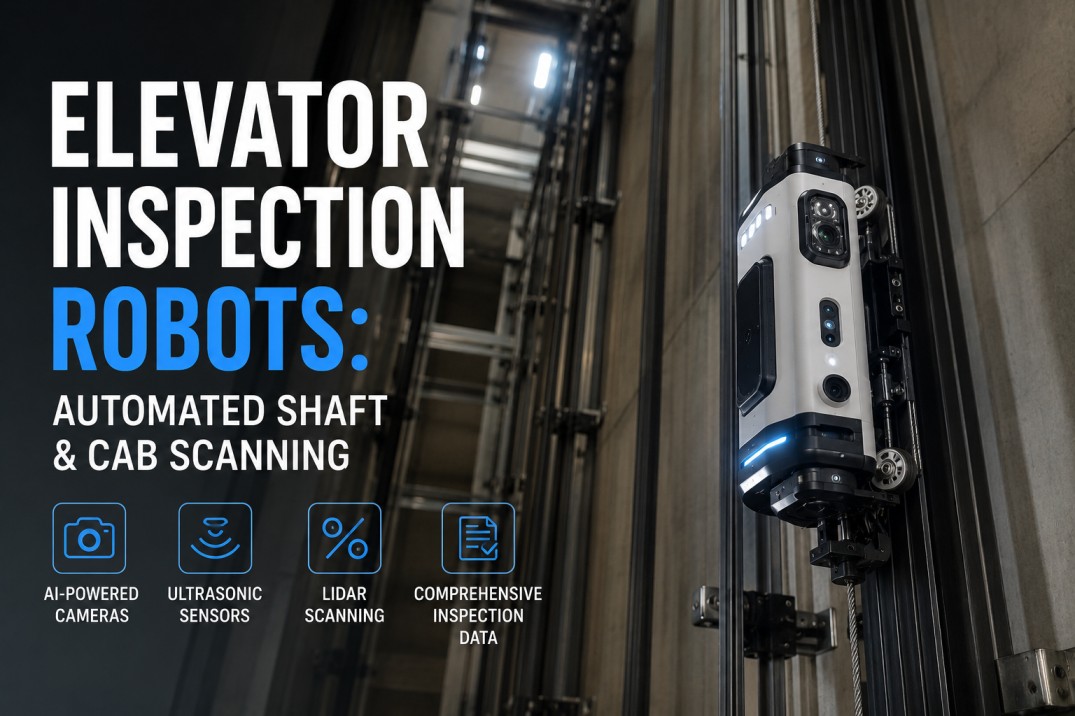
Autonomous elevator inspection robots with LiDAR, ultrasonic, thermal, and HD visual sensors capture complete shaft condition data in a single pass — no confined-space entry, no blind spots, no guesswork.
Manual Shaft Inspection Leaves Critical Data on the Table
A technician riding on top of an elevator car with a flashlight and a clipboard cannot measure guide rail alignment to sub-millimeter tolerance, detect thermal anomalies in electrical connections behind panels, or produce a permanent 3D record for trend comparison. Manual inspection depends on human judgment, limited line of sight, and subjective reporting. The result is a snapshot where a full dataset belongs.
Five Steps From Deployment to Actionable Condition Data
The robot inspection workflow eliminates human shaft entry entirely. One operator manages the entire sequence from the landing — no harnesses, no confined-space permits, no guesswork.
Deploy at Top Landing
Robotic unit positioned at the top floor landing. Tether and safety systems verified. Operator initiates sequence from tablet.
Autonomous Shaft Descent
Robot descends at controlled speed, capturing continuous LiDAR point cloud, thermal imagery, and HD visual data across every floor level.
AI Map Assembly
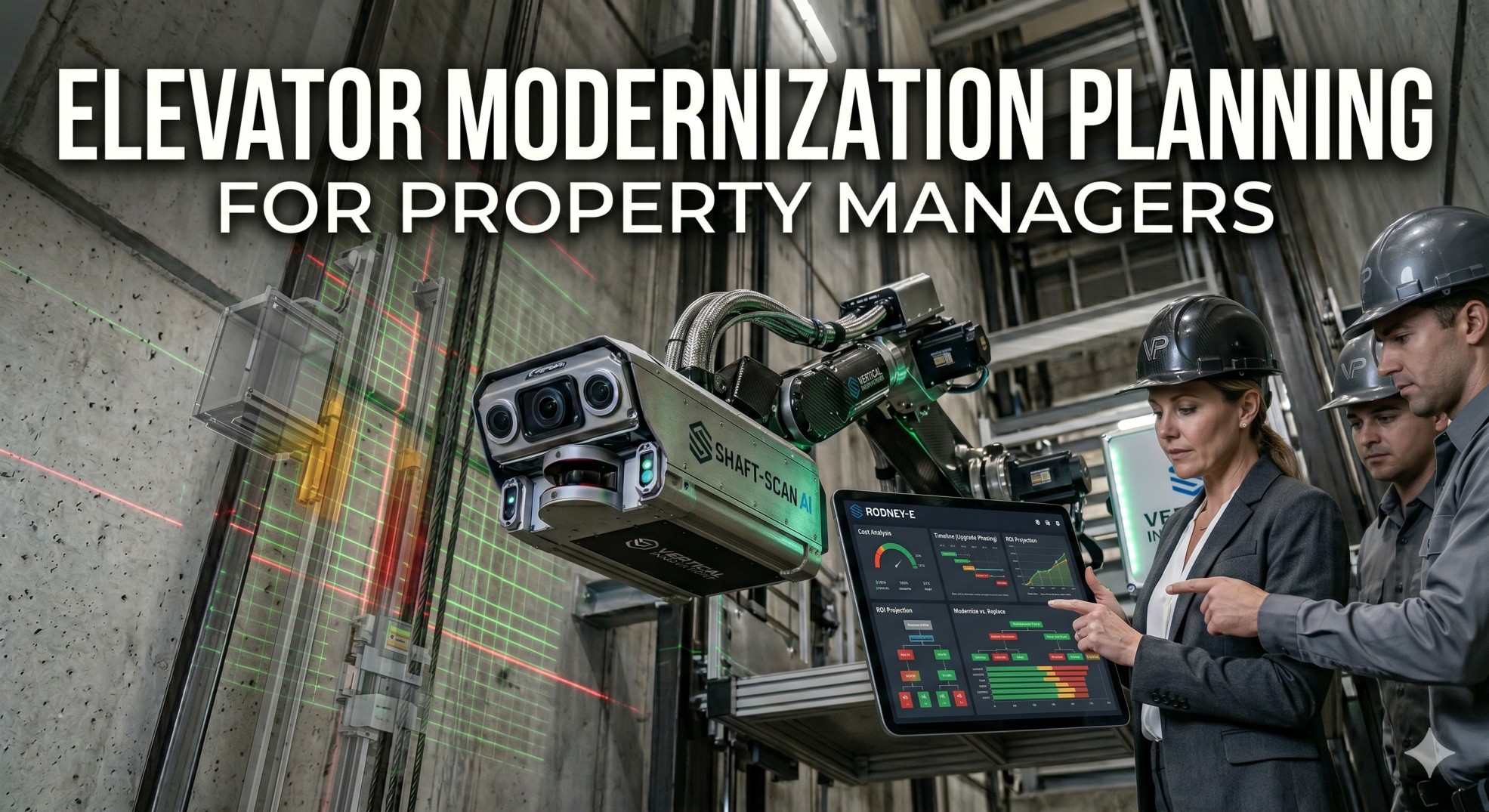
Onboard processing stitches sensor data into a registered 3D point cloud. Every bracket, rail joint, door header, and structural element is geolocated in shaft coordinates.
Defect Detection & Scoring
AI models compare scan data against design specs and prior baselines. Rail misalignment, bracket corrosion, thermal hotspots, and door wear flagged with severity scores.
Actionable Report & CMMS Sync
Condition report generated with prioritized work orders. Data pushed directly to asset records, PM schedules, and CapEx models in your CMMS.
Four Sensor Modalities, One Integrated Inspection Pass
Modern elevator inspection robots carry a multi-sensor payload that captures conditions invisible to the human eye — from sub-millimeter structural shifts to thermal patterns that precede electrical failure.
Structural Geometry & Alignment
Millimeter-accurate 3D point cloud of the entire shaft. Measures guide rail alignment, bracket spacing, structural deformation, and vertical plumb over every floor.
Surface Condition & Component Wear
High-resolution cameras with adaptive LED illumination capture detailed imagery of every door header, interlock, guide rail surface, and bracket for photographic trending.
Electrical & Mechanical Overheating
Infrared camera detects thermal anomalies in motor mounts, electrical connections, braking resistors, and door operator components before they escalate into failures.
Material Thickness & Hidden Corrosion
Ultrasonic transducers measure remaining material thickness on guide rails, brackets, and structural steel — detecting corrosion and wear behind coatings and paint.
Walk Through a Sample Shaft Scan Report in 30 Minutes
Our team demonstrates a live robot deployment — from deployment to AI analysis to CMMS integration — using data from a real commercial building. See exactly what 0.5mm LiDAR accuracy looks like and how defect scores translate into maintenance priorities.
What Unplanned Elevator Downtime Actually Costs Your Portfolio
The numbers behind reactive elevator maintenance tell a consistent story across commercial portfolios. Robotic inspection eliminates the root cause — unknown condition — before it becomes an emergency.
Replace Shaft Entry With Shaft Intelligence
Elevator shafts are the most data-rich, least-measured spaces in commercial buildings. Robotic inspection closes that gap — delivering 0.5mm LiDAR accuracy, 100% shaft coverage, and AI-powered defect detection in a single autonomous pass. For building owners and facility managers, the shift from manual to robotic inspection means moving from subjective checklists to quantified condition baselines that make every maintenance decision data-driven.
The choice is straightforward: keep sending technicians into confined shafts with flashlights and clipboards, or deploy a robot that captures every millimeter, flags every anomaly, and hands you a prioritized action plan before you leave the building. Book a demo to see iFactory robotic elevator inspection in your building.
Frequently Asked Questions
How does robot elevator inspection compare to using a contracted human inspector?
Human inspectors provide valuable qualitative assessment, but their output is limited by line of sight, subjective judgment, and the inability to measure sub-millimeter alignment. Robot inspection produces a quantified 3D baseline with 0.5mm accuracy across 100% of the shaft — including areas no human can safely reach. The two approaches are complementary: robots handle the measurement and detection, while human experts focus on repair decisions and engineering judgment based on better data.
What types of elevator systems can be inspected with this robot?
The system is designed for traction, hydraulic, and machine-room-less elevators common in commercial office, hospitality, residential, and institutional buildings. The robot adapts to shaft dimensions from 1.2m x 1.2m up to 3m x 3m and handles travel heights exceeding 100 meters. Most installations require no shaft modification — the robot deploys from the top landing using existing overhead clearance.
Does the inspection robot require elevator shutdown during operation?
Yes, the elevator must be taken out of service during the scan — typically 30-60 minutes per shaft. However, because robotic inspection is 85% faster than manual methods, the total downtime per elevator is significantly lower. For buildings with multiple elevators, scans are scheduled during low-usage windows (evenings or weekends) and rotated across units so tenant disruption is minimized.
How long does it take to see ROI from robotic elevator inspection?
Portfolios typically see payback within 8-14 months. The largest returns come from avoided emergency repairs (which carry 4.8x cost multipliers), extended equipment life from earlier defect intervention, and reduced inspection labor hours. A single prevented emergency shutdown in a high-traffic commercial tower can offset the annual inspection cost for the entire portfolio.
Can robotic inspection data integrate with existing CMMS or building management systems?
Yes. iFactory connects scan results directly to your CMMS, updating asset condition scores, generating work orders for detected defects, and populating PM schedules with measured condition data. The output also exports to BIM platforms for digital twin enrichment. No manual data entry is required — the inspection report flows from robot to maintenance plan automatically.
Get the Full Picture Inside Every Shaft
Replace dangerous manual shaft inspections with autonomous robots that capture 0.5mm-accurate 3D condition data across 100% of the shaft. One pass. One report. One clear maintenance roadmap.
.jpg)