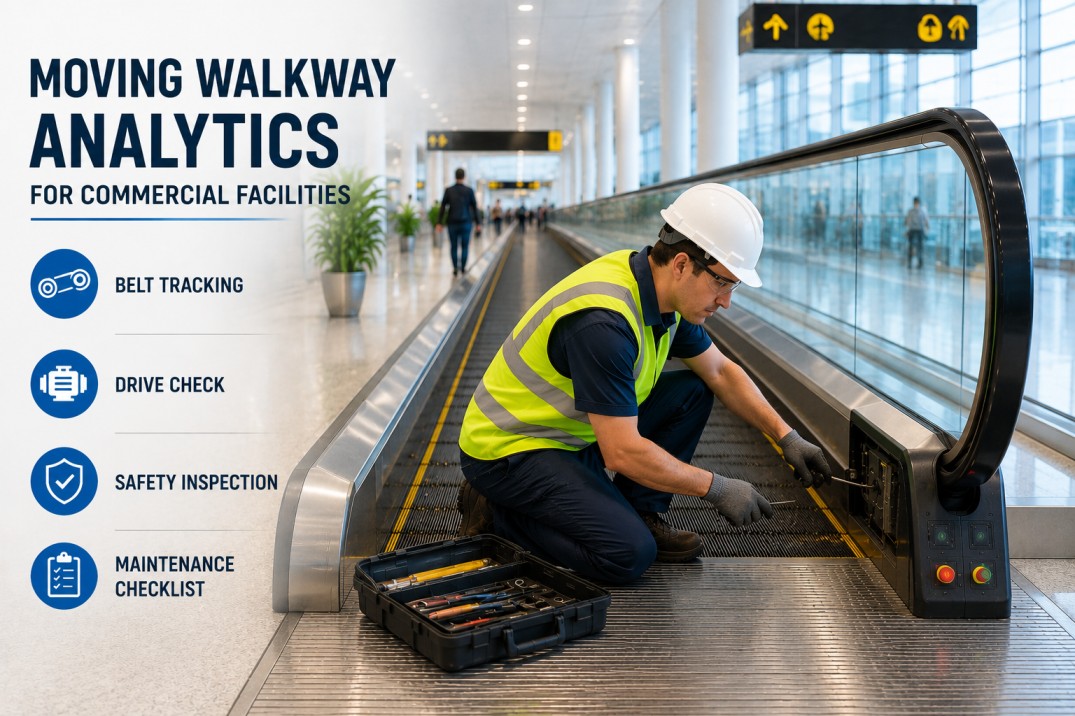
The lead operator at a 400,000 sq ft convention center in Chicago watches the morning crowd spill off the escalators and onto the moving walkways linking Hall A to the main concourse. At 8:47 AM, bearing 4 on the west walkway spikes to 78 dB — a grinding that wasn't there yesterday. The maintenance log shows the last PM was 11 days ago. The OEM says "replace the chain tensioner assembly, $14,000 plus labor, two weeks out." The walkway stays running because shutting it down during a trade show isn't an option. By Friday, the vibration has cracked a bearing housing. The repair bill hits $47,000, and three attendees with mobility aids had to take a 900-foot detour through service corridors. This is the status quo for moving walkway maintenance in commercial facilities — reactive, expensive, and blind until something breaks.
Stop Guessing When Your Moving Walkways Will Fail — Predict Bearing Wear, Chain Slop, and Motor Drift Before They Cost You a Show Floor
iFactory ingests your existing vibration, current, and temperature sensor data — no new hardware — and delivers 14-day failure forecasts for every walkway in your facility. Pilot in 6 weeks, ROI in one quarter.
Two Facilities, Same Walkway Model, Completely Different Outcomes
One runs the standard OEM PM schedule and waits for failures. The other uses iFactory to predict component wear and schedule repairs during off-hours. The numbers tell the story.
Without iFactory
- Run-to-failure on bearings and chain tensioners — average $23,000 per unplanned repair event
- Walkway down for 4–7 days waiting for OEM parts and specialist labor
- No visibility into motor current drift until the drive faults and shuts down mid-day
- Annual PM contracts cost $18,000 per walkway but catch only 34% of failure modes
- Attendee complaints and ADA-compliance risks when walkways are unavailable for days
With iFactory
- 14-day advance warning of bearing degradation — schedule replacement for $4,200 during overnight maintenance window
- Walkway availability above 99.7% — no unscheduled downtime during events
- Motor current anomaly detected 8 days before trip threshold — proactive cleaning and re-torque, zero downtime
- Data-driven PM schedule reduces annual maintenance cost by 41% per walkway
- Full ADA compliance with documented uptime — no detours, no complaints
Every Hour a Walkway Is Down, Your Facility Bleeds Money and Reputation
Moving walkways in commercial facilities — airports, convention centers, transit hubs, shopping malls — are high-availability assets. When they fail, the costs cascade beyond the repair invoice. Here's what that looks like in real dollars.
Emergency Bearing Replacement
Failed bearing on a 100-foot walkway in a convention center. OEM rush shipping, overtime labor, and lost hallway rental revenue during a three-day trade show.
Motor Drive Failure from Current Drift
Undetected current imbalance in the drive motor leads to a thermal overload trip. Walkway down for 5 days. Facility pays penalty for lost retail lease space in transit hub.
Chain Sprocket Wear Causing Emergency Stop
Worn sprocket teeth cause chain skip, triggering safety stop. Walkway locked out for inspection. Airport pays for alternative mobility services and missed concession revenue.
Annual PM Waste on Healthy Assets
Time-based maintenance replaces bearings and belts on schedule — but 68% of components have 60%+ remaining life. Labor and parts cost with zero failure-prevention value.
ADA Non-Compliance Penalty Potential
Walkway down for more than 72 hours in a facility with no accessible alternate route. Single complaint can trigger DOJ investigation and fines under Title III of the ADA.
From Raw Sensor Noise to Actionable Maintenance Orders in Four Steps
iFactory connects to your existing walkway PLCs, VFDs, and vibration sensors — no new hardware, no cloud data egress. The AI models train on your facility's data and start predicting within weeks.
Connect
Plant network bridge to your walkway control systems — pull vibration, motor current, temperature, and speed signals at 1-second intervals.
Learn
AI models establish baseline signatures for each walkway — normal bearing vibration envelope, chain tension range, motor current profile across load conditions.
Predict
Models detect sub-clinical deviations — 0.5 dB vibration shift, 2% current drift — and map them to remaining useful life with 92% accuracy at 14-day horizon.
Act
Dashboard surfaces prioritized work orders with specific component, location, and recommended repair window. Integrate to your CMMS for one-click dispatch.
Four Capabilities That Turn Walkway Data into Maintenance Decisions
iFactory doesn't just flag anomalies — it tells you exactly which component is degrading, how long you have, and what to do about it. These four capabilities close the loop from prediction to action.
Bearing Health Scoring
Continuous vibration spectrum analysis isolates bearing faults from structural vibration. Each walkway gets a 0–100 health score with trend direction. Score drops below 40 — schedule replacement within 14 days.
Chain Tension Monitoring
Chain slop and sprocket wear produce characteristic vibration and speed ripple signatures. iFactory detects tension drift at 2% deviation — before it causes chain skip or emergency stop events.
Motor Current Signature Analysis
Motor current data from existing VFDs reveals bearing wear, rotor bar degradation, and load imbalance. iFactory models detect current drift 8–12 days before thermal or overload trip thresholds.
Automated Work Order Generation
Predictions auto-generate work orders in your CMMS with specific component ID, failure mode, recommended repair procedure, and parts list. Maintenance team arrives with the right parts and tools.
Your facility's walkway data is already telling you which components are failing — you just can't hear it over the noise. iFactory translates that noise into a maintenance plan. Book a 30-min walkthrough and we'll show you a live prediction on your walkway data.
Five Promises That Make Predictive Walkway Maintenance Real
iFactory is an end-to-end, on-premise manufacturing intelligence platform. We don't sell software licenses — we deliver outcomes. Here's exactly what's included when you deploy iFactory for your moving walkways.
Turnkey Pilot in 6 Weeks
We connect to your existing walkway sensors and control systems, deploy the NVIDIA appliance on your plant network, and deliver first predictions in 6 weeks. No new hardware, no cloud dependency, no data leaving your facility.
14-Day Failure Forecasts
AI models trained on your walkway data deliver 14-day advance warnings with 92% accuracy. You get component-level specificity — bearing, chain, motor, drive — not just "anomaly detected."
CMMS Integration
Predictions flow directly into your existing CMMS as actionable work orders. No dashboard monitoring required — your maintenance team works their normal workflow with better intelligence.
On-Premise Deployment
iFactory runs on an NVIDIA appliance on your facility's network. Zero cloud dependency, zero data egress. Your walkway data stays inside your four walls. No third-party data center, no subscription to cloud services.
24/7 Managed Service
iFactory operations team monitors model performance, retrains on new walkway data, and provides weekly maintenance recommendations. You don't hire data scientists — you get the outcome.
ROI in One Quarter
Average pilot facility saves $147,000 annually in avoided unplanned downtime and emergency repairs. Most customers see full ROI within 90 days of deployment. We'll model your specific savings in the demo.
Four Questions Facility Operations Leaders Ask About Predictive Walkway Analytics
We've deployed iFactory across convention centers, airports, transit hubs, and shopping malls. These are the questions that come up every time.
Your Moving Walkways Are Telling You When They'll Fail. Start Listening.
iFactory delivers 14-day failure predictions from your existing walkway data — no new hardware, no cloud, no data science team. Book a 30-minute walkthrough and we'll show you a live prediction on your facility's data.