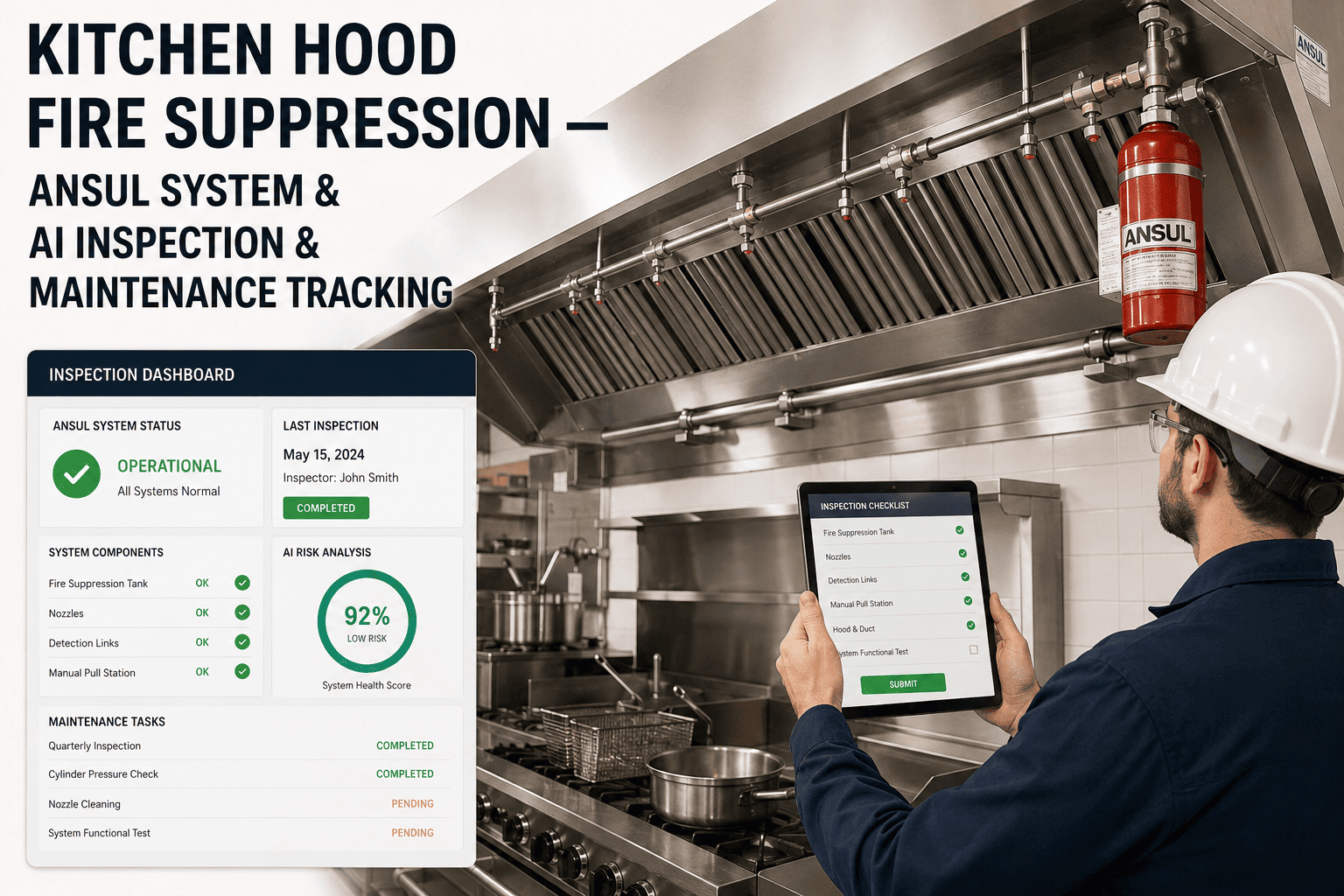
Kitchen hood fire suppression systems sit idle for years at a time, and the wet chemical Ansul-style systems protecting commercial cooking lines depend entirely on fusible links, nozzles and agent tanks staying in exact working order for a fire that, statistically, most locations will never experience. NFPA 96 requires semi-annual professional inspection, but between those scheduled visits a grease-clogged nozzle, a corroded fusible link, or a gauge that has quietly drifted out of the acceptable pressure range can go unnoticed for months, and multi-location restaurant groups managing dozens of hoods across different cities often cannot say with confidence which locations are fully compliant on any given day. Manual inspection tracking through spreadsheets and paper certificates means someone has to remember which system was last serviced when, a system that breaks down exactly when staff turnover or a busy season pulls attention elsewhere. AI-driven inspection scheduling and readiness tracking keeps every hood system's compliance status visible in real time, across as many locations as a restaurant group operates. Book a demo to see inspection tracking mapped across your full location list.
Kitchen Hood Suppression Compliance Tracking
Know Every Hood's Readiness Status Without Chasing Paper Certificates
iFactory tracks semi-annual inspection schedules, system readiness and NFPA 96 documentation across every location, replacing spreadsheet tracking with a real-time compliance view for your entire portfolio.
Inspection Due Within 30 Days
Overdue, Immediate Attention Needed
Why Multi-Location Compliance Tracking Breaks Down on Spreadsheets
A single restaurant location tracking one hood system on a wall calendar or a spreadsheet reminder is manageable, but a group running fifteen, fifty, or more locations across different service providers and inspection schedules quickly loses the ability to answer a simple question with confidence: which locations are actually compliant right now. See how your current tracking method compares to a live compliance dashboard. Paper certificates get filed at the location level and rarely make it back to a central compliance record promptly, so by the time a health inspector or insurance auditor asks for documentation, someone is calling individual store managers trying to track down the most recent inspection report.
What NFPA 96 Compliance Tracking Actually Covers
Semi-Annual Inspection Scheduling
Automatic scheduling and reminders for the required semi-annual professional inspection at every location, with escalating alerts as a due date approaches.
Fusible Link & Nozzle Condition
Inspection findings on fusible link condition, nozzle blockage and grease accumulation are logged centrally rather than staying on a paper form at the location.
Agent Tank Pressure Verification
Wet chemical agent tank pressure readings are tracked against acceptable range at each inspection, flagging any tank trending toward out-of-range before it fails a check.
Certificate Documentation
Inspection certificates are stored centrally and instantly retrievable for health department, fire marshal or insurance audit requests across any location.
See Every Location's Compliance Status in One View
iFactory replaces scattered paper certificates and spreadsheet tracking with a live readiness dashboard across your entire restaurant portfolio.
Spreadsheet Tracking vs. AI-Driven Compliance Dashboard
The gap widens fastest for restaurant groups managing inspection schedules across multiple service providers and jurisdictions. Compare your current process against a centralized readiness view.
| Tracking Method |
Spreadsheet & Paper Certificates |
iFactory AI Compliance Dashboard |
| Portfolio Visibility |
Requires calling individual locations to confirm status |
Live readiness status for every location in one view |
| Inspection Scheduling |
Manual reminders, often missed during busy periods |
Automated scheduling with escalating due-date alerts |
| Certificate Storage |
Filed at location level, slow to retrieve for audits |
Centralized, instantly retrievable documentation |
| Overdue Detection |
Often discovered during an inspection or audit itself |
Flagged automatically before the due date passes |
| Multi-Location Reporting |
Manually compiled, error-prone across many sites |
Automatic portfolio-wide compliance reporting |
How Compliance Tracking Deploys Across a Portfolio
1
Location & System Inventory
Every hood suppression system, service provider and last-inspection date across the portfolio is catalogued into a central record.
2
Schedule Reconciliation
Semi-annual inspection due dates are calculated and reconciled against existing service provider schedules for every location.
3
Live Dashboard Activation
The portfolio-wide readiness dashboard goes live, with automated alerts routing to the right regional or location contact as due dates approach.
4
Ongoing Certificate Capture
Each new inspection certificate is uploaded and linked to its location automatically, keeping the compliance record continuously current.
Results From Restaurant Groups Running Compliance Tracking
Quick-Service Restaurant Group, 38 Locations
Overdue Inspections Eliminated Across the Portfolio
A quick-service chain managing hood suppression compliance through regional manager spreadsheets found several locations had gone past their semi-annual inspection window without anyone at the corporate level noticing. Centralized tracking eliminated overdue inspections entirely within one full inspection cycle after deployment.
Full-Service Restaurant Group, 22 Locations
Insurance Audit Documentation Retrieved in Minutes
An annual insurance audit that previously required a week of collecting paper certificates from individual locations was completed the same day using the centralized compliance dashboard, with every location's current certificate available on demand.
Frequently Asked Questions
Does this replace our current fire suppression service provider?
No. iFactory tracks inspection scheduling and documentation alongside your existing service providers, whoever performs the physical semi-annual inspection at each location, rather than replacing that relationship. The system simply gives you centralized visibility into when each provider last serviced a system and when the next inspection is due.
Can we use multiple fire suppression service providers across different locations?
Yes, the compliance dashboard tracks inspection schedules and certificates regardless of which provider services a given location, which is common for restaurant groups operating across different cities or regions with different local service relationships. Each location's provider and schedule are tracked independently within the same central view.
How does the system know when an inspection is actually due?
Can this help during a health department or fire marshal inspection?
Yes, having every location's current inspection certificate instantly retrievable rather than filed away at the site level significantly speeds up documentation requests during unannounced health department or fire marshal visits.
Book a demo to see how certificate retrieval works during a mock audit scenario.
How quickly can this be set up across our existing locations?
Setup time depends primarily on how many locations and service providers need to be catalogued and reconciled into the system, with most portfolios under fifty locations fully onboarded within a few weeks. Larger portfolios with more varied service arrangements may take longer to fully reconcile existing schedules.
Stop Chasing Paper Certificates Across Every Location
iFactory keeps every kitchen hood suppression system's inspection status and documentation visible in one place, across your entire restaurant portfolio.
Live readiness status for every location
Automated semi-annual inspection scheduling
Centralized, instantly retrievable certificates
Works with any existing service provider

.jpg)