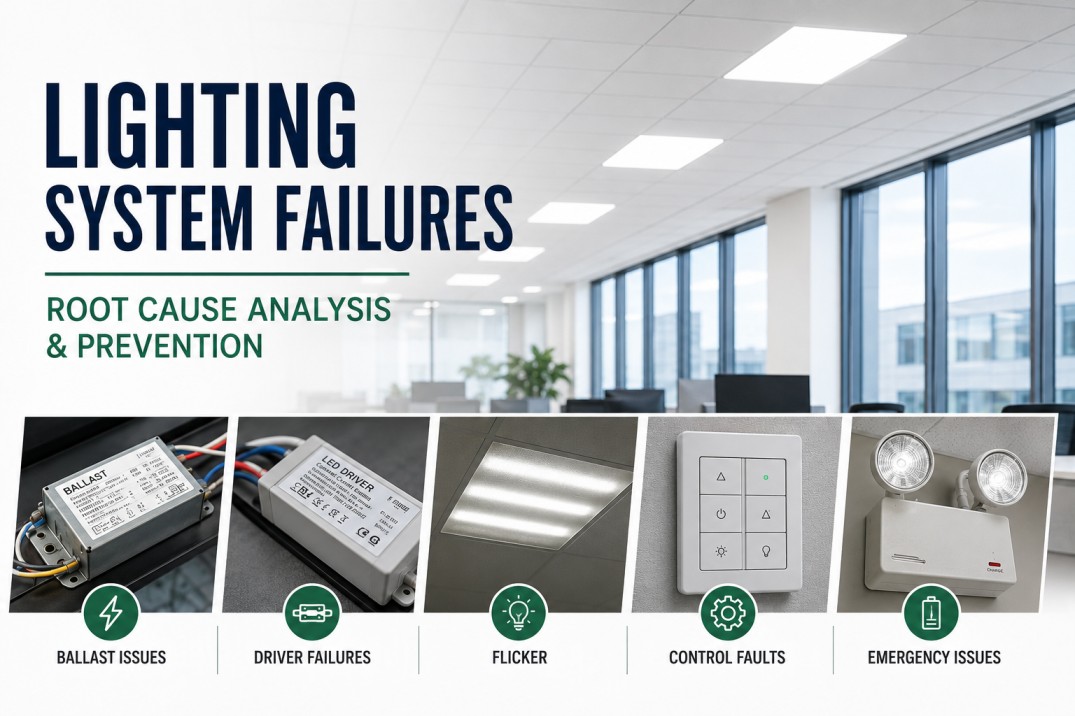
Every minute a commercial facility operates under failed or flickering lighting, productivity drops, safety risks climb, and maintenance costs compound. Yet most lighting failures are preventable — if you know where to look.
Root Cause Analysis
Lighting System Failure:
Diagnose It. Fix It. Prevent It.
Diagnose It. Fix It. Prevent It.
A field-tested framework for commercial facility managers and electrical engineers
Stop Guessing. Start Diagnosing.
iFactory's platform gives your team real-time visibility into every lighting asset — before a failure becomes a crisis.
The Business Impact
Why Lighting Failures Are More Costly Than They Look
38%
of unplanned facility downtime involves lighting or electrical system issues
$4,200
average cost per lighting failure incident including labor, parts, and lost productivity
72%
of repeat failures stem from treating symptoms, not root causes
2.3×
more likely to fail within 90 days if root cause is not addressed
Failure Classification
The 5 Core Categories of Lighting System Failures
Before any root cause analysis begins, failures must be categorized. Each type has a distinct symptom pattern, failure mechanism, and repair path.
01
Ballast Failure
Affects fluorescent and HID fixtures. Manifests as buzzing, overheating, flickering, or complete lamp outage. Often caused by capacitor degradation or thermal cycling stress.
Fluorescent · HID · Metal Halide
02
LED Driver Failure
Primary failure mode in modern LED systems. Presents as sudden dark-out, partial illumination, or premature dimming. Root causes include thermal stress, voltage transients, and capacitor ESR drift.
LED · High-Bay · Retrofit
03
Flicker & Instability
Cyclic light output variation that may be visible or invisible (stroboscopic). Caused by voltage fluctuation, driver compatibility issues, PWM dimming mismatch, or loose connections.
LED · Fluorescent · Dimmable Systems
04
Control System Faults
DALI, 0-10V, or BACnet control failures that disable dimming, scheduling, or occupancy response. Often traced to wiring faults, firmware mismatches, or failed control modules.
DALI · 0-10V · BMS-Integrated
05
Emergency Lighting Failure
Battery degradation, charger faults, or test failures in emergency systems. Code-critical — NFPA 101 and IBC require monthly and annual testing. Often missed until a real emergency.
Emergency · Exit Signs · Battery Backup
Diagnostic Framework
The 6-Step Lighting RCA Workflow
A structured root cause analysis prevents the most common failure mode in maintenance: replacing parts without identifying why they failed.
1
Document the Symptom
Record exact failure mode — complete outage, flicker, partial illumination, or control non-response. Note fixture type, location, hours in service, and when the symptom first appeared. Never skip this step.
2
Isolate the Scope
Determine if the failure is isolated (single fixture), circuit-wide, or zone-level. Use a multimeter to confirm supply voltage at the fixture. Isolate driver/ballast vs. lamp vs. wiring vs. control signal.
3
Measure Power Quality
Check for voltage sags, surges, or harmonic distortion on the supply circuit. Many LED driver failures are caused by upstream power quality events, not the driver itself. Log with a power quality analyzer.
4
Inspect for Thermal Stress
Overheating is the #1 accelerated failure driver. Use a thermal camera to identify hotspots on drivers, ballasts, and connections. Check ambient temperature against fixture ratings. Confirm adequate airflow in enclosed housings.
5
Verify Control Integrity
For control-related failures, test DALI bus voltage (16V DC nominal), check 0-10V signal levels, and verify dimmer compatibility with the driver. Review BMS logs for command history and error codes.
6
Apply Corrective & Preventive Action
Replace the failed component, address the root cause (surge protection, ventilation, compatible controls), update CMMS records, and schedule follow-up inspection at 30 and 90 days.
Failure Comparison
Ballast vs. LED Driver: Side-by-Side Failure Analysis
| Factor | Magnetic Ballast | Electronic Ballast | LED Driver (Constant Current) | LED Driver (Dimmable) |
|---|---|---|---|---|
| Rated Lifespan | 50,000–75,000 hrs | 40,000–60,000 hrs | 50,000–100,000 hrs | 30,000–70,000 hrs |
| Primary Failure Mode | Capacitor failure, core overheating | PCB failure, high-frequency resonance | Electrolytic capacitor degradation | PWM controller failure, MOSFET stress |
| Thermal Sensitivity | High | Very High | High | Very High |
| Voltage Transient Risk | Low | High | High | Very High |
| Failure Warning Signs | Hum, flickering, slow start | Rapid cycling, buzzing | Sudden outage, gradual dimming | Flicker at low dim, unexpected shutoff |
| Diagnostic Tool | Multimeter, tong tester | Oscilloscope, ballast tester | Output voltage/current meter | Flicker meter, oscilloscope |
| Average Replacement Cost | $18–$45 | $25–$80 | $35–$120 | $45–$200 |
Track Every Fixture. Close Every Work Order.
iFactory's CMMS gives your team automated failure tracking, RCA templates, and maintenance history for every lighting asset in your facility.
Code Compliance
Emergency Lighting Failure: What You Can't Miss
Emergency lighting failures are the highest-stakes category. They are also the most frequently overlooked — until an inspection or, worse, an actual emergency.
Monthly Testing Checklist
Initiate 30-second functional test on all units
Confirm battery holds charge during test duration
Visually inspect all indicators and lamp condition
Log results in maintenance management system
Flag any units showing reduced output for follow-up
Annual Testing Checklist
Full 90-minute discharge test per NFPA 101
Verify illuminance levels meet 1 fc minimum at floor
Replace batteries approaching 4-year service life
Check charger output voltage and current
Submit documentation for AHJ records and insurance audit
NFPA 101 Life Safety Code and IBC Section 1008.3 require documented testing records. Failure to maintain records can result in failed inspections and increased liability.
Preventive Strategy
Proactive Maintenance Timeline for Lighting Systems
Monthly
Visual Inspection & Emergency Test
Walk all zones. Document flickering, dark fixtures, and discoloration. Run 30-second emergency test. Update CMMS with findings.
Quarterly
Connection & Control Audit
Inspect all junction boxes for corrosion and loose terminations. Test control system schedules and occupancy sensor response. Verify DALI/0-10V signal integrity.
Bi-Annual
Thermal Imaging Survey
Scan all panels, drivers, and ballasts with IR camera under load. Identify thermal anomalies before they cause failure. Document and trend results over time.
Annual
Full System Assessment
90-minute emergency test. Power quality logging on critical circuits. Group relamping assessment for high-usage fixtures. Driver replacement planning based on hours-in-service data.
5-Year
System Lifecycle Review
Evaluate ROI of LED retrofit for legacy fluorescent zones. Assess control system upgrade opportunities. Review energy benchmarks against current utility rates and rebate programs.
FAQ
Lighting Failure RCA: Common Questions
What is the most common cause of LED fixture failure in commercial facilities?
LED driver failure accounts for over 60% of LED fixture failures. The most frequent root cause is thermal stress — drivers operating above their rated ambient temperature due to inadequate airflow or oversized fixture loads degrade electrolytic capacitors, reducing rated lifespan by 40–70%.
How do I distinguish between a lamp failure and a ballast/driver failure?
Swap the lamp with a known-good unit. If the fixture operates normally, the lamp was the cause. If the issue persists, the ballast or driver is the likely culprit. For LED systems, also test output voltage at the driver terminals — a non-responsive driver will show 0V or abnormal voltage.
Can voltage fluctuations cause lighting system failures?
Yes — voltage transients and sags are responsible for a significant share of premature LED driver failures. Facilities near heavy industrial loads, HVAC compressor banks, or with aging distribution infrastructure are especially vulnerable. Transient voltage surge suppressors (TVSS) on lighting panels are a cost-effective preventive measure.
How often should emergency lighting batteries be replaced?
Most sealed lead-acid batteries used in emergency lighting units have a rated service life of 4–5 years. NiCd batteries typically last 7–10 years. Replace proactively at the rated service life, not reactively after a failed test. Failure to replace on schedule is the #1 cause of emergency lighting non-compliance findings.
What is the right tool for diagnosing lighting flicker?
A dedicated flicker meter (measuring Percent Flicker and Flicker Index per IEEE 1789-2015) is the standard tool. For a quick field check, a high-speed camera or a smartphone slow-motion mode (240fps or higher) can reveal visible flicker. DALI or 0-10V control signal issues contributing to flicker can be diagnosed with an oscilloscope.
Does a CMMS improve lighting failure outcomes?
Consistently, yes. Facilities using a CMMS for lighting asset tracking report 30–50% reductions in repeat failures. Capturing failure history, mean time between failures (MTBF) by fixture type, and hours-in-service data enables proactive replacement planning — shifting teams from reactive firefighting to predictive maintenance.
Your Lighting Failures Have a Pattern.
iFactory Helps You Find It.
iFactory Helps You Find It.
From ballast burnouts to emergency system compliance, iFactory's maintenance platform centralizes your lighting asset data, automates RCA workflows, and keeps your team ahead of the next failure.