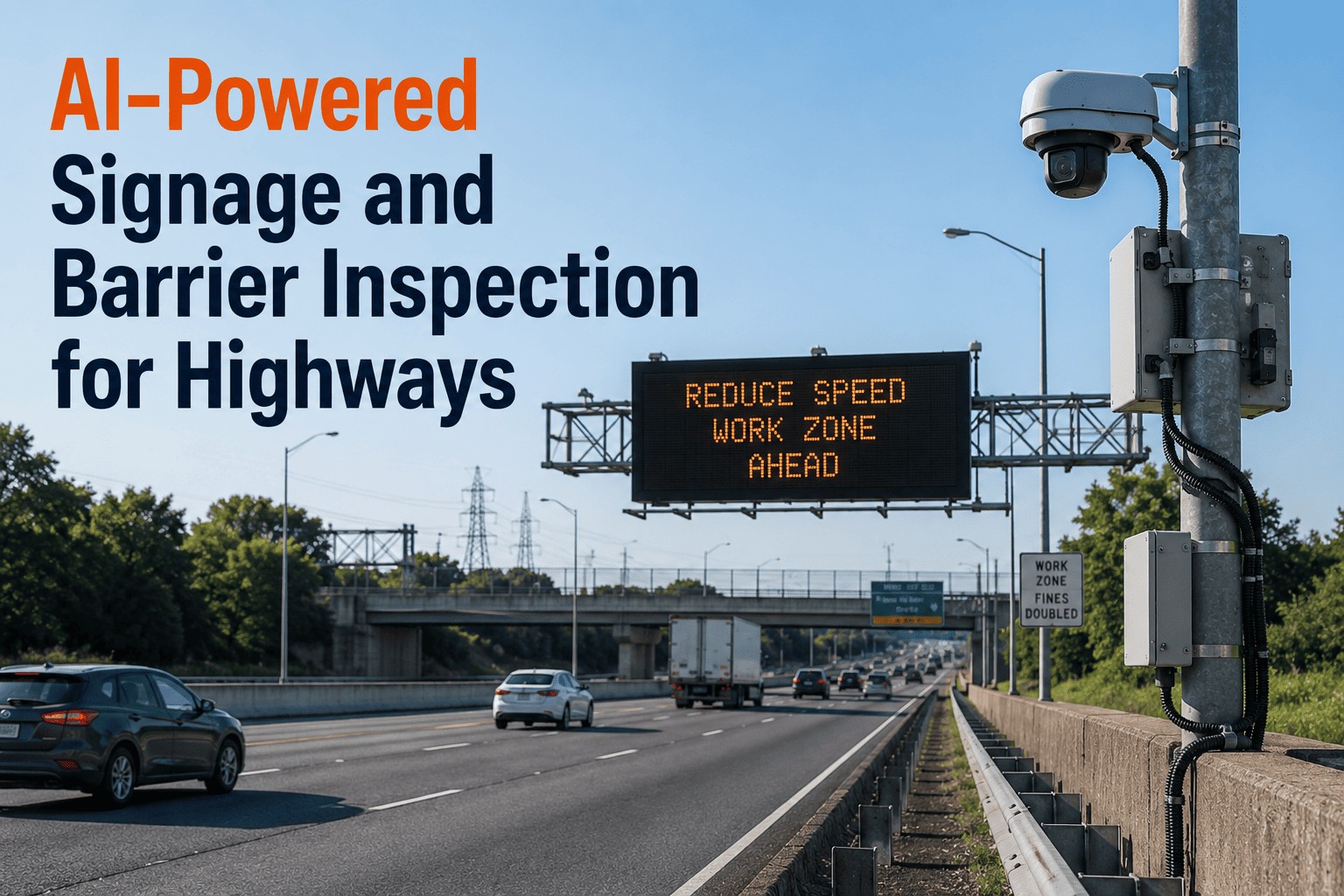
There are over 103,000 guardrail-related crashes on U.S. highways in a single year — 947 of them fatal. Hundreds of thousands more accidents involve signs that were missing, faded, storm-toppled, or simply never flagged as damaged. The uncomfortable truth facing every highway authority and road operator is this: you cannot inspect what you cannot see, and manual inspection crews can only see a fraction of your network on any given day. AI-powered automated vision systems change that equation permanently — converting ordinary patrol vehicles and roadside cameras into a continuous, high-recall detection layer that flags damaged signs and barriers the moment they degrade. If you manage highway assets and want to see how iFactory's platform maps to your inspection workflow, book a 30-minute demo with our infrastructure AI team.
Highway Infrastructure AI · 2025
AI-Powered Signage & Barrier Inspection for Highways
Automated vision systems detect damaged signs, compromised barriers, and safety-critical defects across your entire road network — before a driver encounters them.
103K
Guardrail crashes per year in the U.S.
90%+
AI detection accuracy for sign & surface defects
$247B
U.S. state road spending in FY2024
$105B
Deferred road maintenance backlog (Pew, 2025)
The Inspection Gap on Every Highway
The average highway authority runs manual inspection crews on a quarterly or semi-annual cycle. In the months between visits, signs get struck by vehicles, barriers absorb impact damage without triggering any report, retroreflective sheeting fades below legal visibility thresholds, and storm events topple signage across hundreds of kilometres of road — all of it invisible to the maintenance system until a driver reports it or, worse, hits it.
The ASCE's 2025 infrastructure report gives U.S. roads a grade of D — and state and local governments face a $105 billion deferred maintenance backlog driven in large part by a reactive model where defects are found after failure, not before. AI vision systems break this cycle by turning the inspection process from periodic to perpetual.
System Architecture
How AI Inspects a Highway in Real Time
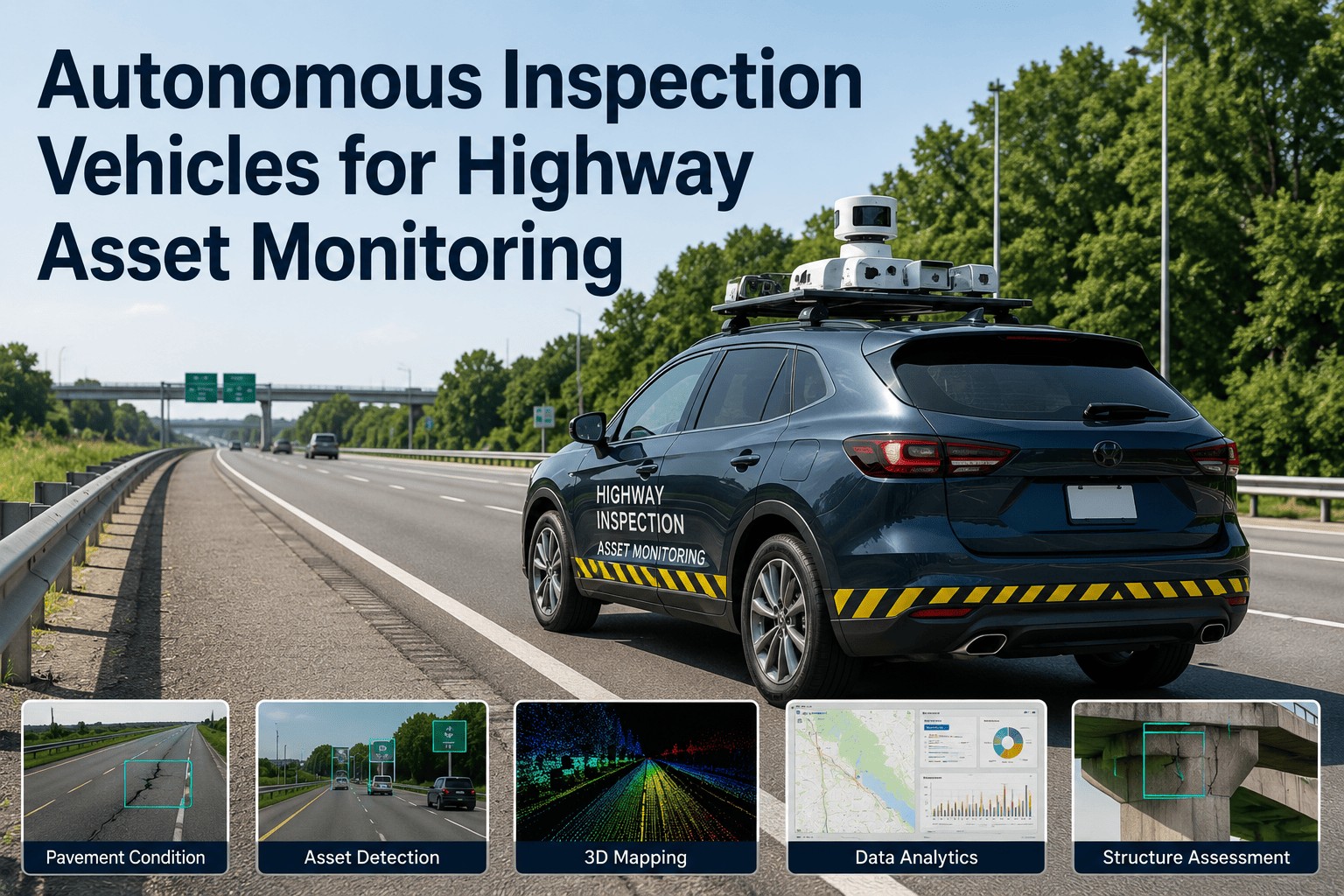
Mobile Patrol Units
Forward & side cameras mounted on existing fleet vehicles. Capture at 30fps as crews drive inspection routes. No dedicated vehicle required.
Fixed Roadside Cameras
High-risk zones, tunnels, junctions, and bridge approaches get permanent visual coverage with 4K IP cameras running edge inference 24/7.
UAV Survey Flights
Post-storm or scheduled drone sweeps for overhead barrier inspection, sign top-damage detection, and wide-area corridor mapping.
↓
AI Edge Processing Layer
YOLO Object Detection
CNN Classification
Semantic Segmentation
Retroreflectivity Analysis
↓
Defect Report
GPS-tagged, photographically evidenced work order
Priority Alert
Immediate notification for safety-critical defects
Asset Map
Live GIS layer with condition status for every asset
Trend Dashboard
Degradation velocity tracking for proactive planning
What the AI Actually Flags: Signage vs. Barriers
Signs and barriers fail in entirely different ways — which means the AI models that inspect them are purpose-trained for different defect signatures. iFactory deploys separate detection pipelines for each asset class, trained on real-world highway imagery across climate zones and road types.
HIGH
Missing or Stolen Signs
Absence detection vs. expected sign database. Alerts within one patrol pass.
HIGH
Impact Damage & Deformation
Bent posts, shattered faces, rotated angles from vehicle strikes.
MED
Faded Retroreflectivity
Night-visibility scoring against MUTCD standards. Flags signs approaching legal minimums.
MED
Vegetation Obscurement
Detects when foliage growth covers >15% of sign face or reduces clearance below standards.
LOW
Graffiti & Vandalism
Pattern detection for spray paint, stickers, and defacement affecting legibility.
HIGH
Post Displacement & Collapse
Lateral or vertical post offset from standard position — common after vehicle strike.
HIGH
End Terminal Damage
Flared, bent, or deformed terminals that convert a safety device into a spearing hazard.
HIGH
Rail Section Gaps
Missing beam sections that leave an open gap in protective coverage — highest severity rating.
MED
W-Beam Deformation
Crush zone damage to beam faces — indicates previous strike and reduced residual protection.
LOW
Corrosion & Coating Loss
Surface rust progression scoring — planned for preventive treatment before structural weakening.
AI Model Types: What's Running Under the Hood
A 2025 research study published in Computers demonstrated CNN-based models achieving over 90% precision in simultaneous detection and classification of traffic signs and road surface defects. A separate research programme from Navinfo's Advanced Research Lab demonstrated that AI models produce higher recall than manual inspection for barriers and guardrails when applied to video streams from mobile survey units. These aren't lab results — they're the operational baselines iFactory deploys against.
Model Type 01
YOLO Real-Time Object Detection
Runs at 30+ fps on edge hardware. Identifies sign type, position, and presence against a route-specific asset database. Flags deviations from expected inventory in under 100ms per frame.
Missing assets
Inventory mapping
Model Type 02
CNN Damage Classification
Once a sign or barrier is detected, a second classification model assesses damage severity across predefined condition classes. Trained on thousands of real-world highway defect images across climates and materials.
Severity scoring
Defect type
Model Type 03
Semantic Segmentation
Pixel-level mapping of barrier rail condition, deformation zones, and corrosion patches across an entire panel face. Enables precise area-of-damage measurement for repair cost estimation and legal documentation.
Barrier condition
Damage area
Model Type 04
LiDAR + Vision Fusion
For high-priority corridors, LiDAR 3D point clouds are fused with camera feeds. This delivers sub-centimetre deformation measurements on barrier faces and sign post lean angles — precision not achievable with camera alone.
3D geometry
Precision measure
From Detection to Work Order: The Alert Workflow
Detection is worthless without an action path. iFactory closes the loop between AI finding a defect and a maintenance crew fixing it — automatically routing issues through your existing asset management system with zero manual re-entry.
Defect Detected & Classified
AI model flags the asset, assigns defect type and severity score, captures timestamp, GPS coordinate, and annotated still frame as evidence.
Priority Routing
High-severity defects (missing sign, rail gap, collapsed post) trigger immediate SMS + app alert to duty supervisor. Medium/low items batch into the daily work queue automatically.
Work Order Created
iFactory pushes a pre-filled work order directly to IBM Maximo, SAP PM, or your existing CMMS — including asset ID, defect photo, GPS location, and recommended repair action.
Post-Repair Verification
Next patrol pass compares the repaired asset against the defect baseline. If the AI confirms restoration to standard, the work order closes automatically. No manual close-out required.
The Maintenance ROI: Why AI Pays for Itself
The ROI case for AI highway inspection rests on three pillars: catching defects earlier (when repair costs are lower), reducing the labour cost of manual inspection rounds, and eliminating the legal and insurance liability that comes from documented failures to detect known defects.
4–6×
Cheaper to repair early
A flagged beam section repaired proactively costs a fraction of a full panel replacement after a secondary strike.
60–80%
Reduction in manual inspection hours
AI covers routes continuously; crews focus on confirmed repairs rather than discovery inspections.
>90%
Defect recall rate
AI recalls more defects per route pass than human inspectors — reducing missed-defect liability exposure.
| Capability |
Manual Inspection Crew |
iFactory AI System |
| Inspection frequency |
Quarterly / semi-annual |
Every patrol pass + 24/7 fixed cameras |
| Night-time capability |
Severely limited |
Full operation with IR cameras |
| Defect evidence trail |
Manual notes, inconsistent photos |
GPS-timestamped images, auto-archived |
| CMMS integration |
Manual data entry required |
Auto-creates work orders via API |
| Storm response speed |
Next scheduled round |
First patrol pass post-event |
"
"We used to find out about barrier damage from the police report. Now iFactory flags it within 24 hours of it happening — usually the same shift. We've cut our post-incident repair lag from 9 days to under 48 hours, and our insurance underwriter gave us a 19% premium reduction when we showed them the detection audit trail."
Head of Road Asset Management
National Highways Authority — South Asia Region
Ready to see iFactory in action on your road network?
Book a 30-minute demo. We'll walk through a live detection workflow using imagery from your corridor type.
Book a Demo
Contact Our Team
Every Day Without AI Inspection Is a Day Defects Go Undetected
iFactory turns your existing patrol vehicles and camera infrastructure into a continuously learning inspection system — detecting damaged signs and compromised barriers before they become accident reports.