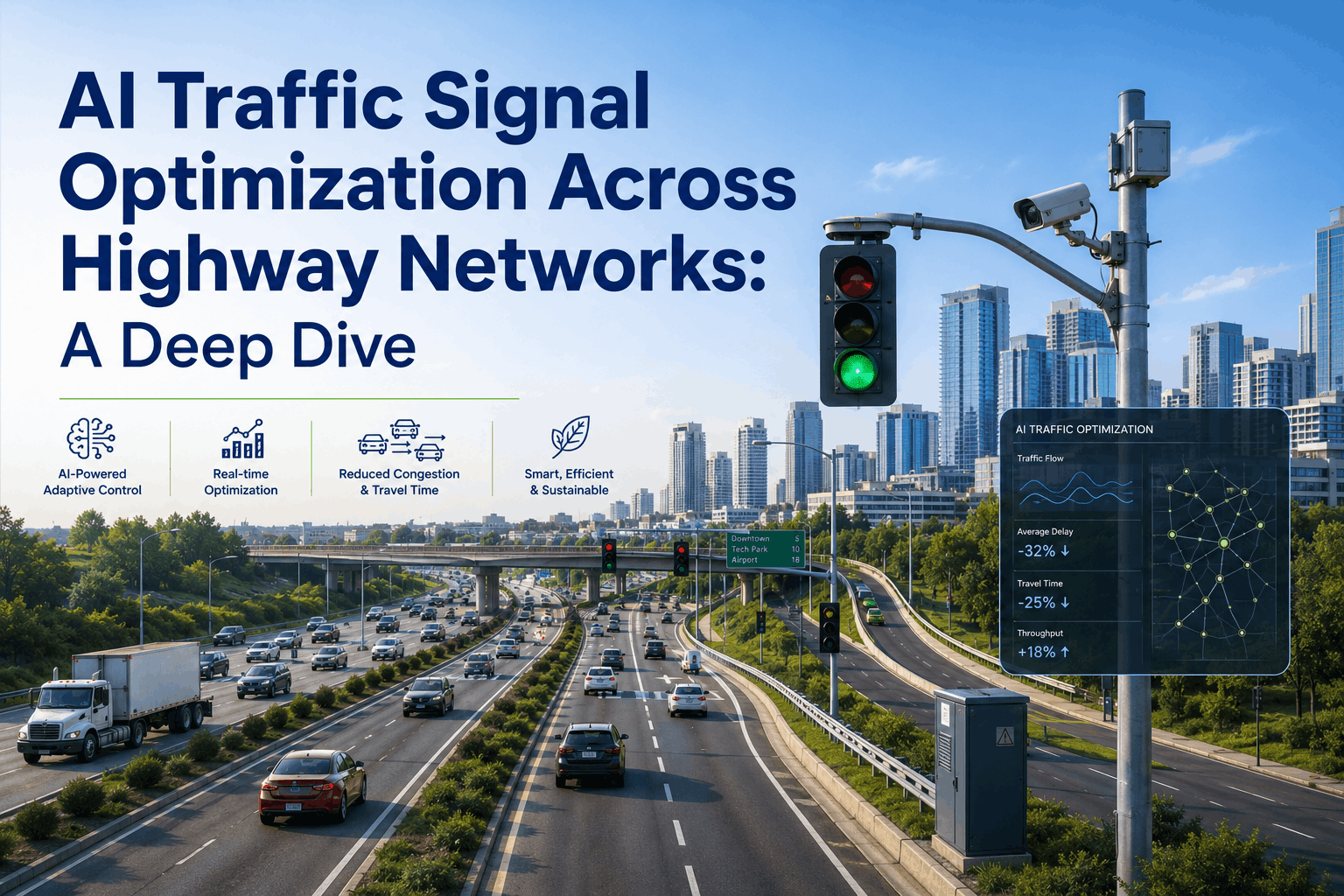
The modern intersection is no longer a static gatekeeper of traffic; it has become a dynamic data hub where milliseconds of timing can prevent miles of gridlock. Traditional traffic signal systems, often relying on pre-timed cycles or simple actuated logic, are fundamentally incapable of responding to the chaotic, non-linear demand patterns of 21st-century urban networks. We call this the "Fixed-Timer Friction"—a systemic inefficiency that costs global economies billions in lost productivity and wasted fuel. A true AI traffic signal optimization strategy requires moving beyond reactive logic toward predictive, multi-agent reinforcement learning models. iFactory’s AI-powered platform provides the essential reliability layer for this transformation. By ensuring that every physical asset—from inductive loops to high-definition traffic cameras—is 100% operational, iFactory enables the deployment of advanced algorithms that synchronize entire highway corridors in real-time. Schedule an optimization audit to unlock the hidden capacity of your network.
AI Traffic Signal Optimization: Synchronizing the Urban Arterial
Deploy adaptive, multi-agent reinforcement learning to reduce intersection delays by up to 35% and maximize corridor throughput without new construction.
The 7-Stage Intelligence Loop for Adaptive Signals
Achieving seamless signal synchronization requires a continuous feedback loop between the physical street level and the cloud-based AI engine. iFactory ensures that the hardware foundation of this loop never fails. View the integration roadmap.
An intelligent signal network is only as strong as its weakest sensor. If a single inductive loop fails or a camera lens becomes obscured, the AI's visibility into the demand curve is compromised. iFactory’s Enterprise Asset Management (EAM) platform acts as the "Reliability Layer" for the smart city, proactively alerting technicians to hardware failures before they can degrade the optimization algorithm. By closing the loop between data ingestion and physical maintenance, iFactory ensures that your "Green Waves" are permanent, not just occasional. Learn more about sensor reliability.
Prioritizing Signal Health for Global Flow
Not all signal failures impact the network equally. iFactory uses AI to calculate the "Congestion Risk" of every controller failure. A timing glitch at a primary highway off-ramp is a Level 1 emergency, whereas a pedestrian push-button failure on a residential street may be Level 4. This granular prioritization ensures your limited maintenance budget is spent where it preserves the most flow.
When a signal controller falls back to "Pre-Timed" mode due to a sensor failure, it doesn't just impact that intersection; it creates a "choke point" that disrupts the entire upstream and downstream flow. iFactory’s AI avoids this by ensuring that the maintenance team is notified of a "Degraded Optimization State" within seconds. This allow for the immediate dispatch of field technicians or remote resets, maintaining the corridor's digital integrity. Predictive signal health is the bedrock of the autonomous city.
Engineering the "Permanent Green Wave"
Our technology stack is designed to bridge the gap between traditional civil engineering and modern data science, providing a unified operating system for smart mobility.
DRL Signal Controller
Deploy Deep Reinforcement Learning (DRL) at the intersection level. Our controller logic learns from every vehicle arrival, optimizing green-time splits to eliminate "split-failures" and reduce unnecessary idling. It adapts in seconds to accidents or lane closures, maintaining flow when traditional systems freeze.
Computer Vision Edge Hub
Process 4K video feeds directly at the intersection. iFactory identifies vehicle types (bus, truck, bike, car) and queue lengths with 99.5% accuracy. This edge-based processing eliminates the need for expensive cloud bandwidth while providing the high-fidelity data required for sub-second signal adjustments.
Corridor Sync Engine
Coordinate entire arterial networks as a single living organism. Our sync engine manages inter-intersection offsets to create dynamic "Green Waves" that shift based on real-time demand. This prevents the "Platoon Breakup" that occurs when signals aren't properly negotiated, ensuring smooth travel across the city.
Asset Health Sentinel
The proactive safety net for your smart infrastructure. The Sentinel monitors electrical vitals, communication pings, and sensor accuracy 24/7. It predicts hardware failures before they impact traffic, automating work orders and ensuring that your optimization investment is never offline due to a blown fuse.
What the Director of Smart Mobility Said
Before iFactory, our signal optimization was a manual, once-a-year process that was out of date before the ink was dry. We were essentially guessing at traffic demand. By integrating iFactory's predictive EAM with adaptive signal control, we've created a self-healing corridor. The AI manages the timing, but more importantly, iFactory ensures the AI always has perfect data. We've seen a 30% reduction in peak-hour delays on our busiest arterial road, and our maintenance team is now solving problems before the public even notices them. It’s the most significant leap in traffic engineering we’ve made in two decades.
Frequently Asked Questions: AI Signal Optimization
How does AI-driven signal control differ from traditional "Actuated" signals?
Traditional actuated signals use simple "if-then" logic—if a car is detected, the light turns green for a fixed minimum duration. AI-driven control uses "Deep Reinforcement Learning" to analyze the entire corridor's state, predicting where the traffic will be in 60 seconds and adjusting splits dynamically to prevent queues from even forming.
What happens if the AI fails or loses its data connection?
Security and safety are built-in. Every controller features a "Fail-Safe Logic" layer. If the AI detects a data blackout or a sensor anomaly, the controller automatically falls back to a high-performance pre-timed plan until iFactory’s EAM system confirms the hardware is restored.
Can this system handle emergency vehicle preemption (EVP)?
Yes. iFactory integrates with GPS-based EVP systems to clear paths for emergency vehicles seconds before they arrive at the intersection. The AI then recalibrates the network immediately after the vehicle passes to dissipate any temporary congestion caused by the preemption.
How long does it take for the AI to "learn" a new intersection?
The system typically establishes a high-performance baseline within 72 hours of data ingestion. However, the multi-agent reinforcement learning model continues to refine its logic over months, identifying seasonal patterns and adapting to long-term shifts in urban growth.
Does iFactory work with our existing NEMA or ATC signal controllers?
Yes. iFactory is hardware-agnostic and designed to overlay on top of existing NEMA, ATC, or 2070 signal controllers. We provide a plug-and-play "Edge Hub" that bridges your legacy hardware with our advanced AI cloud layer.
How does the system handle extreme weather like heavy rain or snow?
Our Computer Vision models are trained for "All-Weather Reliability." We use multi-spectral sensor fusion (combining video with radar and infrared) to ensure that vehicle detection remains accurate even in low-visibility conditions where traditional cameras might struggle.
What is the direct ROI for a typical municipal implementation?
Beyond the 30% reduction in travel time, municipalities see a direct ROI through reduced fuel consumption, lowered carbon emissions, and a significant decrease in rear-end collisions caused by sudden stop-and-go congestion. Most projects achieve a full payback within 12 months.
How secure is the system against cyber threats?
iFactory uses end-to-end AES-256 encryption for all data transmissions between the intersection and the cloud. The local fail-safe logic ensures that even in the event of a network disruption, the signals maintain a safe, synchronized timing plan.
Ready to Eliminate Gridlock with iFactory AI?
Maximize corridor throughput, reduce idling, and ensure 100% signal reliability with the world's most advanced smart city operating system.