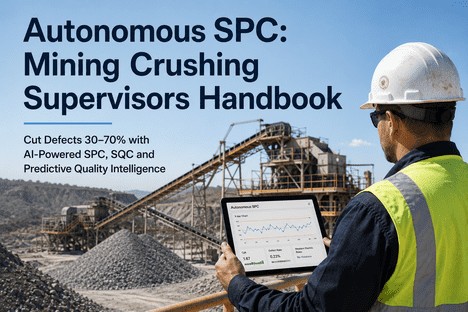
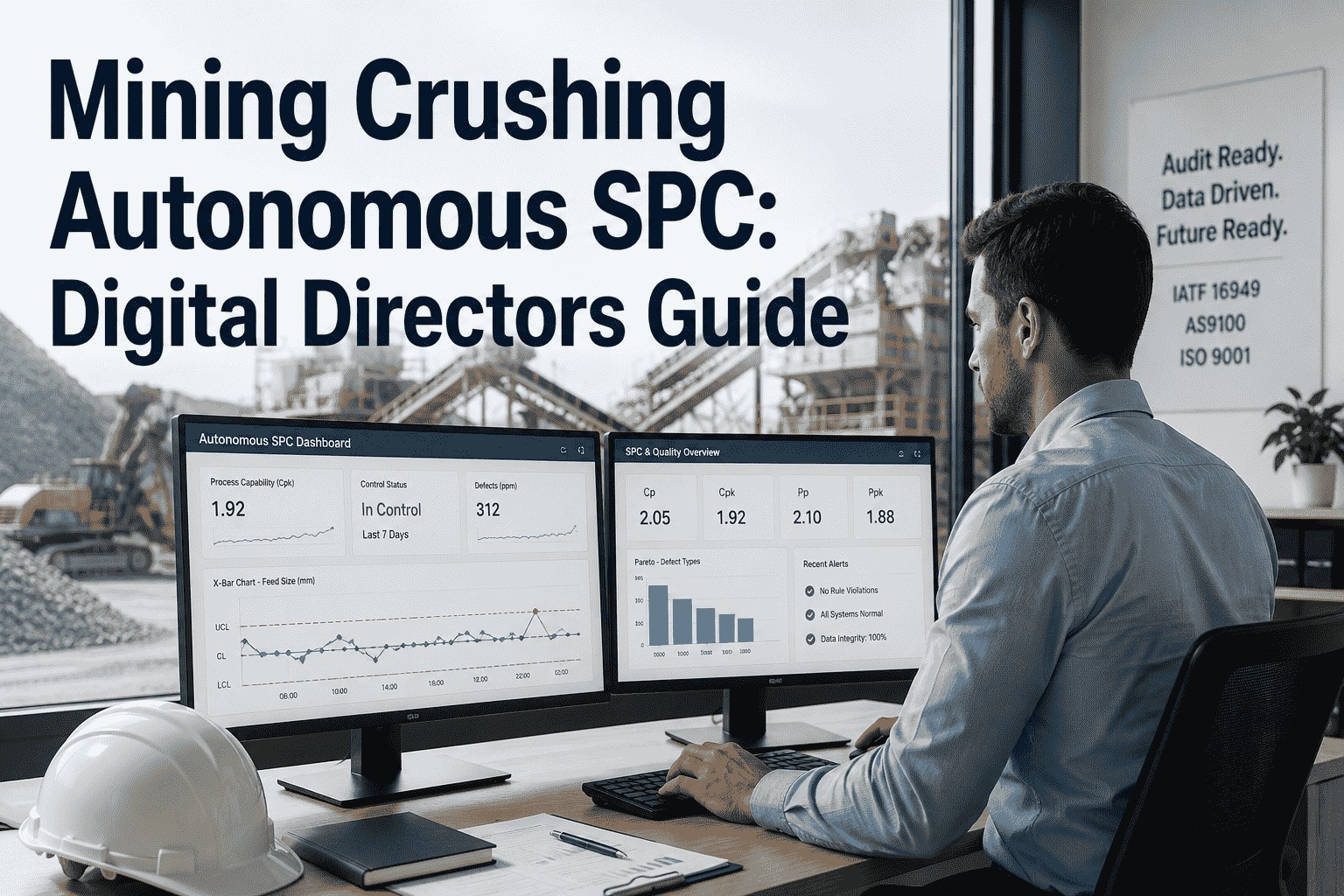
Every shift, crushing supervisors face a version of the same problem: the process looks controlled on paper, but defects keep showing up downstream. Fines generation creeps up. Screen oversize rates drift. Yield targets are missed by a margin that never quite triggers a formal incident — but adds up to real cost by month-end. The culprit, almost always, is a quality monitoring system that was designed for stable manufacturing and applied to a process that is anything but stable. Autonomous SPC changes that equation entirely — replacing static, manually-maintained control charts with a self-tuning intelligence layer that tracks Cpk and Ppk continuously, applies all eight Western Electric rules in real time, and surfaces root-cause explanations the moment drift begins. For mining crushing supervisors, this is what defect elimination actually looks like in 2026.
Self-Tuning SPC · Continuous Cpk/Ppk · Western Electric Rules · AI Root Cause
The Shift Supervisor's Handbook to Autonomous SPC in Mining Crushing
iFactory's Autonomous SPC platform runs self-tuning control charts, live capability indices, and AI-driven defect attribution across your entire crushing circuit — so supervisors eliminate defects 30–70% faster without adding headcount or replacing instrumentation.
Defect reduction achievable with autonomous SPC in crushing operations
Cpk ≥1.33
Industry benchmark for capable processes — tracked continuously per parameter
8 Rules
Western Electric pattern rules running autonomously in real time, every shift
<30 min
Average time to first actionable insight after connecting to your DCS historian
Why the Supervisor Role Is Where Defect Elimination Wins or Loses
Defects in crushing circuits aren't discovered by sensors — they're discovered by people. A shift supervisor is the critical node where process data, operator observation, and corrective action all converge. But supervisors are managing multiple machines, fielding maintenance requests, handling personnel issues, and running shift handovers simultaneously. Traditional SPC systems demand time supervisors don't have: manually reviewing charts, interpreting ambiguous alarms, cross-referencing with production logs to determine if a signal is real. Autonomous SPC removes that friction. It does the watching, the pattern recognition, and the attribution — and hands the supervisor a single, clear instruction when action is needed.
Pain Point 1
Too Many Alarms, Too Little Signal
Static SPC charts fire alarms when ore hardness shifts naturally — events that aren't defects at all. After the fifth false alarm in a shift, supervisors stop responding to any alarm. Real drift goes unaddressed.
Pain Point 2
Cpk Numbers Without Context
A weekly Cpk report showing 1.02 tells a supervisor the process is marginal — but not which crusher, which parameter, which shift, or which variable is dragging the index down. Actionability is zero.
Pain Point 3
Liner Wear Drift Goes Undetected
Progressive liner wear shifts the CSS and PSD baseline over days, not minutes. Each individual reading stays inside static limits. By the time fines generation is visible, the opportunity window to prevent it has long passed.
What "Autonomous" Actually Means on the Shift Floor
Autonomous SPC is not just SPC with a faster update rate. It is a fundamentally different approach: the system continuously adjusts its own baselines, runs pattern detection without human configuration, calculates live capability indices (Cp, Cpk, Pp, Ppk) for every monitored parameter, and generates explanations — not just alerts. Here is what each layer delivers on a shift-by-shift basis.
Layer 1
Self-Tuning Control Limits
What it does autonomously
EWMA-based baseline estimation recalculates UCL and LCL continuously as ore hardness, feed rate, and liner wear shift the process distribution. No manual reconfiguration needed when a new ore blend arrives or liner wear progresses into a new wear zone.
Supervisor outcome: Control limits that actually reflect today's process — not the commissioning baseline from 18 months ago.
Layer 2
Continuous Cpk / Ppk Tracking
What it does autonomously
Cp, Cpk, Pp, and Ppk are calculated live — per machine, per parameter, per shift — and compared against configurable thresholds (industry standard: Cpk ≥ 1.33). When Ppk diverges significantly from Cpk, the system flags instability that short-term capability analysis would miss.
Supervisor outcome: Live capability scorecard for your shift — not a weekly report that arrives after the scrap has already been generated.
Layer 3
8-Rule Western Electric Detection
What it does autonomously
All eight Western Electric pattern rules run against adaptive baselines in real time. Rules 1–4 catch acute events and mean shifts; rules 5–8 catch systematic trends, stratification, and cyclic patterns — including the slow 6-point liner-wear trend that a single-point alarm will never see until the drift has compounded.
Supervisor outcome: Drift caught at day 3–5, not after the mill calls about oversize at day 14.
Layer 4
AI Root-Cause Attribution
What it does autonomously
When any rule triggers, a root-cause ML layer ranks contributing variables — liner wear progression, CSS drift, feed hardness change, moisture shift, feed rate variance — by percentage contribution to the exceedance. The supervisor sees one clear instruction, not six possible causes to investigate manually.
Supervisor outcome: "Liner wear: 58% contribution — check CSS and schedule inspection" replaces "alarm on crusher 3."
See Autonomous SPC Running on Your Crusher Data
iFactory connects to your existing DCS and historian. Book a Shift-Floor Demo and see how your last 90 days of crushing data looks under autonomous SPC — what it would have caught, when.
Reading Capability Indices on the Shift Floor: What Cpk and Ppk Tell You
Capability indices are the most compact summary of process health available. A single Cpk number translates directly into expected defect rates — but only if it is being calculated from current, stable process data, not historical averages. Here is how supervisors should read these numbers in real time.
Cpk Value
Defect Rate
What the Supervisor Should Do
Cpk < 1.00
~2,700+ PPM
Process is incapable. Immediate investigation required — likely mean shift, excessive variation, or both. Autonomous SPC will already have fired Rules 1–4.
1.00–1.33
63–2,700 PPM
Marginal capability. Process is at risk under any additional variation. Watch Western Electric Rules 3 and 4 closely — early trend detection matters most here.
1.33–2.00
< 63 PPM
Capable. Maintain current settings, monitor for liner wear drift. Autonomous SPC holds the baseline stable — focus attention on rules 5–6 (trend detection).
Cpk ≥ 2.00
~3.4 PPM (6σ)
World-class performance. Document this operating state — it defines the reference baseline autonomous SPC uses to detect future degradation immediately.
The Cpk/Ppk gap matters. When Cpk is significantly higher than Ppk, the process performs well in short windows but degrades over longer periods — exactly the liner wear pattern that destroys crushing circuit consistency. Autonomous SPC tracks both indices simultaneously and flags divergence before it becomes a defect event.
A Supervisor's 90-Day Defect Elimination Roadmap With Autonomous SPC
Deploying autonomous SPC in a crushing circuit follows a structured ramp that matches the natural rhythm of mining operations. Here is what the first three months look like for a typical crushing supervisor team.
1
Days 1–14 · Data Connectivity
Connect, Baseline, and Audit
iFactory connects to your DCS via OPC-UA or historian export. The autonomous SPC engine ingests historical data and establishes initial control baselines. Supervisors receive a current-state Cpk/Ppk report across all monitored parameters — most teams discover 2–3 processes running at Cpk below 1.00 that were invisible in weekly quality reports.
2
Days 15–30 · Live Monitoring
First Autonomous Alerts — and the First Catches
The system transitions to live adaptive monitoring. Supervisors see their first autonomous alerts — with root-cause attribution attached. Alarm volume typically drops 40–60% compared to the previous static system within the first week of adaptive limits. The team starts trusting the charts again because alarms mean something.
3
Days 31–60 · Pattern Learning
Liner Wear Trends and Recipe Signatures Identified
With a full month of adaptive data, the system identifies recurring patterns: which ore blends cause Rule 2 violations, how long a liner run lasts before Rule 4 fires, what shift changes look like as Rule 6 cyclic patterns. Supervisors receive pattern-specific playbooks — standard responses for each detected signature.
4
Days 61–90 · Measured Outcome
30–70% Defect Reduction — Measured and Documented
By the end of quarter one, supervisors have a before/after defect rate comparison, shift-level Cpk trend data, and a root-cause frequency report showing which variables drove the most exceedances. The productivity improvement is quantified, exportable, and presentable to site management — closing the loop between autonomous monitoring and business results.
"
We had three supervisors manually reviewing SPC charts across five crushers every shift. They were spending more time interpreting ambiguous alarms than acting on real problems. The moment we moved to autonomous SPC, the alarm load dropped dramatically and the charts started making sense again. By month two, we had caught two liner wear progressions before they generated any reportable fines. That had never happened before — we always found out from the screen, not the chart.
— Production Supervisor, Copper Concentrator — Secondary and Tertiary Crushing Circuit
Autonomous SPC vs Standard SPC: The Supervisor Experience Side-by-Side
Scenario
Standard SPC
Autonomous SPC
Ore hardness changes mid-shift
Zone A alarm fires — likely a false positive
Limits self-adjust — no alarm unless a real exceedance occurs in the new context
Liner wear progresses over 2 weeks
Each reading within limits — drift undetected until screen reports fines
Rule 4 fires at day 7 — liner wear attributed as primary cause, work order initiated
Supervisor reviews shift Cpk
Weekly report, aggregate number, no machine or variable breakdown
Live dashboard: Cpk per crusher, per parameter, per shift — with trend direction visible
Alarm fires on workstation
Red indicator — investigate which of 5 variables caused it
"Feed hardness spike: 71% contribution" — one action taken in under 2 minutes
New ore blend enters the circuit
Old limits applied — continuous false alarms or missed drift depending on direction
Recipe event triggers rebaselining — new limits established within 30 readings automatically
The Shift Supervisor Who Eliminates Defects Is the One Whose System Never Stops Watching
The 30–70% defect reduction autonomous SPC delivers isn't from harder work — it's from a system that does the monitoring work autonomously, at the speed of the process rather than the speed of the shift review. Continuous Cpk and Ppk tracking surfaces capability problems before they become defect events. Self-tuning control limits eliminate the false alarm cycle that destroys team trust in SPC systems. Eight-rule Western Electric detection catches the drift patterns — liner wear, recipe change, feed hardness progression — that single-point alarms were never designed to see. And root-cause attribution turns an anonymous alert into a directed action supervisors can execute in under two minutes. The crushing circuit is too variable and too fast-moving for weekly quality reports and static control limits. Autonomous SPC is what process control looks like when it is designed for the actual conditions of the job.
iFactory's Autonomous SPC platform integrates with your existing DCS and historian — no new instrumentation required. Supervisors get live Cpk dashboards, self-tuning control charts, and AI root-cause alerts on their existing workstations from day one. Book a Demo to see what autonomous SPC would have caught on your last 90 days of crushing data, or Talk to an Expert to start your deployment assessment today.
Frequently Asked Questions
Frequency of calculation is only one dimension. Standard SPC software — even run every minute — still uses static UCL/LCL limits and requires a human to interpret alarms and identify root causes. Autonomous SPC means the system itself adjusts baselines, selects the appropriate statistical model for the current process regime, runs all eight Western Electric rules continuously, calculates live capability indices, and generates root-cause attributions without requiring supervisor intervention except at the point of corrective action. It is the difference between a passive charting tool and an active process intelligence layer.
iFactory monitors all primary quality and process variables: P80, P50, fines percentage and product PSD, closed side setting (CSS), feed rate, motor and power draw per tonne, bearing temperatures, hydraulic pressure, CSS actuator position, gap position, throw, and product yield at the downstream screen. The root-cause ML layer extends monitoring to any continuously instrumented variable in your DCS — so if liner wear progression correlates with a temperature signal three sensors away, the system finds it. A variable inventory assessment is part of the initial deployment engagement. Talk to an Expert to begin yours.
No. The value of autonomous SPC on the shift floor is that the statistical interpretation has already been done by the system before the supervisor sees it. Supervisors interact with actionable instructions and capability scorecard numbers — not raw control charts. The platform translates Western Electric rule violations into plain-language operational descriptions ("sustained upward trend in PSD — likely liner wear") and ranks root causes by contribution percentage. Understanding what Cpk 1.02 means in terms of expected defect rate requires a brief orientation — but the day-to-day interaction is designed for operations professionals, not statisticians.
Alarm rate reduction is visible within the first week of adaptive limits going live. Cpk improvement trends typically emerge within the first 30 days as the most common root causes are identified and resolved. Measurable defect rate reduction — documented against prior shift baselines — is typically available at the 60–90 day mark and aligns with the 30–70% reduction range achieved across deployments. iFactory provides shift-level comparison reporting so supervisors can show quantified before/after performance on their own KPIs from the same data the system was already collecting. Book a demo to see what that reporting looks like for a circuit similar to yours.
Your Shift Deserves a System That Never Stops Watching the Process
Autonomous SPC gives crushing supervisors live Cpk tracking, self-tuning control charts, all eight Western Electric rules, and AI root-cause attribution — connected to your existing DCS on day one. Request a Shift-Floor Demo using your own crusher data and see the defect elimination potential before you commit.