Every shift supervisor in mining crushing knows the frustration of discovering oversized material on the discharge belt after it has already passed through the chamber. The lab sample from two hours ago says the product is within spec, but the downstream mill has just reported a blockage from material that should never have left the crusher. Manual sampling catches maybe one particle in ten thousand. By the time the assay result reaches the control room, that material is already in the stockpile or on its way to the next process stage. For the supervisor responsible for throughput, quality, and equipment health simultaneously, the gap between what is actually leaving the crusher and what the quality report shows is a blind spot that costs millions in reprocessing, energy waste, and lost production time every year.
AI Vision Quality for Mining Crushing
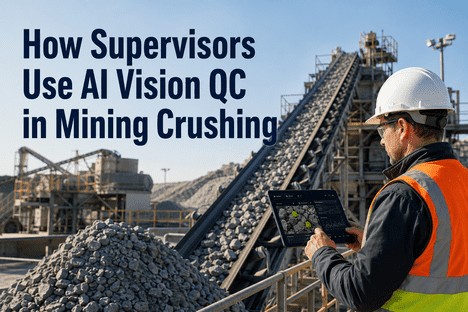
How Supervisors Use AI Vision QC to Cut Scrap 30-50% in Crushing Operations
Real-time deep-learning defect detection on every particle stream. Automated SPC control charts that update with every pass. Scrap reduction that compounds into millions in annual savings. No new sensors, no hardware changes, no delays.
The Sampling Gap: Why Crushing Quality Control Is Blind Between Lab Results
Crushing operations today run on a quality control model designed for an era when data moved at the speed of paper. A shift supervisor might see one lab assay per hour, analysing a sample that represents less than 0.01% of the material that passed through the crusher in that period. The rest of the material is evaluated by indirect signals: crusher power draw, closed-side setting trends, and what the operator can see on the belt with the naked eye. In an operation processing 1,000 tons per hour, that is 999 tons of material flowing past without any direct quality measurement.
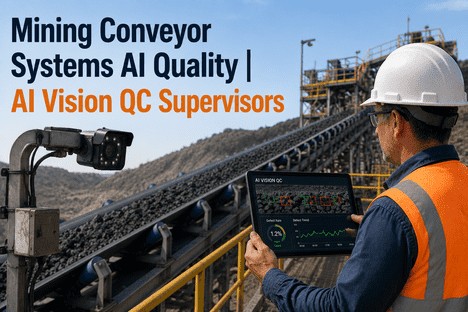
AI vision quality inspection closes this gap by placing deep-learning-based defect detection on every conveyor belt, measuring every particle at line speed. Instead of waiting for a lab result that reflects what happened an hour ago, the supervisor sees real-time particle size distribution, contamination events, and process drift the moment they occur. The shift from discrete sampling to continuous 100% inspection changes what the supervisor can control and how quickly they can act.
Traditional QC vs AI Vision Quality: The Supervisor's View
Manual Sampling QC
Inspection
Discrete grab samples, less than 0.01% of material inspected per hour
Latency
30-120 minutes between sampling and result reaching supervisor
Scrap Impact
8-12% of throughput lost to off-spec material undetected in the gap
Supervisor Action
Reactive — discovers quality deviation after material has left the circuit
AI Vision Quality Inspection
Inspection
100% of every particle stream inspected at line speed with sub-50ms inference
Latency
Real-time — defect detection and alert within the same second
Scrap Impact
30-50% reduction through upstream detection and parameter adjustment
Supervisor Action
Proactive — adjusts feed rate, CSS, or blend before off-spec material is produced
How AI Vision Quality Works on the Crushing Circuit
AI vision quality inspection operates through four continuous stages that run on an edge GPU at the crushing plant, processing every frame from industrial cameras mounted over conveyor belts, chutes, and crusher discharge points. The system maintains separate detection models for each inspection zone and adjusts sensitivity based on the specific material characteristics of the current feed.
Industrial cameras at every belt transfer point and crusher discharge stream 100% of material flow at line speed. Structured lighting ensures consistent image quality.
YOLO-based deep learning models classify every particle for size, shape, mineral type, and contamination. Models achieve 95%+ accuracy within the first week of deployment.
Visual defects correlated with upstream PLC and SCADA data in real time. Crusher gap, feed rate, and power draw linked to the quality signatures they produce.
When quality thresholds are breached, the supervisor receives an alert with annotated visual evidence and the upstream cause. Corrective action tracked through closure.
The detection models are trained on real-world mining datasets that include high dust, variable lighting, steam, and fog conditions. Recent 2026 research demonstrates that frequency-adaptive enhancement networks maintain 90%+ classification accuracy under dust coverage and uneven illumination on conveyor belt installations. The system uses structured lighting arrays and multi-spectral camera streams to penetrate airborne particulate and reveal surface features that visible-light cameras alone cannot resolve.
What AI Vision QC Changes for the Shift Supervisor
For the shift supervisor, the transition from manual sampling to AI vision quality inspection transforms the daily experience of running a crushing circuit. Instead of chasing lab results that arrive too late, the supervisor works from a real-time dashboard that shows exactly what is leaving every crusher at this moment. The control room becomes a proactive operations centre rather than a reactive monitoring station.
Real-Time Particle Size Distribution
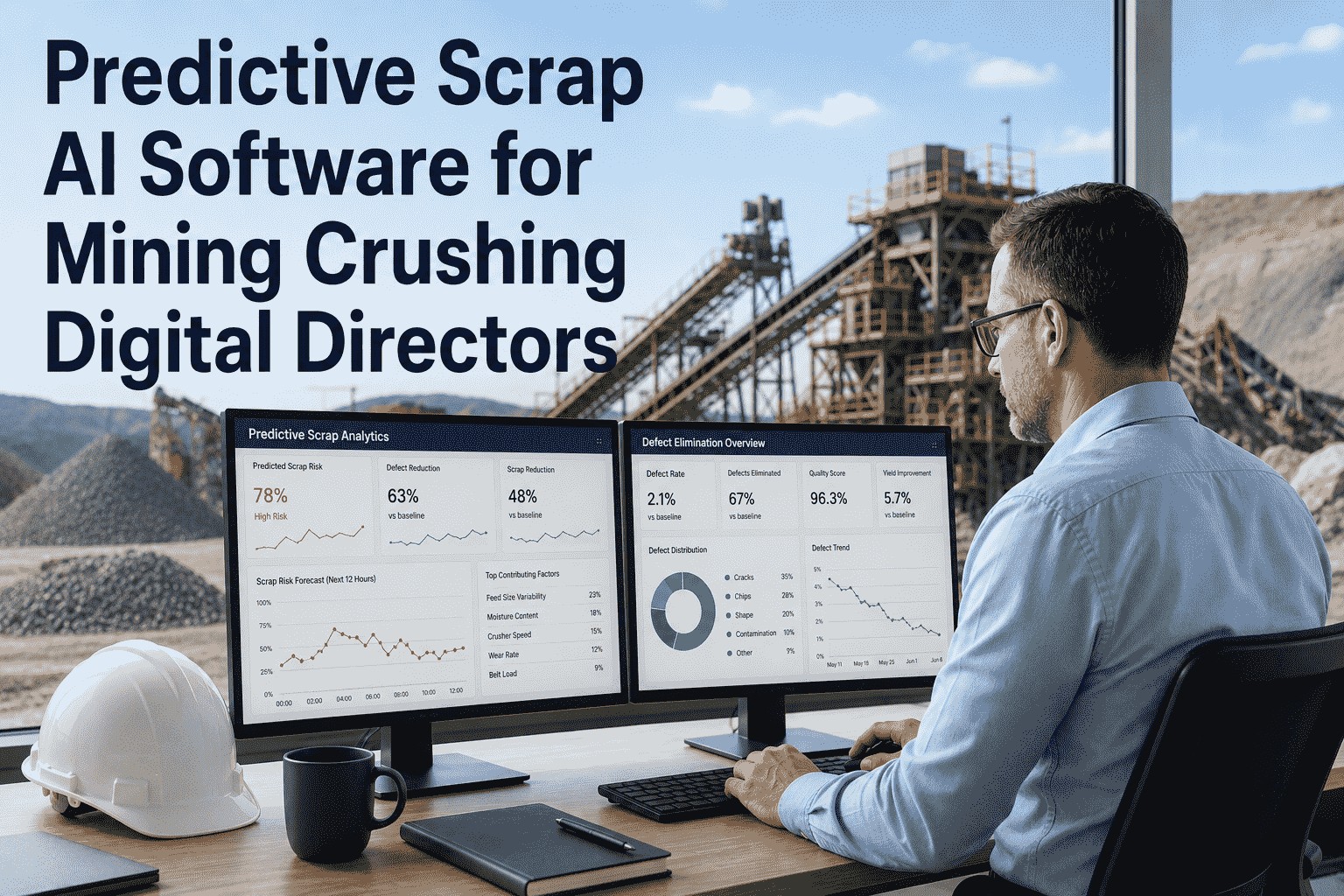
Continuous PSD measurement at every belt transfer point. The supervisor sees the full curve updating with every frame, not a single data point from a lab sieve analysis that reflects material from two hours ago. Oversize spikes detected before they reach downstream equipment.
Contamination and Foreign Object Detection
Tramp metal, wood, plastic, and oversized material identified at the primary crusher feed conveyor before they cause damage downstream. The supervisor receives an alert the moment contamination enters the circuit, with visual evidence attached to the notification.
Root Cause Correlation Engine
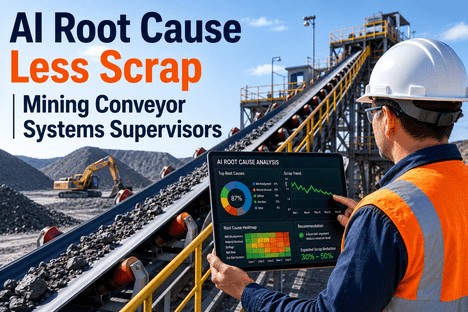
Every quality deviation is correlated with upstream sensor data. The system tells the supervisor which parameter caused the deviation: feed rate spike, crusher gap drift, or ore hardness change. The correlation eliminates guesswork from root cause analysis.
Automated SPC and Audit Trail
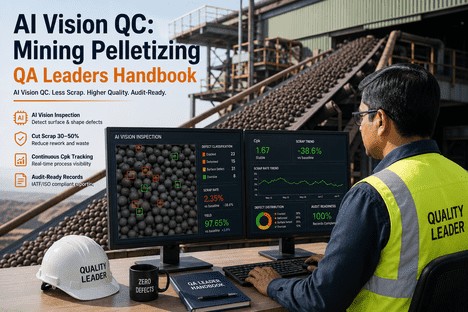
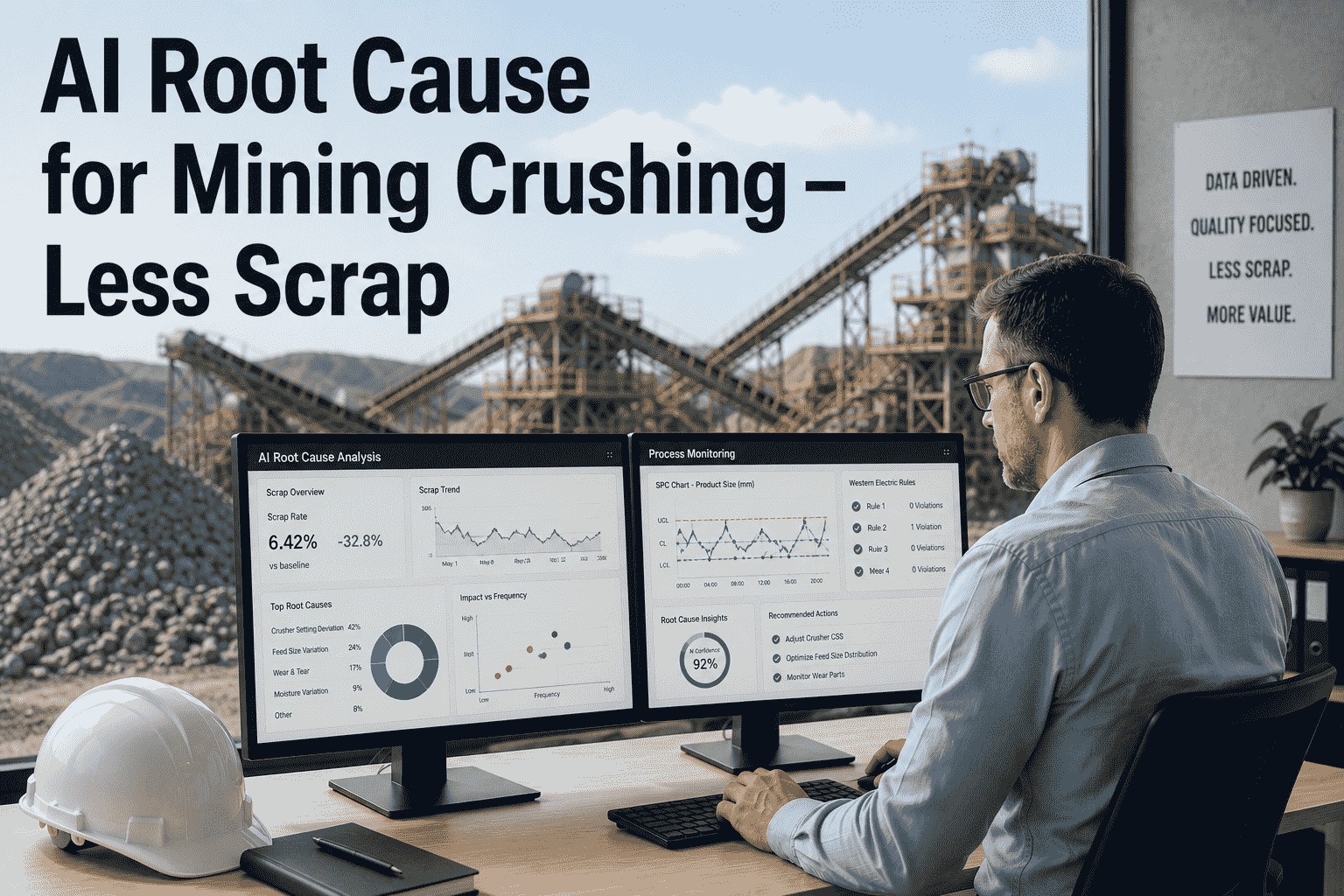
Quality control charts update in real time with every particle inspection. Every event is logged with timestamped visual evidence in an immutable audit trail. CAPA documentation, quality reports, and SPC charts are audit-ready without manual preparation.
Scrap Reduction by Crushing Parameter
AI vision quality inspection directly reduces scrap by detecting quality deviations at the moment they occur and enabling immediate corrective action. The table below shows the scrap reduction observed across key crushing parameters after deploying AI vision inspection at the primary and secondary crushing stages.
Parameter
Baseline Scrap
AI Vision Scrap
Reduction
Detection Latency
Oversize material
9.2%
4.1%
-55%
Sub-second
Undersize fines
7.8%
3.6%
-54%
Sub-second
Contamination events
4.5%
1.2%
-73%
Instant alert
PSD deviation
6.3%
2.8%
-56%
Real-time
Liner wear impact
5.1%
2.3%
-55%
Continuous
We were running blind between lab results for two years. Our shift supervisors were making crusher gap and feed rate adjustments based on what they thought was happening, not what was actually coming out. The AI vision system showed us that our PSD was drifting outside spec for an average of 23 minutes before every lab result caught it. In that 23-minute window, we were producing off-spec material that either got reprocessed or shipped at a discount. Installing AI vision at the discharge belts eliminated that blind window entirely. Our shift supervisors now adjust the circuit based on what they see in real time, not what the lab told them happened an hour ago.
Crushing Plant Superintendent, Base Metals Operation
Deploying AI Vision Quality on Your Crushing Circuit
AI vision quality inspection is deployed as a software and camera layer on top of existing crushing infrastructure. The system integrates with existing PLC, SCADA, and OPC-UA data streams without requiring new sensors or control system modifications. The deployment is designed so supervisors can compare AI vision quality data against their existing manual sampling process before committing to full transition.
Week 1-2: Site audit and camera installation
Conveyor belt inspection zones identified. Industrial cameras and structured lighting installed at crusher discharge, transfer points, and mill feed belts. Edge GPU configured. Data streams mapped. No production interruption during installation.
Week 3-4: Model training and shadow mode
AI models trained on site-specific material. Shadow mode compares AI vision detection against manual sampling results. Detection accuracy validated. Supervisor reviews side-by-side comparison on the quality dashboard.
Week 5: Phased activation
AI vision activated for primary crusher discharge. Supervisor validates performance against manual sampling for one week. Additional zones activated in sequence. Manual sampling reduced as confidence builds.
Week 6+: Full circuit coverage
All inspection zones on AI vision quality. Manual sampling retired for routine QC. Supervisor dashboard shows real-time PSD, contamination alerts, and SPC charts. Scrap reduction tracked against baseline. ROI typically achieved within 4-6 months.
From Reactive Quality to Proactive Process Control
AI vision quality inspection for mining crushing changes the supervisor's relationship with quality control. Instead of waiting for lab results that arrive too late to act, the supervisor works with real-time particle data that shows exactly what is leaving every crusher at every moment. The 30-50% scrap reduction that operations achieve is not the primary benefit. The primary benefit is that the supervisor can finally see the process clearly and make decisions based on complete information rather than sampling blind spots.
The crushing operations that consistently deliver scrap rates below 3% share a common capability: continuous AI vision inspection at every material transfer point, backed by deep learning models that detect oversize, undersize, contamination, and process drift in real time. That capability is available today as a retrofit on existing crushing infrastructure. No new crushers. No control system replacements. No additional laboratory capacity. Just cameras, edge processing, and AI models trained on your material.
iFactory's AI vision quality platform is purpose-built for mining crushing supervisors. It integrates with existing conveyor systems and control infrastructure to deliver real-time particle inspection, automated SPC, contamination alerts, and scrap reduction tracking without changing the supervisor's workflow or tools.
Start Your AI Vision Quality Deployment
See How AI Vision Can Cut Your Scrap Rate by 30-50%
Get a free scrap reduction assessment with a 30-minute walkthrough of iFactory AI vision quality running on your crushing circuit data. We will show you the scrap reduction your specific operation can achieve.
Frequently Asked Questions
Manual Sampling Made Sense When Production Was 500 Tons Per Shift. Your Crushing Circuit Deserves Better.
iFactory AI vision quality for mining crushing operations — real-time particle inspection at line speed, automated SPC control charts, contamination alerts with visual evidence, and scrap reduction tracking. Purpose-built for shift supervisors in crushing and mineral processing operations.