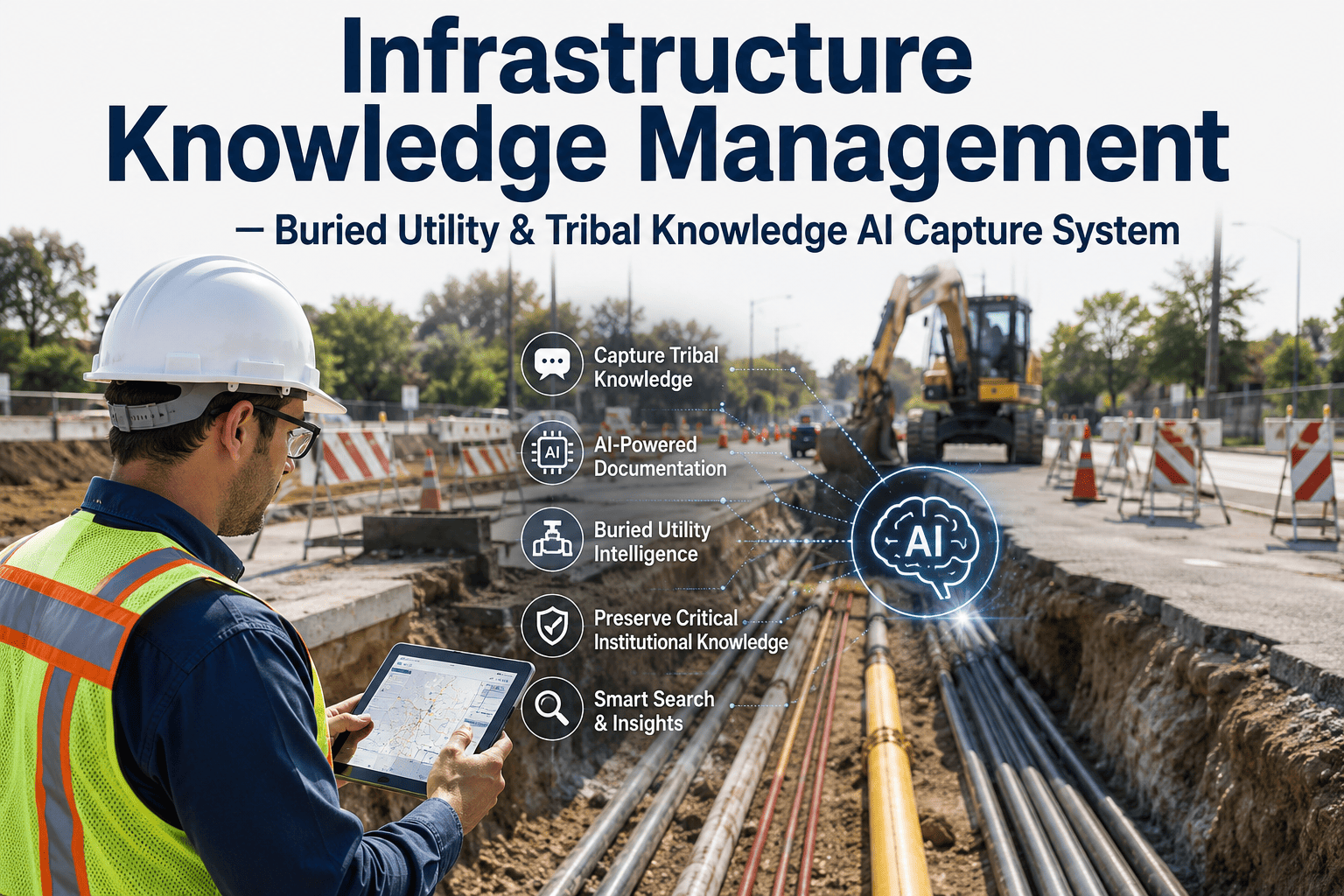
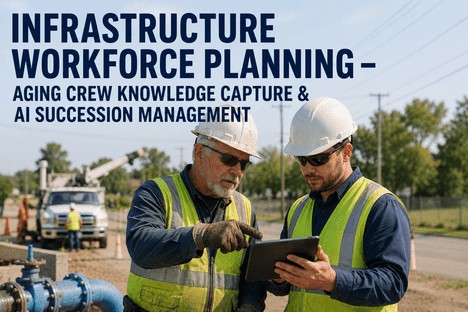
The operator who knows exactly where the 1962 cast iron main jogs around the old foundation nobody put on a drawing is 61 years old and retiring in fourteen months. So is the electrician who can tell you which breaker actually feeds the west wing versus what the panel schedule claims, and the crew lead who remembers why a certain valve gets cracked open every spring before anyone documented the reason. None of that knowledge lives in a database. It lives in memory, and memory is walking out the door on a retirement schedule utilities and facility teams did not plan around. An AI-powered knowledge capture system turns field interviews, walkdown photos, and maintenance history into a searchable record before that expertise disappears for good — see how the capture workflow fits your existing GIS and CMMS before the next retirement notice lands on your desk.
Infrastructure Knowledge Management
Capture What Your Longest-Tenured Crews Know Before They Walk Out the Door
iFactory's AI knowledge capture system turns field interviews, GPS-tagged walkdown photos, and decades of maintenance notes into a searchable institutional record — so the next crew isn't guessing where the buried line runs or why that valve gets cracked open every spring.
Sample Captured Record
Asset
8-inch cast iron main, Elm & 5th
Source
Field interview, 34-yr operator
Location Note
Offset 6ft south of GIS record
Confidence
Verified against 2019 dig record
28%
of utility and facility field staff eligible to retire within five years
15-25 yrs
average tenure of the crews carrying undocumented asset knowledge
Weeks
typical time lost per incident when tribal knowledge isn't captured
Why Institutional Memory Is Your Least-Managed Risk
Most infrastructure organizations manage financial risk, safety risk, and asset risk with dedicated systems and reporting cadences. Knowledge risk gets none of that. It sits entirely inside the heads of a shrinking group of senior operators, electricians, and maintenance leads who learned their systems the hard way — by digging in the wrong spot once, by tracing a fault that took two days because nobody wrote down the workaround, by inheriting a habit from the person before them without ever knowing the reason. When that person retires, the habit stays but the reasoning disappears, and the next incident starts from zero instead of from decades of hard-won context.
The problem compounds because as-built drawings, GIS layers, and CMMS records were never built to hold this kind of knowledge. They capture what was installed, not what was learned afterward — the buried line that shifted during a road repaving, the transformer that runs hot every August and always has, the isolation valve that's technically two turns short of full because the stem seized years ago. iFactory's AI capture system is built specifically to close that gap, pulling tribal knowledge out of the people who hold it and into a record the next generation of crews can actually search.
Four Ways Knowledge Gets Captured Before It's Lost
Field Interviews
Structured voice interviews with senior crew walk through specific assets, valve sequences, and known trouble spots. AI transcribes, tags by asset ID, and flags the location and equipment references for cross-check against existing records.
GPS-Tagged Walkdowns
Crews walk the buried route or equipment line with a mobile device, dropping geotagged photos and voice notes at every point where reality diverges from the drawing. Each note becomes a searchable, mapped record tied to exact coordinates.
As-Built Cross-Reference
AI compares captured field knowledge against existing GIS layers, as-built drawings, and CMMS asset records, automatically flagging discrepancies in depth, offset, or configuration for verification rather than leaving them buried in someone's memory.
Maintenance History Mining
Years of work order notes, closed tickets, and shift logs are mined for recurring language around specific assets, surfacing patterns — recurring failures, seasonal adjustments, known workarounds — that no single record shows on its own.
From Field Knowledge to Searchable Record in Five Steps
1
Identify At-Risk Knowledge
Crews within five years of retirement or transfer are identified alongside the specific assets, routes, and systems they hold the deepest undocumented knowledge of.
2
Structured Capture Session
Field interviews and walkdowns are scheduled asset by asset, with AI-guided prompts steering the conversation toward location, sequence, and reasoning rather than general recollection.
3
AI Tagging & Transcription
Voice, photo, and location data are transcribed and tagged automatically by asset ID, linking every note to the exact record it belongs to in the GIS or CMMS.
4
Cross-Verification
Newly captured knowledge is checked against existing drawings and maintenance history, with conflicts flagged for a supervisor to confirm before the record is finalized.
5
Searchable Institutional Record
The verified record becomes part of a natural-language searchable knowledge base, so the next crew can ask "where does the main run near Elm and 5th" and get an answer built from decades of field experience.
Your Most Experienced Crews Are on a Retirement Clock
Every month without a capture plan is knowledge that leaves with the next retirement party. See how iFactory turns field interviews and walkdowns into a searchable record your newest hire can use on day one.
Tribal Knowledge vs. AI-Captured Institutional Record
| Capability |
Tribal Knowledge (Undocumented) |
AI-Captured Record |
| Where It Lives |
In the memory of a handful of senior staff, inaccessible once they leave or are unavailable. |
In a searchable digital record, accessible to any authorized crew member at any time. |
| Buried Line Accuracy |
Depends entirely on who's on shift and whether they remember correctly under pressure. |
GPS-tagged field notes cross-verified against drawings, with confidence flags on every record. |
| New Hire Ramp-Up |
Months to years of shadowing senior staff before context transfers, if it transfers at all. |
Immediate access to searchable field notes, photos, and reasoning behind past decisions. |
| Incident Response |
Response time depends on reaching the one person who happens to know the answer. |
Field crews search the asset record directly and get context in seconds. |
| Knowledge Continuity |
Resets to zero every time a senior employee retires, transfers, or is unavailable. |
Compounds over time as every crew's field notes add to the same growing record. |
What Gets Lost Without a Capture Plan
Before Capture
Emergency Excavation Near an Unmarked Offset
A contractor crew begins emergency excavation near Elm and 5th based on the GIS record. The line was rerouted six feet south during a 2019 road repaving, a fact known only to the operator who retired eighteen months ago. The dig proceeds on outdated coordinates, the line is struck, and the resulting outage and repair cost far exceed what a five-minute knowledge search would have prevented.
After Capture
Same Dig, Searchable Field Record
The same excavation request pulls up the asset's captured record before crews break ground. A GPS-tagged note from the 2019 walkdown shows the six-foot southern offset, cross-verified against the repaving project's closeout documentation. The crew adjusts the dig plan in minutes, and the retired operator's knowledge protects a job he'll never see happen.
Rolling Out a Knowledge Capture Program
Phase 1
Risk Mapping
Retirement-eligible staff are cross-referenced against the assets and systems they know best, prioritizing capture around the highest-consequence knowledge gaps first.
Phase 2
Pilot Capture
A small set of field interviews and walkdowns validates the tagging and cross-verification workflow against real assets before scaling to the full workforce.
Phase 3
Full-Scale Capture
Interviews and walkdowns expand across remaining at-risk staff, with AI tagging and cross-verification running continuously as records accumulate.
Phase 4
Standard Practice
Knowledge capture becomes a standard step in every offboarding and role transition, keeping the institutional record current as the workforce continues to turn over.
What Changes Once Knowledge Is Searchable
Minutes
Time for a field crew to search asset history instead of tracking down a retired employee's phone number.
Day One
New hires access decades of field context immediately instead of waiting years to absorb it through shadowing.
Zero Reset
Institutional knowledge compounds across retirements instead of resetting to zero with every departure.
Common Mistakes in Knowledge Capture Programs
Waiting for the Retirement Announcement
Capture that starts the week someone gives notice rarely gets the depth needed. Programs that begin years ahead of the retirement wave capture far more context than a rushed exit interview ever will.
Treating It as a One-Time Project
Knowledge capture that runs once and stops leaves every future retirement uncaptured. Ongoing capture tied to offboarding keeps the record current as the workforce keeps turning over.
Storing Notes Without Structure
Unstructured notes in a shared folder are effectively as inaccessible as the knowledge that was never captured. Records need asset tagging and search to actually get used in the field.
Skipping Cross-Verification
Field memory isn't always accurate. Capturing it without checking against drawings and maintenance history risks turning an honest mistake into a permanent, trusted record.
Frequently Asked Questions
How is this different from just writing more detailed as-built drawings?
As-built drawings capture what was installed at a single point in time, but they rarely get updated as conditions change over decades of repairs, reroutes, and field adjustments. Tribal knowledge fills those gaps with context drawings never had — why a line shifted, why a valve setting changed, what a past incident revealed. Capturing that context alongside the drawings, rather than instead of them, gives crews the full picture.
Book a demo to see how captured field notes attach directly to your existing asset records.
Do we need to interview every senior employee before they retire?
No. The most effective programs prioritize by risk, focusing first on employees whose knowledge covers the highest-consequence assets or the least-documented systems. A phased approach that starts years before the heaviest retirement wave captures far more depth than trying to interview everyone in a compressed final stretch.
What happens if a field interview conflicts with the official record?
Every captured note is cross-verified against existing GIS layers, as-built drawings, and maintenance history rather than accepted automatically. Discrepancies are flagged for a supervisor to confirm, so the final record reflects verified reality rather than a single person's unchecked recollection, even when that recollection turns out to be correct.
Can field crews search the captured knowledge from a mobile device?
Yes. The captured record is built to be searched in natural language from the field, whether that's a crew standing over an excavation site checking for offsets or a new hire trying to understand why a valve sequence works the way it does. Records return with the original field context intact, not just a data point.
Talk to support about mobile access for your field teams.
How long does it take to see value from a knowledge capture program?
A pilot phase covering a handful of high-risk assets typically produces a usable, searchable record within weeks, giving field crews immediate value on the specific systems captured first. Full-scale value builds over months as capture expands across the workforce and the record grows deep enough to cover most day-to-day field questions.
Don't Let Decades of Field Knowledge Retire Undocumented
iFactory's AI capture system turns field interviews, walkdown photos, and maintenance history into a searchable institutional record your crews can trust for the next thirty years.
Structured capture from your most experienced field staff
GPS-tagged walkdowns cross-verified against existing drawings
Natural-language search for any crew, any shift, any device
Knowledge that compounds instead of resetting with every retirement