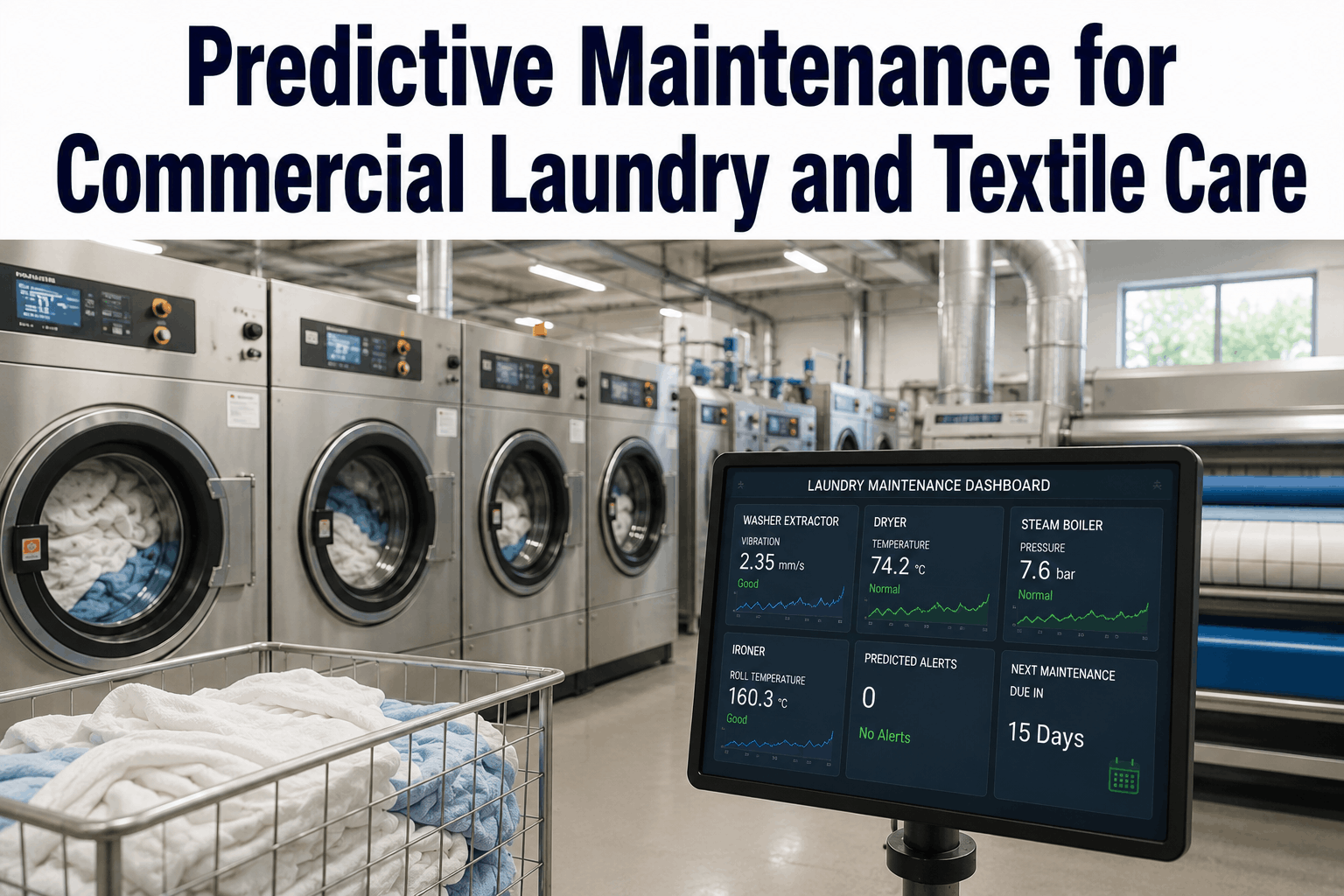
Commercial laundry operations run 18 or more hours every day, processing thousands of kilograms of linen through washer-extractors, tunnel washers, dryers, and flatwork ironers without pause. A single washer-extractor bearing failure during the peak morning hospital linen run does not just create a repair cost — it creates a linen shortage that affects patient care before the shift ends. Industrial laundry equipment carries the same fundamental reliability physics as heavy industrial machinery, but operates in environments with extreme moisture, chemical exposure, and utilization rates that accelerate wear far beyond conventional manufacturing equipment. Get iFactory Support to deploy AI predictive maintenance across your commercial laundry equipment today.
Prevent Laundry Equipment Breakdowns During Peak Linen Demand
iFactory AI monitors washer-extractors, dryers, ironers, and steam boilers continuously — detecting bearing, drum, and heating system degradation before it creates linen shortages at your most critical delivery windows.
The Six Critical Commercial Laundry Systems AI Monitors
Commercial laundry equipment operates in one of the most demanding reliability environments in industry — continuous operation, heavy chemical exposure, extreme temperature cycling, and load unbalance forces that stress bearings and structural components continuously. Each system below represents a distinct failure profile that AI condition monitoring addresses with a different detection strategy. Contact iFactory to configure monitoring for your specific equipment mix and linen service commitments.
System 1
Washer-Extractor Bearings and Drums
Large washer-extractor drum bearings operating under high load unbalance forces from wet linen loads wear faster than any comparable industrial bearing application. Extraction spin at 800–1,100 RPM generates centrifugal forces that amplify any imbalance condition into bearing radial loading far above the design operating point. AI vibration monitoring detects bearing defect frequencies developing in the outer race, inner race, and rolling elements — providing 4–10 weeks of detection lead time before catastrophic bearing failure.
System 2
Tunnel Washer Drive Systems
Continuous batch tunnel washers process dozens of linen loads per hour through a progressive wash cycle, driven by transfer mechanisms and drum drive systems that operate continuously for 18+ hours per day. Drive chain wear, sprocket wear, and drum drive gearbox degradation each affect throughput capacity if not detected early. AI monitors motor current signatures and vibration patterns across the tunnel washer drive train — detecting mechanical wear before it causes transfer mechanism failure or throughput reduction.
System 3
Dryer Heating and Drum Systems
Industrial dryer systems consume the largest portion of energy in a commercial laundry operation and are subject to lint accumulation, burner fouling, drum bearing wear, and lint filter blockage that reduce drying efficiency and create fire risk. AI monitors dryer inlet and outlet temperature differential, drum motor current, exhaust airflow, and gas burner cycling behavior — detecting efficiency losses and abnormal operating patterns that indicate maintenance needs before they cause production delays or safety incidents.
System 4
Flatwork Ironers and Folders
Flatwork ironer rolls heated to 160–180°C process sheets, pillowcases, and tablecloths at production rates of 20–50 meters per minute. Roll bearing wear, pressure adjustment mechanism failure, and heating element degradation each affect ironing quality and production rate. AI monitors ironer motor current, roll pressure consistency, and temperature uniformity across the roll width — detecting the gradual degradation that causes linen quality complaints before operators notice the change.
System 5
Steam Boilers and Distribution
Steam boilers supplying tunnel washers, dryers, and ironers are critical utilities whose failure stops multiple production systems simultaneously. Burner degradation, heat exchanger scaling, and feedwater pump wear each reduce steam generation capacity progressively. AI monitors boiler efficiency ratio, feedwater flow, burner cycling frequency, and steam pressure stability — detecting capacity loss before it affects production throughput across the dependent equipment chain.
System 6
Water Treatment and Chemical Dosing
Precise chemical dosing is essential for wash quality, linen longevity, and regulatory compliance in commercial laundry operations. Dosing pump wear causes under-dosing that affects wash quality or over-dosing that damages linen and increases chemical cost. AI monitors dosing pump cycle counts and volume per dose against programmed targets — detecting calibration drift and pump wear that affect wash chemistry before they create linen quality or compliance issues.
Laundry Equipment Failure Impact Matrix
The consequences of equipment failure in commercial laundry operations scale with the time of day, the customer served, and the linen type affected. A hospital linen supplier faces patient care implications from shortages. A hotel linen service faces room-readiness failures. Understanding the consequence profile of each failure mode drives the right monitoring priority. Book a demo to see iFactory's consequence-weighted monitoring configuration for your customer profile.
Scroll for more →
| Equipment | Primary Failure Mode | Peak Consequence | AI Detection Lead Time |
|---|---|---|---|
| Washer-Extractor | Main bearing failure / drum imbalance | Hospital linen shortage within 4–6 hours of failure | 4–10 weeks via vibration envelope |
| Tunnel Washer | Transfer mechanism / drive chain failure | Full throughput loss — tunnel cannot be partially bypassed | 3–6 weeks via motor current + vibration |
| Industrial Dryer | Lint blockage fire / burner failure | Safety incident or 50% throughput reduction per down unit | 1–3 weeks via temperature delta + airflow |
| Flatwork Ironer | Roll bearing / heating element failure | Manual folding backup — 60% output rate reduction | 2–5 weeks via current + temperature profile |
| Steam Boiler | Burner failure / feedwater pump wear | Multiple dependent equipment stops simultaneously | 3–8 weeks via efficiency ratio trending |
| Chemical Dosing Pump | Pump wear / check valve failure | Wash quality failure, customer complaints, linen damage | 1–3 weeks via dose volume monitoring |
AI Monitoring Performance: Commercial Laundry Outcomes
Washer-Extractor Unplanned Downtime
72% Reduction
Washer-extractor bearing failures are the dominant source of unplanned downtime in most commercial laundry operations. AI vibration monitoring converting emergency bearing replacements to planned maintenance during off-peak shifts achieves 72% reduction in unplanned downtime events — with the remaining events representing sudden-onset mechanical failures that even continuous monitoring cannot provide extended warning for.
Dryer Energy Efficiency
15–22% Energy Reduction
Dryers with partially blocked lint filters, degraded burners, and worn drum seals consume significantly more gas per kilogram of linen dried than properly maintained units. AI monitoring dryer temperature differential and gas consumption per cycle detects the progressive efficiency decline that increases energy cost by 15–22% before it reaches a threshold visible to operators reviewing daily energy reports.
Ironer Linen Quality Complaints
60% Fewer Quality Callbacks
Flatwork ironer roll pressure variation and temperature non-uniformity across the roll width produce linen with wrinkles and inconsistent finish quality that generates customer callbacks — especially in healthcare linen supply where presentation standards are contractually specified. AI detecting roll bearing wear and heating element degradation before they affect ironing quality reduces quality-related customer callbacks by 60% in operations with iFactory deployed on ironer systems.
Steam Boiler Efficiency Recovery
Maintains 88% vs 74% Degraded
Steam boiler efficiency degradation from heat exchanger scaling and burner fouling increases fuel consumption and reduces steam generation capacity simultaneously. AI monitoring boiler efficiency ratio catches the early degradation phase when cleaning or burner servicing restores efficiency with minimal labor — versus reacting to efficiency collapse that requires extended boiler outage for cleaning and inspection.
Washer-Extractor Monitoring Deep Dive: The Highest-Frequency Failure Asset
Main Bearing Vibration Analysis Primary Application
Washer-extractor main bearings experience the most demanding load conditions of any bearing in a commercial laundry facility — wet linen loads creating high unbalance forces at extraction speeds, combined with the continuous cycling from wash agitation through extraction RPM hundreds of times per day. AI vibration envelope analysis at the bearing housing detects inner race, outer race, and rolling element defect frequencies 4–10 weeks before bearing failure — time enough to order bearings, schedule a repair shift during off-peak hours, and execute the replacement without service disruption.
Drum Imbalance Detection
Persistent drum imbalance from worn drum suspension components, damaged counterweights, or structural drum damage produces elevated 1× synchronous vibration at extraction speed that accelerates bearing wear and creates floor vibration issues. AI tracking 1× vibration amplitude as a function of extraction speed identifies imbalance developing over weeks — before it reaches the level that either triggers the machine's imbalance protection trip or causes bearing damage visible in the defect frequency spectrum.
Drive Motor and Inverter Health
Variable frequency drives controlling washer-extractor motors enable smooth speed transitions through wash and extraction cycles but introduce high-frequency common-mode voltages that drive shaft currents through motor bearings — a known cause of premature bearing failure in VFD-driven equipment. AI monitors drive output current harmonics and motor current signature simultaneously — detecting motor bearing electrical fluting damage developing from VFD-induced currents before it progresses to bearing failure.
Door Seal and Gasket Condition
Washer-extractor door seals and gaskets degrading from chemical exposure and mechanical cycling create water leakage that affects floor drainage capacity and creates slip hazards. AI monitors door seal integrity using cycle pressure retention data available from the machine's own pressure sensors — detecting seal degradation patterns that indicate replacement is needed before active leakage becomes a workplace safety issue during peak production hours.
Heating Element and Water Temperature
Washer-extractor heating elements degrading from scale buildup and chemical corrosion reduce water heating rate — extending cycle time on thermally-defined wash programs and reducing disinfection effectiveness on healthcare linen requiring validated temperature-time exposure. AI monitors heating element power draw against expected performance and flags elements requiring descaling or replacement before cycle time extension affects production throughput.
Chemical Pump Dose Volume Monitoring
Each chemical dosing pump — detergent, softener, bleach, neutralizer — must deliver precise volumes per cycle to maintain wash quality and comply with hygiene standards in healthcare linen processing. AI monitors dosing pump cycle counts and compares volume delivered against programmed targets using inline flow transmitter data — flagging drift from check valve wear, pump diaphragm fatigue, or strainer blockage before wash chemistry deviation affects linen quality or regulatory compliance. Contact iFactory Support to configure dosing pump monitoring for your specific chemical program.
Commercial Laundry Monitoring Architecture
IP67 Sensor Housing
All iFactory sensors deployed in laundry environments use IP67-rated enclosures — washdown-proof and resistant to the detergent and steam exposure common in commercial laundry facilities
Machine PLC Integration
iFactory reads cycle data directly from Miele, Jensen, Kannegiesser, and Electrolux machine PLCs — extracting temperature, speed, and pressure data without additional hardware on most modern machines
Shift-Aware Alerting
Alert escalation accounts for shift schedule — urgent alerts during peak morning healthcare linen runs generate immediate supervisor notification, the same alert outside peak hours generates a next-shift maintenance task
Energy Dashboard
Per-machine energy consumption tracking normalized by linen weight processed — identifying inefficient machines and quantifying energy recovery from maintenance interventions
Commercial Laundry AI Deployment: 6-Phase Rollout
01
Linen Service Commitment Risk Mapping
Map your linen service contracts by consequence of delivery failure: healthcare linen with patient care implications, hotel linen with room-readiness commitments, restaurant linen with daily service obligations. This mapping drives monitoring priority — washer-extractors and tunnel washers serving healthcare accounts receive first-priority deployment regardless of maintenance history.
02
Washer-Extractor Bearing Pilot
Deploy vibration monitoring on your highest-utilization washer-extractors first. Install accelerometers on main bearing housings and connect to the iFactory IoT gateway. In a typical commercial laundry, three to five critical machines can be instrumented in a single working day without taking any machine out of service — sensors mount to the bearing housing exterior using adhesive or magnetic bases.
03
Machine PLC Data Integration
Connect iFactory to the machine PLCs of your washer-extractors, tunnel washers, and dryers to extract cycle data — water temperatures, extraction speeds, cycle times, and fault codes. This integration provides the thermal and operational context that enables AI to distinguish fault conditions from normal operational variation without manual data entry from operators.
04
Dryer and Ironer Monitoring
Extend monitoring to dryer energy efficiency and ironer roll condition. Dryer monitoring requires temperature sensors on inlet and outlet airstreams plus connection to the gas meter pulse output — both accessible without machine downtime. Ironer monitoring uses accelerometers on roll end bearing housings and a temperature sensor across the roll width using an existing or added thermocouple strip.
05
Steam Boiler and Utility Monitoring
Deploy boiler efficiency monitoring using existing steam flow, feedwater flow, and fuel consumption transmitters — most commercial laundry boiler rooms have these instruments installed but the data is not being used for predictive analytics. iFactory's boiler efficiency model begins trending immediately upon data connection, establishing the clean baseline that subsequent fouling is detected against.
06
Healthcare Compliance Documentation
For laundry operations serving healthcare customers, configure iFactory to generate wash cycle compliance records documenting temperature achievement, chemical dose delivery, and equipment operating status for every healthcare linen batch. This documentation supports Infection Prevention requirements and provides evidence of process control for healthcare contract compliance audits. Get iFactory Support to configure healthcare compliance reporting.
Frequently Asked Questions
How does iFactory handle the wet and chemical-intensive environment of a commercial laundry?
All iFactory hardware deployed inside commercial laundry facilities uses IP67-rated enclosures — fully sealed against water ingress from washdown, steam condensation, and chemical spray. IoT gateway units are installed in electrical panels outside the main wash hall, receiving data from IP67 sensor nodes via wired or wireless connection. Sensor cables use chemical-resistant PVC jacketing rated for detergent and bleach exposure.
Can AI monitoring help a commercial laundry meet healthcare linen hygiene standards?
Yes, directly. iFactory monitors wash water temperature achievement, heating element performance, and chemical dosing accuracy on every healthcare linen cycle — generating time-stamped records that document compliance with thermal disinfection requirements (typically 65°C for 10 minutes or 71°C for 3 minutes for healthcare linen) and chemical disinfection programs. These records are essential evidence in healthcare contract compliance audits and Infection Prevention reviews.
How early can AI detect washer-extractor bearing failure in a commercial laundry environment?
Commercial laundry washer-extractor bearings typically show detectable defect frequency development 4–10 weeks before catastrophic failure. The detection lead time depends on the severity of operating conditions — high extraction speeds, heavy linen loads, and worn suspension components that increase bearing radial loading shorten the lead time. iFactory alerts at the first statistically confirmed defect frequency detection, giving the longest possible planning horizon.
Does iFactory integrate with specific commercial laundry machine brands?
iFactory has pre-built integration profiles for major commercial laundry equipment manufacturers including Miele Professional, Jensen Group, Kannegiesser, Electrolux Professional, and UniMac. These profiles map the available PLC data tags for each machine model to iFactory's asset health data structure — reducing integration time from days to hours for supported machine types. Custom integration is available for other machine brands via OPC-UA or Modbus protocols.
Keep Your Linen Service Commitments — Never Miss a Delivery Because of Equipment Failure
iFactory AI gives commercial laundry operators 4–10 weeks of early warning on washer-extractor, dryer, ironer, and boiler failures — converting emergency breakdowns during peak linen demand into planned maintenance during off-peak windows.