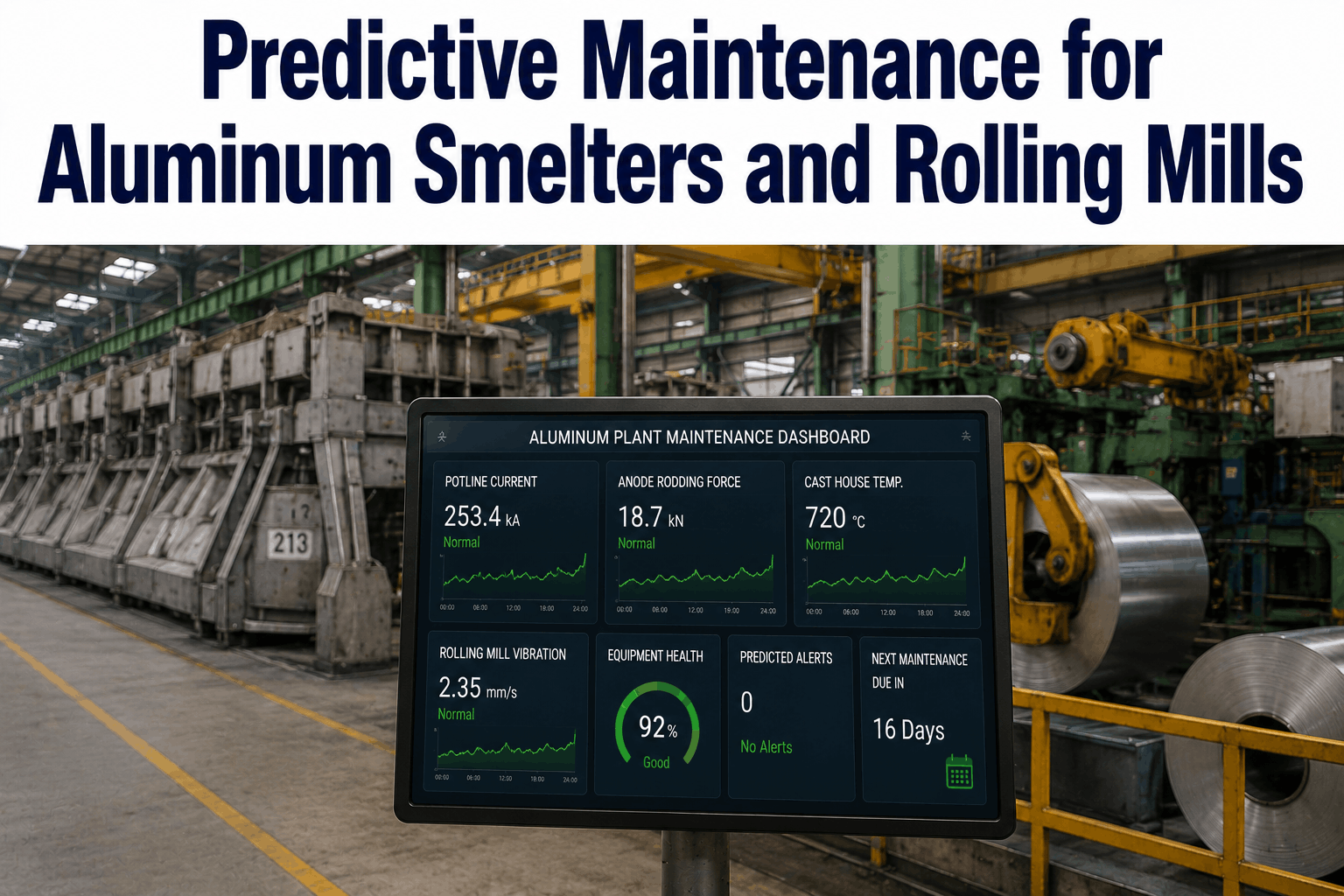
AI monitors SAG mills, flotation cells, smelter furnaces, and electrowinning equipment in copper and zinc mineral processing — detecting developing failures across the processing value chain before cascading equipment stops translate into lost recovery, missed production targets, and unplanned smelter outages. Start Trial Free to see how iFactory gives mining and smelting reliability engineers the asset-specific monitoring intelligence needed to protect continuous mineral processing operations from equipment-driven production losses.
Monitor Every Critical Asset from SAG Mill to Electrowinning Tank — Without Gaps
iFactory integrates SAG mill vibration analysis, flotation cell condition monitoring, smelter furnace performance tracking, and electrowinning equipment health into a unified predictive maintenance platform covering the full copper and zinc processing chain.
Why Mineral Processing Reliability Requires Value-Chain-Wide Equipment Monitoring
Copper and zinc mineral processing is a sequential value chain where failure at any stage disrupts all downstream operations. A SAG mill bearing failure that stops comminution backs up the crushing circuit and starves the flotation cells simultaneously; a flotation cell agitator failure reduces recovery in that bank and shifts load unevenly to adjacent cells; a smelter furnace problem forces concentrate stockpiling that disrupts the mine's shipping schedule. Monitoring each asset in isolation misses the cascading consequence picture — a borderline bearing condition in the SAG mill that looks manageable on its own becomes critical when the only backup mill is already at reduced capacity. AI predictive maintenance for mining and smelting requires monitoring coverage that spans the value chain and integrates equipment health across process stages. Engineering teams that Book a Demo with iFactory see how cross-stage equipment monitoring changes maintenance priority decisions when the full production consequence picture is visible.
-
SAG and Ball Mill Monitoring
iFactory monitors SAG and ball mill trunnion bearing vibration and temperature, shell liner progression, charge weight estimation, and motor drive condition — detecting bearing degradation and liner wear before they cause unplanned mill stops that halt the entire comminution circuit.
-
Flotation Cell Agitator Health Tracking
iFactory tracks flotation cell agitator motor current, shaft vibration, and impeller wear indicators — identifying developing impeller damage and bearing failures before they reduce air dispersion efficiency and depress metal recovery in the affected bank.
-
Concentrate Thickener and Filter Monitoring
iFactory monitors thickener rake drive torque trends, overflow clarity indicators, and filter press hydraulic system performance — detecting rake mechanism overload and drive degradation before thickener upset forces concentrate circuit slowdown.
-
Smelter Furnace Performance Tracking
iFactory tracks smelter furnace temperature uniformity, tap hole condition indicators, off-gas flow and composition trends, and cooling water system differential temperature — detecting developing furnace problems before they require unplanned campaign shutdown for repairs.
-
Electrowinning Rectifier and Busbar Monitoring
iFactory monitors electrowinning rectifier current efficiency trends, busbar connection temperature via thermal data, electrolyte flow distribution, and cathode cycle completion data — detecting rectifier performance degradation and connection problems that reduce copper or zinc recovery per ampere-hour.
-
Conveyor and Materials Handling Health
iFactory monitors overland conveyor belt tension, idler bearing condition, drive pulley vibration, and take-up tension — protecting the materials handling infrastructure that connects mine face output to processing plant feed across the full ore movement distance.
Critical Processing Asset Monitoring: Failure Mode Analysis
-
SAG Mill Trunnion Bearing and Shell Liner Condition Monitoring
Highest Production ImpactThe SAG mill is the throughput bottleneck in most copper concentrators — and a SAG mill forced stop for a trunnion bearing failure or catastrophic liner failure typically results in five to fifteen days of reduced or zero throughput depending on spare parts availability and the repair scope required. iFactory monitors SAG mill trunnion bearing vibration and temperature continuously — tracking bearing defect frequencies, overall vibration trends, and oil film temperature to detect degradation trajectories weeks before bearing condition reaches the forced shutdown threshold. Shell acceleration measurements provide liner wear progression data — declining shell acceleration amplitude as liner wear reduces the lifting action indicates approaching liner replacement timing. Integrating bearing condition with liner wear estimates gives the reliability team a combined picture of the time window available for planned maintenance before forced shutdown probability increases significantly. Teams that Start Trial can configure SAG mill monitoring from existing instrumentation and add liner wear estimation from shell acceleration data in iFactory's mill monitoring template.
Bearing Monitoring
Defect frequencies, overall vibration, oil film temperature trend
Liner Monitoring
Shell acceleration amplitude trend as liner wear indicator
iFactory Record
Bearing and liner condition trend per SAG mill with planned stop projection
-
Flotation Cell Agitator Impeller and Bearing Condition Monitoring
Recovery ProtectionFlotation cell agitators maintain the air-mineral slurry suspension that enables bubble-particle contact and metal recovery — and impeller wear or agitator bearing failure in one or more cells in a bank redistributes air and slurry handling to adjacent cells in ways that reduce overall bank recovery even before a complete agitator failure stops the cell entirely. iFactory monitors flotation agitator motor current as an indirect impeller wear indicator — declining current at constant slurry density indicates reduced impeller efficiency from wear; increasing current variation indicates instability from uneven wear or shaft wobble from bearing degradation. Shaft vibration monitoring provides the bearing condition indicator that confirms whether the motor current anomaly originates from the impeller or from the drive components. Connecting agitator condition data to bank-level recovery trending in iFactory enables maintenance to prioritize impeller replacements in cells where condition correlates most strongly with recovery depression.
Primary Indicator
Motor current trend at constant density as impeller wear indicator
Secondary Indicator
Shaft vibration for bearing condition confirmation
iFactory Record
Agitator condition trend correlated to bank recovery data per cell
-
Thickener Rake Drive Torque and Mechanism Monitoring
Concentrate CircuitConcentrate thickener rake mechanisms are subjected to highly variable loading from slurry density fluctuations and rake bed depth changes — and rake drive overloads that progress to mechanism failure force the thickener offline for bed excavation and mechanism repair that can take days and disrupt the entire concentrate circuit. iFactory monitors thickener rake drive torque continuously — tracking both mean torque level and torque variation pattern as indicators of rake bed condition, density overload, and mechanism degradation. A steadily rising mean torque indicates increasing bed depth or slurry density beyond design; rapid torque oscillations indicate rake mechanism looseness or bearing deterioration. Connecting torque trend data to thickener feed density and overflow clarity in iFactory enables early identification of whether high torque is driven by process conditions (correctable by feed rate adjustment) or by mechanical deterioration (requiring maintenance intervention).
Torque Indicators
Mean torque level and torque oscillation pattern per thickener
Process Correlation
Torque trend vs feed density and overflow clarity for root cause
iFactory Record
Rake torque and thickener performance trend history per unit
-
Smelter Flash Furnace and Converter Performance Monitoring
Pyrometallurgy AssetCopper smelter flash furnaces and converters operate in highly corrosive environments at temperatures above 1200°C — making refractory condition, cooling system performance, and off-gas system integrity the primary reliability concerns rather than rotating equipment vibration. iFactory monitors flash furnace settler temperature distribution across the shell thermocouple array as a refractory wear indicator — identifying hot spots that indicate refractory thinning requiring emergency repair before shell breakthrough. Converter cooling water inlet-outlet temperature differential trends detect developing cooling element deterioration that precedes leak-induced blowback events. Off-gas volume and composition trends provide converter blowing efficiency data — declining off-gas SO2 content at constant feed indicates converter performance degradation from tuyere blockage or bath chemistry problems. Teams that Start Trial can configure furnace temperature and cooling system monitoring from existing DCS and process historian data.
Refractory Indicator
Shell thermocouple array hot spot pattern and trend
Cooling System
Cooling element dT trend as leak and deterioration indicator
iFactory Record
Furnace temperature profile and cooling trend history per vessel
-
Electrowinning Tankhouse Current Efficiency and Connection Monitoring
Refinery AssetElectrowinning tankhouse current efficiency — the ratio of actual metal deposited to theoretical maximum from the applied current — directly determines operating cost per tonne of refined copper or zinc, and declining current efficiency from electrolyte chemistry drift, busbar connection resistance increase, or cathode surface contamination adds cost to every tonne produced. iFactory monitors tankhouse current efficiency trend from production and power consumption records — tracking the efficiency degradation rate that indicates whether the cause is a gradual chemistry drift (requiring reagent dosing adjustment) or a discrete event like a high-resistance connection (requiring physical inspection and correction). Infrared thermal monitoring data from busbar connection inspection rounds is integrated into iFactory — correlating hot connection locations with local cell group current efficiency to prioritize connection restoration. Teams that Book a Demo can review tankhouse monitoring integration for their specific rectifier and cell configuration.
Efficiency Monitoring
Current efficiency trend from production and power consumption data
Connection Monitoring
Thermal inspection data correlated to local efficiency by cell group
iFactory Record
Current efficiency trend and busbar inspection findings per tankhouse
-
Overland Conveyor Idler and Drive Pulley Condition Monitoring
Materials HandlingOverland conveyors moving ore from pit to plant or concentrate from plant to port represent linear infrastructure where a single seized idler bearing that is not detected before failure can cause belt damage that puts the entire conveyor offline for splice repair — a multi-day stoppage that affects mine-to-plant throughput regardless of crushing and milling capacity. iFactory monitors overland conveyor systems through a combination of acoustic emission sensors on idler frames for seized idler detection, drive pulley vibration for drive system health, and belt scale tension readings for tension uniformity — identifying developing idler bearing failures, drive pulley lagging deterioration, and belt tension anomalies at inspection frequencies higher than practical manual patrol rounds. For long conveyors where manual inspection is infrequent, iFactory's continuous monitoring provides the between-inspection bearing condition assessment that prevents failure from progressing undetected to belt damage.
Idler Monitoring
Acoustic emission from idler frames for bearing failure detection
Drive Monitoring
Pulley vibration, gearbox condition, take-up tension trend
iFactory Record
Idler condition and drive health trend per conveyor section
Mining and Smelting Predictive Maintenance Performance Indicators
SAG Mill Unplanned Stop Reduction
AI bearing and liner monitoring reduces SAG mill unplanned stops from 8 to 1 per year — each prevented stop recovering 5–15 days of production throughput at full plant feed rate.
Flotation Recovery Improvement
Flotation recovery improvement vs monitoring approach
Full AI agitator condition monitoring with recovery correlation delivers 2.8% flotation recovery improvement versus no monitoring — equivalent to processing significantly more ore from the same feed at current mine rates.
Tankhouse Current Efficiency Recovery
Tankhouse current efficiency % over 12 months
Electrowinning current efficiency recovers from 91% to 96% within 12 months of iFactory connection monitoring and busbar inspection integration — recovering the full cost of the monitoring program in power savings alone.
Cascading Failure Prevention Rate
iFactory's cross-stage monitoring prevents 75% of potential cascading failures by detecting the initiating equipment fault before it progresses to the throughput impact stage that forces downstream process adjustments.
Mining and Smelting Asset Monitoring: Reference Specifications
Scroll for more
| Processing Asset | Primary Failure Mode | Detection Method | iFactory Data Source | Alert Lead Time |
|---|---|---|---|---|
| SAG Mill Trunnion Bearing | Bearing degradation, liner wear | Bearing defect freq + shell acceleration | Trunnion vibration + temperature | 14–45 days |
| Flotation Cell Agitator | Impeller wear, bearing failure | Motor current trend + shaft vibration | Motor current + shaft accelerometer | 7–28 days |
| Thickener Rake Drive | Mechanism overload, drive failure | Torque mean and oscillation trend | Drive torque measurement | 3–14 days |
| Flash Furnace / Converter | Refractory thinning, cooling failure | Shell TC array hot spot + cooling dT | DCS thermocouple array | 7–21 days |
| Electrowinning Tankhouse | Current efficiency loss, hot connections | Efficiency trend + thermal inspection | Production records + IR inspection data | Weekly efficiency tracking |
How iFactory Supports Copper and Zinc Processing Reliability
The mineral processing value chain from ore feed to refined metal spans equipment categories — large rotating mills, electrochemical flotation cells, high-temperature pyrometallurgical furnaces, and electrochemical refining tankhouses — that each require different monitoring approaches connected in a single platform that shows the reliability picture across all stages. iFactory provides this unified view: SAG mill bearing and liner condition monitored alongside flotation agitator health and bank recovery data, thickener rake torque trends integrated with concentrate circuit feed rates, and smelter furnace thermocouple profiles connected to converter blowing performance data. When iFactory identifies a developing SAG mill trunnion bearing defect on Mill 2 that is projected to require maintenance in twenty-one days, while Mill 1 is already showing elevated liner wear, the production planning team has the constraint information needed to schedule the Mill 2 bearing replacement in the next planned shutdown window without putting two mills offline simultaneously. Facilities can Start Trial and configure iFactory monitoring for SAG mill and flotation circuit assets within the first deployment session using existing plant instrumentation data.
Comminution Circuit Monitoring
iFactory monitors SAG and ball mill bearing condition, liner wear progression, and drive system health — protecting the throughput bottleneck that determines the production capacity of the entire concentrator.
Flotation Recovery Protection
iFactory tracks flotation agitator motor current and vibration with correlation to bank recovery — identifying the agitator conditions that reduce recovery in individual cells before bank-level performance impact becomes measurable.
Pyrometallurgy Asset Tracking
iFactory monitors smelter furnace shell temperature profiles, cooling system performance, and off-gas trends — detecting refractory and cooling system problems before they require unplanned furnace campaign shutdown for repair.
Cross-Stage Cascade Prevention
iFactory connects equipment health data across all processing stages — enabling maintenance priority decisions that account for the cascading consequence of each asset's failure on downstream processing capacity and product quality.
Deploying Predictive Maintenance in Copper and Zinc Processing: Implementation Steps
01
Map Processing Value Chain and Critical Asset Dependencies
Identify the equipment failure modes at each processing stage that would cause downstream throughput impact — establishing the cascade consequence map that determines monitoring priority and alert severity classification for each asset in the processing chain.
02
Deploy SAG Mill and Comminution Circuit Monitoring First
Configure iFactory trunnion bearing vibration monitoring, temperature trending, and shell acceleration data for the SAG mill — establishing the comminution circuit monitoring that protects the highest-consequence single point of failure in most copper concentrators.
03
Connect Flotation Circuit Process and Equipment Data
Integrate flotation agitator motor current data and shaft vibration with bank-level recovery data in iFactory — enabling the correlation between agitator condition and recovery performance that prioritizes maintenance intervention based on production impact rather than equipment condition alone.
04
Integrate Smelter Process Historian Data
Connect smelter DCS thermocouple arrays, cooling water system measurements, and off-gas composition data to iFactory — establishing the furnace monitoring that detects refractory and cooling system problems before they force campaign shutdown.
05
Configure Tankhouse Current Efficiency Tracking
Set up iFactory current efficiency calculation from production and power consumption records for the electrowinning tankhouse — establishing the refinery efficiency monitoring that identifies busbar connection and electrolyte chemistry problems in their early stages.
06
Review Cross-Stage Condition Portfolio Weekly
Schedule weekly maintenance planning reviews using iFactory's cross-stage equipment health dashboard — evaluating the combined condition picture across comminution, flotation, smelting, and refining to make maintenance sequencing decisions that account for cascade consequences. Book a Demo to see the full mining and smelting deployment workflow.
Frequently Asked Questions
What makes copper and zinc processing predictive maintenance different from single-plant PdM?
Copper and zinc mineral processing requires monitoring across multiple asset classes — rotating mills, electrochemical flotation cells, pyrometallurgical furnaces, and electrochemical tankhouses — connected in a value chain where failure at one stage directly constrains all downstream stages. iFactory provides the unified cross-stage monitoring that shows each asset's failure risk in the context of its cascade consequence on the full processing chain.
How does iFactory detect SAG mill trunnion bearing degradation?
iFactory monitors trunnion bearing vibration through defect frequency analysis (BPFO, BPFI, BSF) using envelope demodulation appropriate for the low-speed, high-load operating environment — supplemented by oil film temperature trending that detects bearing condition changes before significant vibration elevation occurs in the heavily loaded trunnion bearing configuration.
How does flotation agitator motor current indicate impeller wear?
A worn flotation impeller pumps less slurry per revolution at constant speed — reducing the hydraulic load on the motor and causing a declining motor current trend at constant slurry density and cell level. iFactory tracks this current trend normalized for slurry density variation, identifying impeller wear as a gradual current decline rather than a fault event that conventional motor protection systems would detect.
Can iFactory monitor smelter furnace refractory condition?
iFactory monitors furnace shell thermocouple arrays for hot spot development — identifying locations where increasing shell temperature indicates refractory thinning that requires emergency repair before shell breakthrough. The temperature profile pattern and rate of hot spot development provides the severity assessment needed to prioritize repair scheduling against ongoing production requirements.
How does iFactory measure electrowinning current efficiency?
iFactory calculates current efficiency from total metal production weight and cumulative ampere-hours applied during the same period — comparing the actual metal deposited against the theoretical maximum from Faraday's law. Declining efficiency triggers investigation of electrolyte chemistry, busbar connections, and cathode surface condition as likely root causes.
Protect the Full Copper and Zinc Processing Value Chain with Cross-Stage AI Monitoring
iFactory gives mining and smelting reliability teams the SAG mill bearing and liner monitoring, flotation recovery protection, furnace condition tracking, and tankhouse efficiency intelligence needed to prevent cascading failures across the full mineral processing chain.