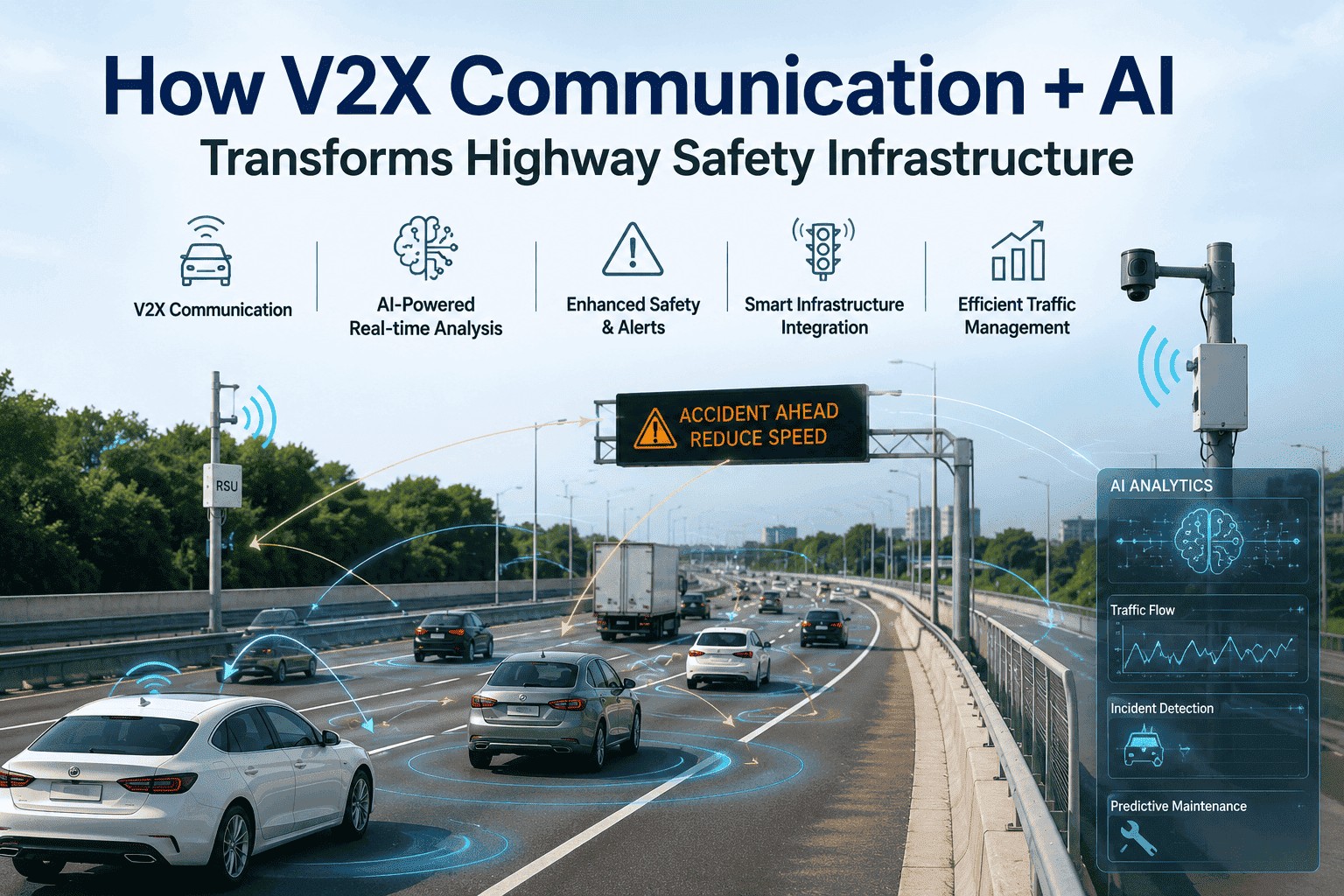
Every second, a highway has no idea what is happening on it. A vehicle brakes hard around a blind curve. A pedestrian steps into a crosswalk in fog. A signal fails at a rural intersection. In each of these moments, the road itself is silent — it has no way to warn the vehicles approaching, reroute traffic around the hazard, or alert a maintenance crew. That silence costs lives. The U.S. Department of Transportation released its national V2X Deployment Plan in August 2024 with one stated objective: reduce roadway fatalities to zero. Vehicle-to-Everything (V2X) communication — combined with AI that processes, interprets, and acts on that data in real time — is the technology that makes the road itself an active participant in safety. Here is how the infrastructure layer of V2X actually works, what AI adds to it, and why highway agencies that understand both will have a decisive advantage in the next decade of road network management.
V2X Infrastructure · AI Asset Monitoring · Real-Time Safety · Smart Highway Management
Your Highway Infrastructure Needs to Talk to Vehicles. AI Makes That Conversation Intelligent.
iFactory's AI platform monitors, manages, and connects your highway infrastructure — giving agencies the real-time asset intelligence that V2X communication depends on to keep roads safe.
What V2X Communication Actually Means for Highway Infrastructure
V2X is not a single technology — it is a communication architecture that connects four different entities on and around the road network. Understanding which channel carries which type of safety-critical data is the foundation for understanding where AI creates the most value in the infrastructure layer.
Channel 01
V2V — Vehicle to Vehicle
Vehicles broadcast their speed, position, heading, and brake status to all nearby vehicles continuously — without relying on infrastructure. A truck braking hard on the far side of a curve transmits that event to every vehicle within 300 metres before a human driver could react.
Latency target: under 20ms · Range: up to 300m
Channel 02
V2I — Vehicle to Infrastructure
Roadside units (RSUs) embedded in signals, gantries, and corridor infrastructure broadcast road condition data, signal phase timing, speed advisories, and work zone alerts directly to passing vehicles. This is the channel where highway agencies have the most direct influence — and the most infrastructure asset responsibility.
Agency-owned channel · Requires current infrastructure asset data
Channel 03
V2P — Vehicle to Pedestrian
Smartphones and wearable devices carried by pedestrians and cyclists broadcast position data to approaching vehicles. A Maryland DOT pilot on MD-214 demonstrated measurable crosswalk safety improvements using infrastructure-to-pedestrian (I2P) messaging at a single instrumented intersection.
Vulnerable road user protection · Infrastructure-triggered alerts
Channel 04
V2N — Vehicle to Network
Cellular connectivity links vehicles to cloud-based traffic management platforms, navigation services, and agency operations centres. C-V2X over 5G achieves data transmission delays of 0.25ms — over 200 times lower latency than earlier DSRC technology — enabling real-time network-wide traffic optimisation.
C-V2X latency: 0.25ms · DSRC baseline: 50–55ms
Where AI Transforms Raw V2X Data into Highway Safety Decisions
V2X communication generates enormous volumes of position, speed, and condition data — but data alone does not prevent crashes. AI is the processing layer that converts sensor streams into prioritised safety actions: predicting hazard trajectories, triggering the right alert to the right vehicle, and updating infrastructure condition models in real time. Without AI, V2X is a radio. With AI, it is a nervous system.
How AI Processes V2X Data for Infrastructure Safety
Function 01
Hazard Prediction
AI models predict vehicle trajectories and identify collision risk before a crash occurs — not after
Deep learning architectures including LSTM and 3D-CNN analyse V2X message streams to forecast where each vehicle will be in the next 2–5 seconds. When predicted paths intersect, the system triggers forward collision warnings through the V2I channel — giving drivers and infrastructure managers advance notice that static signal timing cannot provide.
Function 02
Adaptive Signal Control
Traffic signal timing adjusts dynamically based on real-time V2X vehicle flow data — not fixed time plans
C-V2X pilot deployments have shown a 40% reduction in bus stop frequency and 13% reduction in travel time when AI-controlled signal timing responds to vehicle position broadcasts rather than inductive loop schedules. Signal phase and timing (SPaT) messages broadcast to approaching vehicles allow drivers to adjust speed for a green wave — reducing stop-start conflict points.
Function 03
Infrastructure Condition Intelligence
AI continuously monitors RSU health, sensor status, and infrastructure asset condition — so V2I broadcasts only trusted, current data
A V2I system broadcasting stale or inaccurate infrastructure data is worse than no broadcast — it creates false confidence. AI asset monitoring verifies that roadside units are active, that speed advisory data matches current conditions, and that infrastructure condition records feeding the V2X messages are up to date. This is where asset register quality becomes a direct safety variable.
Function 04
Work Zone Management
V2X-equipped maintenance vehicles broadcast live work zone boundaries — AI updates lane closure and speed advisory messages in real time
Wyoming DOT retrofitted 320 heavy-duty trucks, highway patrol vehicles, and snowplows with onboard V2X units. These vehicles broadcast real-time work zone and weather advisories to approaching traffic — data that AI systems use to update recommended speeds and route guidance dynamically, reducing work zone conflict events.
Function 05
Crash Modification Modelling
AI quantifies the safety impact of V2X interventions — enabling agencies to prioritise infrastructure investment by predicted crash reduction
Research published in March 2025 found that V2X-enhanced forward collision warnings improve crash modification factors by 7–8% beyond the baseline provided by forward collision warning and automatic emergency braking alone. AI probability risk assessment models allow agencies to calculate the expected crash reduction per corridor from a given RSU deployment — making the business case for infrastructure investment calculable rather than assumed.
The Safety Numbers V2X + AI Is Delivering
Deployment data from active V2X programmes gives agencies concrete performance benchmarks for what the technology achieves when infrastructure communication and AI processing are combined at scale.
38%
reduction in traffic conflicts at intersections when C-V2X reaches 60% vehicle penetration
PMC research, 2025
89%
of vehicle-to-pedestrian crashes addressed by V2X messaging within 30 years of mass deployment
USDOT ITS evaluation
7–8%
additional crash probability reduction from V2X-enhanced warnings beyond FCW and AEB alone
MobilityCoE, March 2025
40%
fewer vehicle stops when AI-controlled signals respond to V2X vehicle position broadcasts in real time
USDOT connected vehicle pilot
0.25ms
C-V2X data transmission latency — 200× faster than legacy DSRC technology for time-critical safety messages
PMC C-V2X analysis, 2025
13%
decrease in travel time on instrumented corridors where V2X signal coordination was actively deployed
USDOT ITS evaluation
The Infrastructure Problem V2X Deployment Reveals
V2X deployment exposes a problem that most highway agencies have not yet confronted: the system can only broadcast what the infrastructure knows about itself. If your asset register does not accurately reflect the location, condition, and operational status of every roadside unit, every sign, every signal — the V2I channel broadcasts outdated or incomplete safety data to vehicles relying on it. The infrastructure communication layer is only as trustworthy as the asset data feeding it.
Without Current Asset Intelligence
RSUs broadcasting stale speed advisories that no longer match current road conditions
Signal phase data from controllers with unknown maintenance history
Work zone geometry not updated after physical layout changes
Security certificate expiry silently disabling V2X message authentication
Infrastructure asset gaps that create blind spots in the V2I coverage map
With AI-Maintained Asset Intelligence
RSU condition and operational status verified on every survey pass — stale data flagged automatically
Signal asset records current, with maintenance history and condition scores in the register
Asset changes detected on the next vehicle pass — no manual update cycle required
Certificate and firmware status monitored as infrastructure asset attributes with alert triggers
Coverage gaps identified and prioritised for RSU deployment in the infrastructure investment plan
Asset Register · RSU Monitoring · V2I Data Quality · Infrastructure Coverage
V2X Is Only as Safe as the Infrastructure Data Behind It.
iFactory's AI platform keeps your highway asset register current — so the data your V2X infrastructure broadcasts to vehicles is accurate, verified, and up to date on every corridor.
V2X Deployment Readiness: What Infrastructure Agencies Need to Prepare Now
The USDOT National V2X Deployment Plan sets out a phased roadmap for infrastructure agencies. The agencies that will deploy fastest and most effectively are those that address three infrastructure readiness conditions before their first RSU goes live.
Readiness Condition 01
Current Asset Register
Every signal controller, RSU mounting location, and roadside asset needs a georeferenced, condition-graded register entry before V2I deployment. A V2X system cannot manage what is not in the register. AI-automated inventory survey is the fastest path to getting there — completing corridor-wide asset capture in weeks rather than the months a manual programme requires.
Readiness Condition 02
Interoperability Standards
V2X only delivers its safety value if messages are interoperable across jurisdictions. A vehicle moving from one state to another must communicate with RSUs across every boundary it crosses. USDOT's deployment plan specifies that V2X infrastructure must conform to interoperability standards — meaning agencies need to align their RSU configurations, message formats, and security certificate management with the national framework from day one.
Readiness Condition 03
Continuous Monitoring
RSU firmware issues, security certificate expiry, and antenna mounting failures have been documented as real operational failure modes in early V2X deployments. USDOT guidance explicitly recommends proactive monitoring mechanisms for certificate status and firmware health. AI asset management platforms that flag infrastructure anomalies in real time close this gap — so V2X infrastructure does not silently degrade while vehicles continue to rely on it.
"
V2X connectivity is a crucial, lifesaving tool in the safety toolbox — it enhances mobility and improves efficiency. These communications, exchanged between vehicles, roadside infrastructure, and vulnerable road users, add a 360-degree situational awareness capability even when vehicles and infrastructure are not within line of sight of each other.
— U.S. Department of Transportation, ITS Deployment Evaluation Programme, December 2025
Conclusion: The Infrastructure Layer Is the Bottleneck
V2X communication backed by AI delivers measurable, documented safety improvements: a 38% reduction in intersection conflicts, crash modification factors improved by 7–8% through enhanced warning systems, and corridor travel times cut by 13% through intelligent signal coordination. The technology works when it is deployed correctly. But the deployment bottleneck in most highway agencies is not the vehicles or the communication hardware — it is the quality and currency of the infrastructure asset data that the V2X system depends on. An RSU that is broadcasting stale condition data is an active liability, not a safety asset.
iFactory's AI platform addresses the infrastructure intelligence layer that makes V2X deployment trustworthy: automated asset capture, continuous condition monitoring, georeferenced records written directly to GIS and RAMS, and real-time alerts when infrastructure assets fall outside operational parameters. Agencies preparing for V2X deployment — or auditing the integrity of an existing system — can start with a corridor inventory that establishes the asset baseline their V2I communications depend on. Book a Demo to see how the iFactory platform prepares your infrastructure for V2X deployment, or Get In Touch to begin your first corridor assessment.
Frequently Asked Questions
V2X makes the road a participant in safety. AI makes the infrastructure smart enough to participate accurately.
iFactory's AI infrastructure platform gives highway agencies the asset intelligence layer V2X deployment depends on — current, georeferenced, and continuously maintained. See how the platform works on a corridor like yours.