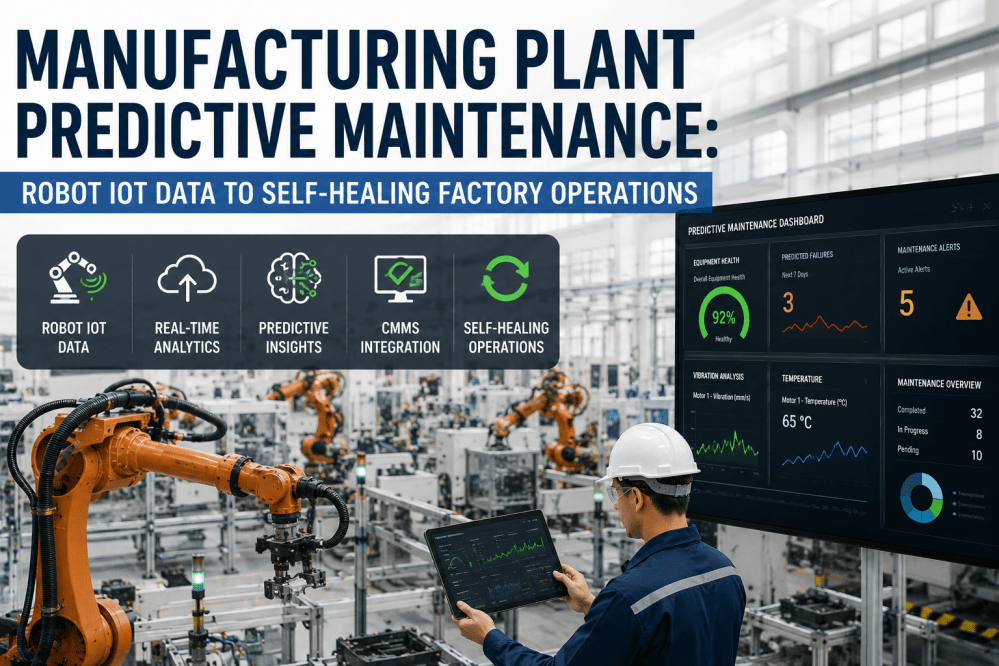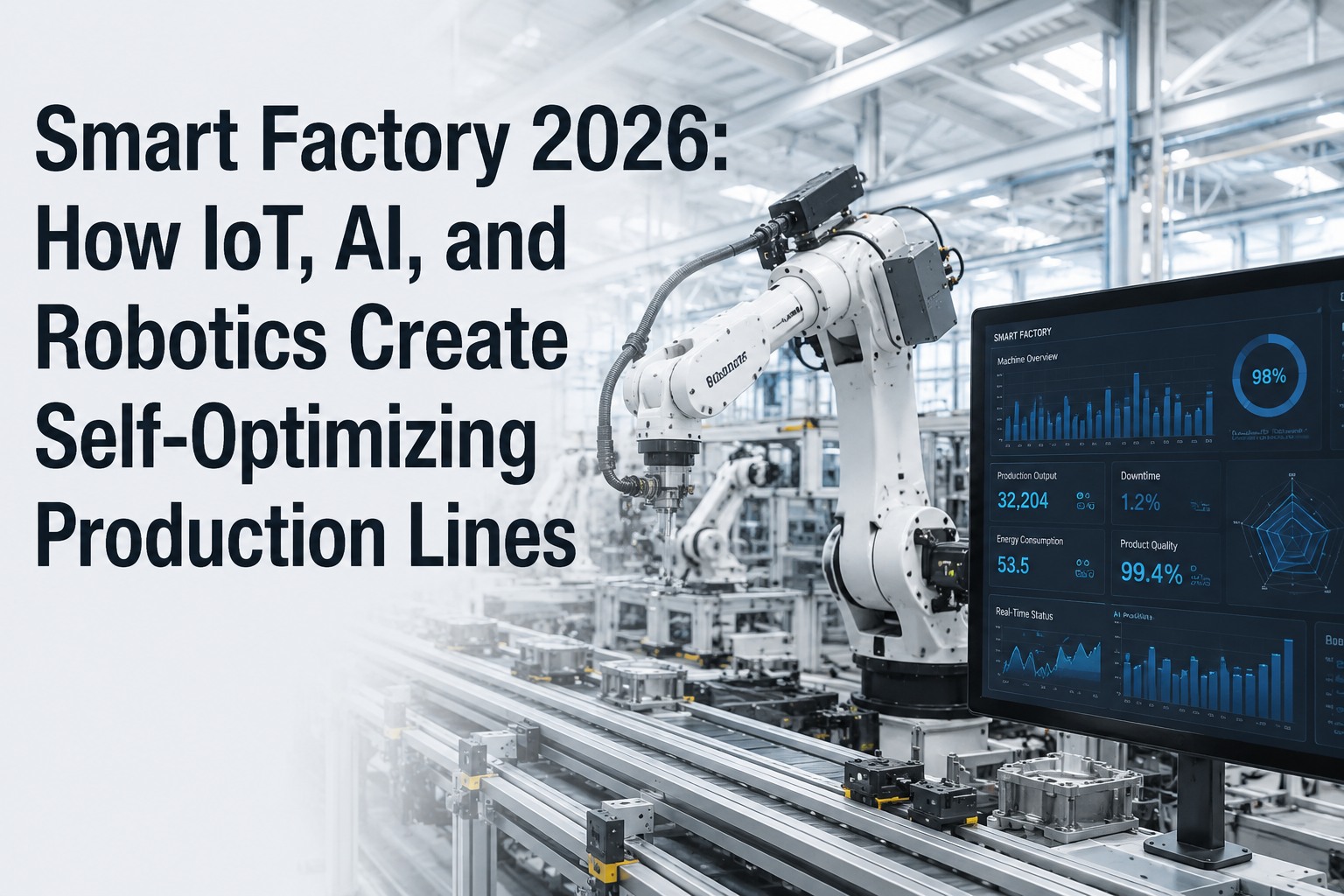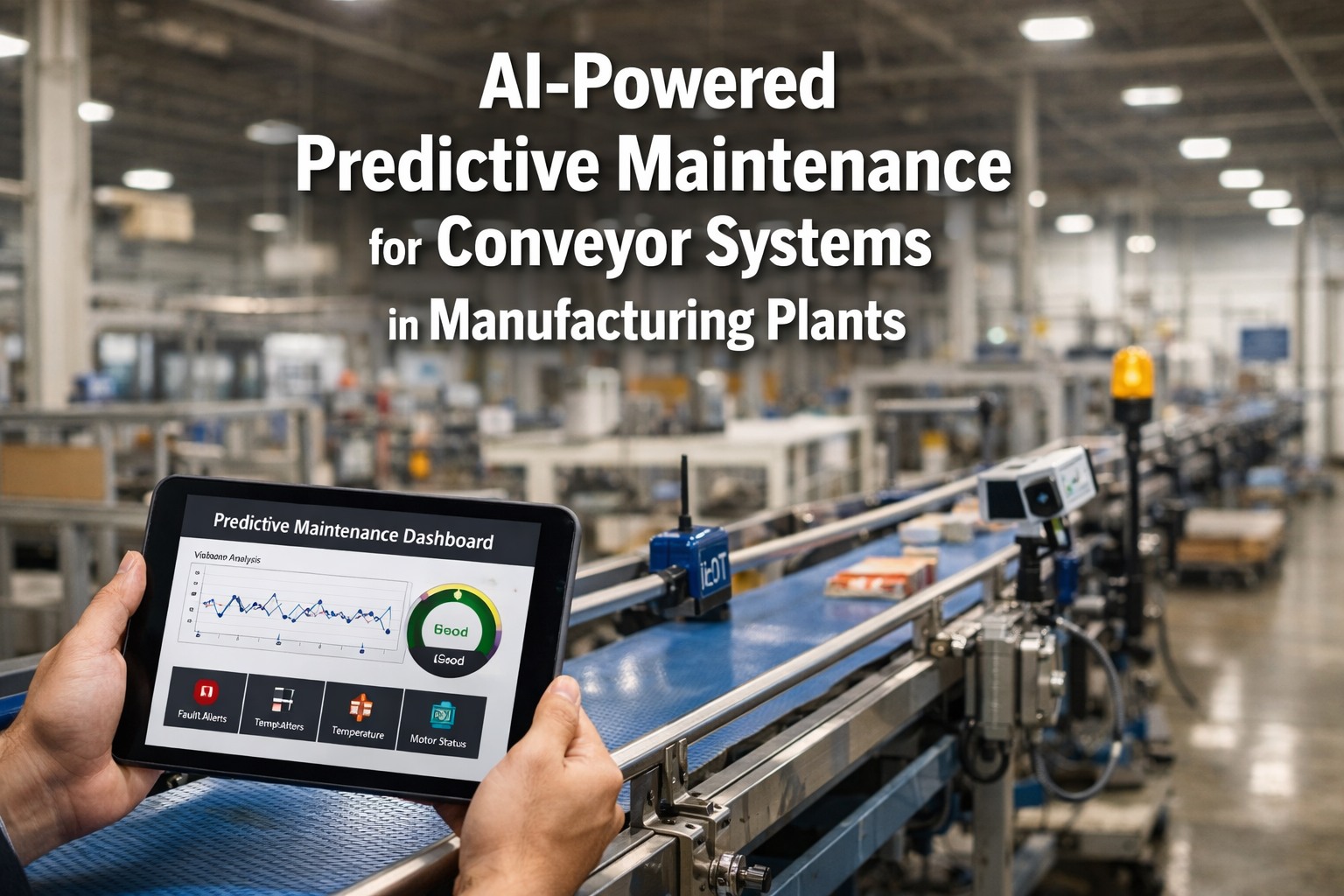
The factory of 2026 is no longer just automated — it is becoming aware. Ambient intelligence in manufacturing represents a fundamental shift from machines that follow instructions to environments that perceive, reason, and act on their own. By weaving thousands of low-power IoT sensors, edge AI processors, and contextual decision engines into the physical plant, manufacturers are creating self-aware factories that detect a bearing degradation 18 days before failure, dim non-critical lighting when a zone empties, reroute material flow around a stalled conveyor, and warn a technician before they cross into a hazardous arc-flash boundary. iFactory's IoT Sensor Integration and Edge AI platform turns this vision into a deployed reality — connecting vibration, thermal, acoustic, gas, occupancy, and energy sensors into a single contextual intelligence layer that runs on-premise, integrates with your existing SCADA and MES, and gives your plant a nervous system that never sleeps. Book a Demo to see ambient intelligence operating on a live production floor.
What Ambient Intelligence Actually Means on a Factory Floor
Ambient intelligence is the difference between a plant that has sensors and a plant that is aware. A traditional Industry 4.0 deployment installs vibration probes on motors, temperature sensors on bearings, and energy meters on panels — and then displays the readings on a dashboard for a human to interpret. An ambient intelligence deployment installs the same sensors, but the system itself understands what the readings mean in context: it knows that a 2°C bearing temperature rise during a planned overspeed run is normal, but the same rise during steady-state operation at 70% load with elevated humidity is a leading indicator of lubricant degradation. The dashboard does not just show the temperature; the system raises a work order, schedules the lubrication task during the next planned changeover, and quietly updates the maintenance plan — all without a technician opening an application.
For U.S. manufacturing leaders, this distinction matters because the cost of plant unawareness is measurable and growing. An average mid-size discrete manufacturing plant generates 5–15 terabytes of sensor and process data per month, of which less than 8% is ever reviewed by a human before being overwritten. Ambient intelligence closes that gap by making the system itself the primary consumer of the data — humans intervene only at the decision points where their judgment is genuinely required. See how this works on your asset base.
The Five Sensor Domains That Make a Plant Self-Aware
A self-aware factory is not built on a single super-sensor. It is built on the layered integration of five distinct sensing domains, each capturing a different dimension of plant state, fused at the edge into a unified contextual model. Most operations begin by deploying one or two domains and expanding outward — the value compounds as additional domains come online because the AI inference engine can correlate signals across them. A vibration anomaly that correlates with a 1.5 kWh power draw spike and a thermal hotspot tells a much richer story than any single sensor reading on its own.
Reference Architecture: From Sensor Edge to Adaptive Action
An ambient intelligence deployment is an architectural commitment, not a product purchase. The reference architecture below reflects how iFactory deploys self-aware factory infrastructure in U.S. manufacturing environments — designed for retrofit on existing plants with operational SCADA and PLC systems, not greenfield-only installations. Each layer is independently deployable, and operations typically activate them in sequence over 6–18 months as the value model is proven and budget is released.
| Architecture Layer | Function | Typical Hardware | Deployment Time | Independent Value |
|---|---|---|---|---|
| Layer 1 — Sensor Edge | Capture physical phenomena, local pre-processing | MCU-based sensor nodes · NPU-enabled gateways | 2–6 weeks per zone | Condition monitoring baseline |
| Layer 2 — Edge AI Inference | Local anomaly detection, classification, sub-50ms response | Industrial GPU node · NVIDIA Jetson · ARM SoC clusters | 3–4 weeks per line | Predictive maintenance alerts |
| Layer 3 — Contextual Fusion Engine | Cross-domain signal correlation, state inference | On-premise server · time-series database · ML model registry | 4–8 weeks plant-wide | Root-cause and adaptive control |
| Layer 4 — Adaptive Action Layer | Work order generation, setpoint adjustment, operator notifications | iFactory CMMS · MES bridge · OPC-UA controller writeback | 2–3 weeks integration | Autonomous workflow execution |
| Layer 5 — Enterprise Intelligence | Plant-to-plant benchmarking, ERP push, executive analytics | Cloud aggregation · SAP integration · BI dashboards | 6–10 weeks rollout | Strategic capacity and capex planning |
Any ambient intelligence claim that depends on cloud round-trips for inference is structurally incompatible with the use cases that matter most on a factory floor. A safety stop on an arc-flash zone intrusion needs to fire in under 100 ms — a typical cloud API round-trip alone consumes 180–400 ms. An adaptive setpoint change on a temperature loop cannot tolerate a 2-second WAN outage. The non-negotiable design rule for self-aware factories is that all time-critical inference runs on local hardware within the same network segment as the sensors, with cloud connectivity used only for model updates, aggregation, and non-time-critical analytics. iFactory's edge stack runs entirely on-premise and continues to operate through internet outages — your plant stays self-aware even when the WAN is down. Map the architecture for your plant.
Four High-Value Use Cases Proven in U.S. Manufacturing
Ambient intelligence becomes real when it produces a measurable change in plant operating metrics — not a new dashboard. The four use cases below are the most commonly deployed first wave in U.S. manufacturing operations and consistently produce ROI within the first 6–12 months of activation. They span maintenance, energy, safety, and quality, which is the typical four-quadrant scope a plant manager wants to see addressed before committing to a full ambient intelligence rollout.
Predictive Maintenance with Cross-Sensor Correlation
A single vibration spike is noise. A vibration spike correlated with a 0.8°C bearing temperature rise, a 2.1% motor current draw increase, and an audible ultrasonic emission at 38 kHz is a confirmed lubrication degradation event with a 17-day predicted time-to-failure. The contextual fusion engine reaches this conclusion in real time and auto-generates a work order with the recommended action, required parts, and the optimal maintenance window from the production schedule. Plants deploying this use case consistently report 30–45% reduction in unplanned downtime within the first operating year.
Occupancy-Aware Energy Optimization
UWB and radar occupancy sensors detect that a packaging hall has been unoccupied for 12 minutes during a shift handover. The ambient control layer dims overhead lighting to 30%, reduces HVAC setpoint by 3°F, and idles non-critical compressed air branches — then restores all parameters automatically 90 seconds before the next operator enters the zone, based on RTLS movement tracking from the locker room. Energy savings of 12–28% on non-production load are typical, with zero impact on worker comfort or production startup time.
Proactive Safety Zone Awareness
A technician approaches an energized panel for a planned inspection. The ambient system reads their RTLS badge, cross-references the active work order, verifies their arc-flash PPE qualification in the EHS database, confirms the panel has been de-energized via the breaker status sensor, and silently logs the entry as compliant. If any of these conditions fail, the system fires a visible-light alert at the panel and a notification to the supervisor before the technician makes contact — preventing incidents that paperwork-based LOTO cannot catch in real time.
In-Process Quality Drift Detection
A CNC machining cell is running within all SPC control limits, but the contextual engine detects that the combination of rising spindle temperature, slight tool deflection variance, and a 0.4% coolant flow drop is correlated with a historical pattern that preceded the last three out-of-spec batches. The system raises a soft alert to the line lead, recommends a tool change at the next part boundary, and updates the maintenance plan — preventing the scrap event 6–10 parts before it would have occurred. Quality teams report 20–40% reduction in in-process scrap on equipped cells.
Traditional Industry 4.0 vs. Ambient Intelligence: What Actually Changes
The technology stack overlaps significantly between a conventional Industry 4.0 deployment and an ambient intelligence deployment — the cameras, sensors, and gateways often look identical on a bill of materials. The difference is in where decisions get made, who acts on them, and how quickly the loop closes. The comparison below is drawn from iFactory deployments where the same plant operated in both modes during a phased transition, giving a like-for-like view of the operational shift.
Phase 1: Baseline Sensor Coverage
Deploy condition monitoring on the top 20% of assets that produce 80% of downtime cost. Establish a clean data foundation in the time-series database. This phase delivers traditional predictive maintenance value and validates the data pipeline before more advanced inference is layered on. Typical duration: 6–10 weeks for a mid-size plant.
Phase 2: Edge AI Activation
Deploy the on-premise inference node, train initial anomaly detection models on the baseline data, and move from threshold alerts to behavioral pattern alerts. This phase is where false alarm rates drop dramatically — typically from 15–25% to under 3% — because the model has learned what normal looks like for each specific asset under each operating condition.
Phase 3: Cross-Domain Fusion
Connect the energy, environmental, and spatial sensing domains to the same inference engine. This is the inflection point where ambient intelligence becomes structurally different from predictive maintenance — the system now reasons about combined states (machine + operator + environment) rather than isolated signals. Use cases two through four from the previous section activate in this phase.
Phase 4: Adaptive Closed-Loop Control
The system gains controlled write-back permission to selected PLC setpoints, lighting, HVAC, and material handling controllers. Decisions that previously required a supervisor's approval are executed autonomously within pre-defined bounds, with full audit logging. Human operators shift from monitoring to managing the exceptions the system flags for judgment — the operational definition of a self-aware plant.
Expert Review: What Distinguishes Successful Ambient Intelligence Deployments
The plants that succeed with ambient intelligence are not the ones with the biggest sensor budgets — they are the ones that get three organizational decisions right before the first sensor is installed. First, they appoint a single accountable owner for the ambient intelligence program who has authority across maintenance, operations, EHS, and IT — not a committee. Without that owner, every cross-domain correlation use case stalls in the gap between functional silos. Second, they commit to on-premise edge inference as an architectural standard and refuse vendor proposals that require cloud round-trips for any time-critical decision. The plants that compromise on this point end up with a system that works during the vendor demo and fails the first time their internet goes down. Third, they accept that the first 90 days after activation will produce a higher alert volume than the legacy system — because the AI is now seeing things the threshold-based system never could — and they staff for that learning period rather than declaring the system noisy and disabling it. The plants that get those three decisions right typically reach autonomous closed-loop operation within 12 months. The plants that get them wrong are still calling it a pilot two years later.
Conclusion
Ambient intelligence is not a future-state vision for U.S. manufacturing — it is a deployed reality in plants that have committed to the architectural and organizational shift required to make it work. The sensor technology is mature, the edge AI inference hardware is industrial-grade and field-proven, and the integration pathways with existing SCADA, PLC, MES, and ERP systems are well-understood. What separates the plants that capture the value from those that do not is no longer technology selection — it is the willingness to treat the ambient intelligence layer as the primary nervous system of the operation rather than as a parallel monitoring system that supplements human oversight.
For operations leaders evaluating where to begin, the practical entry point is rarely a full plant-wide deployment. It is a single phase 1 sensor coverage rollout on the highest-downtime asset cluster, paired with a clear roadmap for activating edge AI inference and cross-domain fusion in the following 6–9 months. That phased path converts ambient intelligence from a capital project into a series of self-funding investments, each of which produces measurable plant performance improvement on its own. The plants that begin this transition in 2026 will be the plants with structural cost and reliability advantages by 2028 — and the ones that defer will be competing against operations that no longer need human attention to run within spec.
Frequently Asked Questions
The hardware overlap is significant — the sensors, gateways, and network infrastructure are largely the same. The difference is architectural. A standard IIoT deployment streams sensor data to dashboards where humans interpret readings and decide what to do. An ambient intelligence deployment moves the interpretation and the initial decision-making into the edge inference layer itself, so the system understands context, correlates signals across multiple sensor domains, and takes action — generating work orders, adjusting setpoints, alerting operators only when judgment is needed. Practically, this means an IIoT deployment makes plant data visible; an ambient intelligence deployment makes the plant responsive. The same sensor base can serve both, but the value model is fundamentally different because the closed-loop response time drops from minutes-to-hours down to sub-50 milliseconds for the use cases that matter.
No, and any vendor proposal that requires PLC or SCADA replacement should be treated with skepticism. iFactory's ambient intelligence stack is designed to overlay existing control infrastructure, not replace it. The edge AI inference node reads from your SCADA historian and your sensor gateways via OPC-UA, MQTT, or direct industrial protocol drivers, and writes back to selected PLC tags only with explicit operator authorization for closed-loop control. Plants typically retain their existing Rockwell, Siemens, or Schneider control infrastructure entirely unchanged, with the ambient intelligence layer running in parallel and integrating through standard industrial communication standards. This overlay model is what makes 6–10 week deployment timelines feasible — there is no rip-and-replace of working production infrastructure.
For a mid-size U.S. manufacturing plant of 150,000–400,000 square feet with 80–200 production assets, a Phase 1 condition monitoring deployment typically requires 200–500 sensor nodes covering the highest-value assets — vibration and temperature on critical motors and gearboxes, sub-metering on the top 20% of electrical loads, and 8–15 environmental sensors for plant-wide air quality and humidity baselines. Capital cost ranges from $85,000 to $240,000 for hardware and initial software licensing, depending on sensor density and asset count. The Phase 2 edge AI inference layer adds $45,000–$90,000 for the on-premise GPU node and model training services. Total Phase 1+2 deployment for a mid-size plant typically lands in the $130,000–$330,000 range, with payback periods of 8–14 months from downtime reduction alone before accounting for energy and quality benefits.
The architecture is designed for ISA/IEC 62443-compliant deployment with clean IT/OT separation. Sensor nodes and the edge AI inference engine sit entirely within the OT network segment behind the plant DMZ — there is no direct internet exposure of any operational technology component. Aggregated, non-time-critical analytics data is pushed to the IT-side dashboards through a unidirectional data diode or strictly controlled DMZ gateway, ensuring no inbound paths exist from IT to OT. All sensor-to-gateway communication uses encrypted industrial protocols, role-based access control is enforced at every layer, and a full audit log captures every setpoint write-back, configuration change, and operator action. Plants operating under NIST 800-82, IEC 62443, or customer-specific cybersecurity audits routinely deploy the system without exceptions to their security posture, and the on-premise inference architecture eliminates the cloud-dependency vulnerabilities that disqualify many competing platforms in regulated environments.
The realistic ongoing team requirement for a mid-size plant is a single 0.5–0.8 FTE owner — typically a senior reliability engineer or controls engineer with system-level visibility — supported by part-time involvement from maintenance planning, EHS, and IT. The ambient intelligence platform is not a data science project that requires a dedicated ML team in-house. Model training, retraining, and tuning are performed by iFactory's deployment engineers during the initial 12-month period, after which the system enters maintenance mode where the internal owner manages exception escalations, approves new use cases, and coordinates with iFactory for quarterly model performance reviews. Plants that try to staff a full internal data science team typically over-engineer the program; plants that rely entirely on the vendor without an internal owner lose institutional knowledge and fail to expand the use case base. The middle path of one accountable internal owner plus vendor-supported model lifecycle management is what successful deployments consistently use.