Best Predictive Analytics Technologies for Manufacturing
By Hannah Baker on June 8, 2026
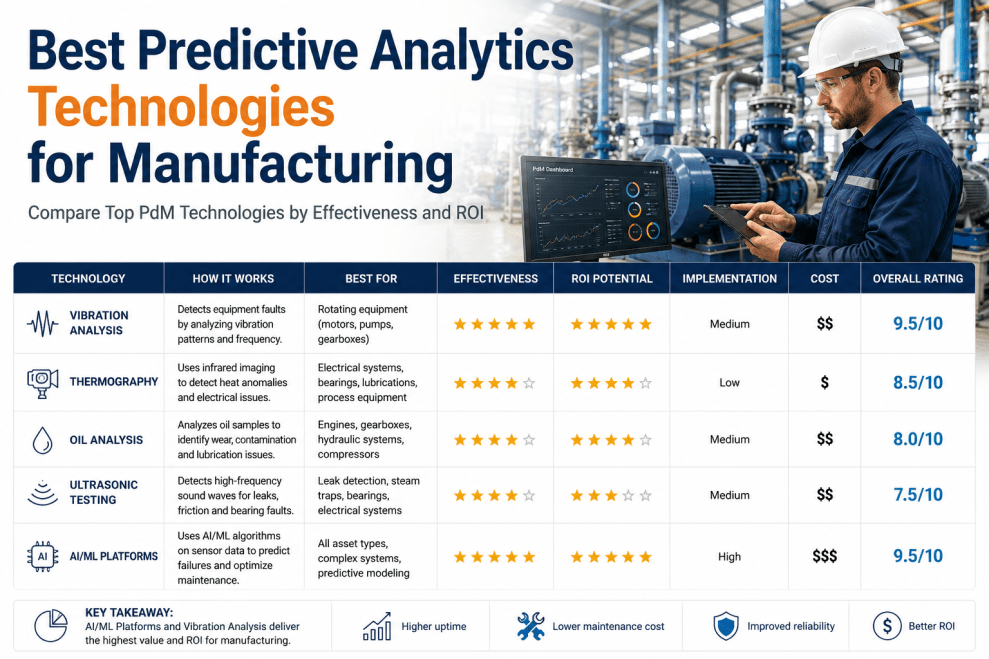
In every manufacturing plant, assets generate a continuous stream of data—vibration signatures, thermal patterns, lubricant chemistry, acoustic emissions—that most teams never fully connect. Each technology answers a specific question about machine health, but the real reliability gain comes when those answers are fused into a single, coherent view. Predictive analytics has moved beyond standalone sensors and clipboards; the five core technologies—vibration analysis, infrared thermography, oil analysis, ultrasonic testing and AI-powered monitoring—now form an integrated stack that sees failure from every angle. This guide maps each technology to its best use, shows how they layer together, and explains how a unified predictive analytics platform turns fragmented data into a single source of reliability truth.
Predictive Analytics Guide • 2026
Best Predictive Analytics Technologies for Manufacturing
A complete comparison of vibration analysis, thermography, oil analysis, ultrasonic testing, and AI-powered monitoring — and how to layer them into an integrated reliability program.
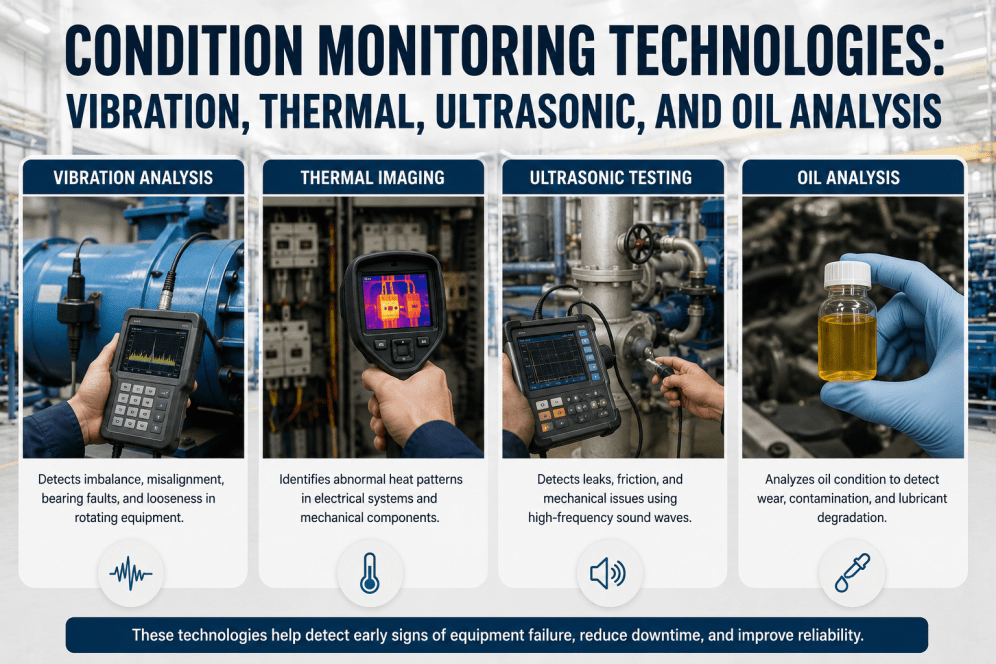
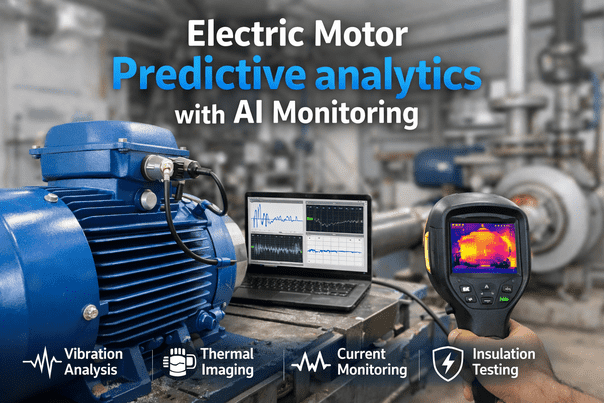
Vibration analysis is the most mature and widely deployed predictive technology in manufacturing. Accelerometers mounted at bearing points capture frequency spectra that reveal imbalance, misalignment, bearing degradation, mechanical looseness, and resonance. When compared against a baseline signature, even a 5% shift in amplitude at a specific frequency can indicate a developing fault weeks before temperature or audible noise confirms it.
Lead time: 4-12 weeks before failure
Best for: Motors, pumps, fans, compressors, gearboxes
Limitation: Limited effectiveness on slow-speed or reciprocating equipment
2. Infrared Thermography
02
The primary lens for electrical system health
Infrared thermography detects surface temperature anomalies that signal electrical resistance, friction, or insulation breakdown. A loose connection in a breaker panel generates heat long before it arcs; a bearing running hot reveals lubrication failure before it seizes. Because thermography is non-contact and safe for live inspections, it is the primary technology for electrical system reliability and a strong secondary tool for mechanical assets that generate thermal signatures.
Lead time: 2-8 weeks before failure
Best for: Switchgear, MCCs, bus bars, bearings, refractory
Limitation: Surface measurement only; requires line of sight
3. Oil Analysis
03
The earliest warning for internal component wear
Oil analysis detects what vibration and thermography cannot: the chemical and particulate evidence of internal wear. Spectrometric analysis identifies specific metal alloys in suspension, revealing exactly which component is wearing. Particle counts track contamination ingress. Viscosity and acid-number trending quantify lubricant degradation. Because these changes occur at the molecular level before they manifest as heat or vibration, oil analysis often delivers the earliest warning of catastrophic failure in lubricated systems.
Lead time: 8-24 weeks before failure
Best for: Gearboxes, turbines, hydraulic systems, large bearings
Limitation: Requires lab turnaround; not real-time without online sensors
4. Ultrasonic Testing
04
High-frequency detection in noisy environments
Ultrasonic testing captures acoustic emissions in the 20-100 kHz range, far above plant-floor background noise. These high-frequency signals reveal air and gas leaks, steam trap blow-through, bearing starvation, and electrical partial discharge that vibration and thermography would miss. Because ultrasound is directional, technicians can pinpoint the exact source of a leak or fault without shutting down the system. It is the fastest technology for leak detection and a critical secondary tool for bearing and electrical diagnostics.
Lead time: 2-6 weeks before failure
Best for: Steam traps, valves, compressed air, bearings, electrical arcing
Limitation: Requires trained ear for interpretation; less effective on submerged equipment
5. AI-Powered Monitoring
05
The layer that sees what single sensors miss
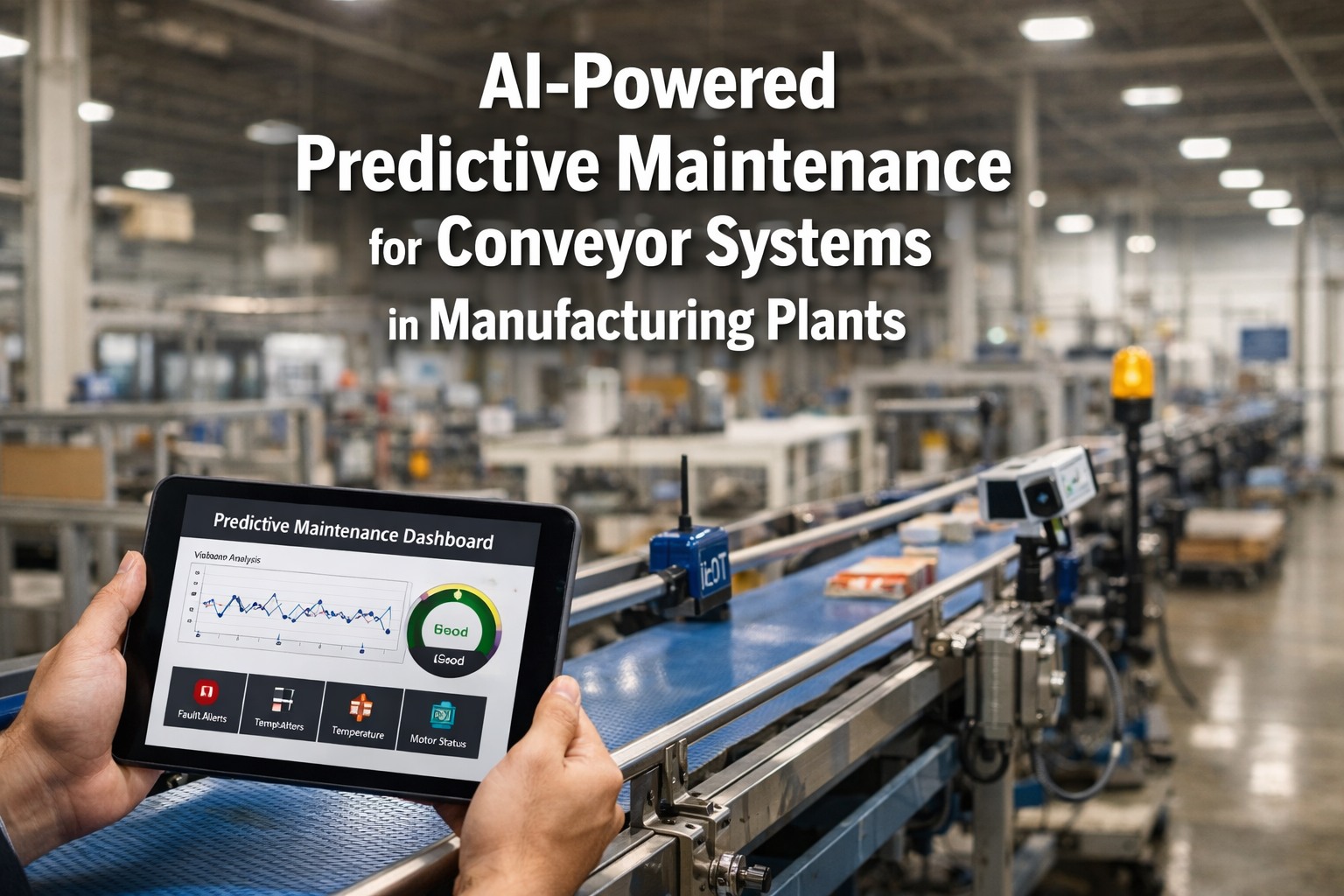
AI-powered monitoring ingests data from vibration, thermal, ultrasonic, oil analysis, and PLC sources simultaneously, learning the normal multi-dimensional operating envelope of each asset. When a subtle anomaly emerges that no single technology would flag on its own—a bearing running warmer while vibration stays flat, for example—the AI detects the correlation and alerts the team. The iFactory AI platform trains models on plant-specific data, so the detection baseline reflects your actual operating conditions rather than generic thresholds, delivering higher accuracy and fewer false alarms.
Lead time: 2-12 weeks depending on sensor data available
Best for: All critical assets; multi-sensor fusion and pattern detection
Limitation: Accuracy improves with training data volume over first 3-6 months
Every technology detects a specific failure window. AI closes the gaps between them to fuse multi-sensor data into a single predictive view.
Technology Coverage Matrix: Which Technology Detects What
Each technology covers a specific set of failure modes. Deploying them without mapping coverage creates blind spots. The matrix below shows primary (P) and secondary (S) detection capability across the most common manufacturing failure modes.
Failure Mode
Vibration
Thermography
Oil Analysis
Ultrasonic
AI
Bearing wear
P
S
P
S
P
Shaft misalignment
P
-
-
-
P
Electrical overload
-
P
-
S
S
Lubrication failure
S
S
P
S
P
Steam trap leak
-
S
-
P
S
Contamination ingress
S
-
P
-
P
Cavitation
P
-
-
P
P
Primary detection
Secondary detection
Layered Coverage • One Platform
Stop Managing Predictive Technologies in Silos
iFactory AI ingests vibration, thermal, ultrasonic, oil analysis, and PLC data into a single AI-powered dashboard. One platform, one set of alerts, one reliability picture.
How AI Fuses Multi-Technology Data into Actionable Intelligence
The value of running multiple predictive technologies is not in having more data. It is in correlating that data to detect patterns that single-threshold monitoring cannot see. AI models trained on plant-specific data fuse all sensor streams and learn what "normal" looks like for each asset across all dimensions simultaneously. When a bearing temperature rises slightly while vibration stays steady, a conventional system sees two independent readings; an AI sees a combined anomaly that signals early-stage lubrication failure.
Aggregate
All sensor streams converge into a unified time-series database with common asset tagging
Train
ML models learn multi-dimensional normal baselines per asset, adjusting for load, speed, and ambient conditions
Detect
The model flags combined-signal anomalies, correlating readings across technologies to identify the likely failure mode
Act
The platform prescribes the corrective action and generates a work order with all supporting evidence attached
Expert Review: Selecting the Right Technology Stack
Patricia Langston
Director of Reliability Engineering, Johnson Controls
28 years in industrial asset management
Expert Insight
"The plants that achieve 90%+ prediction accuracy are not running one technology well. They are layering vibration, thermography, oil analysis, and ultrasonic, and fusing all that data through an AI layer that correlates across domains. If you only deploy one technology, you are blind to every failure mode that technology cannot detect. A comprehensive predictive program is not a purchase decision. It is a coverage design problem."
Langston's point is critical: predictive analytics is not about choosing the best technology but about designing a layered coverage strategy where each technology fills the detection gaps of the others. The AI layer then correlates signals across all of them to surface failure patterns that no single technology would reveal on its own.
Building Your Integrated Predictive Program
Transitioning from reactive maintenance to integrated predictive analytics follows a repeatable maturity path. These four levels define how plants progress from no prediction to full multi-technology AI-driven coverage.
L1
Reactive
No predictive technology deployed. Maintenance is driven by breakdowns and scheduled calendar-based PM. Downtime is unpredictable and costly.
L2
Single-Technology
One technology deployed on critical assets, typically vibration or thermography. Alerts are threshold-based with manual review. Coverage is partial.
L3
Multi-Technology
Two or more technologies deployed with centralized data collection. Analysts review data streams separately. Cross-correlation is manual.
L4
AI-Fused
All technologies feed an AI platform that correlates signals, detects combined anomalies, prescribes actions, and generates work orders autonomously.
Where does your plant sit on this maturity path? Book a Demo and we will assess your current coverage and map the next layer to deploy.
Conclusion
The best predictive analytics technology for your plant is not a single tool but a layered stack designed to cover every failure mode of every critical asset. Vibration analysis, infrared thermography, oil analysis, and ultrasonic testing each detect a specific category of deterioration; AI-powered monitoring ties them together and catches the patterns that operate between technologies. The iFactory AI platform was purpose-built to unify this stack, fusing multi-sensor data into a single dashboard that prescribes actions rather than just displaying readings. Start with your highest-impact assets, deploy the technologies that match their failure modes, and layer AI on top to see the full picture. Book a Demo to begin building your integrated predictive analytics program.
Frequently Asked Questions
Which predictive technology delivers the fastest ROI?
Vibration analysis typically delivers the fastest ROI for plants with significant rotating equipment. It is the most mature technology, with well-established baselines and low sensor costs. Plants that deploy wireless vibration sensors on a pilot group of 10-20 critical motors and pumps often see their first detected failure within 30 to 60 days, with ROI realized on the first prevented breakdown. However, the fastest ROI path depends on your dominant failure modes. If electrical failures are your biggest cost driver, thermography may deliver faster returns.
Can I run predictive analytics on older equipment without built-in sensors?
Yes. Retrofitting sensors on legacy equipment is straightforward and cost-effective. Wireless vibration sensors with magnetic mounts install in minutes without drilling or wiring. Handheld thermal cameras require no installation at all. Oil sampling works on any lubricated system regardless of age. Ultrasonic detectors are portable and require no permanent mounting. AI platforms like iFactory AI accept data from any sensor source, so the age of the equipment does not limit the predictive capability. The only requirement is physical access to the measurement point.
How many technologies do I actually need for good coverage?
Two technologies cover roughly 60-70% of failure modes in a typical plant. Three technologies push coverage to 80-85%. Full coverage of the top failure modes across rotating, electrical, and structural assets requires four technologies plus an AI fusion layer. The specific combination should be driven by a failure mode audit of your most critical assets. Most plants achieve strong coverage with vibration plus thermography plus oil analysis, then add ultrasonic for steam and leak diagnostics and AI to correlate across all four.
How do I train my team to use predictive analytics technologies?
Each technology has a different learning curve. Vibration analysis requires the most training, typically Level I and Level II certification through organizations like the Vibration Institute or Mobius Institute. Thermography certification is available through the Infrared Training Center. Oil analysis training is offered by labs and lubricant suppliers. Ultrasonic training is typically one to two days with the equipment vendor. AI monitoring platforms like iFactory AI are designed for plant personnel without data science backgrounds, with alert-based workflows that guide the technician from detection to action.
What is the typical cost to implement a multi-technology predictive program?
Costs vary by plant size and scope, but a pilot program on 10-20 critical assets typically ranges from $15,000 to $50,000 for sensors, training, and software, depending on the technologies selected. Scaling to plant-wide coverage on 200+ assets ranges from $100,000 to $500,000. ROI is typically realized within 6 to 12 months through reduced unplanned downtime, extended asset life, and optimized maintenance labor. The most cost-effective approach is to start small with one or two technologies, prove the return, then expand coverage and layer additional technologies based on demonstrated savings.
Start Building Your Integrated Stack
Get a Predictive Technology Coverage Assessment
Share your critical asset list and current maintenance approach. We will map the right technology combination to your failure modes, design the data integration architecture, and lay out a phased deployment plan from pilot to plant-wide AI fusion.