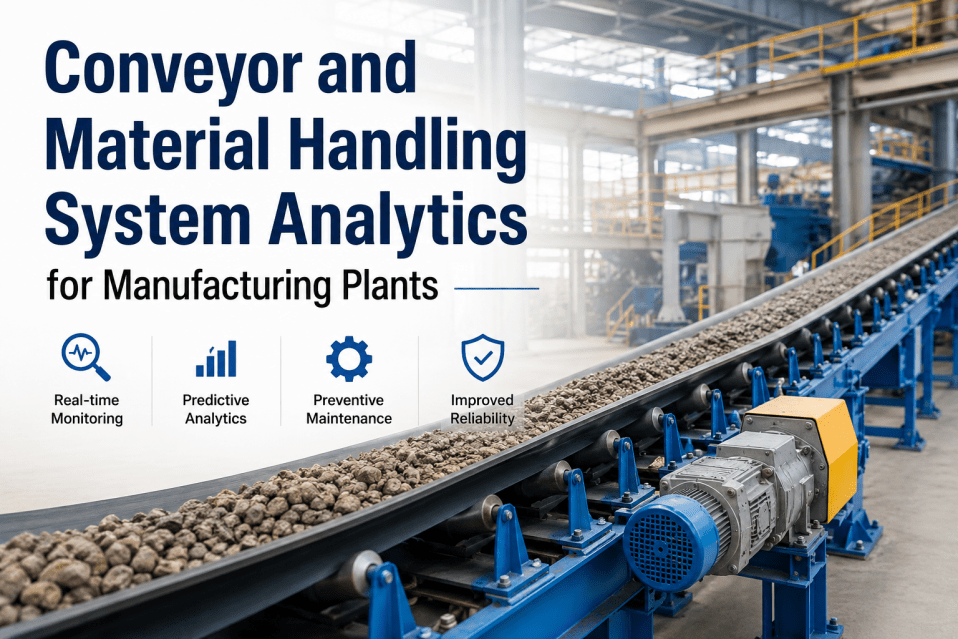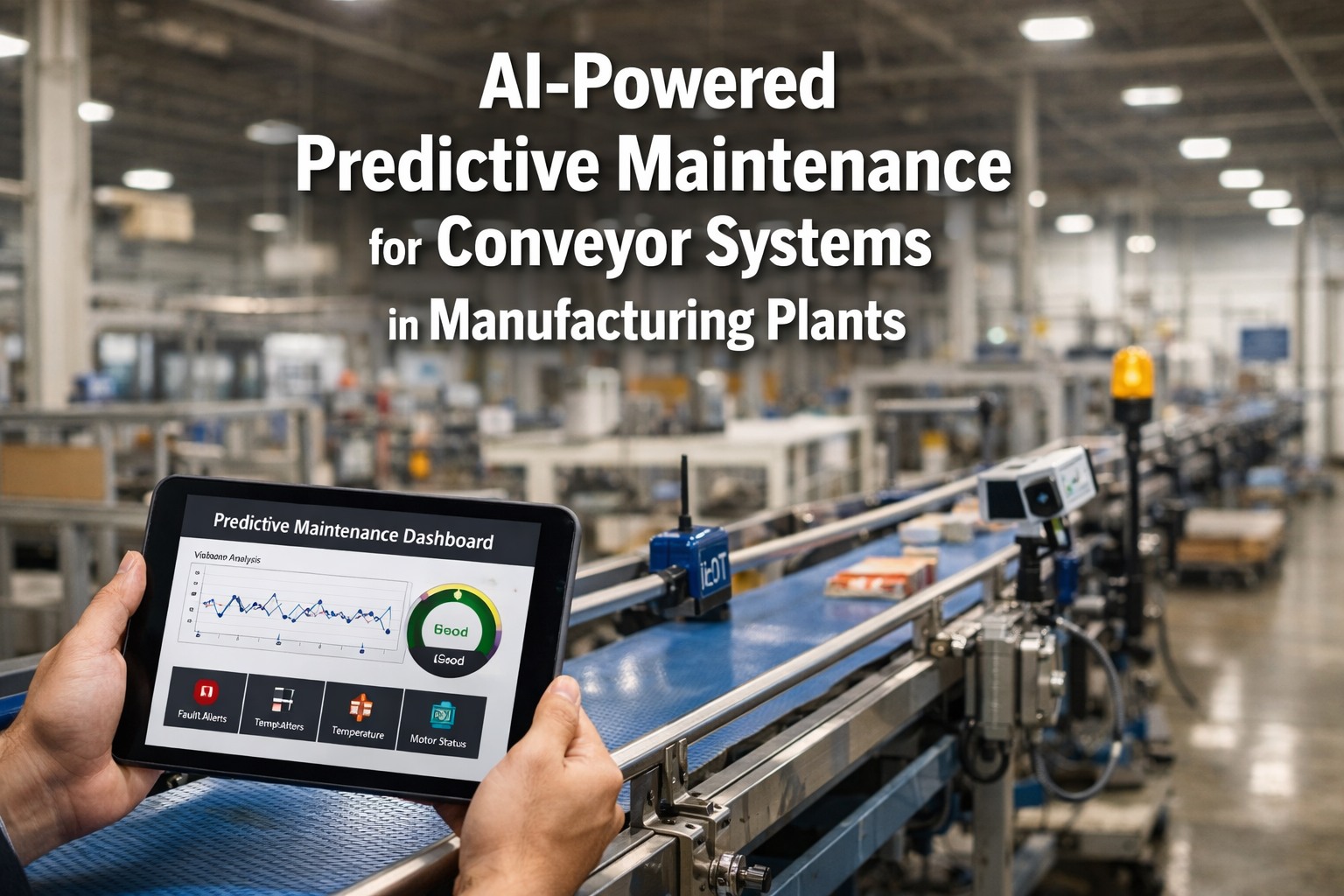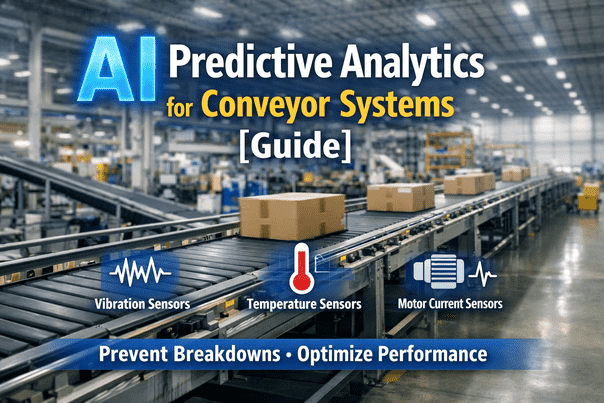
Conveyor system failures account for more unplanned production stoppages than any other single equipment category on the manufacturing plant floor — and the majority are entirely predictable. Belt tears, roller seizures, drive motor failures, and gearbox degradation all produce detectable vibration, thermal, and current signatures days or weeks before the failure forces a line stoppage. iFactory's AI platform monitors every conveyor drive, motor, gearbox, and belt system through multi-sensor fusion — delivering specific fault alerts with 30-45 days of advance warning, so your maintenance team intervenes during the next planned window instead of scrambling for an emergency repair crew at 3 AM. Book a free conveyor risk assessment for your plant today.
iFactory's AI platform predicts conveyor system failures — belt tears, roller seizures, drive motor faults, gearbox degradation, and pulley bearing failures — 30 to 45 days in advance, using vibration, MCSA, thermal, and belt tension sensor fusion. It connects to your existing PLCs and SCADA in read-only mode, deploys in 7-14 days without any conveyor shutdown, and auto-generates work orders when AI detects developing faults.
Stop Conveyor Failures Before They Stop Your Line
Vibration, temperature, motor current, and belt tension data — fused by iFactory's AI into a single conveyor health score per system. Fault alerts fire 30-45 days before failure. Work orders generate automatically. Your line keeps running.
The 6 Conveyor Failure Modes iFactory Monitors
Each failure mode requires different sensor types and analysis techniques. iFactory deploys all six monitoring streams simultaneously from a single edge gateway — providing complete conveyor health coverage without multiple separate monitoring systems.
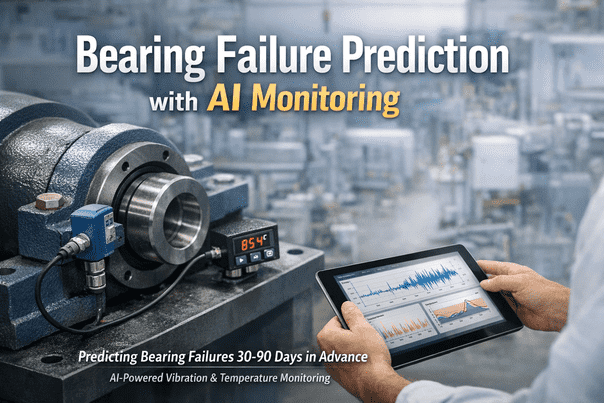
Conveyor drive motors fail from bearing degradation, winding insulation breakdown, rotor bar breaks, and shaft misalignment. Motor failures account for 35-40% of all conveyor line stoppages. iFactory monitors drive motor health through combined MCSA and vibration analysis — detecting bearing faults at BPFI/BPFO/BSF frequencies and winding faults through current asymmetry tracking. First detectable: 30-90 days before failure.
Conveyor gearboxes fail from gear tooth wear, bearing fatigue, lubricant contamination, and oil seal failure. Gear mesh defects produce characteristic vibration at gear mesh frequency (shaft RPM x number of teeth) and harmonics. iFactory tracks gear mesh frequency amplitude trending and oil temperature rise to identify developing gearbox faults weeks before catastrophic failure. First detectable: 14-45 days before failure.
Pulley shaft bearings carry the full belt tension load continuously and are among the highest-load bearing applications in manufacturing conveyor systems. Bearing failure causes conveyor belt misalignment, belt edge damage, and ultimately complete belt derailment. iFactory monitors pulley bearing health through envelope analysis at calculated defect frequencies — detecting developing faults before belt damage propagates. First detectable: 21-60 days before failure.
Seized rollers and idlers cause belt edge wear, belt fires from friction heat in enclosed conveyors, and rapid belt damage. Individual roller seizure is impossible to detect visually during operation — seized rollers often run for weeks under the belt before discovery. iFactory detects seized and seizing idlers through thermal camera arrays that identify hot spots across the full roller span during normal conveyor operation. First detectable: Same shift as seizure begins.
Belt slippage under heavy load damages drive pulleys and belt covers. Belt misalignment causes belt edge wear and potential belt derailment. iFactory monitors belt speed through encoder or non-contact tachometer and compares measured belt speed against expected speed at the measured motor current loading — detecting belt slip events and tracking misalignment drift through belt edge tracking sensors. First detectable: Real-time detection of each slip or tracking event.
Gradual belt tension loss from belt elongation, splice fatigue, or take-up system failure increases drive motor load and accelerates belt wear. Tension loss below optimal also reduces conveyor throughput capacity. iFactory tracks belt tension through load cell monitoring at the take-up system and correlates tension data with motor current to detect developing tension problems before belt breakage occurs. First detectable: 7-21 days before critical tension loss.
iFactory deploys across your conveyor systems in 7-14 days — no conveyor shutdown, no control system modification. All 6 monitoring streams activate from a single edge gateway per conveyor zone.
How iFactory Conveyor Monitoring Works — The Data Flow
From raw sensor signal to completed maintenance work order — without manual intervention at any stage. See the full workflow configured for your conveyor systems in a live demo.
Vibration, MCSA, thermal, tension, and speed sensors stream data to iFactory's edge gateway at up to 25,600 samples/second. PLC and SCADA process data (belt speed, load, motor amperage) connects via OPC-UA or Modbus in read-only mode. Zero conveyor downtime for installation.
iFactory's AI builds a system-specific health baseline for each conveyor — learning normal vibration signatures, thermal profiles, motor current envelopes, and speed patterns across different load states, material types, and production speeds. Alert thresholds activate automatically when baseline learning completes.
When AI detects a deviation from the health baseline, it classifies the fault type (bearing, gear mesh, motor winding, belt slip, thermal anomaly), severity (Watch / Alert / Critical), and affected component — with an estimated remaining useful life range so your team can schedule intervention appropriately.
Confirmed fault alerts automatically generate condition-based work orders in iFactory's CMMS or your existing system (Maximo, SAP PM, Fiix, MaintainX). Work orders include the fault description, affected conveyor and component, recommended action, parts list pre-populated from inventory, and priority based on production criticality. Technician mobile app notification fires simultaneously.
iFactory's AI processes every sensor reading against the conveyor's health baseline continuously. When a fault signature emerges, the alert fires and the work order generates in your CMMS — without any manual review step between the data and the maintenance action.
Conveyor Monitoring KPIs — Before and After iFactory
Measured across iFactory conveyor deployments in manufacturing plants over a minimum 12-month operational period.
iFactory vs Competing Conveyor and Plant Monitoring Platforms
Most monitoring platforms address either the CMMS layer or the sensor layer — not both. iFactory unifies sensor deployment, AI analytics, and work order management in a single on-premise system. Book a demo to see iFactory benchmarked against your current tools.
| Capability | iFactory | TRACTIAN | Augury | L2L (Leading2Lean) | Evocon | Mingo Smart Factory | MaintainX | Fiix (Rockwell) |
|---|---|---|---|---|---|---|---|---|
| Conveyor Monitoring | ||||||||
| Conveyor drive motor AI (MCSA + vibration) | Native — full MCSA + vibration | Yes | Yes | No sensor layer | OEE only | OEE only | No sensor layer | Via add-on |
| Thermal imaging — roller/idler seizure | Integrated thermal monitoring | Partial | Partial | No | No | No | No | No |
| Belt tension and speed monitoring | Load cell + encoder integration | Via sensors | Partial | No | No | No | No | No |
| Maintenance Operations | ||||||||
| Automatic work order generation | Yes — full WO with parts list | Alert only | Alert only | Yes | Basic | Basic | Yes | Yes |
| OEE tracking alongside PdM | Full OEE + PdM unified | PdM only | PdM only | Yes (OEE focus) | Yes (OEE focus) | Yes (OEE focus) | Via CMMS only | Via CMMS only |
| Infrastructure and Deployment | ||||||||
| On-premise — no cloud dependency | Full on-premise AI | Cloud primary | Cloud primary | Cloud SaaS | Cloud SaaS | Cloud SaaS | Cloud SaaS | Cloud SaaS |
| Deployment time to first alert | 7-21 days | 4-8 weeks | 6-12 weeks | Days | Days | Days | Days | Days |
Based on publicly available documentation as of Q1 2025. Verify current capabilities with each vendor before procurement decisions.
Regional Compliance — Conveyor Safety and Maintenance Records
iFactory's maintenance audit trail provides the documentation your compliance team needs across every operating region — without manual record compilation before each audit cycle.
| Region | Applicable Standards | Conveyor Maintenance Requirement | iFactory Coverage |
|---|---|---|---|
| USA | OSHA 1910.217 / ANSI B20.1 / CEMA conveyor standards / NFPA 85 (belt fire suppression) / OSHA PSM (where applicable) / ISO 55001 | Documented conveyor inspection and maintenance records, OSHA-compliant LOTO procedures for conveyor maintenance, fire suppression system maintenance records | OSHA-compliant conveyor PM records, LOTO audit trail per work order, ANSI B20.1 inspection documentation, ISO 55001 decision evidence |
| UAE | ADNOC Engineering Standard / UAE Fire and Life Safety Code / AGES rotating equipment standards / ISO 55001 / Dubai Municipality industrial regulations | Conveyor condition monitoring evidence, rotating equipment maintenance records aligned to ADNOC/AGES standards, fire suppression maintenance records for enclosed conveyors | ADNOC-aligned condition monitoring records, ISO 55001 documentation, Arabic-language platform support, AGES rotating equipment maintenance evidence |
| UK | PUWER 1998 / LOLER (for belt conveyors with lifting elements) / HSE Safe Use of Work Equipment guidance / BS EN 620 (enclosed belt conveyors) / ISO 55001 | Safe plant inspection records demonstrating PUWER compliance, LOLER examination records where applicable, HSE-compliant conveyor guarding inspection documentation | PUWER-compliant conveyor inspection records, LOLER examination audit trail, ISO 55001 maintenance decision evidence, full LOTO documentation |
| Canada | CSA Z1000 / Provincial OHS Acts / Ontario Regulation 851 (Industrial Establishments) / CSA conveyor safety standards / ISO 55001 | Documented conveyor inspection programs per provincial OHS regulations, conveyor maintenance records for regulatory inspection, LOTO documentation per CSA Z1000 | CSA Z1000-compliant maintenance records, provincial OHS documentation, bilingual (EN/FR) platform, ISO 55001 audit trail |
| Germany / EU | EU Machinery Directive 2006/42/EC / BetrSichV operational safety / DGUV Regulation 1 / EN 620 / ATEX Directive (dusty conveyor environments) / GDPR / ISO 55001 | CE marking maintenance evidence, BetrSichV operational safety documentation, ATEX conveyor inspection records in dusty or explosive atmosphere zones, GDPR-compliant maintenance data handling | EU data residency available, GDPR-compliant architecture, ATEX zone documentation, BetrSichV records, EU Machinery Directive maintenance evidence |
| Australia | WHS Act / AS 1755 (conveyor safety) / AS/NZS 4024 (safeguarding) / Safe Work Australia / State mining regulations / ISO 55001 | AS 1755-compliant conveyor safety and maintenance records, WHS-required plant inspection documentation, HSNO safety records for conveyor cleaning chemicals | AS 1755-aligned conveyor maintenance records, WHS-compliant inspection audit trail, ISO 55001 decision documentation, State mining regulation support |
iFactory's immutable work order audit trail gives your compliance team OSHA, PUWER, ADNOC, BetrSichV, and AS 1755 documentation automatically — no manual compilation before audits, no gaps in the inspection record.
Results — Conveyor Plants Running iFactory
Frequently Asked Questions
Continue Reading
Every conveyor drive motor, gearbox, and pulley bearing in your plant is already generating the vibration, thermal, and current signatures that predict its next failure. iFactory captures those signals and delivers specific, actionable maintenance alerts — automatically, 30-45 days before the failure forces a stoppage.