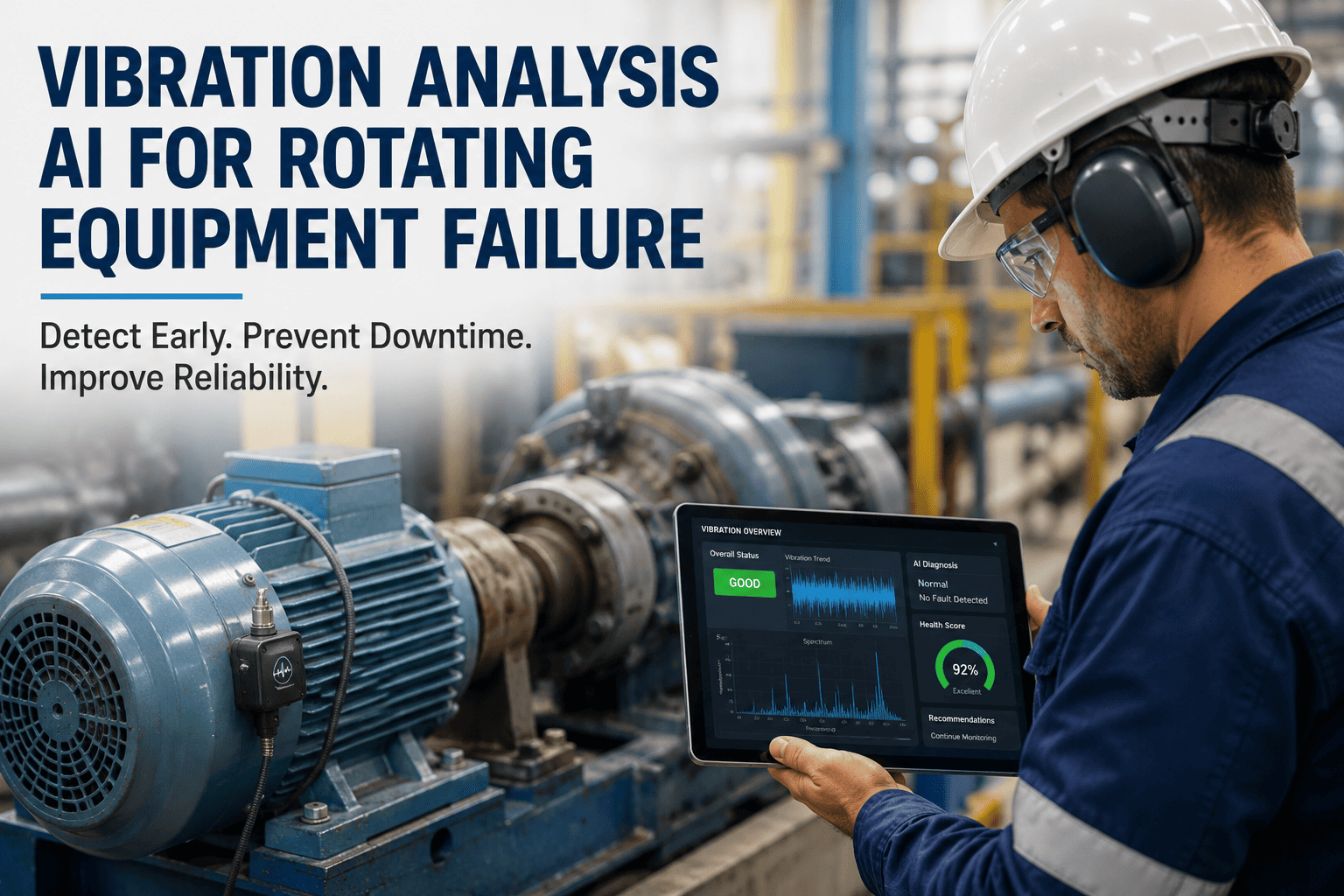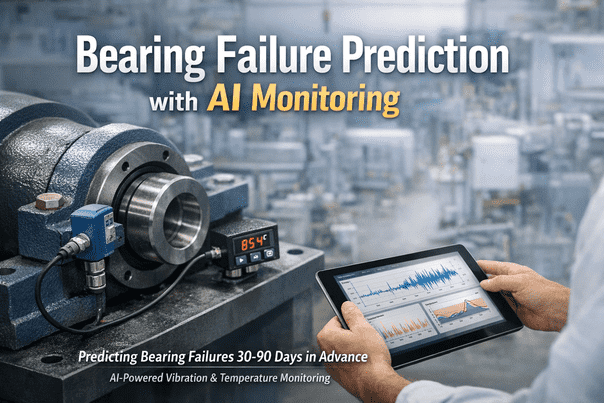
Bearing failures cause 40 to 50 percent of all rotating equipment breakdowns in manufacturing plants. Every motor, pump, fan, gearbox, and conveyor drive in your facility depends on bearings whose degradation is measurable, predictable, and stoppable with the right monitoring technology. iFactory's AI platform detects developing bearing faults through envelope analysis, vibration trending, and temperature correlation up to 90 days before failure. Manufacturing plants running iFactory have eliminated the majority of bearing-related emergency stoppages and shifted bearing replacement from reactive to fully planned interventions. Book a free bearing risk assessment for your plant today.
iFactory predicts bearing failures 30 to 90 days in advance by monitoring bearing defect frequencies through continuous envelope analysis at BPFI, BPFO, BSF, and FTF frequencies, combined with temperature trending and vibration overall level tracking. The AI detects Stage 1 bearing degradation automatically, generates a condition-based work order, and pre-stages replacement parts from inventory before the bearing progresses to a failure-risk stage.
The Four-Stage Bearing Failure Progression
Every bearing failure follows a predictable degradation path. Understanding which stage each monitored bearing occupies determines the urgency and type of maintenance intervention required. iFactory tracks all four stages simultaneously for every bearing in your monitored asset population.
Microscopic subsurface cracks begin forming in the bearing raceway or rolling elements. No external symptoms are visible. The only detectable signal is high-frequency stress waves in the ultrasonic range, appearing as elevated kurtosis and early-stage envelope analysis signals at bearing defect frequencies. Standard vibration velocity measurements remain below ISO alarm thresholds.
Pitting and spalling begin on the raceway surface. Bearing defect frequencies become clearly visible in envelope analysis, with harmonics of BPFI or BPFO appearing in the spectrum. Overall vibration begins rising. Temperature may show a 2 to 5 degree Celsius increase above the established baseline for this machine at its current operating load.
Spalling has extended across the raceway. Bearing defect frequencies now appear in the standard velocity spectrum without needing envelope analysis. Overall vibration levels may approach ISO Zone C alarm thresholds. Temperature rise accelerates. Noise becomes audible in some cases. The defect is now visible to conventional threshold monitoring, but iFactory would have been alerting since Stage 1.
The raceway and rolling elements have extensive damage. Vibration is high and broadband, with the specific bearing defect frequencies becoming harder to distinguish as the entire spectrum elevates. Temperature has risen 10 degrees Celsius or more above baseline. Audible noise is significant. Seizure or catastrophic failure is imminent. Emergency shutdown is the only safe option if replacement has not occurred.
Conventional DCS threshold alarms trigger at Stage 3 or Stage 4 only. By that point, emergency replacement is often unavoidable, parts are not pre-staged, and production loss has already begun.
iFactory's AI envelope analysis fires at Stage 1, giving 30 to 90 days of planning time. Replacement becomes a scheduled 4-hour planned maintenance event instead of a multi-day emergency stoppage.
The 6 Root Causes of Bearing Failure
Predicting bearing failure is only half the solution. iFactory's root cause analysis module identifies which failure cause is driving each bearing's degradation, so maintenance teams can address the underlying condition, not just replace the bearing and repeat the cycle.
The single largest cause of bearing failures globally. Insufficient lubricant film allows metal-to-metal contact, accelerating fatigue. iFactory monitors bearing temperature and vibration signatures characteristic of lubricant starvation: elevated temperature with high-frequency vibration and reduced low-frequency content. The AI distinguishes lubrication failure from overloading through the temperature-to-vibration ratio analysis.
Particulate contamination (dirt, metal particles, process fluids) damages bearing surfaces through abrasion and false brinelling. Moisture contamination causes corrosion pitting. Contamination produces characteristic vibration signatures: random high-frequency noise superimposed on bearing defect frequencies. iFactory detects contamination-driven degradation early through the kurtosis factor elevation that precedes surface damage from abrasive particles.
Improper bearing installation, incorrect shaft and housing fits, and damage during mounting create stress concentrations that dramatically shorten bearing life. Installation errors often cause immediate Stage 2 or Stage 3 degradation within the first operating hours. iFactory catches these installation problems during the commissioning baseline learning period, flagging abnormal vibration signatures before they escalate to early failure.
Operating bearings beyond their rated dynamic or static load capacity accelerates fatigue exponentially. Bearing life is inversely proportional to the cube of the load ratio: doubling the load reduces bearing life by a factor of eight. iFactory monitors motor current load trending and compares it against rated operating parameters, flagging sustained overload conditions before they translate into accelerated bearing fatigue and premature failure.
Bearings that have operated correctly within their rated parameters will eventually reach their fatigue life limit. iFactory's remaining useful life model tracks cumulative fatigue exposure based on operating load and speed history, predicting the expected remaining service life of each monitored bearing. This allows calendar-based replacements to be replaced with load-adjusted, data-driven replacement schedules that neither waste serviceable bearing life nor run bearings past their calculated fatigue limit.
Variable frequency drives can induce shaft currents that arc through bearing rolling elements, creating characteristic washboard pitting (fluting) on the raceway. Fluting produces a distinctive high-frequency vibration signature at non-integer multiples of running speed. iFactory specifically monitors for the electrical fluting signature in VFD-driven motor bearings, providing early detection of this failure mode that is completely invisible to temperature-only monitoring systems.
iFactory's envelope analysis fires 30 to 90 days before your DCS threshold alarm would ever trigger. Every bearing in your critical asset population monitored continuously. Work orders generated automatically.
iFactory Bearing Monitoring Technology Stack
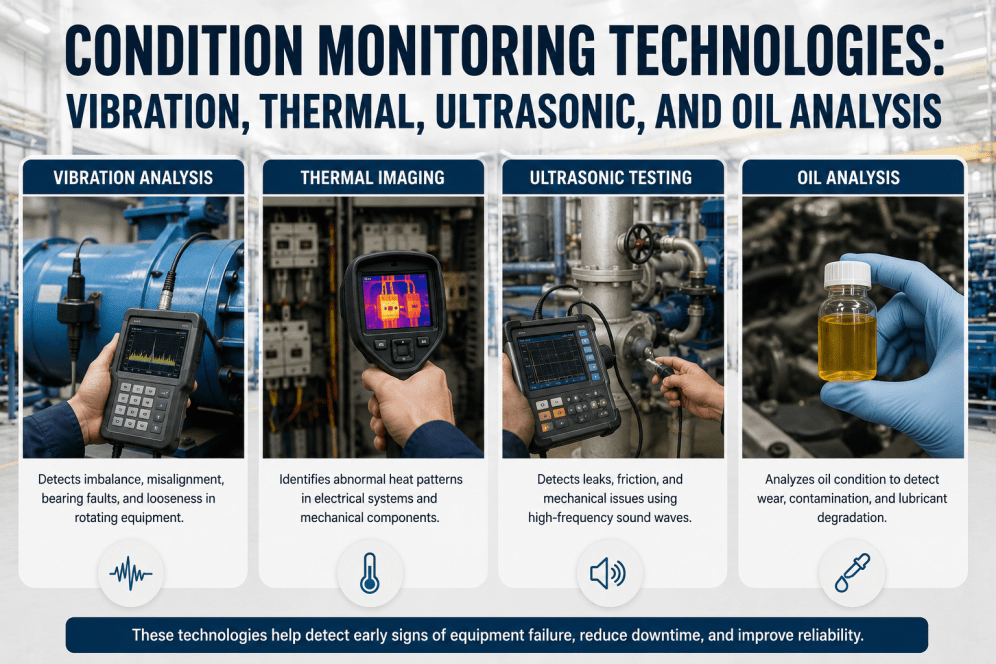
Four complementary monitoring techniques applied simultaneously across every monitored bearing, providing complete degradation coverage from Stage 1 through Stage 4. Book a demo to see all four techniques configured for your bearing population.
High-frequency vibration is filtered, envelope-detected, and FFT-analyzed to extract bearing defect frequencies buried in low-frequency machine noise. iFactory calculates BPFI, BPFO, BSF, and FTF automatically from the bearing model in your asset register, then tracks amplitude at each frequency continuously. The earliest possible warning method for rolling element bearing degradation.
Overall vibration RMS (root mean square velocity) is tracked against ISO 10816 machine class alarm thresholds and against the machine's individual baseline. Kurtosis measures the impulsiveness of the vibration signal, rising sharply with bearing impact severity at Stages 1 and 2 before the RMS level rises significantly. Together, RMS and kurtosis trend data provide a multi-parameter view of bearing degradation progression.
Bearing housing temperature is monitored continuously and compared against the load-adjusted baseline for the current operating conditions. A 2 to 5 degree Celsius rise above the load-adjusted baseline indicates increased friction from lubrication degradation or early contact. A 10 degree rise is a critical alert. iFactory correlates temperature against vibration to distinguish bearing faults from ambient temperature changes and process load variations.
iFactory's AI RUL (Remaining Useful Life) model integrates envelope analysis amplitude trend, kurtosis trajectory, temperature rise rate, and operating load history to project each bearing's expected remaining service life. The RUL estimate is updated continuously as new data arrives, providing a maintenance window projection that narrows as degradation accelerates, ensuring work orders are generated with sufficient lead time for parts procurement and shutdown planning.
Investment vs Return: Bearing Monitoring with iFactory
Every bearing failure iFactory prevents delivers measurable financial value. The numbers below are based on actual iFactory deployments in manufacturing plants, not theoretical projections.
| Value Source | Reactive Bearing Replacement | iFactory Planned Replacement | Saving per Event |
|---|---|---|---|
| Bearing replacement cost | $800-$5,000 (emergency premium pricing) | $400-$2,500 (standard pricing, planned order) | 30-50% parts cost saving |
| Production downtime cost | 8-24 hours unplanned (parts sourcing + repair) | 3-4 hours planned (parts pre-staged) | 5-20 hours of production time recovered |
| Secondary damage | Shaft damage, housing damage, coupling impact ($5,000-$50,000) | No secondary damage (bearing replaced before seizure) | $5,000-$50,000 secondary damage avoided per event |
| Emergency labor cost | Overtime rates, contractor callout, weekend premium | Standard labor rate, planned shift allocation | 40-60% labor cost reduction per event |
| Compliance documentation | Incident report, root cause investigation, manual records | Auto-generated work order with full audit trail | 2-4 hours of administrative time saved per event |
| Total per prevented failure | $20,000 - $200,000+ (including production loss) | $5,000 - $20,000 (planned intervention) | $15,000 - $180,000 value per prevented failure |
iFactory vs Competing Bearing Monitoring Platforms
The bearing monitoring market ranges from single-sensor hardware to enterprise APM platforms. iFactory uniquely combines sensor deployment, multi-parameter AI analysis, automatic work order generation, and on-premise data security in a single deployable system. Book a demo to compare iFactory against your current bearing monitoring approach.
| Capability | iFactory | TRACTIAN | Augury | Siemens Insights Hub | MaintainX | Fiix (Rockwell) | C3 AI Mfg | Limble CMMS |
|---|---|---|---|---|---|---|---|---|
| Bearing Detection Capability | ||||||||
| Stage 1 envelope analysis | BPFI/BPFO/BSF/FTF auto-calculated | Yes | Yes | Partial | No sensor layer | No sensor layer | Via connectors | No sensor layer |
| Temperature correlation with vibration | Load-adjusted thermal + vibration fusion | Yes | Yes | Partial | No | No | Data source dependent | No |
| Remaining useful life (RUL) estimate | Multi-parameter RUL model | Basic RUL | Yes | Selected assets | No | No | Model dependent | No |
| Root cause identification | 6 failure cause signatures detected | Basic | Basic | No | No | No | Via models | No |
| Maintenance Operations | ||||||||
| Auto work order with parts pre-staging | Full WO: fault, action, parts list | Alert only | Alert only | Via SAP PM | Yes | Yes | Via CMMS | Yes |
| On-premise: no cloud dependency | Full on-premise AI | Cloud primary | Cloud primary | Cloud or hybrid | Cloud SaaS | Cloud SaaS | Cloud primary | Cloud SaaS |
| Deployment to first alert | 14-21 days | 4-8 weeks | 6-12 weeks | 3-6 months | Days | Days | 6-12 months | Days |
Based on publicly available documentation as of Q1 2025. Verify capabilities with each vendor before procurement decisions.
Regional Compliance: Bearing Maintenance Records
iFactory's bearing monitoring audit trail provides the documentation required by every major manufacturing compliance framework. No manual record compilation before audits.
| Region | Key Standards | Bearing Maintenance Requirement | iFactory Coverage |
|---|---|---|---|
| USA | OSHA 1910 / API 670 (vibration monitoring) / API 689 (mechanical integrity) / NFPA 70B / ISO 55001 | PSM mechanical integrity program records, API 670 vibration monitoring logs for rotating equipment, NFPA 70B predictive maintenance documentation | OSHA PSM records, API 670 bearing monitoring logs, NFPA 70B PM documentation, ISO 55001 audit trail |
| UAE | ADNOC Asset Integrity / AGES rotating equipment / API 670 / ISO 55001 / UAE Vision 2030 reliability standards | Bearing condition monitoring evidence per ADNOC/AGES, rotating equipment maintenance records, asset integrity assurance documentation for audits | ADNOC-aligned bearing monitoring records, AGES rotating equipment evidence, ISO 55001 decision trail, Arabic platform available |
| UK | PUWER 1998 / HSE COMAH / BS EN ISO 10816 / ISO 55001 / EAW Regulations (vibration exposure) | PUWER safe plant inspection records, COMAH major hazard bearing maintenance evidence, EAW worker vibration exposure records where applicable | PUWER maintenance audit trail, COMAH bearing records, ISO 55001 documentation, worker exposure monitoring data |
| Canada | CSA Z1000 / OHS Provincial Acts / Ontario Regulation 851 / ISO 55001 / CSA-API 670 adoption | OHS-compliant rotating equipment maintenance records, bearing monitoring documentation for provincial inspection, CSA Z1000 PM program evidence | CSA Z1000 records, provincial OHS documentation, bilingual platform (EN/FR), ISO 55001 audit trail |
| Germany / EU | EU Machinery Directive / BetrSichV / DGUV / DIN ISO 10816 / GDPR / IEC 62443 OT security / ISO 55001 | BetrSichV operational safety records, DIN ISO 10816 compliance documentation, GDPR-compliant maintenance data handling, ATEX bearing inspection evidence | EU data residency option, GDPR-compliant architecture, BetrSichV bearing maintenance records, IEC 62443 OT security compliance |
| Australia | WHS Act / AS/NZS ISO 10816 / Safe Work Australia / State mining OHS Acts / ISO 55001 | WHS plant inspection records, bearing monitoring documentation for high-risk plant, Safe Work Australia reporting requirements, state mining bearing maintenance records | WHS-compliant bearing maintenance records, AS/NZS inspection documentation, ISO 55001 audit trail, state mining compliance support |
iFactory's immutable bearing monitoring and work order audit trail provides OSHA, ADNOC, PUWER, BetrSichV, and ISO 55001 compliance documentation automatically. Audit packages assemble in under 2 hours, not 3 days of manual record collection.
Results: Manufacturing Plants Running iFactory Bearing Analytics
Average reduction in unplanned stoppages from bearing failures across iFactory manufacturing plant deployments over 12 months, compared to pre-deployment baseline.
Average time between first iFactory AI bearing alert and confirmed fault requiring replacement, providing planning time for parts procurement and scheduled shutdown.
Measured accuracy across Stage 1 through Stage 3 bearing fault identification, including fault type classification (outer race, inner race, rolling element, cage) after baseline learning period.
Condition-based replacement at Stage 2 degradation rather than calendar-based replacement extends average bearing service life by 60% across the monitored population.
Early Stage 1 or 2 intervention replaces bearing at standard cost with planned labor, versus emergency replacement at 3 to 5 times higher total cost from rush parts and unplanned downtime.
Every sensor reading, AI alert, work order, and maintenance action timestamped in iFactory's immutable audit trail, providing complete OSHA, ADNOC, PUWER, and ISO 55001 compliance records automatically.
Frequently Asked Questions
Continue Reading
Every bearing in your plant is producing vibration, thermal, and current signatures that encode its degradation stage. iFactory captures those signals continuously, identifies the fault stage and likely cause, and delivers a maintenance recommendation with specific replacement timing well before any threshold alarm fires.