Electric motors consume 70 percent of all industrial energy in a typical manufacturing plant and drive every critical process from conveyor systems to pump stations, compressors, and production machinery. When a motor fails without warning, the production line stops. When motor health degrades slowly, energy costs climb and downstream equipment suffers cumulative damage. iFactory's AI platform monitors motor health through four simultaneous data streams: Motor Current Signature Analysis (MCSA), continuous vibration envelope analysis, thermal imaging integration, and insulation resistance trending. Manufacturing plants running iFactory have eliminated over 85 percent of motor-related unplanned stoppages within 12 months of deployment. Book a free motor health assessment for your plant.
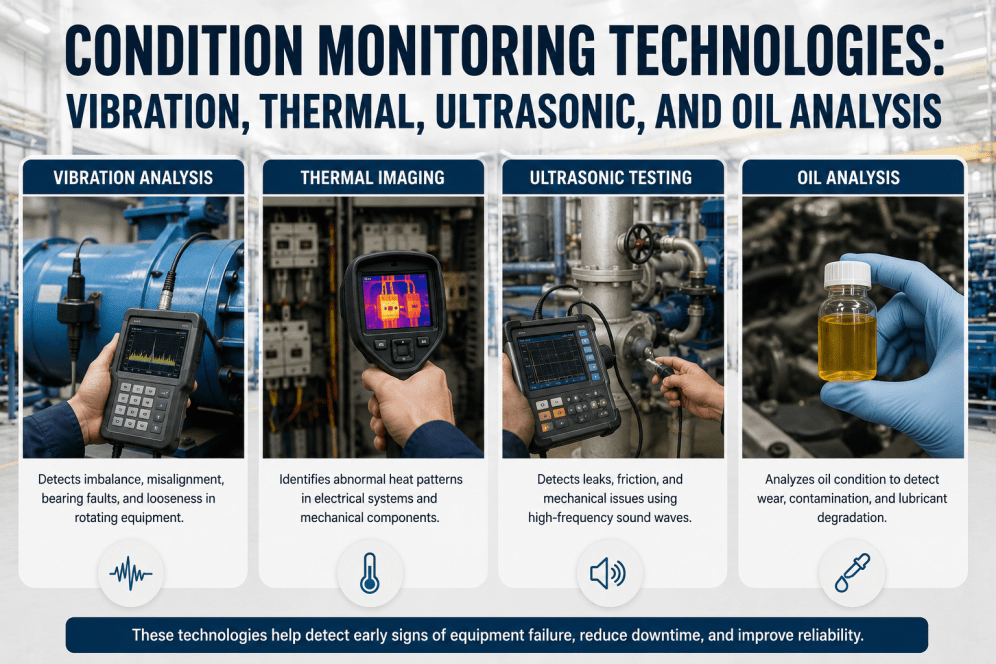
iFactory monitors electric motor health through four integrated data streams: MCSA detects rotor bar breaks, stator faults, and bearing defects via current frequency analysis; vibration envelope analysis tracks bearing degradation at BPFI/BPFO/BSF/FTF; thermal imaging monitors winding and bearing temperatures; insulation resistance trending detects gradual winding insulation degradation. All four streams feed a single AI model that generates condition-based work orders automatically when motor fault signatures emerge.
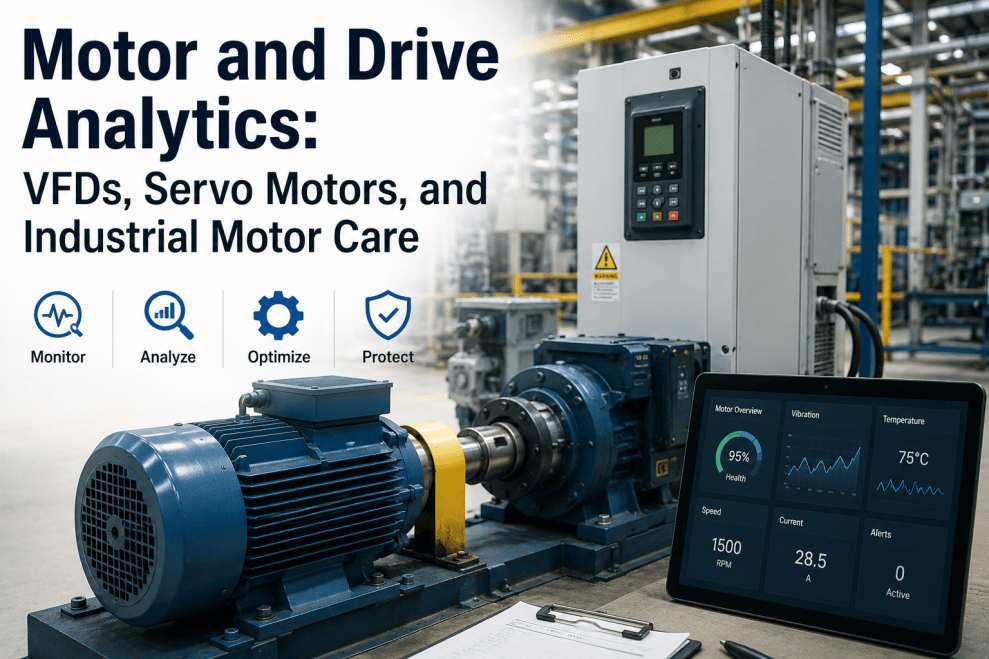
iFactory Motor Health Dashboard: 4 Monitoring Streams, 1 AI Score
Rather than four separate monitoring systems requiring four separate analyst reviews, iFactory fuses all four motor health data streams into one AI health score per motor, updated continuously. Book a demo to see the motor health dashboard live across your motor population.
High-resolution current spectrum analysis at up to 50,000 samples per second. Detects rotor bar breaks, stator inter-turn faults, bearing defect signatures, air gap eccentricity, and load variation anomalies without any mechanical sensor contact with the motor. One MCSA sensor per motor, clipped to the power cable in 5 minutes without motor shutdown.
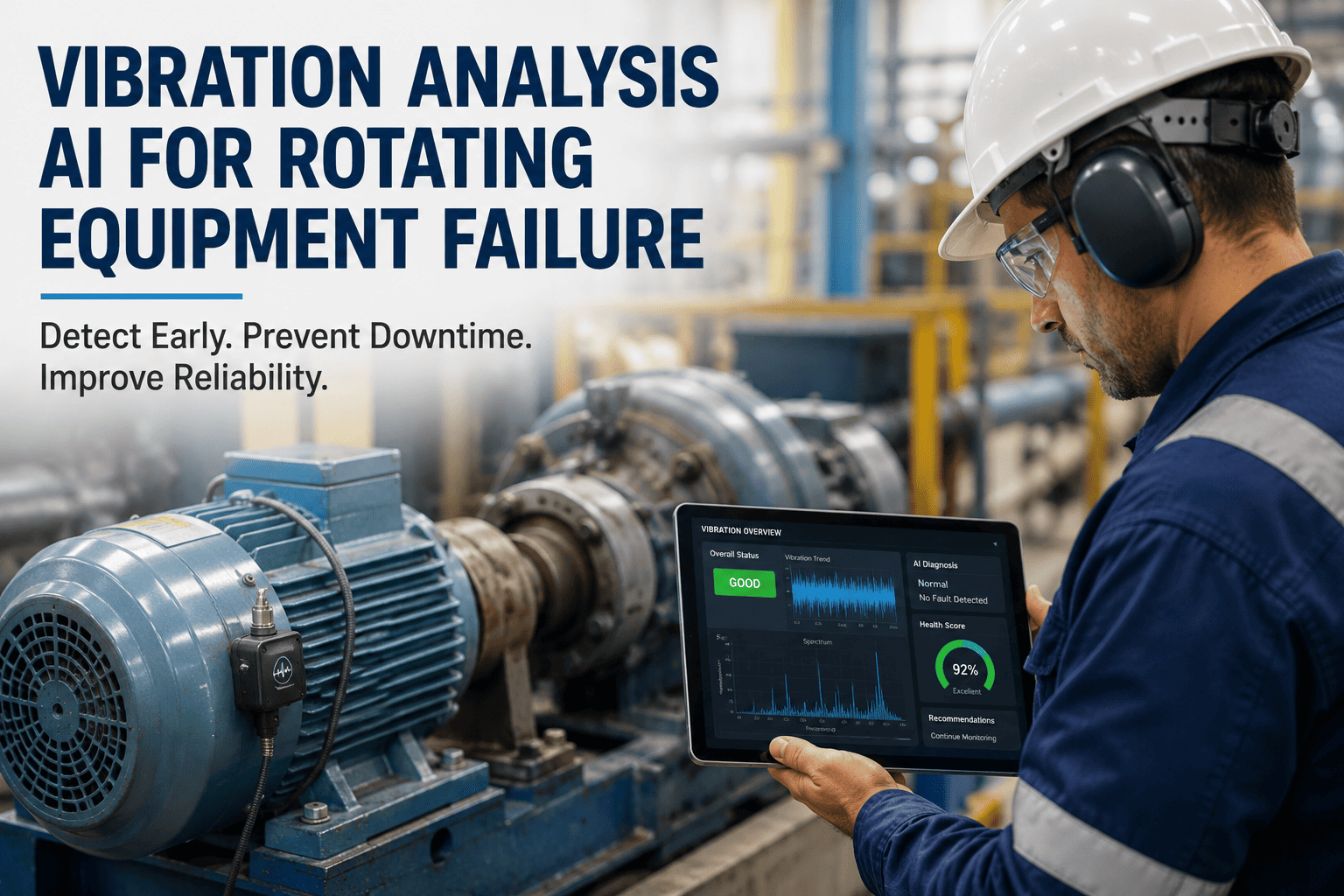
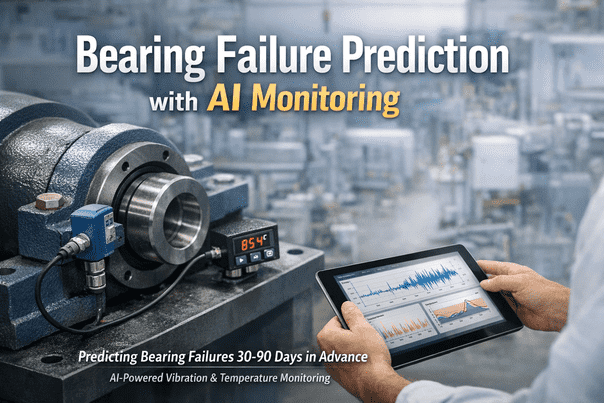
Tri-axial wireless accelerometers at motor drive end and non-drive end bearing housings monitor vibration in horizontal, vertical, and axial directions. Envelope analysis extracts bearing defect frequencies (BPFI, BPFO, BSF, FTF) calculated automatically from the installed bearing model. Detects Stage 1 bearing degradation 30 to 90 days before failure, earlier than current-based monitoring alone.
Non-contact infrared or contact RTD temperature monitoring at motor housing and bearing housings, compared against the load-adjusted baseline for current operating conditions. Every 10 degrees Celsius above the insulation class design temperature halves motor winding insulation life. iFactory correlates temperature against current load to distinguish true thermal degradation from ambient temperature variation.
Insulation Resistance (IR) and Polarization Index (PI) test results from scheduled testing are integrated into iFactory's motor health record and trended over time. A Polarization Index below 2.0 for a Class F or Class H motor indicates insulation needing investigation. iFactory tracks IR values per motor across every test, automatically flagging declining trends before they reach critical levels requiring emergency rewind or replacement.
The 5 Motor Failure Modes iFactory Identifies
Each motor failure mode requires different detection techniques. iFactory applies all monitoring streams simultaneously and identifies the specific failure mode driving each alert, so your team knows what to fix, not just that something is wrong.
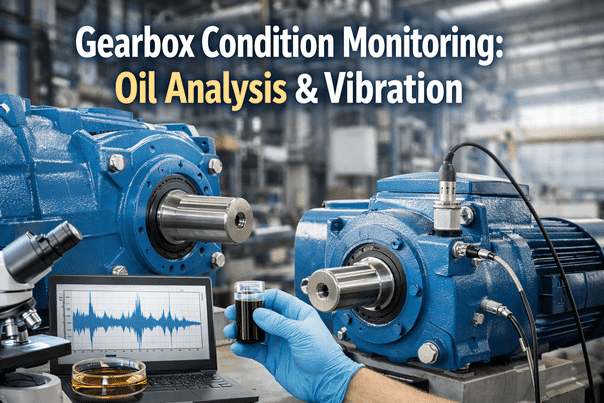
Drive end and non-drive end motor bearings fail from contamination, inadequate lubrication, electrical fluting from VFD shaft currents, and end-of-life fatigue. iFactory monitors motor bearing health through vibration envelope analysis at BPFI, BPFO, BSF, and FTF frequencies, combined with MCSA bearing signature detection in the current spectrum. First detectable 30 to 90 days before failure. A single motor bearing failure prevented covers multiple months of monitoring platform cost.
Gradual insulation degradation from thermal aging, moisture ingress, voltage stress, and contamination causes inter-turn short circuits that progress to phase-to-phase or phase-to-ground faults. MCSA detects inter-turn faults through current phase imbalance tracking, insulation resistance trending detects gradual insulation deterioration, and thermal monitoring identifies localized hot spots from winding damage. Early intervention enables targeted rewind rather than full motor replacement.
Motor to load misalignment creates cyclic bearing loading that accelerates bearing fatigue and produces elevated vibration at 2x running speed in the axial direction. Rotor imbalance from erosion, buildup, or assembly error produces a dominant 1x radial peak. Both conditions worsen over time if not corrected. iFactory distinguishes misalignment from imbalance through phase analysis across the motor drive end and load coupling measurement points, providing the specific correction guidance needed for each condition.
Broken rotor bars in squirrel cage induction motors create characteristic sidebands in the current spectrum at frequencies of (1 +/- 2s) times the supply frequency, where s is the motor slip. MCSA detects single broken rotor bars before adjacent bars fail, allowing repair during planned maintenance rather than emergency replacement after cascading bar failure causes complete rotor damage. Rotor bar breaks are completely invisible to vibration-only monitoring at early stages, making MCSA essential for this failure mode.
Voltage imbalance as small as 3.5 percent can cause motor temperature rise of 25 percent above rated, dramatically reducing insulation life. VFD-induced shaft currents cause electrical fluting damage to motor bearings. Harmonic distortion from nonlinear loads increases motor losses and temperature. iFactory monitors motor supply voltage quality and VFD output characteristics, flagging power quality issues that cause premature motor failure before cumulative thermal damage reaches critical levels.
iFactory deploys MCSA sensors, wireless vibration sensors, and thermal probes across your critical motor population in 7 to 14 days without any motor shutdown. First AI fault alerts fire within 21 days of sensor deployment completion.
MCSA Fault Signatures: What iFactory Reads in Motor Current
Motor Current Signature Analysis extracts mechanical and electrical fault information from the motor's supply current without any mechanical sensors. The current waveform carries a complete diagnostic record of the motor's internal condition at every moment it is running.
| Fault Type | MCSA Fault Frequency | Detection Sensitivity | First Detectable | iFactory Action |
|---|---|---|---|---|
| Broken Rotor Bars | (1 +/- 2s) x f_supply (s = slip) | High: Single bar break detectable | 14-45 days before cascade failure | Alert with rotor bar count estimate and planned rewind recommendation |
| Stator Inter-Turn Fault | Supply frequency harmonics + current phase imbalance ratio | High: Phase imbalance as small as 1.5% flagged | Weeks to months before phase-to-phase fault | Insulation resistance test scheduled. Rewind urgency classified by imbalance rate of change |
| Bearing Defect (via current) | Bearing defect frequencies appear as current modulation sidebands | Medium: Complements vibration envelope analysis | Stage 2-3 bearing degradation (7-30 days before failure) | Combined with vibration alert for confidence-weighted bearing fault classification |
| Air Gap Eccentricity | f_supply +/- n x f_rotor (static and dynamic eccentricity) | High: Static vs dynamic eccentricity distinguished | Detectable at any severity level during normal operation | Eccentricity severity score with maintenance recommendation based on bearing load impact |
| Shaft Misalignment (via current) | 2x running speed appears in current spectrum with axial vibration elevation | Medium: Confirmed with vibration phase analysis | Detectable as developing condition from installation | Misalignment severity score with shaft alignment correction task generated |
| Load Variation and Overload | Current draw vs. rated FLA and load trending over time | High: Load creep of 2% above baseline triggers alert | Detectable in real time as load increases above baseline | Load trending alert with energy efficiency impact quantified in kWh and cost per month |
iFactory Motor Monitoring Deployment: From Motors to AI Alerts in 21 Days
Five structured deployment steps, no motor shutdown at any stage. iFactory's engineers provide the sensor placement plan and handle integration setup for your PLC and SCADA systems. Book a demo to receive your plant-specific motor monitoring deployment plan.
Motor population classified by production criticality, power rating, failure consequence, and spare availability. The critical 20 to 30 percent of motors that drive 80 percent of downtime risk are prioritized for immediate sensor deployment.
MCSA sensors clip to motor power cables in under 5 minutes each. Wireless vibration sensors mount at bearing housings magnetically during shift changeovers. Thermal probes install at motor housing. No disassembly, no electrical work, no production impact.
iFactory AI builds motor-specific health baselines across all operating load states, production modes, and ambient conditions. MCSA fault frequency libraries are activated per motor using the bearing model and gear specifications in the asset register. Alert thresholds activate automatically at baseline completion.
AI fault alerts generate automatically when motor health scores deviate from established baselines. Each alert includes the motor ID, fault type, affected component, severity, and a pre-populated work order with recommended action and parts list from inventory. Maintenance team mobile app notification fires simultaneously.
Fleet-level motor health analytics identify systematic patterns: power quality problems affecting motor groups, lubrication practices causing accelerated bearing wear across a production zone, or motor overloading from process changes. Energy efficiency dashboard quantifies motor energy waste from degradation conditions in kWh and cost per month per motor.
iFactory vs Competing Motor Analytics Platforms
Most monitoring platforms cover vibration only, or MCSA only, or thermal only. iFactory unifies all four motor monitoring streams into one AI model without requiring three separate platforms or a specialist analyst to correlate the data. Book a demo to benchmark iFactory against your current motor monitoring approach.
| Capability | iFactory | TRACTIAN | Augury | Siemens Insights Hub | Fracttal | MaintainX | Fiix (Rockwell) | Limble CMMS |
|---|---|---|---|---|---|---|---|---|
| Motor Monitoring Capability | ||||||||
| MCSA: rotor bar and stator fault detection | Full MCSA: bars, stator, eccentricity | Yes | Partial | Siemens motors only | No | No sensor layer | Via Rockwell drives | No sensor layer |
| Vibration envelope (BPFI/BPFO/BSF/FTF) | Auto-calculated per bearing model | Yes | Yes | Partial | No | No | Via add-on | No |
| Insulation resistance (IR/PI) trending | Integrated IR/PI records and trending | Manual entry | Manual entry | Via integration | Manual entry | Manual records | Manual records | Manual records |
| Thermal + MCSA + vibration fusion in one model | All 3 in one AI health score | Yes | Yes | Partial | No | No | Partial | No |
| Maintenance Operations and Deployment | ||||||||
| Auto work order with parts pre-staging | Full WO: fault, action, parts, priority | Alert only | Alert only | Via SAP PM | Yes | Yes | Yes | Yes |
| VFD-aware motor analysis | Full VFD-aware MCSA and vibration | Yes | Yes | Yes (Siemens drives) | No | No sensor layer | Rockwell VFDs | No sensor layer |
| On-premise: no cloud dependency | Full on-premise AI | Cloud primary | Cloud primary | Cloud or hybrid | Cloud SaaS | Cloud SaaS | Cloud SaaS | Cloud SaaS |
Based on publicly available documentation as of Q1 2025. Verify capabilities with each vendor before procurement decisions.
Regional Compliance: Motor Maintenance Records
iFactory's motor monitoring documentation provides the maintenance records required by every major manufacturing compliance framework across your operating regions.
| Region | Key Standards | Motor Maintenance Requirement | iFactory Coverage |
|---|---|---|---|
| USA | OSHA 1910 / NFPA 70B / IEEE 43 (insulation resistance) / NEMA MG-1 / API 670 (rotating equipment) / ISO 55001 | Documented electrical PM program per NFPA 70B, insulation resistance records per IEEE 43, OSHA PSM mechanical integrity documentation for covered motors | NFPA 70B PM records, IEEE 43 IR/PI trending logs, OSHA PSM mechanical integrity evidence, ISO 55001 decision audit trail |
| UAE | ADNOC Asset Integrity Standards / AGES rotating equipment / IEC 60034 / IEEE 43 / ISO 55001 / UAE Vision 2030 | Motor condition monitoring records per ADNOC/AGES, insulation class compliance documentation, rotating equipment maintenance evidence for asset integrity audits | ADNOC-aligned motor monitoring records, AGES compliance documentation, ISO 55001 decision trail, Arabic platform available, ICV reporting data |
| UK | PUWER 1998 / BS EN 60034 / IET Code of Practice for Electrical PM / ISO 55001 / EAW vibration regulations | PUWER-compliant motor inspection and maintenance records, electrical PM documentation per IET Code, worker vibration exposure records where applicable | PUWER motor maintenance records, IET electrical PM documentation, ISO 55001 audit trail, worker vibration exposure monitoring data |
| Canada | CSA Z1000 / CSA C22.1 electrical code / OHS Provincial Acts / IEEE 43 / ISO 55001 | OHS-compliant motor maintenance documentation, electrical equipment maintenance records per CSA C22.1, IR testing records per IEEE 43 adoption | CSA Z1000 PM records, CSA C22.1 electrical maintenance documentation, bilingual (EN/FR) platform, ISO 55001 audit trail |
| Germany / EU | EU Machinery Directive / BetrSichV / IEC 60034 / IEC 62443 OT security / GDPR / ATEX Directive / ISO 55001 | BetrSichV operational safety records, IEC 60034 compliance evidence, ATEX motor inspection records in hazardous zones, GDPR-compliant motor data handling | EU data residency option, GDPR-compliant architecture, BetrSichV motor records, ATEX zone documentation, IEC 62443 OT security compliance |
| Australia | WHS Act / AS 1359 (rotating electrical machines) / AS/NZS 3000 / Safe Work Australia / ISO 55001 | WHS-compliant motor inspection and maintenance records, AS 1359 compliance documentation, Safe Work Australia reporting for high-risk plant motors | WHS motor maintenance records, AS 1359 compliance documentation, Safe Work inspection evidence, ISO 55001 audit trail |
iFactory's immutable motor monitoring and work order audit trail provides OSHA, ADNOC, PUWER, BetrSichV, and ISO 55001 compliance documentation without manual record compilation. Every motor health reading, alert, and maintenance action permanently timestamped and retrievable within seconds for any audit.
Results: Motor Monitoring Plants Running iFactory
Average reduction in unplanned stoppages from motor failures across iFactory manufacturing plant deployments, measured over 12 months versus pre-deployment baseline.
Average window between first iFactory AI motor alert and confirmed fault requiring intervention, providing planning time for parts procurement and scheduled maintenance.
Degraded motors drawing excess current from bearing friction, misalignment, or winding faults are identified and corrected. Plants typically recover 10 to 20 percent of motor energy costs within 12 months of iFactory deployment.
Condition-based motor service replaces components when data shows actual need, extending average motor service life by 60 percent compared to calendar-based replacement programs that over-replace healthy motors.
Early fault detection enables targeted motor rewind or bearing replacement at standard cost versus emergency replacement at 3 to 5 times higher total cost from rush parts and unplanned production loss.
Every sensor reading, AI alert, work order, and maintenance action permanently timestamped in iFactory's immutable audit trail, providing complete OSHA, ADNOC, PUWER, and ISO 55001 compliance records without manual compilation.
Frequently Asked Questions
Continue Reading
Every motor in your plant is already producing current, vibration, and thermal signatures that predict its failure trajectory weeks in advance. iFactory captures those signals, interprets them using four integrated monitoring techniques, and delivers specific maintenance recommendations without requiring your team to become motor diagnostics specialists.