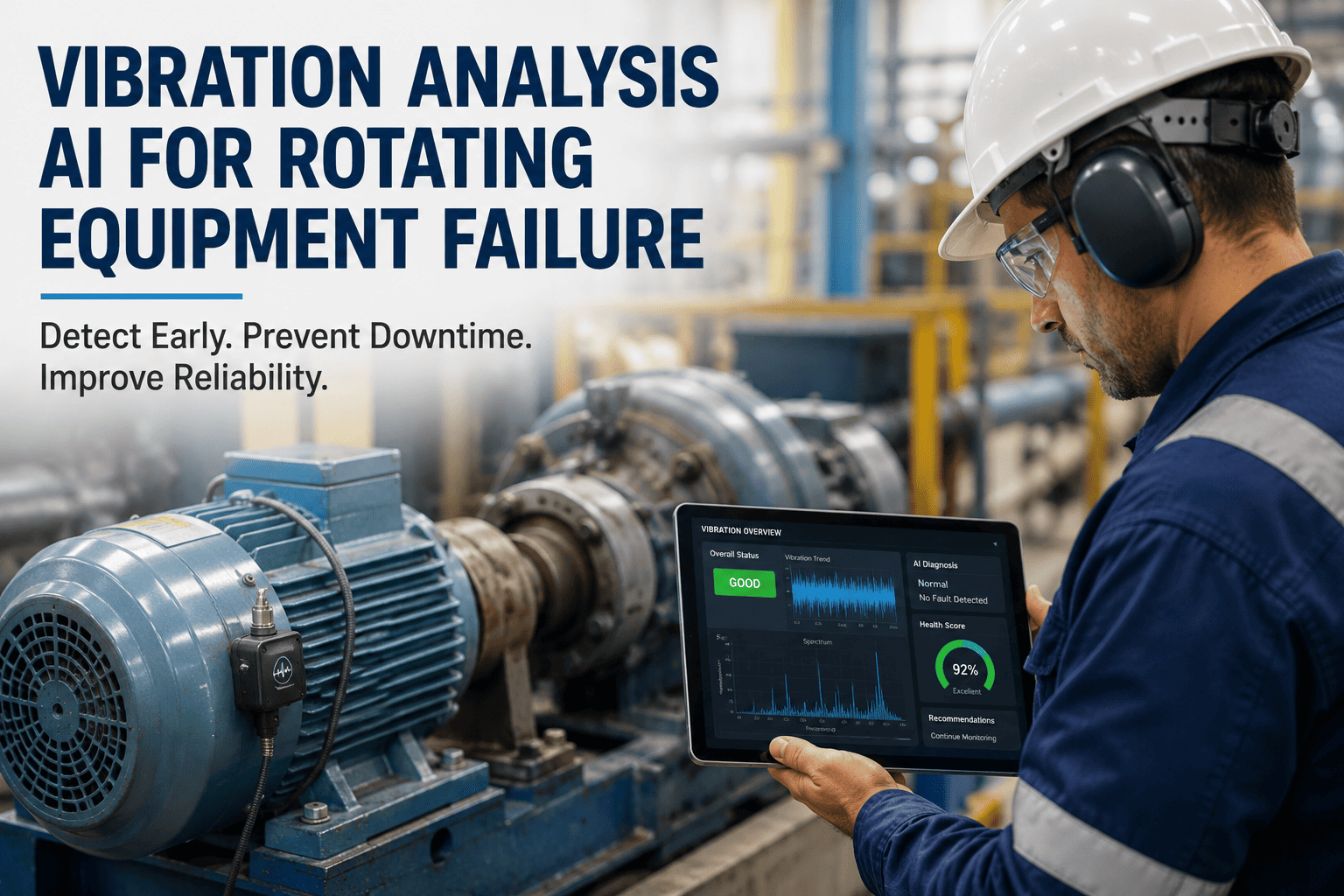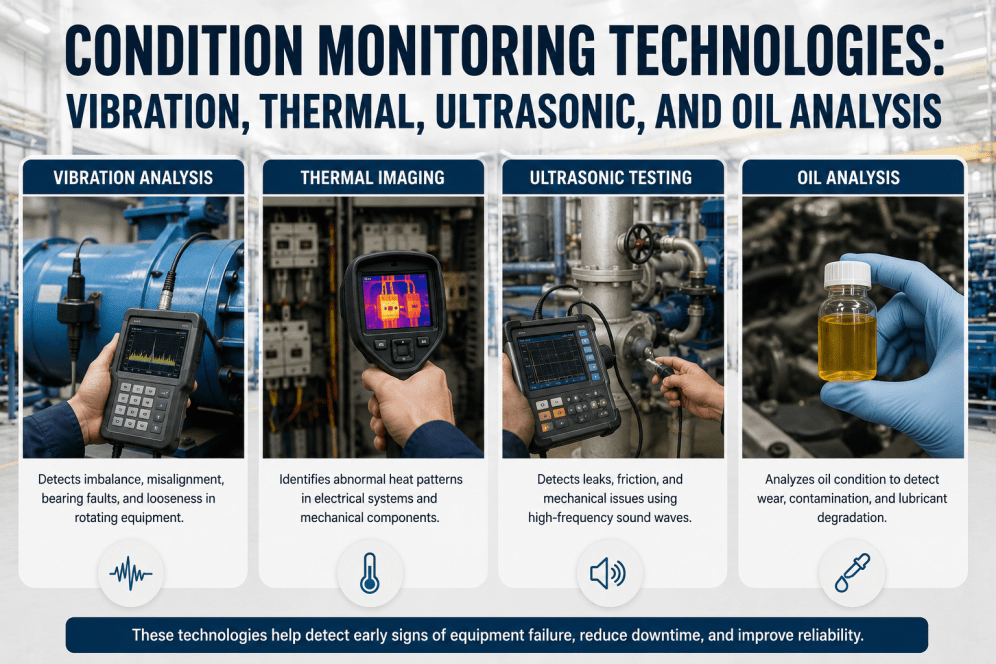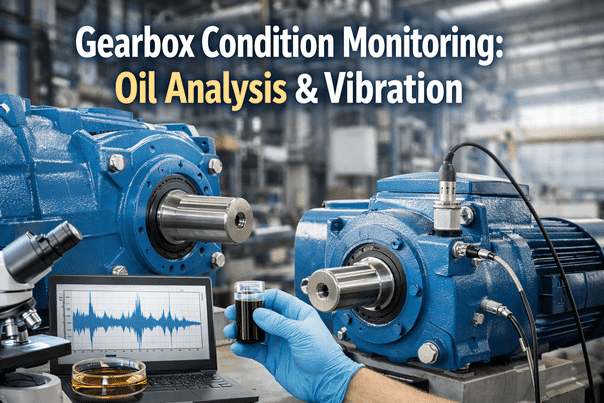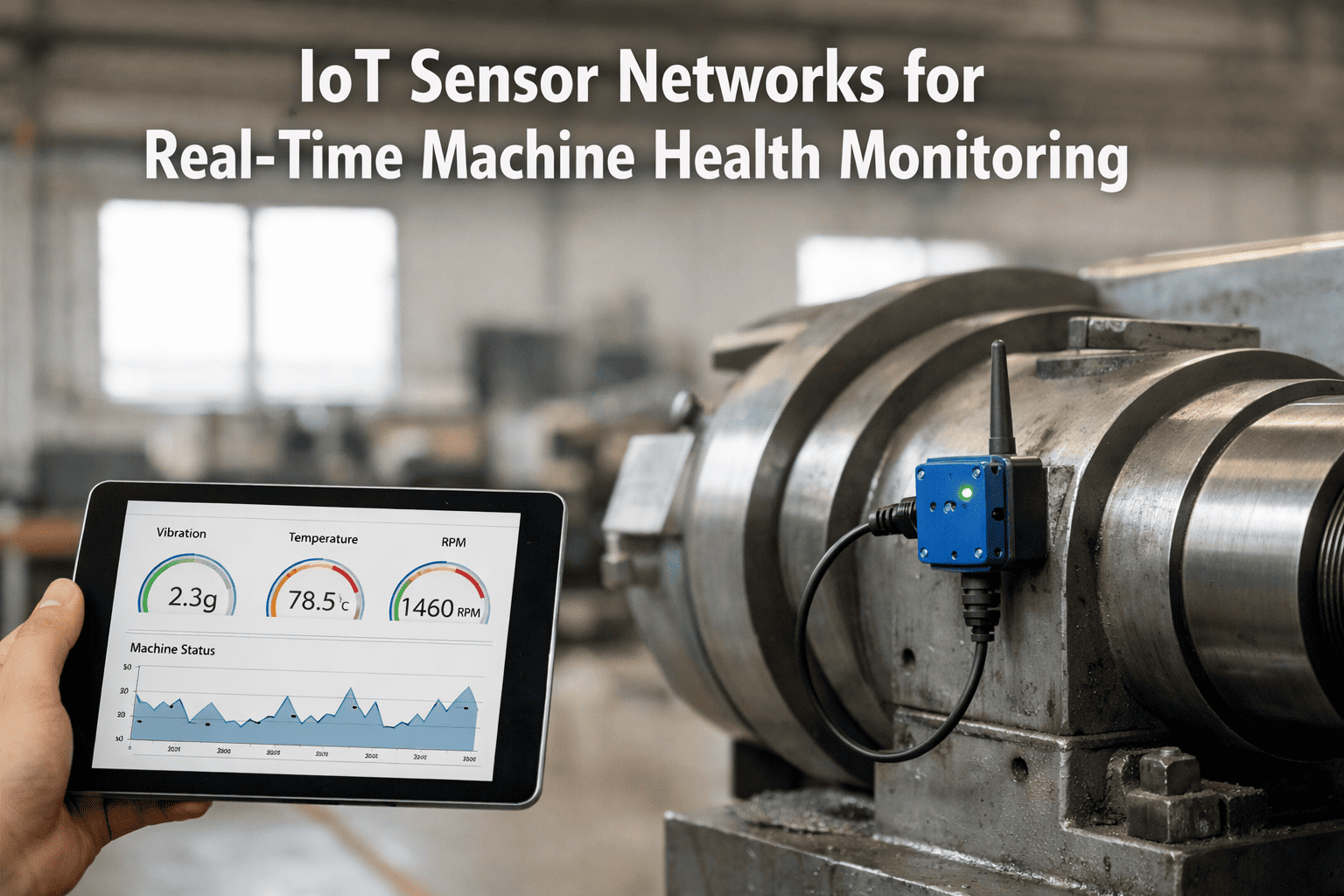
Vibration analysis is the most widely deployed predictive analytics technique in manufacturing — and for good reason. Every rotating machine generates a vibration signature that encodes the mechanical health of its bearings, shafts, gears, and support structures. When a bearing begins to degrade, its defect frequencies appear in the vibration spectrum weeks before any threshold alarm fires. When a shaft is misaligned, a characteristic 2x running speed peak emerges in the radial frequency domain. When a gearbox tooth chips, the gear mesh frequency amplitude rises and sidebands appear. Knowing how to read those signatures and deploying AI to read them continuously across hundreds of machines simultaneously is the foundation of a high-performing predictive maintenance program. This guide covers the fundamentals of vibration analysis for manufacturing equipment, from ISO alarm standards through fault frequency identification, and shows how iFactory's AI platform applies these principles automatically across your plant's entire asset population. Book a free vibration monitoring assessment for your plant.
Vibration analysis detects equipment faults by measuring the frequency content and amplitude of machine vibration against ISO alarm standards and established baselines. iFactory's AI platform applies vibration analysis continuously across all monitored equipment — automatically identifying bearing defect frequencies, shaft fault signatures, and mechanical anomalies without requiring a specialist vibration analyst to review each measurement manually.
The Four Domains of Vibration Analysis
Vibration data is processed through four analytical domains — each revealing different types of fault information. iFactory applies all four simultaneously on every sensor channel, automatically surfacing the relevant domain for each fault type detected.
The raw vibration waveform plotted against time. Time domain analysis reveals impulsive events (bearing impacts, gear tooth defects), waveform shape changes (looseness, rubs), and amplitude trends. Most useful for early-stage fault identification and impact severity assessment.
Fast Fourier Transform converts the time waveform into a frequency spectrum showing amplitude at each frequency. The spectrum reveals the specific fault frequencies — 1x for imbalance, 2x for misalignment, gear mesh frequency (GMF) for gear defects, and bearing defect frequencies (BPFI, BPFO, BSF, FTF) for bearing faults.
High-frequency content is filtered, envelope-detected, and then FFT-analyzed to extract bearing defect frequencies buried in low-frequency machine noise. Envelope analysis detects bearing faults at Stage 1 and Stage 2 — weeks before they become visible in the standard vibration spectrum. This is the most sensitive early-warning tool for bearing degradation.
Overall vibration levels (RMS, peak, crest factor, kurtosis) tracked over time against ISO alarm thresholds and equipment-specific baselines. Trending reveals gradual degradation that individual spectra miss — a slowly rising 1x peak over 30 days indicates developing imbalance that no single measurement flags as alarming.
From Raw Vibration Data to Maintenance Work Order — Automatically
iFactory's AI applies all four vibration analysis domains simultaneously across every monitored asset — no specialist analyst required. Fault signatures trigger automatic work orders. Your team focuses on execution, not signal interpretation.
Your team doesn't need a vibration specialist to interpret every FFT spectrum. iFactory's AI reads the data, identifies the fault frequencies, and delivers a specific maintenance recommendation with the asset, fault type, severity, and suggested action.
ISO Vibration Alarm Standards for Manufacturing Equipment
ISO 10816 and ISO 20816 define velocity-based vibration alarm thresholds by machine class, power rating, and mounting configuration. iFactory pre-loads these standards as default alarm baselines and adjusts them per-asset based on your equipment's historical operating signature.
| Machine Class | Examples | Good (Zone A) | Satisfactory (Zone B) | Alarm (Zone C) | Danger (Zone D) | Mounting |
|---|---|---|---|---|---|---|
| Class I — Small Machines | Motors up to 15kW, small pumps, fans | 0 – 0.71 mm/s | 0.71 – 1.8 mm/s | 1.8 – 4.5 mm/s | Over 4.5 mm/s | Rigid or flexible |
| Class II — Medium Machines | Motors 15-75kW, mid-range pumps, compressors | 0 – 1.12 mm/s | 1.12 – 2.8 mm/s | 2.8 – 7.1 mm/s | Over 7.1 mm/s | Rigid mounting |
| Class III — Large Rigid | Large motors over 75kW, large pumps, heavy fans on rigid foundations | 0 – 1.8 mm/s | 1.8 – 4.5 mm/s | 4.5 – 11.2 mm/s | Over 11.2 mm/s | Rigid mounting |
| Class IV — Large Flexible | Large turbines, large generators, large rotating machinery on flexible mounts | 0 – 2.8 mm/s | 2.8 – 7.1 mm/s | 7.1 – 18.0 mm/s | Over 18.0 mm/s | Flexible mounting |
Source: ISO 10816-1 / ISO 10816-3 vibration severity zones for industrial machines. iFactory pre-loads ISO thresholds per asset class and refines them against each machine's operating baseline during the 7-21 day learning period.
Sensor Placement for Maximum Fault Detection Coverage
Correct sensor placement is the most important hardware decision in a vibration monitoring program. iFactory's deployment engineers provide equipment-specific sensor placement plans based on the machine type, bearing configuration, and failure mode priorities. Book a demo to receive a sensor placement plan for your critical equipment.
iFactory's wireless vibration sensors mount magnetically at bearing housings during shift changeovers. No wiring, no disassembly, no production stop. iFactory deployment engineers provide the exact placement plan for every machine on your critical asset list before sensor installation begins.
The 6 Vibration Fault Signatures iFactory Identifies Automatically
Each mechanical fault produces a characteristic frequency signature. iFactory's AI identifies these signatures continuously — comparing measured spectra against fault frequency libraries calculated from each machine's specific speed, bearing model, and gear tooth count. Book a demo to see iFactory's fault library configured for your equipment.
Unbalance occurs when the centre of mass does not coincide with the centre of rotation — from manufacturing tolerances, erosion, buildup, or assembly error. In the FFT spectrum, unbalance produces a dominant peak at 1x running speed in the radial (horizontal and vertical) directions. Axial vibration remains low, distinguishing unbalance from misalignment. iFactory tracks the 1x peak amplitude trend per machine — detecting gradually increasing imbalance (fan blade erosion, impeller buildup) weeks before the vibration exceeds ISO alarm thresholds.
Angular misalignment between coupled shafts produces a dominant 2x running speed peak, while parallel (offset) misalignment produces both 1x and 2x peaks with high axial vibration. Misalignment also accelerates bearing fatigue by creating cyclic loading that exceeds design radial loads. iFactory identifies misalignment through the combination of elevated 2x, high axial-to-radial ratio, and phase relationship analysis across the coupling — distinguishing misalignment from unbalance even when both faults are present simultaneously.
Mechanical looseness — from foundation bolts, bearing housing fits, or coupling looseness — produces a complex spectrum with many harmonics of running speed and often sub-synchronous components at 0.5x. The time waveform shows a clipped, asymmetric shape. Looseness is often mistaken for unbalance in a simple overall-level check, but the FFT harmonic series immediately distinguishes it. iFactory's spectrum pattern recognition identifies looseness even when other faults are superimposed on the spectrum.
Bearing defects produce impacts at specific defect frequencies determined by the bearing geometry: Ball Pass Frequency Inner race (BPFI), Ball Pass Frequency Outer race (BPFO), Ball Spin Frequency (BSF), and Fundamental Train Frequency (FTF). These non-synchronous frequencies appear first in envelope analysis at Stage 1 degradation — 30-90 days before the defect is visible in the standard velocity spectrum. iFactory calculates BPFI/BPFO/BSF/FTF automatically for every bearing model in your asset register and monitors all four frequencies continuously.
Healthy gears produce vibration at the gear mesh frequency (GMF) — the product of shaft speed and the number of teeth on the gear. Damaged gear teeth produce sidebands around GMF at the shaft running speed — with sideband amplitude proportional to the severity of tooth damage. iFactory monitors GMF amplitude, sideband patterns, and the cepstrum (a tool for identifying sideband families) to detect gear wear, eccentricity, gear tooth cracks, and pitch errors — distinguishing between localized (single tooth) and distributed (wear pattern) gear damage.
When a machine's running speed (or a harmonic of it) coincides with a structural natural frequency, resonance amplifies vibration well beyond what the force input would produce on a non-resonant structure. Resonance produces a broad vibration peak at the natural frequency that does not track linearly with speed change. iFactory identifies resonance through runup and coast-down analysis — a Bode plot showing vibration amplitude versus speed — and distinguishes resonance from force-related faults by its phase behavior during speed variation.
iFactory Vibration Analytics — Implementation Roadmap
From asset register to continuous AI-driven vibration monitoring in four structured phases. First fault alerts typically fire within 14-21 days of sensor deployment completion.
Every monitored machine registered with make, model, rated speed, bearing models (for BPFI/BPFO/BSF/FTF calculation), and gear tooth counts. ISO machine class assigned per asset for alarm threshold pre-loading.
Wireless tri-axial accelerometers mounted at each bearing housing measurement point during shift changeovers. No machine shutdown required. Sensor commissioning verified against expected amplitude range at rated speed.
iFactory's AI learns each machine's normal vibration fingerprint across all operating load states. ISO thresholds applied as the starting point, then refined per machine based on the learned baseline. Bearing defect frequency monitors activate automatically.
AI fault alerts fire when vibration signatures deviate from baselines or exceed ISO thresholds. Each alert includes fault type, affected bearing or component, severity, and auto-generated work order with recommended action and pre-staged parts list.
No vibration analyst required on your team. iFactory's AI reads every spectrum, identifies every fault frequency, and delivers a clear maintenance recommendation — so your technicians act on AI intelligence, not on decibel levels they have to interpret themselves.
iFactory vs Competing Vibration Monitoring Platforms
The vibration monitoring market spans pure sensor hardware, cloud analytics platforms, and full CMMS integrations. iFactory unifies all three layers in a single on-premise deployable system — no middleware, no separate analyst tools, no cloud data dependency. Book a demo to benchmark iFactory against your current vibration tools.
| Capability | iFactory | TRACTIAN | Augury | Fracttal | Siemens Insights Hub | SafetyCulture | Limble CMMS | MaintainX |
|---|---|---|---|---|---|---|---|---|
| Vibration Analytics | ||||||||
| Envelope / bearing defect analysis | BPFI/BPFO/BSF/FTF auto-calculated | Yes | Yes | Manual entry | Partial | No sensor layer | No sensor layer | No sensor layer |
| Gear mesh and sideband analysis | GMF + cepstrum auto-tracked | Yes | Partial | No | Partial | No | No | No |
| ISO 10816/20816 threshold pre-loading | All 4 machine classes built-in | Manual setup | Manual setup | Manual | Partial | No | No | No |
| Multi-sensor fusion (vibration + thermal + MCSA) | All 3 in one AI model | Yes | Yes | Vibration only | Partial | No | No | No |
| Integration and Operations | ||||||||
| Auto work order from vibration alert | Full WO — fault, action, parts | Alert only | Alert only | Yes (via CMMS) | Via SAP integration | Yes (inspections) | Yes | Yes |
| On-premise AI — no cloud dependency | Full on-premise | Cloud primary | Cloud primary | Cloud SaaS | Cloud / hybrid | Cloud SaaS | Cloud SaaS | Cloud SaaS |
| Deployment to first alert | 14-21 days | 4-8 weeks | 6-12 weeks | 2-4 weeks | 3-6 months | Days | Days | Days |
Based on publicly available documentation as of Q1 2025. Verify capabilities directly with each vendor before procurement decisions.
Regional Standards and Compliance — Vibration Monitoring Programs
iFactory's vibration monitoring documentation meets the maintenance record requirements for every major industrial compliance framework across your operating regions.
| Region | Key Standards | Vibration Monitoring Requirement | iFactory Documentation |
|---|---|---|---|
| USA | OSHA 1910 / NFPA 70B / API 670 (rotating equipment) / API 689 (mechanical integrity) / ISO 10816 / ISO 55001 | Documented vibration monitoring program for OSHA PSM mechanical integrity, API 670 proximity probe records, NFPA 70B predictive maintenance documentation | OSHA PSM mechanical integrity records, API 670 vibration alarm logs, NFPA 70B PM documentation, ISO 55001 audit trail |
| UAE | ADNOC Asset Integrity Standard / AGES / API 670 / ISO 10816 / ISO 20816 / ISO 55001 / UAE Vision 2030 smart manufacturing | Condition monitoring records for rotating equipment per ADNOC/AGES requirements, vibration trending evidence for asset integrity assurance, ISO 55001 maintenance decision documentation | ADNOC-aligned vibration monitoring records, AGES rotating equipment evidence, ISO 55001 decision trail, Arabic-language platform available |
| UK | PUWER 1998 / HSE COMAH Major Hazards / BS EN ISO 10816 / BS ISO 20816 / ISO 55001 / Control of Vibration at Work Regulations 2005 | PUWER-compliant vibration monitoring records demonstrating safe working condition, COMAH major hazard maintenance evidence, Control of Vibration regulations compliance for worker exposure | PUWER maintenance records, COMAH safety case evidence, worker vibration exposure records, ISO 55001 audit trail |
| Canada | CSA Z1000 / OHS Provincial Acts / CSA-ISO 10816 adoption / ISO 55001 / Transport Canada (where applicable) | OHS-compliant vibration monitoring documentation, rotating equipment maintenance records per provincial regulations, ISO 55001 asset management documentation | CSA Z1000 maintenance records, provincial OHS documentation, bilingual (EN/FR) platform, ISO 55001 audit trail |
| Germany / EU | EU Machinery Directive / BetrSichV / DGUV / DIN ISO 10816 / DIN ISO 20816 / VDI 3834 / GDPR / IEC 62443 OT security / ISO 55001 | BetrSichV operational safety records, DIN ISO 10816/20816 compliance documentation, GDPR-compliant maintenance data handling, ATEX vibration monitoring evidence for hazardous zones | EU data residency option, GDPR-compliant architecture, BetrSichV records, DIN ISO 10816 alarm threshold documentation, IEC 62443 OT security |
| Australia | WHS Act / AS/NZS ISO 10816 adoption / Safe Work Australia / AS 2205 (vibration measurement) / ISO 55001 | WHS-compliant plant inspection and maintenance records, AS 2205 vibration measurement documentation for hazardous plant, Safe Work Australia reporting for high-risk plants | WHS-compliant vibration monitoring records, AS/NZS maintenance documentation, Safe Work plant inspection evidence, ISO 55001 audit trail |
Results — Manufacturing Plants Running iFactory Vibration Analytics
Average advance warning between first envelope analysis alert and confirmed bearing fault requiring intervention — enough time for planned parts procurement and scheduled replacement.
Measured fault identification accuracy across bearing, imbalance, misalignment, looseness, gear, and resonance fault signatures after the 21-day baseline learning period completes.
Plants with iFactory vibration monitoring across their critical rotating equipment population report 83% average reduction in unplanned stoppages from vibration-related mechanical failures within 12 months.
Condition-based replacement at Stage 2-3 bearing degradation — rather than calendar-based replacement — extends average bearing and gear service life by 60% compared to fixed-interval programs.
iFactory's AI interprets every vibration spectrum, identifies every fault frequency, and delivers maintenance recommendations in plain language — no ISO Category II or III analyst required on your maintenance team.
Every vibration measurement, alarm event, work order, and maintenance action is permanently timestamped in iFactory's immutable audit trail — providing ISO 10816, OSHA, ADNOC, and PUWER compliance documentation automatically.
Frequently Asked Questions
Continue Reading
Vibration analysis is powerful — and it becomes truly transformative when applied continuously across every bearing and gear in your plant, automatically, without requiring a specialist to review each measurement. That is what iFactory delivers. Every fault frequency tracked. Every ISO threshold enforced. Every maintenance action pre-planned before the failure happens.