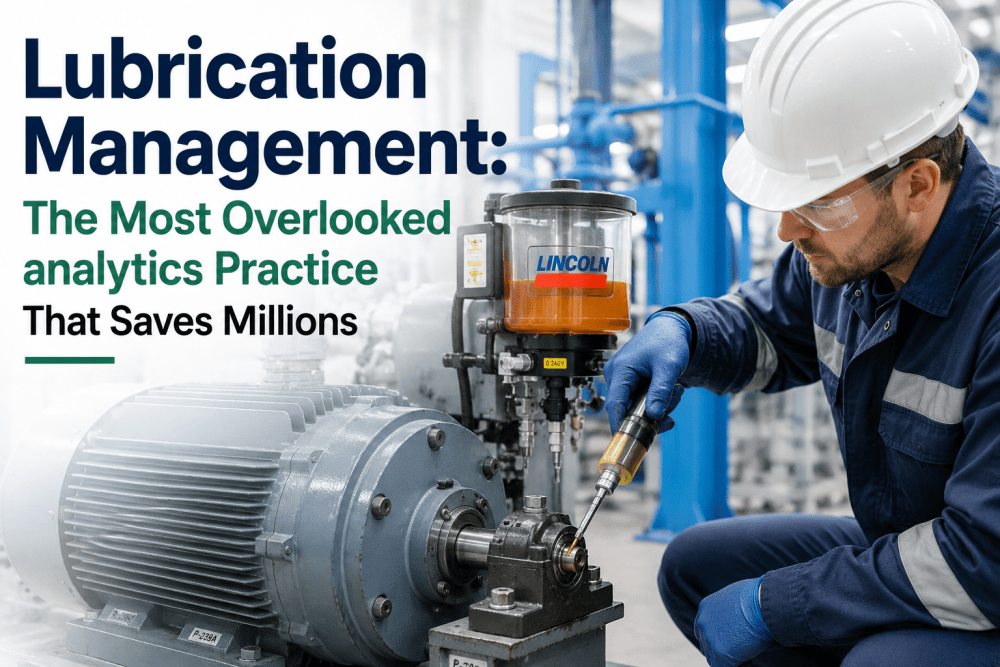
Walk into any manufacturing plant and ask the maintenance manager about their lubrication program. You'll usually hear about a grease gun schedule, an oil change calendar, and a binder somewhere with OEM specifications. What you rarely hear about is the data — the contamination trending, the bearing temperature correlation, the silent oil degradation that's quietly destroying $400,000 worth of gearbox before anyone notices. Lubrication is the most consequential maintenance practice that nobody talks about. Industry studies consistently show that 60–80% of bearing failures trace directly to lubrication issues: wrong lubricant selection, contamination, over-greasing, under-greasing, or simply running degraded oil past its useful life. At enterprise scale, the cost compounds quickly — a single mid-size manufacturing plant typically loses $1.2M to $4.8M annually in lubrication-attributable failures, premature replacements, and unplanned downtime. Yet lubrication remains stubbornly analog at most operations: paper checklists, gut-feel grease intervals, oil samples sent to labs with results filed and forgotten. iFactory AI's lubrication management module brings this critical practice into the same digital observability layer as every other maintenance discipline — scheduled grease and oil tasks with mobile execution, oil analysis results trended against bearing health, contamination thresholds with predictive alerts, and automatic lubrication system performance monitoring. Book a demo to see how digital lubrication management transforms reliability outcomes.
Lubrication management is the systematic tracking, scheduling, and analysis of all lubricant applications across plant equipment — covering bearing greasing intervals, oil change cycles, contamination control, oil analysis trending, and automatic lubrication system performance. Done well with software like iFactory AI, it eliminates 60–80% of bearing failures, extends equipment life by 30–50%, and typically delivers $1M–$4M in annual savings for mid-size manufacturing plants through prevented downtime, deferred capital replacements, and reduced lubricant waste.
Why Lubrication Management Is the Most Underrated Reliability Discipline
Predictive maintenance gets the conferences, vibration analysis gets the consultants, and thermal imaging gets the LinkedIn posts. Lubrication management gets a clipboard. This mismatch between operational importance and organizational attention is exactly why it remains the single largest source of preventable mechanical failure in U.S. manufacturing. The mechanics are simple: every rotating asset in your plant depends on a thin film of lubricant to separate metal surfaces under load. When that film fails — through contamination, degradation, depletion, or wrong specification — metal-to-metal contact begins, and the failure clock starts ticking. The fix isn't more sophisticated sensors. The fix is treating lubrication with the same rigor applied to every other reliability practice.
Of all premature bearing failures trace directly to lubrication-related root causes — wrong lubricant, contamination, over/under-greasing, or degraded oil. Bearings are designed for L10 lives of 50,000+ hours but average only 10–15% of that in real operations because lubrication conditions aren't actively managed.
Aggregate cost of lubrication-attributable failures, premature component replacements, unplanned downtime, and lubricant waste at a typical mid-size U.S. manufacturing operation. The cost is invisible because it's distributed across hundreds of work orders rather than appearing as a single line item.
Asset life extension typically achieved when lubrication moves from time-based scheduling to condition-based management with oil analysis trending. Gearboxes, hydraulic systems, and large bearings show the strongest gains — capital deferrals frequently exceed software investment within 9 months.
Reduction in total lubricant purchasing achieved by replacing calendar-based oil changes with condition-based intervals informed by oil analysis. The savings on lubricant SKUs and disposal cost is real, but the larger benefit is eliminating premature changes that introduce contamination and air during refill.
The Five Pillars of Modern Lubrication Management
A defensible lubrication program rests on five practices that work together. Skip any one and the others lose most of their value — that's why fragmented spreadsheet-based approaches consistently underperform. iFactory AI builds each of these pillars into a single workflow so the lubrication technician, reliability engineer, and maintenance planner all see the same data in real time.
Every lubrication point in the plant tied to a specific lubricant SKU with OEM-approved viscosity grade, additive package, and operating temperature range. iFactory maintains a master lubricant database with cross-reference tables so a technician scanning an asset QR code sees exactly which product to apply — eliminating the wrong-lube errors that account for an estimated 12–18% of lubrication-caused failures. Consolidation analysis identifies opportunities to reduce SKU count, often shrinking inventory from 40+ products to 12–15 without compromising any equipment.
Greasing intervals, oil top-ups, and full oil changes scheduled through the preventive maintenance engine with route optimization — a technician's tablet shows the optimal physical path through the plant to complete all assigned lubrication tasks in minimum walking time. Each task confirmed with photo upload, lubricant batch number, quantity dispensed, and digital signature. Missed or skipped tasks logged with reason codes, creating accountability that paper checklists never provided.
Oil samples collected on scheduled intervals, sent to ISO 17025 accredited labs, and results imported automatically into iFactory via lab API or CSV upload. Viscosity, total acid number, water content, particle counts, wear metals, and additive depletion trended over time per asset. Threshold-based alerts when any parameter crosses caution or critical limits, with automatic work order generation for follow-up actions — oil change, filter replacement, or root cause investigation.
ISO 4406 cleanliness targets set per asset based on operating pressure and component sensitivity. Filtration system performance tracked — filter differential pressure, change-out intervals, beta ratings verified against target cleanliness. Storage and transfer practices audited: dedicated containers per lubricant type, sealed transfer pumps, breather desiccant cartridge condition. Contamination ingress is the leading degradation mechanism, and most of it happens between the warehouse and the equipment, not inside the equipment.
Single-point lubricators and centralized auto-lube systems monitored for cartridge level, dispense rate, line pressure, and blocked-line faults. Integration with PLC-based monitoring delivers real-time alerts when a system stops dispensing, preventing the silent failures where an auto-lube fault goes unnoticed for weeks until the bearing it was supposed to protect seizes. Cartridge replacement scheduled proactively based on actual dispense rate rather than nominal interval.
Oil Analysis Trending — The Single Highest-Value Lubrication Practice
If you can implement only one new lubrication practice this quarter, make it systematic oil analysis trending. Oil is a continuous condition sensor that operates inside the equipment 24 hours a day — it sees wear before vibration sensors detect it, contamination before performance degrades, and additive depletion before lubricant film failure. The challenge isn't running the tests. Most reliability-focused plants already sample critical assets monthly or quarterly. The challenge is turning lab reports into action. Reports filed in folders or emailed to engineers who scan them once and move on capture none of the value the analysis offers.
| Oil Analysis Parameter | What It Indicates | Typical Caution Threshold | iFactory Automated Action |
|---|---|---|---|
| Viscosity at 40°C | Lubricant degradation, contamination with wrong fluid, oxidation | ±10% from new oil baseline | Investigation work order; cross-reference recent top-up records |
| Total Acid Number (TAN) | Oxidation, additive depletion, end of useful life | Doubled from new oil value | Oil change work order; resample after change to confirm |
| Water Content (ppm) | Seal failure, breather issue, condensation, coolant ingress | >500 ppm for hydraulics; >1000 ppm for gearboxes | Seal inspection work order; breather desiccant check task |
| ISO 4406 Particle Count | Filtration effectiveness, contamination ingress, internal wear generation | 2 ISO codes above target cleanliness | Filter change task; filtration kidney loop recommendation |
| Iron (Fe) ppm | General wear from bearings, gears, shafts | Rising trend >30% over 90 days | Vibration analysis correlation; ferrography recommendation |
| Copper (Cu) ppm | Bronze bushing wear, thrust washer degradation | >25 ppm or rising trend | Specific component inspection scheduled |
| Silicon (Si) ppm | Dirt ingress, seal failure, environmental contamination | >25 ppm above baseline | Breather inspection; seal integrity check; ambient air quality review |
| Additive Elements (Zn, P, Ca) | Anti-wear, detergent, dispersant package depletion | >25% reduction from new oil values | Oil change consideration even if other parameters acceptable |
iFactory AI's lubrication management module integrates scheduled tasks, oil analysis trending, contamination control, and auto-lube system monitoring into a single workflow — turning the most underrated maintenance practice into your highest-ROI reliability investment.
Contamination Control — Where Most Lubrication Programs Quietly Fail
Industry tribology research consistently identifies contamination as the leading lubricant degradation mechanism — ahead of thermal breakdown, additive depletion, and oxidation. The unsettling part is that most contamination doesn't originate inside the equipment. It enters during storage, transfer, top-up, and oil change procedures performed by well-meaning technicians using contaminated tools and unfiltered new oil. New oil straight from the drum routinely tests at ISO 22/20/17 — already exceeding the target cleanliness of many hydraulic systems before it ever enters the reservoir.
Expert Review — Reliability Engineering Perspective
"In my career I've walked into more than two hundred manufacturing plants for reliability assessments, and lubrication is the single most consistent gap I find. Plants will invest seven figures in vibration analysis programs, infrared cameras, and ultrasound detectors while their lubrication program runs on a clipboard a grease technician carries in his back pocket. The math is upside down. Vibration analysis tells you a bearing is failing; lubrication management prevents the bearing from failing in the first place. The leverage point is dramatically further upstream, and the practices required are dramatically simpler — they just need to be done consistently with documentation.
The shift from paper to digital lubrication management is more transformative than people expect. When a technician has to scan a QR code and confirm the correct lubricant before dispensing, the wrong-lube errors disappear overnight — and those errors alone account for a meaningful fraction of premature failures at most plants. When oil analysis results flow directly into the asset history with automatic threshold alerts, reliability engineers actually see trending data instead of opening PDF reports that get filed and forgotten. When the work order system generates a follow-up task automatically based on a TAN excursion, the corrective action actually happens rather than being remembered by one engineer who happens to read the email.
The capital deferral case is what gets CFOs interested. A large gearbox costs $80,000 to $300,000 to replace and runs 6–10 weeks of downtime if it fails unexpectedly. Extending the life of that gearbox by even 40% — which is conservative for well-managed lubrication — defers capital in a way that's directly attributable and easy to defend in budget reviews. I've seen lubrication management software pay for itself in nine months at plants that previously thought their lubrication program was 'good enough.' It almost never is."
Building a Lubrication Management Program with iFactory AI
The implementation path for a modern lubrication program is shorter than most plants assume. The data foundations already exist — OEM manuals, lubrication schedules, oil analysis history, asset registers — they just need to be consolidated and operationalized. iFactory AI's deployment approach moves a plant from fragmented spreadsheet-based lubrication tracking to integrated condition-based management in 30–45 days, with measurable reliability improvements typically appearing within the first 90 days of operation.
Comprehensive walk-down to identify every lubrication point on every asset — bearings, gearboxes, hydraulic systems, chains, slides. OEM lubrication specifications consolidated into iFactory's lubricant master database with cross-reference for SKU consolidation opportunities. Existing lubricant inventory audited and rationalized. QR codes generated and posted at each lubrication point for mobile scan-to-task workflow.
Greasing intervals, oil top-ups, and oil change schedules built into iFactory's preventive maintenance engine using OEM intervals as starting point, with planned migration to condition-based intervals as oil analysis history accumulates. Route optimization configured so technicians receive geographically efficient task assignments. Lubrication technician tablets provisioned and field training delivered. Failure mode codes configured for missed and skipped task reporting.
Lab partnership established or existing lab relationship integrated via API or CSV import. Historical oil analysis data imported and trended per asset. Caution and critical thresholds set per parameter per asset class. Automatic work order generation rules configured for each threshold excursion. Reliability engineer dashboard built with trending charts, threshold compliance, and exception lists.
ISO 4406 cleanliness targets assigned to all hydraulic and critical lubrication systems. Filtration system inventory built with change-out scheduling. Storage and transfer procedures audited; corrective actions tracked. Automatic lubrication system devices catalogued; cartridge replacement schedules built; PLC integration completed for real-time fault monitoring where available. Performance baseline established for 90-day improvement measurement.
Conclusion — Lubrication as the Quiet Foundation of Reliability
The maintenance disciplines that generate headlines — predictive analytics, AI-driven failure prediction, digital twin simulations — all assume that the basics are handled. They're rarely as handled as plants believe. Lubrication management is the most consequential of those basics, the practice that determines whether an asset reaches its design life or fails at 15% of it. The plants that consistently lead their industries in reliability metrics aren't the ones with the most sophisticated sensors. They're the ones who treat lubrication with the same rigor they apply to every other maintenance discipline: scheduled tasks with mobile execution accountability, oil analysis trending with automated follow-up, contamination control as a measured outcome rather than an aspiration, and auto-lube systems monitored as critical equipment rather than set-and-forget devices. iFactory AI brings these practices into a single digital workflow that scales from single-plant deployments to multi-site enterprise programs — turning the most underrated maintenance practice into the highest-ROI reliability investment most plants will make this decade. Book a demo to see lubrication management built for modern manufacturing.
Frequently Asked Questions
iFactory AI's lubrication management module brings scheduled task execution, oil analysis trending, contamination control, and automatic lubrication system monitoring into a single digital workflow. Deployed in 30–45 days, with measurable reliability gains in the first 90 days, and typical payback in under 9 months for mid-size manufacturing operations.