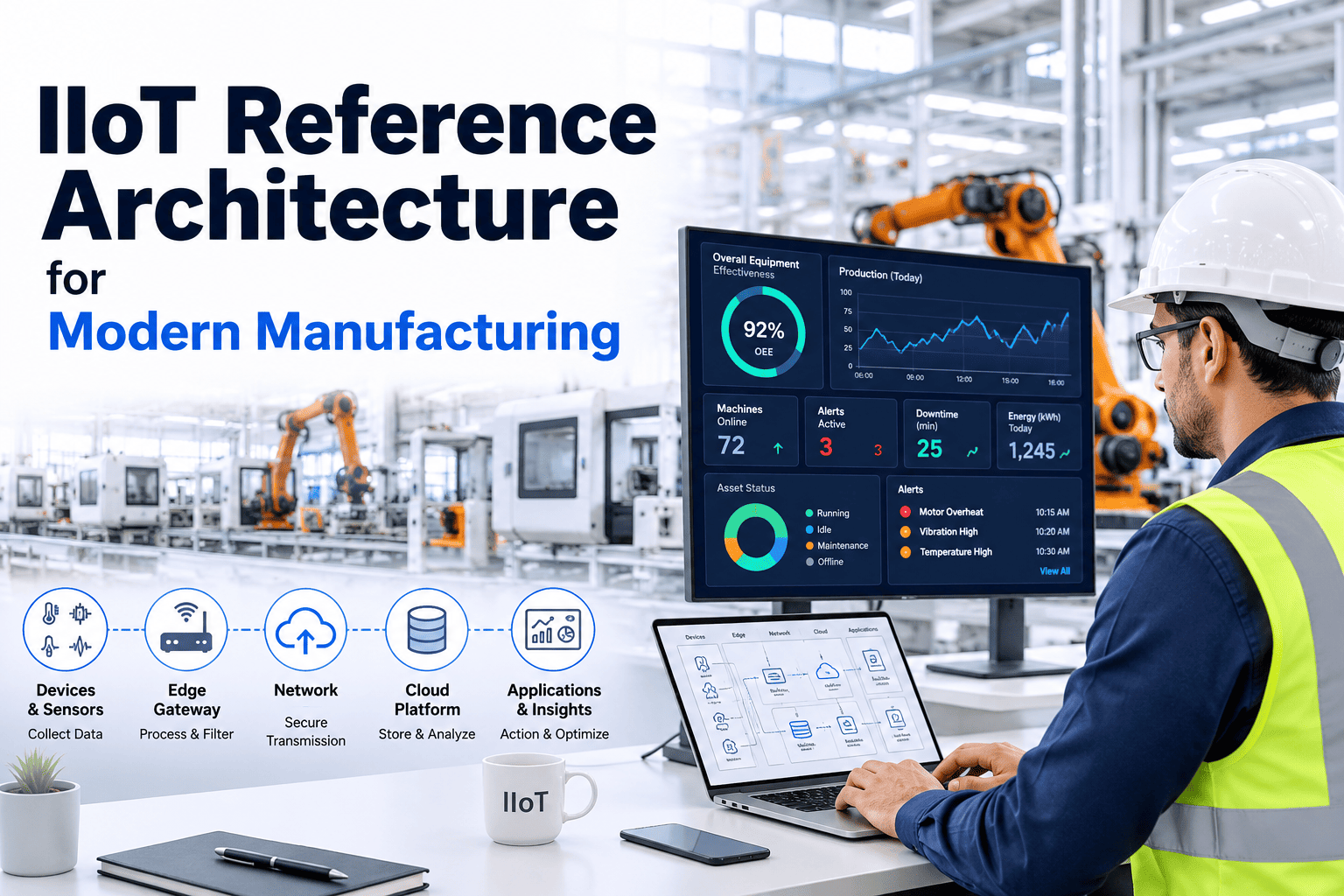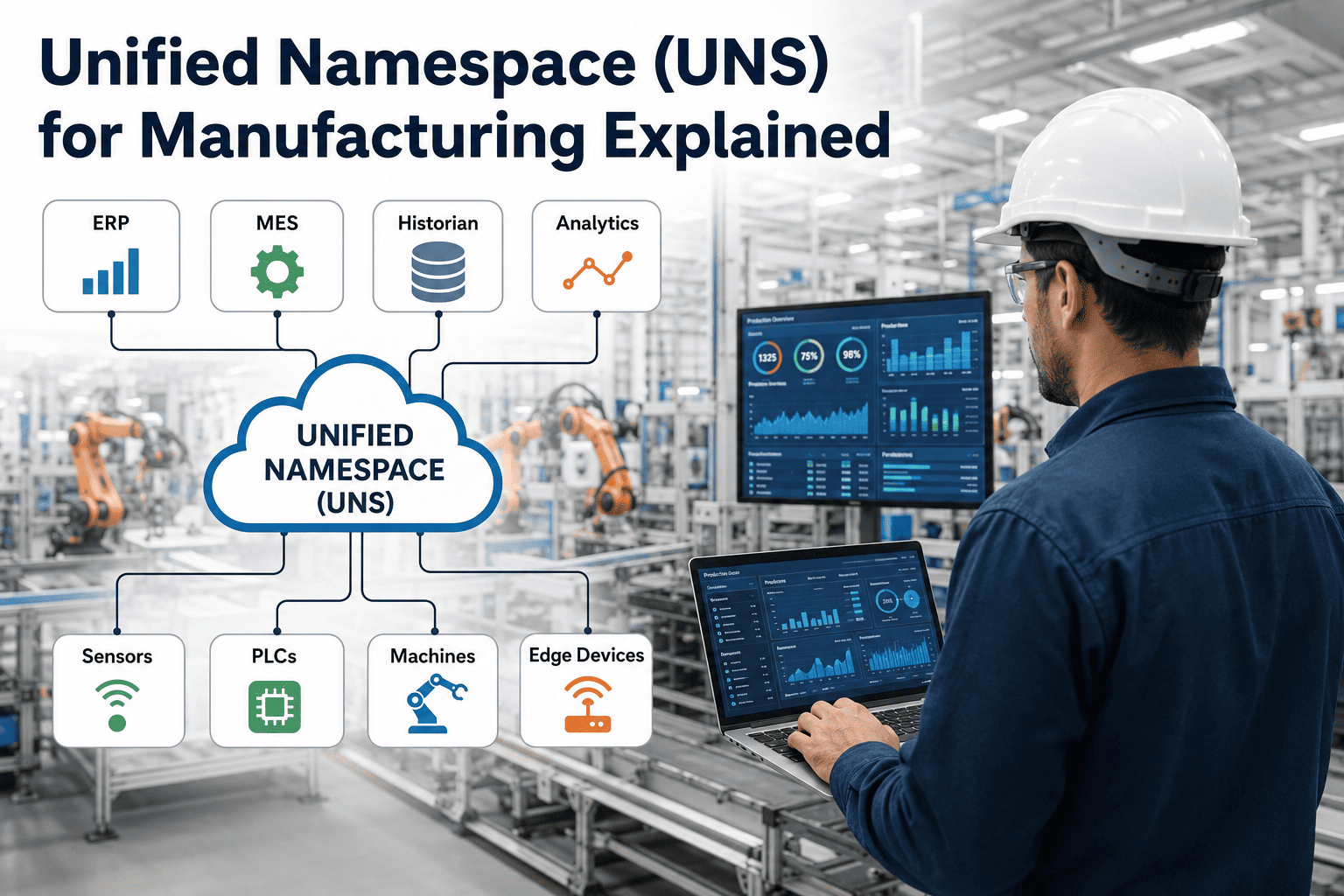
In the journey toward Industry 4.0, manufacturers face a critical bottleneck: the fragmentation of data across operational technology (OT) and information technology (IT) systems. Traditional point-to-point integrations create brittle, high-maintenance data silos that stifle real-time analytics and AI-driven predictive maintenance. The Unified Namespace (UNS) emerges as the architectural antidote—a single, centralized data hub that leverages MQTT and Sparkplug to publish and subscribe to all plant-floor data. By decoupling data producers from consumers, UNS enables a scalable, event-driven smart factory where every machine, sensor, and enterprise system speaks the same language. This guide provides a deep-dive into UNS architecture, deployment strategies, and its transformative role in manufacturing efficiency. For a hands-on consultation, Book a Demo with our experts.
Unified Namespace: The Backbone of Smart Factory Data Architecture
Eliminate data silos, enable real-time analytics, and scale your Industry 4.0 initiatives with a single source of truth.
What is a Unified Namespace (UNS)?
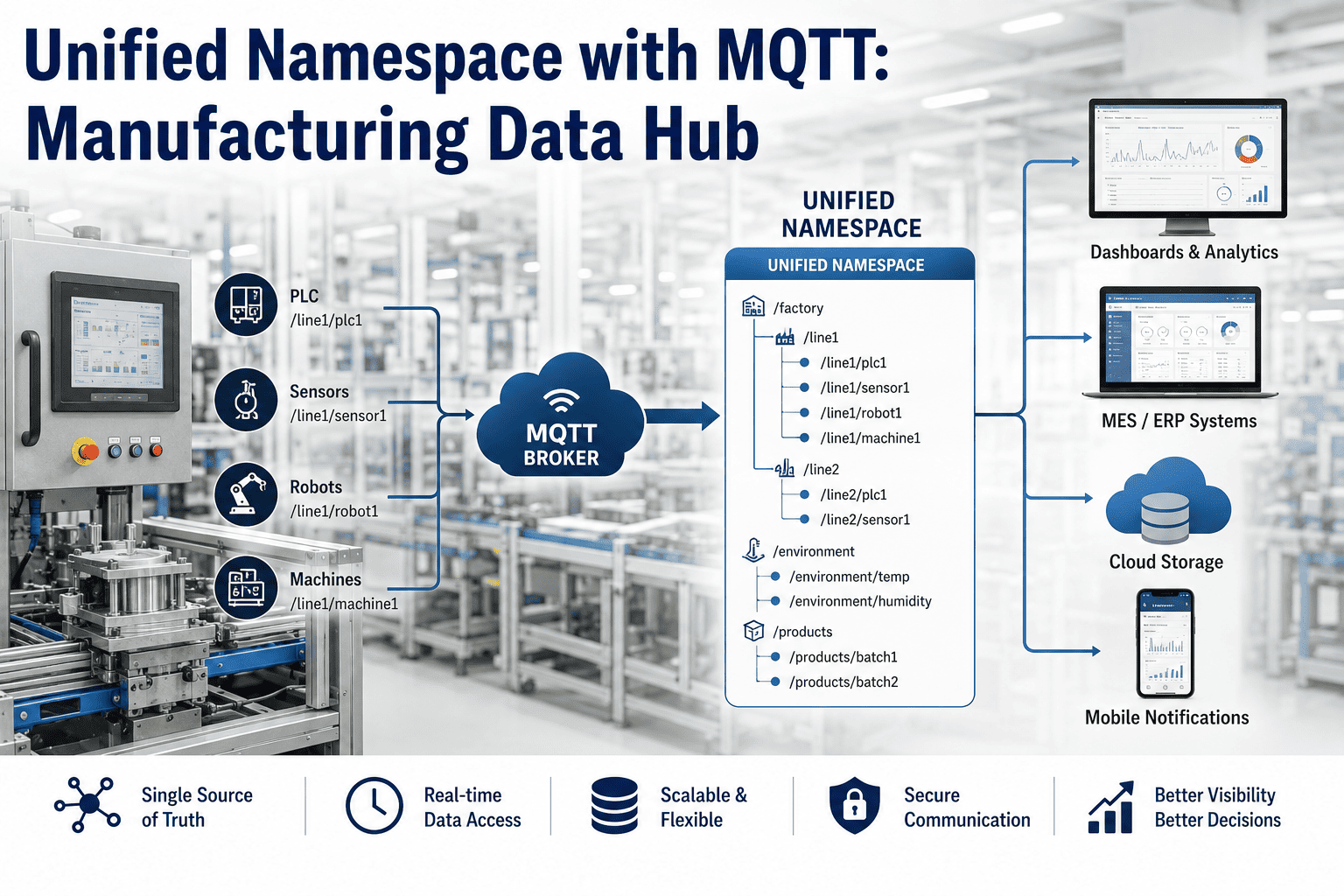
A Unified Namespace is a logical data architecture pattern that aggregates all manufacturing data into a single, centralized message broker using the MQTT protocol with Sparkplug specification. Unlike traditional point-to-point integrations, UNS decouples data producers (PLC, sensors, robots) from data consumers (SCADA, MES, ERP, analytics platforms) through a publish-subscribe model. This creates a real-time, event-driven data hub where any authorized system can access the exact data it needs without complex custom integrations. The UNS acts as the single source of truth for the entire plant, ensuring data consistency, reducing latency, and enabling scalable, future-proof Industry 4.0 deployments.
Core Components of a UNS Architecture
MQTT Broker
The central nervous system of UNS, handling millions of messages per second with QoS levels (0,1,2). Supports clustering for high availability and edge buffering for offline resilience.
Sparkplug Specification
An MQTT extension that defines a standard payload format for industrial data, including birth certificates for devices, metrics, and template-driven data models. Ensures interoperability across vendors.
Data Producers (Publishers)
Edge gateways, PLCs, sensors, and IIoT devices that publish data to the broker under specific topic namespaces (e.g., spBv1.0/plant1/line2/machine3).
Data Consumers (Subscribers)
SCADA, MES, ERP, AI/ML analytics, dashboards, and mobile apps that subscribe to relevant topics and process data in real-time.
Topic Hierarchy
A well-defined, hierarchical naming convention (e.g., site/area/line/machine/metric) that organizes data logically, enabling granular subscriptions and access control.
Edge Gateway
Hardware or software that bridges legacy fieldbus protocols (Modbus, Profinet, Ethernet/IP) to MQTT, applying local buffering and data transformation before publishing.
How UNS Transforms Plant Data Flow: A Step-by-Step Timeline
Data Ingestion at the Edge
Edge gateways collect raw data from diverse OT equipment—PLC registers, vibration sensors, temperature probes—at sub-second intervals. The gateway translates proprietary protocols into MQTT Sparkplug messages, buffering locally to prevent data loss during network interruptions.
Publishing to the MQTT Broker
The gateway publishes structured messages to the central MQTT broker under the defined topic hierarchy. Each message includes a Sparkplug payload with device ID, timestamp, metric names, and values, along with birth/death certificates for device lifecycle management.
Real-Time Subscription & Processing
IT applications (MES, ERP, AI models) subscribe to specific topics and receive data instantly. For example, a predictive maintenance algorithm subscribes to vibration metrics on critical pumps, triggering alerts when thresholds are exceeded.
Historical Storage & Analytics
A time-series database subscribes to all topics, storing raw data for long-term trend analysis. This enables root-cause analysis, OEE calculations, and machine learning model training without impacting real-time operations.
Visualization & Action
Dashboards (e.g., Grafana, Power BI) subscribe to aggregated topics to display live KPIs. Alerts from the UNS can automatically trigger work orders in CMMS or adjust production schedules in MES, closing the loop between data and action.
UNS vs. Traditional Integration: A Comparative Analysis
| Feature | Point-to-Point Integration | Unified Namespace (UNS) |
|---|---|---|
| Integration Complexity | High: each pair requires custom adapter | Low: one-to-many via broker |
| Scalability | Poor: N connections become N*(N-1)/2 | Excellent: linear scaling with broker |
| Real-Time Capability | Best-effort, often batched | Sub-millisecond pub/sub |
| Data Consistency | Fragmented, duplicates common | Single source of truth |
| Vendor Lock-In | High: proprietary protocols | Low: open standard MQTT/Sparkplug |
| Maintenance Overhead | Very high | Low: centralized management |
| Security | Inconsistent, per-connection | Centralized TLS, ACLs, IAM |
Ready to Deploy UNS in Your Plant?
Reduce integration costs by 80% and accelerate your digital transformation with iFactory's UNS-ready platform.
UNS Deployment Strategies for Manufacturing Plants
Deploying a Unified Namespace requires careful planning around network segmentation, broker sizing, and data modeling. The most common approach is a hybrid topology: a primary MQTT broker on-premises (or in a private cloud) with edge brokers at each plant for local data aggregation. Edge brokers buffer data during WAN outages and forward to the central broker once connectivity resumes. This ensures zero data loss and low latency for time-critical operations like safety interlocks. For global enterprises, a multi-broker federation using MQTT bridging enables cross-site data sharing while maintaining autonomy. Each broker publishes a subset of topics to a global broker, enabling corporate dashboards without exposing all plant data. Security is enforced through TLS encryption, client certificates, and fine-grained ACLs on each topic, ensuring that only authorized systems can read or write data.
Key Benefits of UNS for Smart Factory Analytics
Real-Time Predictive Maintenance
AI models subscribe to vibration, temperature, and current data from rotating equipment. Anomaly detection triggers alerts within milliseconds, preventing unplanned downtime.
Unified OEE Tracking
Overall Equipment Effectiveness (OEE) calculations pull availability, performance, and quality data from multiple sources (PLC, CMMS, QC) via UNS, providing a holistic view.
Dynamic Production Scheduling
MES subscribes to real-time machine status and order progress, automatically adjusting schedules based on bottlenecks or material shortages.
Energy Optimization
Energy meters publish consumption data to UNS. Analytics identify peak usage patterns and adjust production schedules to reduce demand charges.
Topic Naming Best Practices
A well-structured topic hierarchy is the bedrock of a successful UNS. Use a format like site/area/line/machine/metric (e.g., atlanta/assembly/line3/robot7/ motor_current). Include metadata like data type and unit in the topic to reduce payload parsing. Avoid using dynamic values like timestamps in topics; instead, use them as payload fields. This ensures that subscribers can use wildcards (+ and #) to easily filter data.
Broker Sizing & Performance
Selecting the right MQTT broker is critical. For small plants (up to 1000 devices), a single high-availability cluster with 3 nodes handles 100k messages/sec. For large sites, use a federated architecture with edge brokers. Key metrics: message throughput, disk I/O for persistence, and memory for retained messages. Sparkplug adds overhead (birth certificates, template definitions), so plan for 20-30% more bandwidth.
Security Considerations for UNS in Manufacturing
Industrial environments demand robust security. UNS security should be layered: network segmentation using VLANs and firewalls between OT and IT, TLS 1.2+ for all MQTT connections, client certificate authentication for devices, and ACLs that restrict topic access per client. Use Sparkplug's device birth/death certificates to detect spoofing. For compliance with IEC 62443, implement role-based access control (RBAC) on the broker, audit logging, and anomaly detection on message patterns. The UNS broker itself should be hardened—disable unused ports, apply patches, and run in a DMZ with strict egress rules.
Frequently Asked Questions
What is the difference between UNS and a traditional data lake?
A UNS is a real-time, event-driven data hub that provides current state data with minimal latency (milliseconds), whereas a data lake is a historical storage system optimized for batch analytics. UNS is ideal for operational decisions (e.g., machine control, real-time alerts), while data lakes are for retrospective analysis. Many architectures use both: UNS feeds real-time dashboards and triggers, while a data lake archives UNS data for ML training. For a deeper understanding, contact our support team.
Can UNS work with legacy PLCs and fieldbus protocols?
Yes, edge gateways translate legacy protocols (Modbus, Profinet, DeviceNet, EtherNet/IP) into MQTT/Sparkplug. These gateways can be hardware (e.g., Red Lion, HiveMQ Edge) or software agents running on industrial PCs. They handle protocol conversion, data normalization, and local buffering. The UNS broker remains protocol-agnostic. For specific legacy integration scenarios, book a demo to discuss your environment.
How does UNS handle data quality and validation?
Data quality is enforced at the edge: gateways can apply range checks, deadband filtering, and unit conversion before publishing. Sparkplug templates define expected data types and structures, enabling validation at the broker level. Subscribers can further validate using rules engines (e.g., Node-RED). For critical metrics, use MQTT QoS 2 to ensure exactly-once delivery. For a comprehensive data quality framework, reach out to our experts.
Is UNS suitable for multi-site global manufacturing?
Absolutely. A federated UNS architecture with edge brokers at each site and a central broker for corporate aggregation is the standard. Edge brokers handle local real-time needs, while the central broker provides a global view. MQTT bridging with topic filters ensures data sovereignty. This pattern scales to hundreds of sites. For a reference architecture, schedule a consultation.
What are the costs of implementing a UNS?
Costs vary based on scale: open-source brokers (e.g., Mosquitto, EMQX) are free but require engineering effort. Commercial brokers (e.g., HiveMQ, Solace) offer enterprise features like clustering, monitoring, and support. Edge gateways cost $500-$5000 each. Total cost is often 60-80% lower than traditional point-to-point integration when considering maintenance savings. For a detailed cost analysis, contact our sales team.
Transform Your Plant with UNS Today
Leverage the power of a Unified Namespace to unlock real-time insights, reduce integration costs, and future-proof your smart factory.