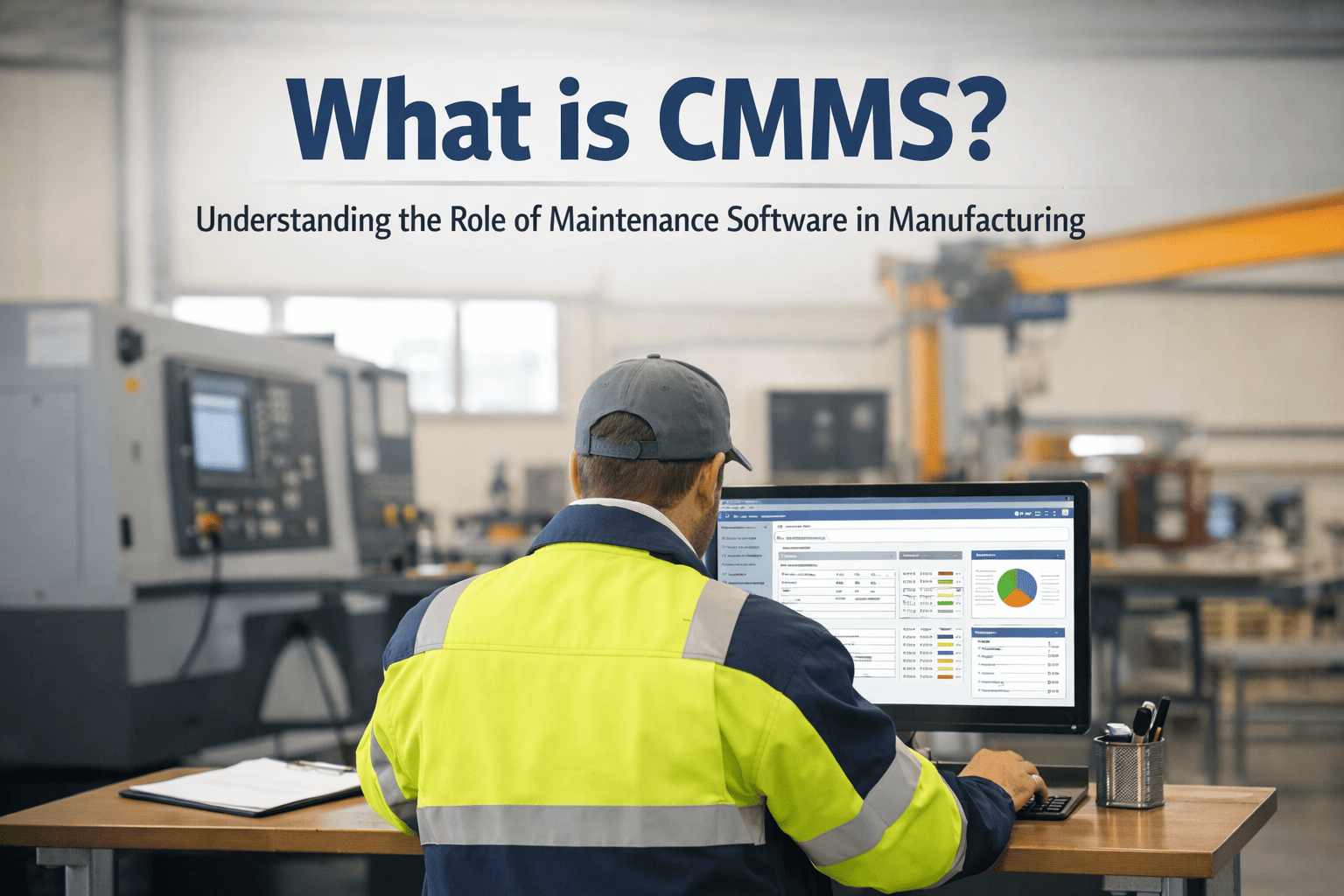
What is CMMS? Understanding the Role of Maintenance Software in Manufacturing
By oxmaint on March 5, 2026
Manufacturing plants lose an average of 800 hours per year to unplanned equipment failures — and most of those breakdowns are preventable. A Computerized Maintenance Management System (CMMS) is the software that closes this gap, giving maintenance teams a single digital hub to track every asset, automate work orders, schedule preventive maintenance, and monitor equipment health in real time. For manufacturers still running on spreadsheets, paper logs, or gut-feel maintenance decisions, the cost of not switching grows every quarter. Want to see how this works for your plant? Book a free demo and get a walkthrough of iFactory CMMS configured for your specific equipment and workflows.
How CMMS Solves the Manufacturing Downtime Problem
Downtime is the single most expensive problem in manufacturing. Equipment failures account for nearly half of all unplanned production stoppages, and each incident typically takes four hours or more to resolve. The ripple effect — missed shipments, overtime labor, scrap material, customer penalties — multiplies fast. CMMS software attacks this problem at the root by replacing reactive maintenance habits with structured, data-driven processes that catch issues before they shut down production lines.
42%
of unplanned downtime traced to equipment breakdowns
50%
downtime reduction achieved through predictive CMMS strategies
$1.4B
projected CMMS market size in 2025, growing at 11% annually
These numbers explain why adoption is accelerating. Manufacturers who implement CMMS consistently report that maintenance costs drop, equipment lifespan extends, and their teams spend less time firefighting and more time on planned, productive work. The shift from reactive to proactive is not a luxury anymore — it is the baseline for competitive manufacturing.
Ready to stop losing production hours to surprise breakdowns?
iFactory CMMS gives your maintenance team real-time visibility into every asset on the shop floor — from a single, mobile-friendly dashboard.
Inside a Manufacturing CMMS: The Modules That Run Your Plant
A CMMS is not a single tool — it is a connected system of modules that work together to manage every aspect of maintenance operations. Each module solves a specific operational pain point, and together they create a maintenance ecosystem that is structured, measurable, and continuously improving. Here is what sits inside a modern manufacturing CMMS and why each piece matters.
01
Work Order Engine
The core of every CMMS. Create, assign, prioritize, and close maintenance tasks digitally. Technicians receive jobs on mobile devices with complete context — equipment history, attached procedures, required parts — so nothing gets lost between shifts or departments. Track time-to-completion, technician workload, and backlog in real time.
02
Preventive Maintenance Scheduler
Automate recurring maintenance based on calendar intervals, runtime hours, or meter readings. The scheduler generates tasks ahead of due dates, assigns the right technician, and reserves the necessary parts — ensuring critical equipment gets serviced before it degrades to failure. No more missed PMs buried in a spreadsheet.
03
Asset Registry & History
Every piece of equipment in your facility gets a digital profile: specifications, location, warranty, vendor contacts, and a complete repair history. When a technician opens a work order, they see everything that has ever happened to that asset — enabling faster diagnosis and smarter repair-or-replace decisions.
04
Spare Parts & Inventory Control
Track every spare part across stockrooms and tool cribs. The CMMS links parts directly to the assets that use them, sets minimum stock thresholds, and triggers automatic reorder alerts when inventory runs low. Eliminate the two worst inventory scenarios: stockouts that delay repairs and overstocking that wastes capital.
05
Reporting & Maintenance Analytics
Transform raw maintenance data into KPI dashboards. Track mean time between failures (MTBF), mean time to repair (MTTR), PM compliance rates, cost per asset, and technician utilization. These reports turn maintenance from a cost center into a measurable contributor to plant performance. Want to track MTBF, MTTR, and PM compliance from day one? Contact our support team and we will help you set up your maintenance KPI dashboard from scratch.
From Reactive Repairs to Condition-Based Intelligence
The most significant shift CMMS enables is moving maintenance strategy up the maturity curve — from waiting for things to break, to servicing on a schedule, to monitoring actual equipment condition and acting on real data. Research consistently shows that fixed-interval preventive maintenance alone only catches 10 to 30 percent of potential failures. The remaining 70 to 90 percent require condition-based approaches where sensor data drives maintenance decisions.
Maintenance Strategy Maturity
Stage 1
Reactive
Fix it when it breaks. Highest cost, maximum downtime, shortest equipment life.
Low Effectiveness
Stage 2
Preventive
Service on a schedule. Better uptime, but risk of over-maintaining healthy equipment.
Moderate Effectiveness
Stage 3
Condition-Based & Predictive
Sensors monitor real-time equipment health. CMMS triggers action only when data demands it.
High Effectiveness
Modern CMMS platforms like iFactory integrate directly with IoT sensors — vibration analyzers, thermal monitors, oil quality sensors, pressure transducers — to receive continuous equipment health data. When a reading crosses an established threshold, the CMMS automatically generates a prioritized work order, assigns the right technician, and attaches the relevant repair procedures. No manual intervention, no delayed response, no ambiguity about what needs attention and when.
Vibration Analysis
Detects bearing wear, misalignment, and imbalance in motors, pumps, and fans 3 to 5 weeks before failure
Thermal Imaging
Spots overheating in electrical panels, motor windings, and bearings before insulation breakdown occurs
Oil & Fluid Analysis
Measures contamination, viscosity breakdown, and metal particles to determine true fluid service intervals
Pressure & Flow Tracking
Identifies pump degradation, hydraulic leaks, and pneumatic blockages through continuous system monitoring
See how condition monitoring connects to automated work orders
Book a live demo and we will walk you through sensor-to-work-order automation inside iFactory — tailored to your specific equipment.
Real Numbers: What CMMS Delivers on the Manufacturing Floor
CMMS value is not theoretical — it compounds across multiple measurable outcomes. Manufacturing facilities that fully adopt CMMS consistently report improvements in maintenance spending, equipment availability, team productivity, and compliance readiness. Here is what the benchmark data shows across thousands of deployments.
25-40%
Lower maintenance spend
Through fewer emergency repairs, optimized parts purchasing, and better labor allocation
20-35%
Less equipment downtime
Preventive schedules and condition alerts catch failures weeks before they cause stoppages
30-50%
Higher team productivity
Digital work orders, mobile access, and automated scheduling eliminate wasted coordination time
200-400%
ROI within 12-24 months
Combined savings from reduced breakdowns, extended asset life, and improved inventory efficiency
Which Manufacturing Operations Benefit Most from CMMS?
Every manufacturing environment has unique equipment profiles, compliance demands, and maintenance challenges. A well-configured CMMS adapts to each — but certain sectors see especially dramatic returns because their downtime costs are highest and their regulatory requirements are most demanding.
Automotive & Assembly
CNC machines, robotic welders, conveyors, paint systems
A single conveyor stoppage can idle an entire assembly line. CMMS tracks runtime on every motor, schedules bearing replacements before failure, and maintains OEE dashboards that connect maintenance performance directly to production output.
FDA and FSMA compliance demand audit-ready maintenance records. CMMS automates sanitation schedules, tracks calibration on temperature-critical equipment, and generates compliance documentation instantly during inspections.
21 CFR Part 11 compliance requires electronic signatures, complete audit trails, and validated maintenance processes. CMMS provides the digital infrastructure to meet these standards while keeping production running efficiently.
Steel, Metals & Heavy Industry
Blast furnaces, rolling mills, overhead cranes, hydraulic presses
Extreme operating conditions accelerate wear. If your furnaces, mills, or cranes are running in high-heat environments, book a demo to see how iFactory condition monitoring detects heat-cycle degradation and bearing wear weeks before they force a shutdown.
Plastics, Packaging & Consumer Goods
Injection molders, extruders, blow molders, labeling systems
Mold maintenance cycles and temperature control directly impact product quality. CMMS tracks shot counts on every mold, schedules cleaning and inspection at optimal intervals, and links maintenance events to defect rate data.
Not sure if CMMS fits your specific manufacturing setup?
Our team configures iFactory for your exact equipment profiles, compliance requirements, and team workflows — no generic templates.
Implementing CMMS does not require months of planning or massive IT projects. Cloud-based platforms like iFactory are designed for rapid deployment — most manufacturing facilities move from first login to live operations within four to six weeks. Here is what a typical first-month roadmap looks like.
Days 1-5
Asset Discovery & Data Import
Walk the floor, inventory every asset, and bulk-import equipment data into the CMMS. Assign asset hierarchies (plant > line > machine > component) and attach existing documentation like manuals and warranty records.
Days 6-12
Workflow Setup & PM Scheduling
Configure work order templates for common repair types. Set up preventive maintenance schedules on critical equipment using OEM-recommended intervals. Establish spare parts inventory with minimum stock levels and reorder triggers.
Days 13-20
Team Training & Parallel Run
Train technicians on the mobile app — submitting work requests, completing tasks, logging parts used. Run the CMMS alongside existing processes for one week to validate data accuracy and workflow logic before fully committing.
Days 21-30
Go Live & Continuous Improvement
Switch fully to digital operations. Monitor PM compliance, work order closure rates, and backlog trends. Begin planning Phase 2: IoT sensor integration for condition-based maintenance on your highest-impact assets. Ready to begin your 30-day transformation? Reach out to our team — we will guide you through every step from asset import to go-live.
The plants that achieve 95 percent uptime or better almost always share one thing in common — a structured CMMS managing every maintenance decision, every work order, every spare part. It is never an accident. It is a system.
— Plant Reliability Director, Manufacturing Industry
Move Your Maintenance Operations from Chaos to Control
iFactory CMMS replaces scattered spreadsheets, forgotten work orders, and surprise breakdowns with a single platform that your entire maintenance team can access from anywhere. Real-time asset tracking, automated preventive schedules, condition monitoring integration, and actionable analytics — built specifically for the manufacturing floor.
What does CMMS stand for and what does it do in a manufacturing plant?
CMMS stands for Computerized Maintenance Management System. In manufacturing, it serves as the central software platform for all maintenance operations — tracking assets, managing work orders, scheduling preventive maintenance, controlling spare parts inventory, and generating performance reports. It replaces paper-based and spreadsheet-driven processes with a digital system that gives maintenance managers and technicians real-time visibility into every piece of equipment on the shop floor. Curious how it looks in practice? Get in touch with our support team and they will walk you through work orders, asset tracking, and PM scheduling inside the platform.
How long does it take to implement CMMS in a manufacturing facility?
Cloud-based CMMS platforms can be deployed in as little as four to six weeks for a typical manufacturing facility. The first week focuses on asset data import, the second on workflow configuration and PM scheduling, the third on team training, and by week four most plants are running fully digital maintenance operations. Larger facilities with complex multi-site setups may take slightly longer, but the cloud model eliminates the need for server infrastructure or lengthy IT projects.
What is the difference between CMMS and EAM software?
CMMS focuses on day-to-day maintenance execution — work orders, PM schedules, inventory management, and technician coordination on the floor. Enterprise Asset Management (EAM) takes a broader view covering the entire asset lifecycle including procurement, capital budgeting, depreciation tracking, and retirement planning. For most manufacturing maintenance teams, a robust CMMS delivers the operational tools they need, while EAM is better suited for corporate-level financial planning across large asset portfolios.
Can CMMS integrate with IoT sensors for condition monitoring?
Yes. Modern CMMS platforms connect directly with vibration sensors, thermal monitors, oil analyzers, pressure transducers, and other IoT devices installed on critical equipment. When a sensor reading exceeds a predefined threshold, the CMMS automatically generates a work order, assigns the appropriate technician, and attaches relevant repair procedures — bridging the gap between detecting a problem and acting on it without any manual intervention. Want to see how a sensor alert becomes a completed work order automatically? Book a demo and we will walk you through the full sensor-to-repair workflow live.
What ROI can manufacturers expect from CMMS implementation?
Industry benchmarks show that manufacturing facilities typically achieve 200 to 400 percent return on investment within 12 to 24 months. This comes from combined savings across multiple areas: 25 to 40 percent reduction in maintenance costs, 20 to 35 percent decrease in equipment downtime, 30 to 50 percent improvement in maintenance productivity, and better inventory management that reduces both stockouts and excess carrying costs.