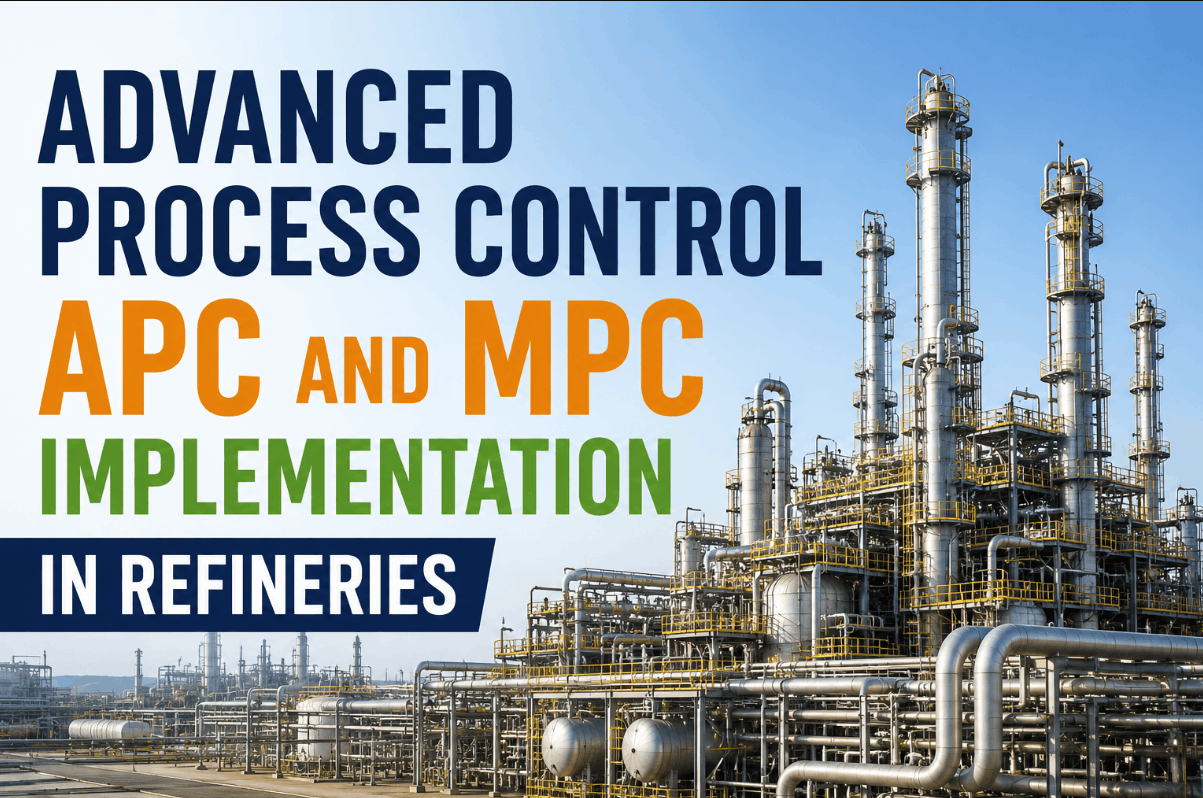
Advanced process control is the layer that sits above basic regulatory control and decides how close a unit can safely run to its real constraints — not the conservative constraints written into the operating manual a decade ago, but the actual limits of the column, the reactor, and the fractionator on any given day. In the CDU, the FCC, and the hydrocracker, that difference between manual-driven and APC-driven operation is consistently worth 2–6% margin improvement, delivered through steadier yields, lower energy consumption, and tighter give-away on product specifications. The path to that margin is not a single software install — it is a sequence of step testing, model identification, controller commissioning, and ongoing sustainability work that determines whether the benefit shows up once at startup or compounds every month the unit runs. iFactory AI's APC and MPC implementation framework is built around that full sequence, connecting step test data, model quality, and controller performance into one decision layer for refinery process and control engineers.
Is Your APC Program Capturing the Margin That's Actually Available?
Connect step test data, model identification quality, and controller uptime into one analytics layer designed for CDU, FCC, and hydrocracker APC programs.
Why APC Delivers Margin That Manual Operation Structurally Cannot
Manual and basic regulatory control hold each loop near its own setpoint, but they have no mechanism for understanding how dozens of interacting variables move together across a CDU, FCC, or hydrocracker. Operators compensate by running with wide safety margins below the real constraint — back off the column from flood point, run the regenerator a few degrees cooler than the metallurgical limit, leave conversion on the table rather than risk an upset. APC closes that gap with a multivariable model that predicts how every manipulated variable affects every controlled variable simultaneously, then pushes the unit toward its true operating limits instead of the conservative limits built into manual practice. When refinery teams Book a Demo, the most common discovery is that their existing APC controllers are running well below their original design benefit because nobody has tracked model degradation or step-tested the unit since the original commissioning years ago.
The economics are unit-specific but consistent in direction. CDUs gain primarily from tighter cut point and overlap control between distillate products. FCC units gain from feed maximization and pushing conversion and severity constraints without triggering catalyst or emissions limits. Hydrocrackers gain from reactor temperature optimization and conversion control that holds product quality on-spec with less margin given away. In every case, the benefit is only as good as the model behind it — which is why model identification through step testing, not the control algorithm itself, is the part of APC implementation that most often determines program success.
CDU Cut Point Optimization
Tighten distillate cut points and reduce product overlap, capturing margin that manual operation gives away to stay safely inside spec on every cut.
FCC Conversion Maximization
Push feed rate, severity, and conversion constraints closer to their real limits while holding regenerator temperature and emissions within operating bounds.
Hydrocracker Reactor Optimization
Coordinate reactor bed temperatures and conversion targets across the train, reducing quench give-away and improving product yield distribution.
Controller Sustainability Monitoring
Track model quality, controller uptime, and constraint activity continuously, flagging degraded models before benefit erosion shows up in monthly margin reports.
The Core Stages of an APC/MPC Implementation, Unit by Unit
Every successful refinery APC program covers the same four implementation stages regardless of which unit it's deployed on: pre-test scoping, step testing for model identification, controller commissioning, and ongoing sustainability monitoring. Process control engineers consistently report — after they Book a Demo — that the stage most often shortchanged on time and budget, model identification, is also the stage that determines whether the eventual controller delivers anywhere close to its design benefit.
| Implementation Stage | Primary Activity | Typical Duration | Key Output | Priority Level |
|---|---|---|---|---|
| Pre-Test Scoping | Constraint & variable identification | 1–2 weeks | MV/CV pairing list | Critical |
| Step Testing | Plant-test data collection | 2–6 weeks | Dynamic response data | Critical |
| Model Identification | Empirical model building | 2–4 weeks | Validated process model | Critical |
| Controller Commissioning | Tuning & closed-loop activation | 2–4 weeks | Live MPC controller | High |
| Sustainability Monitoring | Ongoing model & uptime tracking | Continuous | Sustained margin capture | Standard |
From Step Test to Sustained Margin: How an APC Deployment Actually Runs
APC benefit does not arrive the day a controller goes live — it arrives through a structured sequence where each stage's output becomes the next stage's input. Skipping or compressing any one stage is the most common reason a refinery APC project underdelivers against its original economic case. Book a Demo early in project planning to avoid the rework that comes from poor step test design discovered only after model identification has already failed.
Constraint and Variable Scoping
Identify every manipulated variable, controlled variable, and disturbance variable relevant to the unit, and map the MV-CV pairing matrix that the controller will eventually manage.
Step Testing for Dynamic Response Data
Execute planned step changes on each manipulated variable while the unit continues normal operation, capturing the dynamic response data that empirical models depend on. Closed-loop and non-invasive step testing methods reduce disruption to ongoing production.
Model Identification and Validation
Build the multivariable process model from step test data, then validate it against held-out response data before it is ever used inside a live controller. Models built on empirical step test data consistently outperform models built on theoretical or analytical process assumptions alone.
Controller Commissioning and Tuning
Activate the controller in closed loop, tune constraint priorities and move suppression, and confirm the controller behaves as predicted under live operating conditions before handing control authority fully to the optimizer.
Sustainability and Benefit Tracking
Monitor controller uptime, model mismatch, and constraint activity continuously after go-live, since benefits that are not actively sustained typically decay as feedstock, catalyst, and market conditions shift away from the conditions the original model was built on.
"Our hydrocracker APC controller had been live for years but nobody could tell us if it was still earning its keep. Once we connected step test history and model quality tracking through iFactory, we found three constraint pairings that had drifted out of tolerance. Re-identifying those models alone recovered most of the margin we'd quietly lost over the previous two years."
Where Refinery APC Programs Lose the Margin They Were Built to Capture
Most refineries pursuing **APC implementation** programs encounter a predictable set of technical and organizational gaps. Understanding these before a controller goes live — or before a legacy controller is revamped — dramatically improves the odds that the **MPC refinery** investment delivers its full economic case rather than a fraction of it.
Controllers built on theoretical process models rather than empirical step test response data consistently underperform once deployed against real plant dynamics.
Product margin and feed cost assumptions baked into the controller at commissioning go unrevised for years, pushing the optimizer toward an economic target that no longer reflects current market conditions.
Without continuous monitoring, model mismatch accumulates silently as catalyst activity, feedstock, and equipment condition drift away from the conditions the original model was identified under.
Operators take controllers off-line during upsets and forget to re-engage them, and without uptime tracking, a controller can sit idle for weeks while operations reverts to manual practice.
Major turnarounds, catalyst changes, and equipment modifications invalidate prior models, yet many refineries only revisit step testing during a full controller revamp years later.
APC economic targets and refinery-wide planning and scheduling models run on separate assumptions, leading the controller to optimize toward a target the planning department has already moved away from.
Closing these gaps requires more than a one-time controller tuning exercise — it demands continuous visibility into model quality, controller uptime, and economic relevance. Book a Demo to benchmark your current APC program against a structured sustainability framework.
Sustaining APC Benefit Beyond the First Year of Deployment
One of the most consistent findings across refinery APC programs is that the benefit captured in the first weeks after commissioning is rarely the benefit that remains five years later, unless the program is actively sustained. **APC step test** data, model accuracy, and controller priorities all require periodic revisiting as feedstock slates, catalyst activity, and market conditions shift. A purpose-built **refinery APC sustainability** approach treats this as continuous work rather than a one-time deployment, maintaining the connection between live plant data and the model assumptions the controller depends on.
Key Sustainability Capabilities for Refinery APC Programs
Continuously compare controller predictions against actual plant response, flagging MV-CV pairings where model mismatch has exceeded acceptable tolerance.
Track time in service for every controller, surfacing patterns where operators are routinely taking the optimizer off-line during specific operating conditions.
Flag when product margin, feed cost, or constraint priorities embedded in the controller's optimization layer have fallen out of step with current market conditions.
Identify which constraints the controller is actually pushing against in practice, informing where the next round of step testing will deliver the most additional margin.
Find the Margin Your Current APC Program Isn't Capturing
Deploy a unified analytics layer that connects step test data, model quality, controller uptime, and economic targets across your CDU, FCC, and hydrocracker APC programs.
Refinery APC and MPC Implementation — Common Questions Answered
What margin improvement is realistic from APC in a CDU, FCC, or hydrocracker?
Documented refinery APC programs typically deliver 2–6% margin improvement, driven by tighter cut points, higher conversion, and reduced energy consumption depending on the unit.
Why does step testing matter more than the control algorithm itself?
The controller's predictions are only as accurate as the empirical model behind them, and that model comes from step test response data — models built on theoretical assumptions alone consistently underperform.
How long does a typical APC implementation take from step test to live controller?
A full cycle from pre-test scoping through commissioning typically runs 8–16 weeks, depending on unit complexity and how many manipulated variables require step testing.
Why do APC benefits decay after the first year if nothing changes mechanically?
Feedstock, catalyst activity, and market conditions shift continuously, and without ongoing model and economic target updates, the controller's assumptions drift away from current reality.
Can existing legacy APC controllers be evaluated without a full revamp?
Yes — model quality, controller uptime, and constraint activity can all be assessed against historical data to identify where a targeted re-identification will recover lost benefit.