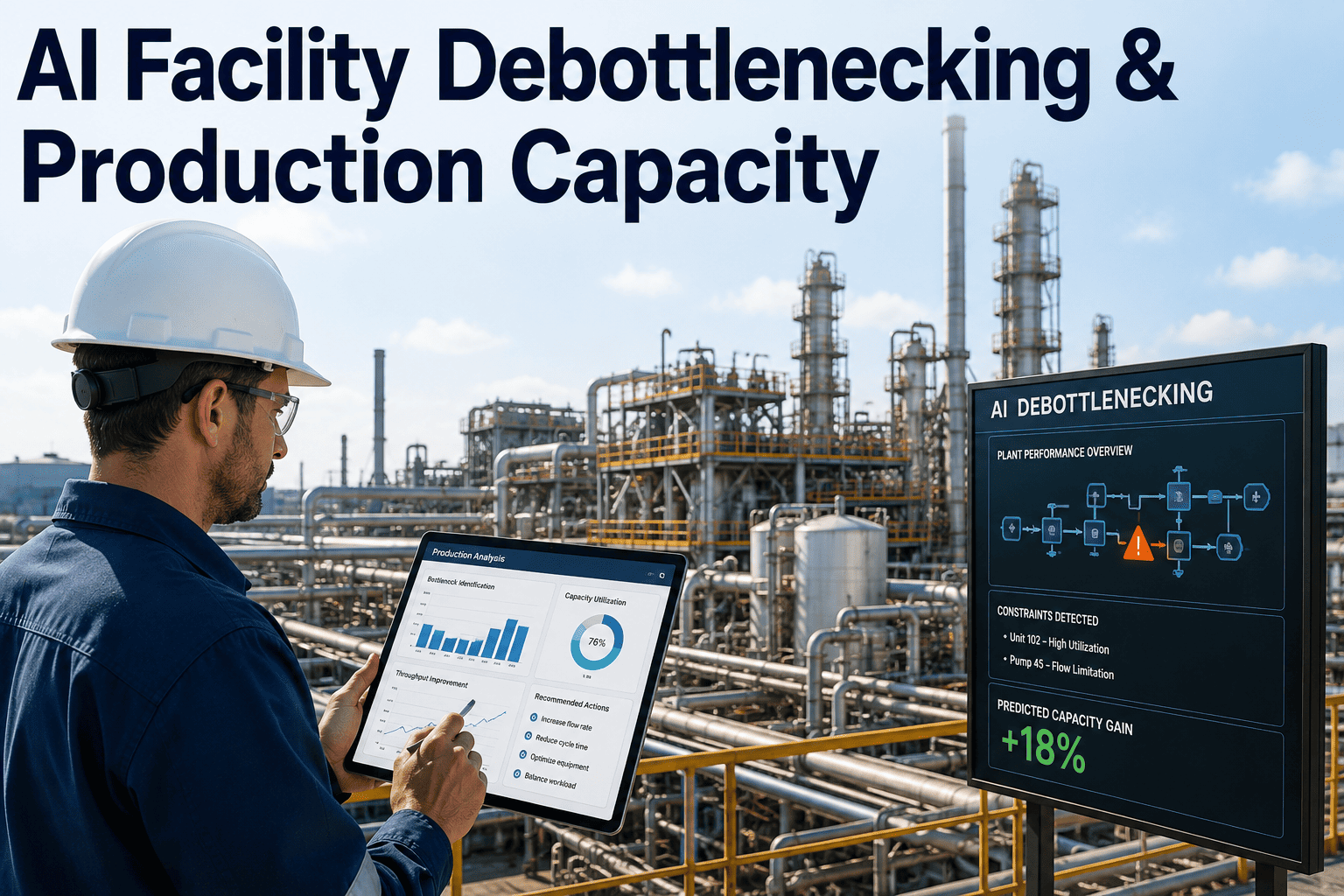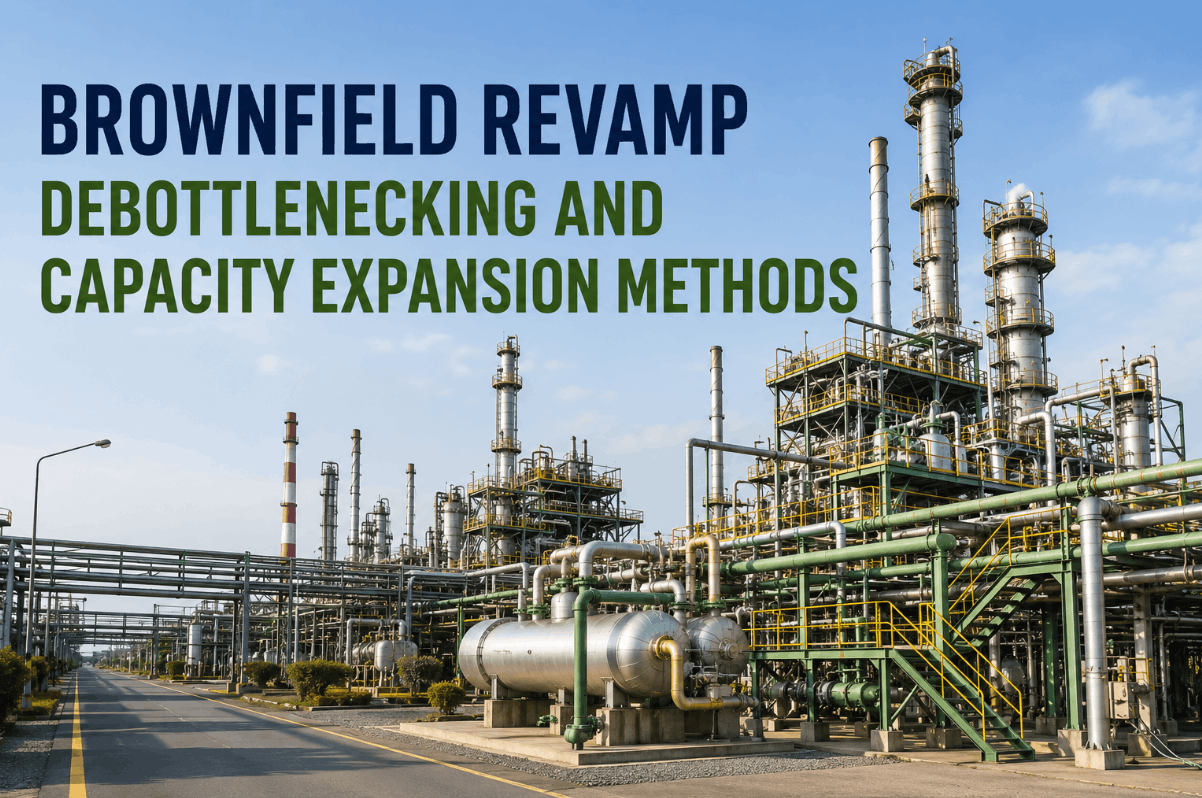
Most domestic refining capacity growth since the 1980s has come not from new grassroots refineries but from expansions, debottlenecking projects, and revamps at existing sites — and that pattern has only accelerated. When a refinery, gas processing facility, or petrochemical unit is leaving 15 to 30 percent of potential throughput on the table because of a handful of identifiable constraints, the economics of brownfield capacity expansion are compelling. The capital required to squeeze incremental barrels or standard cubic feet from an existing unit is a fraction of what a greenfield project demands, and the time-to-first-production is measured in months rather than years. But brownfield execution is not simply a smaller version of greenfield construction. Working in and around live hydrocarbon units — managing SIMOPS, hot-tap tie-ins, Management of Change under API RP 750, and control system integrations into aging infrastructure — requires a precision of planning and real-time execution visibility that manual coordination systems cannot reliably deliver. This guide covers the full methodology for brownfield revamp and debottlenecking projects and how iFactory AI's platform closes the data and coordination gaps that turn manageable projects into costly overruns.
Brownfield Revamp Intelligence: From Bottleneck to Throughput
A practical execution framework for identifying process constraints, planning tie-ins and hot taps, managing SIMOPS across live units, and commissioning new capacity without losing the plant — supported by iFactory AI's real-time project and process intelligence platform.
Six Brownfield Failure Modes That Destroy Revamp Economics
Brownfield projects typically require 20 to 30 percent contingency budgets versus 10 to 15 percent for greenfield — because the probability of encountering undocumented field conditions, legacy design deviations, and live-plant coordination failures is high enough that experienced project managers build it into the estimate from day one. These are not random failures; they are predictable failure modes with specific digital mitigation strategies. Book a Demo to see how iFactory AI addresses each one in your specific revamp scope.
Undocumented As-Built Deviations
1990s as-built drawings rarely reflect thirty years of field modifications. Tie-in points that appear feasible on paper require 3D LiDAR scanning and Positive Material Identification (PMI) testing on existing pipe to confirm material grades before weld procedures are specified. iFactory AI manages the scan-to-model workflow and tracks PMI results against every tie-in package.
SIMOPS Coordination Failures
Inadequate SIMOPS management contributes to 40% of major industrial accidents during facility expansions. Construction crews performing hot work within 30 meters of live hydrocarbon transfers, crane lifts over active process equipment, and scaffold erection in congested pipe alleys all require real-time coordination between operations and construction that manual PTW systems cannot reliably maintain at scale.
Scope Creep at Tie-In Interfaces
The number of interfaces between old and new facilities — tie-ins, pipe racks, utilities, equipment, control system integration points — grows with every field condition discovered during execution. Without a live interface register tracked against MoC approvals, scope additions accumulate uncontrolled, consuming schedule float and budget before the project team sees the exposure in their cost report.
Shutdown Window Overruns
Many brownfield tie-ins require a plant shutdown window that must be planned months in advance and executed within hours of the scheduled duration. When tie-in work packages are incomplete at shutdown start — missing materials, incorrect isolation plans, unresolved permit conditions — the shutdown extends, and production loss turns a cost-effective brownfield project into a capital allocation disaster.
Control System Integration Risk
Expanding capacity in an existing unit means integrating new instrumentation, control loops, and safety system logic into a DCS and SIS that were designed for the original process envelope. Configuration errors in the SIS during commissioning carry potential for process safety events. iFactory AI tracks instrument loop testing completion and SIS functional test records against the commissioning plan before any new equipment is brought online.
Bottleneck Misidentification
The single most expensive mistake in debottlenecking is eliminating the wrong constraint. A compressor upgrade that increases suction flow does nothing if the downstream separator is already running at 98% of hydraulic capacity. iFactory AI's process performance analytics identifies the true throughput-limiting constraint across the full unit — ensuring every capital dollar addresses the actual bottleneck, not the most visible one.
Brownfield vs. Greenfield: When Revamp Wins the Economics
Debottlenecking and brownfield revamp are not always the right answer — but for most U.S. operators adding capacity to an existing permitted site, the comparison looks like this across the dimensions that matter to project sponsors.
The Debottlenecking Methodology: Finding and Eliminating the True Constraint
Debottlenecking begins with a system-wide performance assessment — not a single-unit study. The constraint limiting throughput across the full production chain from feed inlet to product export is rarely where operators expect to find it. Developing a rigorous basis for debottlenecking requires establishing limiting capacities for critical equipment and systems, simulating operations with actual field data, and evaluating the cost-benefit of modifications large and small against the incremental production each delivers. iFactory AI's process performance analytics layer integrates the actual operating data from your DCS historian into a bottleneck identification model that quantifies the throughput contribution of each potential intervention before a single capital dollar is committed. Book a Demo to model the debottlenecking opportunity in your specific unit configuration.
System-Wide Constraint Mapping
Comprehensive evaluation of the full production chain — reservoirs and wellheads through surface facilities and export — using site surveys, operational data analysis, and digital simulation. Pinpoints constraints from equipment limitations, suboptimal operating parameters, process misalignments, or design inefficiencies. iFactory AI ingests DCS historian data to build a real-time throughput constraint map per unit.
Process Simulation and Options Assessment
Targeted engineering solutions evaluated against simulation models — adjusting separator pressures, enhancing pump performance, resizing pipelines, improving compression strategies, or upgrading specific equipment. The cost of each modification is compared against the additional throughput it delivers. iFactory AI links simulation outputs to the project cost model, enabling real-time cost-benefit tracking as engineering develops.
Tie-In and Hot-Tap Planning
Each physical interface between new and existing equipment defined and work-packaged before field execution begins. 3D LiDAR scan alignment verified against plant master coordinate system. PMI testing completed on existing run pipe at every tie-in point. SIMOPS risk assessment conducted per API RP 750 for each tie-in location. Hot-tap feasibility assessed based on existing line pressure, temperature, material grade, and minimum wall thickness.
MoC, Pre-Startup Safety Review and Commissioning
Every brownfield modification triggers a Management of Change process that must capture changes to the fire and explosion risk profile, pressure relief system adequacy, control system logic, and SIS functional requirements. Process safety statistics show that a significant proportion of major industrial incidents occur within 12 months of a plant modification. iFactory AI tracks every MoC item from initiation through PSSR sign-off and instrument loop test completion before first online.
SIMOPS and Tie-In Execution: Where Brownfield Projects Are Won or Lost
The execution gap between a well-planned brownfield revamp and a cost-overrun project is almost always found in SIMOPS coordination and tie-in readiness. iFactory AI tracks the status of every live-plant work activity against the permit-to-work system and tie-in readiness register in real time.
| Execution Challenge | Traditional Approach | iFactory AI Approach | Project Impact |
|---|---|---|---|
| SIMOPS conflict identification | Manual PTW review meetings — conflicts discovered at site | Real-time activity map cross-referenced against live unit status — conflicts flagged before crew mobilization | Eliminates unplanned work stoppages and hot work suspension events |
| Tie-in package readiness | Spreadsheet tracking — status unknown at shutdown start | Digital tie-in register with material receipt, drawing issue, and isolation plan status per package | Zero incomplete packages when the shutdown window opens |
| Hot-tap feasibility and execution | Field engineer judgment — inconsistent documentation | Hot-tap assessment records linked to PMI results, wall thickness data, and operating conditions per point | No last-minute scope changes due to undocumented pipe condition |
| MoC tracking through commissioning | Paper MoC register — open items unresolved at startup | Live MoC register with PSSR and loop test completion linked to startup authorization | Regulatory compliance at startup; no post-startup safety finding backlog |
| Shutdown duration management | Daily schedule meetings — progress visible only to site team | Real-time shutdown progress dashboard accessible to project sponsors and operations leadership | Production restart on schedule; no unplanned shutdown extensions |
"We executed a mid-scale debottlenecking project on our CDU that was supposed to add 8,000 barrels per day of throughput capacity. The process engineering was solid — we had identified the correct constraint, and the hardware selection was right. What we underestimated was the tie-in complexity. Three of the eleven tie-in packages had as-built discrepancies that we only discovered during the shutdown window itself, and one hot-tap location had been previously repaired with a sleeve weld that our drawings did not show. We extended the shutdown by four days, which cost us roughly $1.2 million in lost production on top of the project budget. After that project, we moved to iFactory AI's platform for brownfield execution. On the next revamp — a debottlenecking of our vacuum tower — every tie-in package was fully characterized before we entered the shutdown window, including a 3D scan that identified two additional clash points we would not have caught any other way. We completed that shutdown in 89% of the planned duration and brought the new capacity online clean."
Frequently Asked Questions: Brownfield Revamp and Debottlenecking
How does iFactory AI identify the true throughput bottleneck in an existing processing unit?
iFactory AI ingests real-time and historical DCS data across the full unit — feed systems, heat exchangers, columns, compressors, pumps, and product export — building a throughput constraint model that quantifies utilization and limiting conditions per equipment item. The bottleneck is identified where incremental feed increase produces the smallest fractional throughput gain per dollar of modification, not simply where the highest operating rates are observed.
What is a hot tap and when is it the right approach for a brownfield tie-in?
A hot tap is a connection made to an operating pipeline or vessel without taking it out of service — enabling a new branch or bypass to be added without a process shutdown. It is appropriate when the existing line's pressure, temperature, material grade, and minimum remaining wall thickness meet the requirements of the hot-tap procedure, and when the production loss cost of a shutdown to make a cold tie-in exceeds the incremental cost and risk of the hot-tap method.
What Management of Change documentation does iFactory AI generate for brownfield modifications?
iFactory AI tracks every MoC from initiation through PSSR and startup authorization — capturing the change description, hazard assessment, affected P&IDs, required instrument loop tests, SIS functional test records, and training completion for affected operators. Every MoC item is linked to its tie-in package and commissioning checklist, so no modification proceeds to startup with an open safety action.
How does iFactory AI reduce the risk of shutdown window overruns on brownfield projects?
iFactory AI tracks tie-in package readiness — material receipt, drawing issue, isolation plan approval, and hot work permit pre-authorization — against the planned shutdown window opening date, flagging any package that will not be ready in time to replan work sequencing before the shutdown begins. Shutdown progress is tracked in real time against the critical path schedule, with alerts when any activity is at risk of extending the window beyond its planned duration.
What capacity improvement is realistic from a brownfield debottlenecking project at a U.S. refinery?
Targeted debottlenecking of a CDU, vacuum unit, or gas processing unit typically delivers 15 to 30 percent throughput improvement when the constraint is correctly identified and the modification is properly engineered — documented cases include refinery debottlenecks achieving 30% capacity increases with zero increase in GHG emissions per barrel. The range depends on how conservatively the unit was originally designed, how well the constraint is characterized, and how cleanly the tie-in execution is completed.
Conclusion: Brownfield Execution Quality Determines Whether Revamp Economics Deliver
The economic case for brownfield capacity expansion and debottlenecking is clear — lower capital intensity, faster time to production, shorter permitting timelines, and access to established infrastructure. What separates the projects that deliver 15 to 30 percent throughput improvement on schedule from the ones that overrun by $10 million and restart late is execution quality at the interface between planning and field work: tie-in packages that are complete when the shutdown window opens, SIMOPS coordination that prevents live-plant incidents during construction, and MoC processes that close every safety action before the unit comes back online.
iFactory AI's brownfield project intelligence platform provides the real-time execution visibility that makes the difference — connecting bottleneck analytics, tie-in readiness tracking, SIMOPS coordination, and MoC compliance into a single dashboard accessible to project engineers, operations leadership, and project sponsors simultaneously. The capacity is in the existing units. The execution infrastructure to unlock it is the variable. Book a Demo to see how iFactory AI supports your next brownfield revamp from constraint identification through first incremental barrel.