LIMS Lab Information Management for Crude Assay and Product Spec
By Henry Green on June 22, 2026
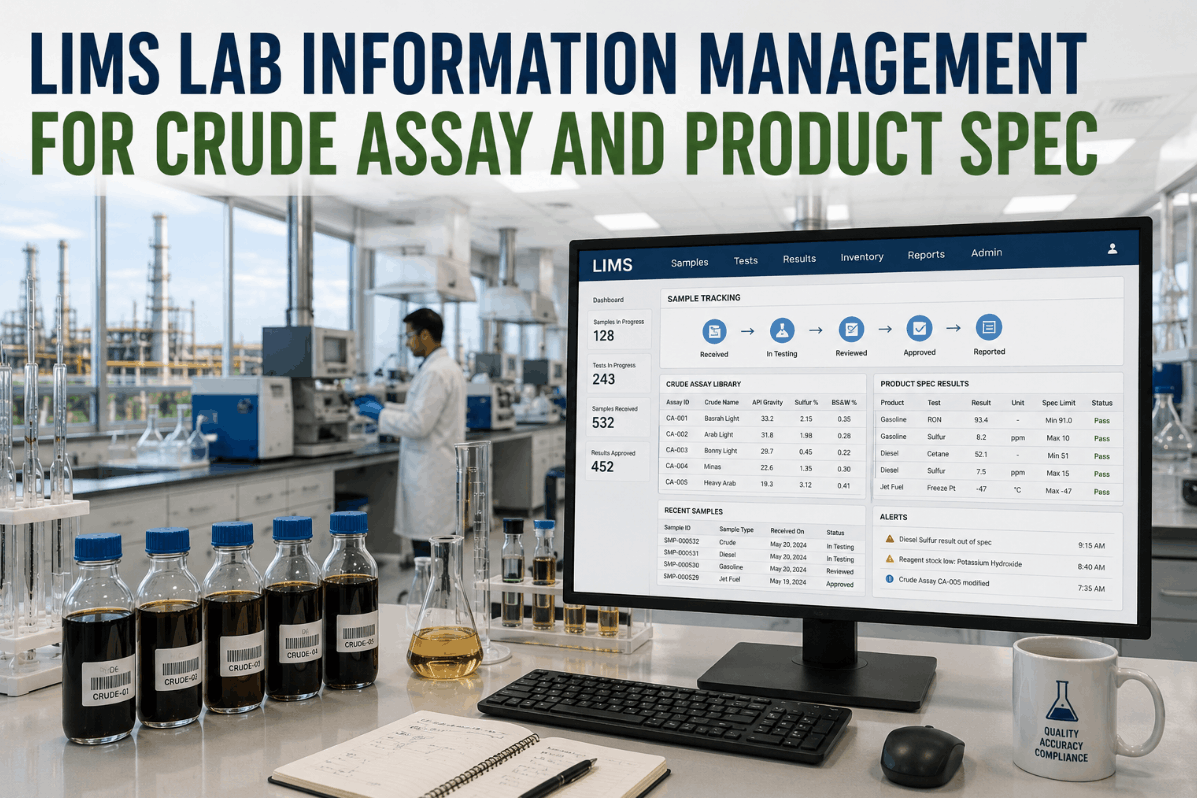
Every barrel of crude oil entering a U.S. refinery arrives with a different density, sulfur content, distillation profile, and contamination signature — and every finished product leaving the gate has to meet precise customer specs, ASTM test method requirements, and regulatory documentation standards before it ships. The gap between those two realities is the refinery laboratory, and the gap between a refinery laboratory that runs on paper logbooks, spreadsheets, and disconnected instrument exports and one that runs on a modern LIMS is measured in sample turnaround time, audit exposure, and off-spec batch frequency. A purpose-built Lab Information Management System connects every step from sample receipt through certificate of analysis generation — tracking crude assay data, managing product specification testing, validating blend calculations, and maintaining a tamper-evident audit trail without a single paper logbook. Book a Demo to see how iFactory's LIMS platform deploys across refinery and petrochemical lab environments in five weeks.
30–50%
Reduction in sample testing turnaround time after LIMS instrument integration
100%
Sample traceability from field collection through COA generation and disposal
ISO 17025
Accreditation and ASTM compliance documentation generated automatically from LIMS records
Zero
Manual transcription between instruments and result records in automated LIMS deployments
Why Refinery Labs Can No Longer Operate Without a Purpose-Built LIMS
Refinery and petrochemical laboratories process hundreds to thousands of samples daily — crude feedstock composites, intermediate stream cuts, final product quality checks, blend verification samples, and environmental monitoring specimens. Each sample type carries a different test panel, different ASTM method requirements, different specification limits, and different reporting obligations. Managing that complexity across paper logbooks, spreadsheets, and instrument printouts is not a workflow challenge — it is a quality risk and a regulatory liability.
The core problem with manual laboratory data management in a refinery setting is that data lives in silos that never speak to each other. The gas chromatograph produces a result printout that someone transcribes into a spreadsheet, which gets emailed to a quality manager, who checks it against a specification document in a different folder, who then prepares a Certificate of Analysis from a third system. At every transcription step, error probability compounds. Book a Demo to see how iFactory's LIMS eliminates every manual handoff between instrument result and COA output.
Manual Transcription Errors
Hand-keying instrument results into spreadsheets introduces systematic transcription errors that are invisible until an off-spec shipment reaches the customer or a regulatory audit surfaces a result discrepancy between the logbook and the COA.
Broken Chain of Custody
Paper-based sample tracking cannot guarantee unbroken chain of custody from field collection through analytical disposal — a requirement for ISO 17025 accreditation and a critical control point in ASTM-compliant petroleum testing programs.
Crude Assay Data Silos
Crude assay results locked in individual test reports and disconnected spreadsheets cannot be queried across crude supply history, compared against blend targets, or leveraged by the planning team when evaluating new crude opportunities.
Audit Trail Gaps
When a result is modified, a method is changed, or a sample is re-tested, paper systems have no mechanism for capturing who made the change, when, and why — leaving labs exposed during regulatory inspections and accreditation assessments.
Crude Assay Management: From Sample Receipt to Assay Library
Crude assay management is one of the most data-intensive workflows in refinery laboratory operations. A complete crude assay covers API gravity, sulfur content, viscosity, distillation profile, yield fractions across the TBP curve, metal content, nitrogen and salt levels, pour point, and acid number — typically requiring multiple ASTM test methods executed across different instruments over 24 to 48 hours per assay. Without a LIMS, that data lives in disconnected instrument exports and never becomes a searchable, comparable asset for the planning and optimization teams that need it most.
01
Sample Receipt and Unique Identifier Assignment
Every crude sample arriving at the laboratory is logged into the LIMS at point of receipt — assigned a unique barcode identifier, associated with the cargo or custody transfer documentation, and routed automatically to the assay test panel appropriate for its origin crude type. Storage location, priority, and analyst assignment are captured at login without manual routing decisions.
02
Automated Test Panel Assignment by Crude Origin
The LIMS applies pre-configured test panels based on crude origin, contract specifications, or regulatory protocol — automatically scheduling the required ASTM methods (D1298 for API gravity, D4294 for sulfur, D86 or D2892 for distillation) to the appropriate instruments and analysts without manual work order creation. Urgent samples are flagged for priority routing during high-throughput periods.
03
Direct Instrument Integration and Automated Data Capture
Results from gas chromatographs, X-ray fluorescence sulfur analyzers, viscometers, and distillation units flow directly into the LIMS via instrument interface — eliminating manual transcription entirely. The system validates each result against method precision and specification limits in real time, flagging outliers for analyst review before results are accepted into the record.
04
Assay Library Population and Historical Query
Completed crude assay results are stored in the LIMS assay library — searchable by crude origin, assay date, API gravity range, sulfur tier, or any property tested. Planning and optimization teams can query the assay library to compare incoming crude candidates against historical assays, evaluate yield projections, and support blend planning without waiting for the laboratory to produce manual summary reports.
05
Certificate of Analysis Generation and Release
Once all test results are validated and approved through the LIMS electronic review workflow, the system generates the Certificate of Analysis automatically — formatted to customer, regulatory, or internal specification template requirements. The COA is linked permanently to the sample record and assay data, creating an unbroken chain of evidence from raw instrument output to customer document.
Product Specification Testing, Blend Validation, and Finished Product Release
Finished product quality control at a U.S. refinery covers every product stream from gasoline and diesel to jet fuel, heating oil, lubricant basestocks, and specialty petrochemicals — each with its own specification matrix, test method requirements, and customer documentation obligations. A LIMS manages the full product release workflow from incoming blend sample to approved release decision, with specification limit checking, out-of-spec alerting, and re-test authorization built into the electronic workflow.
Product Stream
Key Specification Tests
Primary ASTM Methods
LIMS Workflow Action
Gasoline (finished / blended)
Research octane number, motor octane, Reid vapor pressure, sulfur, benzene content, distillation
D2699, D2700, D323, D4294, D3606, D86
Blend recipe validation against spec limits; automatic COA generation on pass; out-of-spec alert with re-blend authorization workflow
Ultra-Low Sulfur Diesel
Sulfur (15 ppm max), cetane number, cloud point, flash point, viscosity, distillation T90
D5453, D613, D2500, D93, D445, D86
Real-time sulfur result flagging against 15 ppm EPA limit; automatic hold placement on suspect batches; regulatory compliance documentation generated at release
Jet Fuel (Jet-A / Jet A-1)
Flash point, freeze point, thermal oxidative stability (JFTOT), aromatics, smoke point, viscosity
D56/D3828, D2386, D3241, D1319, D1322, D445
Full ASTM D1655 specification matrix checking; DEF STAN 91-091 parallel reporting for export; batch hold and release authorization with approver signature capture
Lubricant Basestocks
Kinematic viscosity, viscosity index, pour point, color, flash point, oxidation stability
D445, D2270, D97, D1500, D92, D943
Multi-grade viscosity classification against API Group I–IV specification bands; blend certification with customer-specific COA template population
Marine Fuel (VLSFO/HSFO)
Sulfur content, viscosity at 50°C, density, water content, flash point, pour point
D4294, D445, D4052, D95, D93, D97
IMO MARPOL Annex VI 0.5% sulfur cap compliance verification; bunker delivery note data export; MARPOL compliance documentation auto-generated at batch release
24 hrs
Crude assay turnaround reduction achieved at refineries with automated LIMS instrument integration
ASTM + EPA
Compliance documentation auto-generated from LIMS records for every product release event
Real-time
Out-of-spec alerting and batch hold placement without manual QA review cycle
From Sample Receipt to Certificate of Analysis — Without a Single Paper Log
iFactory's LIMS platform manages crude assay workflows, product specification testing, blend validation, and regulatory audit trails across single-site and multi-refinery environments — deployed in five weeks with native ASTM, ISO 17025, and EPA compliance documentation built in.
Audit Trail, Regulatory Compliance, and ISO 17025 Accreditation Support
Refinery and petrochemical labs operate under a regulatory framework that spans ASTM International test method compliance, ISO 17025 laboratory accreditation requirements, EPA reporting obligations for environmental samples, and OSHA documentation standards for safety-critical tests. Every data entry, result modification, method change, instrument calibration, and sample disposition event must be captured in an auditable, tamper-evident record — and that record must be retrievable on demand during inspections without a manual search through paper archives.
iFactory LIMS Audit Trail and Compliance Capabilities
Every result entry, modification, and approval captured with user identity, timestamp, and reason for change — unbroken tamper-evident audit trail for regulatory inspection without manual reconstruction
ISO 17025 accreditation documentation generated automatically — method validation records, instrument calibration logs, and analyst competency tracking consolidated in the LIMS record
ASTM D-series method templates pre-configured in the LIMS — method parameters, precision criteria, and specification limits loaded at deployment without manual configuration
Environmental compliance reports for produced water, flare emissions, and waste characterization auto-formatted to EPA and state regulatory submission requirements
Role-based access controls ensuring lab staff, QA leads, and external auditors access only the records relevant to their function — with full access log retained for security audit purposes
Out-of-specification result management with corrective action tracking — every OOS event documented from first detection through investigation, disposition, and closure without paper-based NCR forms
Expert Review: What Refinery Lab Managers Say About LIMS Deployment
We were running a paper-based sample logbook system alongside three separate spreadsheets for crude assay tracking, product release records, and instrument calibration logs. When our ISO 17025 assessor arrived, we spent two days pulling together documentation that should have been instantly retrievable. After iFactory's LIMS deployment, our entire crude assay library — seven years of assay data across 140 crude origins — was searchable in one system, our COAs were generating automatically from instrument results, and our last ISO assessment took half a day. The assessor commented that our audit trail documentation was the most complete she had seen at a refinery laboratory of our size. Our sample turnaround for full crude assays dropped from 48 hours to under 22 hours because the work order routing and instrument scheduling happens automatically now.
Laboratory Manager
Crude and Products Testing Laboratory, Mid-Continent U.S. Refinery, 65,000 BPD
Conclusion: A LIMS Is Not a Lab Convenience — It Is a Refinery Operational Control
Crude assay data that cannot be queried across supply history is not an asset — it is a filing cabinet. Product specification test results that pass through manual transcription steps before reaching a release decision carry error risk that compounds with every sample. Audit trails that exist only in paper logbooks cannot support ISO 17025 accreditation, EPA inspection requirements, or ASTM compliance documentation demands without days of manual reconstruction.
A purpose-built LIMS for refinery and petrochemical laboratory environments resolves all three problems simultaneously — by making every sample traceable, every result electronically captured, every specification check automated, and every compliance document generated from the same data record that produced the test result. The operational and regulatory case for LIMS deployment is no longer a question of whether the system pays for itself. The question is whether a refinery laboratory can sustain the quality, compliance, and turnaround performance that modern operations demand without one. Book a Demo with iFactory to see how LIMS deployment across your laboratory environment deploys in five weeks.
Frequently Asked Questions
What is a LIMS and how does it differ from a generic laboratory spreadsheet or ERP module?
A LIMS is purpose-built to manage sample lifecycle, test workflows, instrument integration, and audit trail in a laboratory environment — capabilities that ERP modules and spreadsheets cannot provide without significant manual workaround and the error risk that comes with it.
Which crude assay tests and ASTM methods does iFactory's LIMS support out of the box?
iFactory's LIMS comes pre-configured with ASTM D-series method templates covering API gravity (D1298), sulfur (D4294, D5453), viscosity (D445), distillation (D86, D2892), pour point (D97), flash point (D93), and additional petroleum test methods — configurable to facility-specific panels during the Week 1 data audit.
Can iFactory's LIMS manage crude assay data across multiple refineries or processing sites from a single instance?
Yes — iFactory's LIMS supports multi-site deployment under a single instance with site-specific configuration, centralized crude assay libraries, and cross-site reporting dashboards accessible to planning and optimization teams across the network.
How does iFactory's LIMS handle out-of-specification results and the corrective action workflow?
When a result falls outside specification limits, the LIMS automatically places a hold on the batch, generates an OOS event record, routes the investigation workflow to the designated QA approver, and tracks corrective action through to closure — with every step documented in the tamper-evident audit trail.
How long does iFactory's LIMS deployment take for a refinery laboratory environment?
iFactory's LIMS deployment follows a structured five-week program — data audit and method configuration in Weeks 1–2, pilot validation on highest-priority workflows in Weeks 3–4, and full laboratory rollout with instrument integration and analyst training completed by Week 5.
Replace Paper Logbooks and Disconnected Spreadsheets With a LIMS That Runs Your Entire Lab Workflow
iFactory's LIMS platform delivers crude assay library management, product specification testing, blend validation, automated COA generation, and ISO 17025 audit trail documentation — fully deployed in five weeks, integrated with your instruments and ERP, with ASTM and EPA compliance built in from day one.